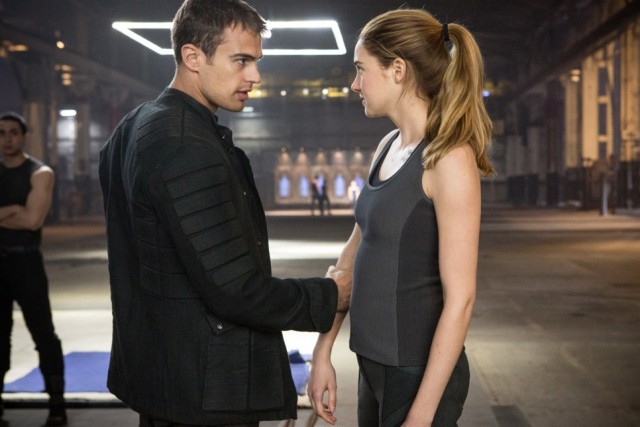
Four (Theo James) offers pointers to Tris (Shailene Woodley) as she trains to become Dauntless in DIVERGENT
DIVERGENT (Neil Burger, 2014)
Opens Friday, March 21
www.divergentthemovie.com
 First things first: In another part of our life, we are directly involved in the publication of Veronica Roth’s bestselling Divergent trilogy. Does that mean we can be impartial when it comes to reviewing the first of three films based on her books? We certainly hope so. In a near-future dystopian Chicago following a devastating war, people are divided into five factions: the selfless Abnegation, the honest Candor, the peaceful Amity, the intelligent Erudite, and the brave Dauntless. Upon turning sixteen, every individual participates in a Choosing Ceremony in which they decide which faction they will serve for the rest of their lives. But Tris (Shailene Woodley) is clearly different. Raised by her parents (Ashley Judd and Tony Goldwyn) in Abnegation, she shows an aptitude for more than one faction after taking the life-determining test all teens must endure: Her multifaceted personality means she’s Divergent. Test administrator Tori (Maggie Q) reveals that Divergence is a death sentence in this ever-more-fascistic society and that she must keep it a secret. She ultimately chooses to become Dauntless, going through rigorous training led by Four (Theo James), who sees something special in her even as she continually fails at feats of strength. But soon she is using her intellect to rise in the ranks as she tries to find her place in a world that, as she discovers, is powered by evil and corruption. “Human nature is the enemy,” Erudite leader Jeanine Matthews (Kate Winslet) tells her.
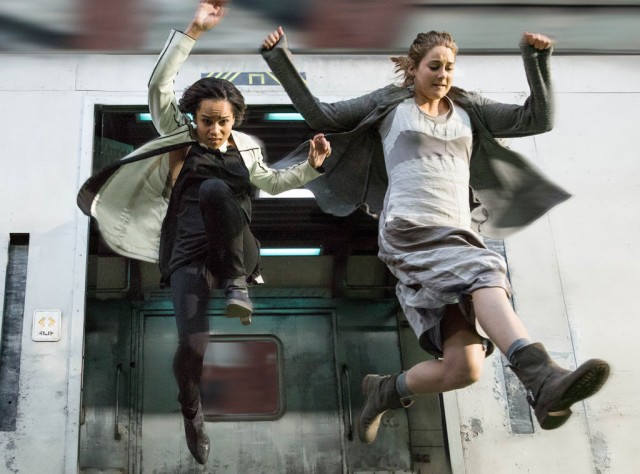
Tris (Shailene Woodley) and Christina (Zoë Kravitz) set out on the next phase of their life in DIVERGENT
Directed by Neil Burger (The Illusionist, Limitless), who will not be helming the sequels, Insurgent and Allegiant, Divergent has more than its fair share of plot holes and red herrings, but they are overcome by a strong lead performance by Woodley, a promising young actress who has previously appeared in such well-received fare as The Descendants and The Spectacular Now — and will next star in the adaptation of John Green’s The Fault in Our Stars alongside Ansel Elgort, who plays her brother, Caleb, in Divergent. Woodley captures the pitfalls and missteps of an adolescent on the verge of adulthood, facing the deeply entrenched apprehensions and anxieties that will follow her through life, in many ways a wildly imagined metaphor for the daughter leaving the nest, beginning with SAT testing and selecting a college, then searching for the right clique as she desperately tries to fit in somewhere. Perhaps not coincidentally, Roth began writing the book while still in college herself. No mere Hunger Games ripoff, Divergent is about the fears we all carry with us and must face time and time again in the choices we make on our path to finding out who we are.

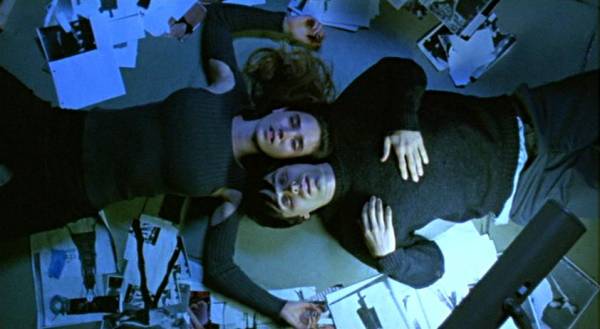
 Darren Aronofsky’s Requiem for a Dream is a devastating portrait of addiction, featuring one of the most brutal endings in cinema history. Based on the novel by Hubert Selby Jr. (Last Exit to Brooklyn), who cowrote the screenplay with Aronofsky, the Coney Island-set film focuses on four central figures: Sara Goldfarb (Ellen Burstyn), a lonely widow living in Brighton Beach who learns that she might appear on a television program so is desperate to lose weight to fit into her red dress, ultimately getting lost in a haze of prescription drugs; her son, Harry (Jared Leto), a junkie looking to make a big score; Harry’s girlfriend, Marion Silver (Jennifer Connelly), who dreams of becoming a fashion designer but has to decide how far she will go for her next taste; and Harry’s partner in crime, Tyrone Love (Marlon Wayans), who shoots up while remembering the warm comfort of his mother’s arms. Using repetitive fast-paced editing, enhanced sound effects, and a harrowing score by Clint Mansell, Aronofsky creates a nightmare world where delusional dreams come crashing down with horrific consequences. The acting throughout is a veritable tour de force, led by Burstyn’s Oscar-nominated descent into hell. Requiem for a Dream is screening March 21 at 7:00, kicking off the Museum of the Moving Image’s weekend tribute to Aronofsky in celebration of the release of his latest film, Noah. The series also includes Pi, The Fountain, The Wrestler, and Black Swan before concluding with a members-only preview of his new biblical epic on March 27.
 Winner of the Un Certain Regard prize at Cannes and nominated for a Best Foreign Language Film Academy Award, Rithy Panh’s The Missing Picture is a brilliantly rendered look back at the director’s childhood in Cambodia just as Pol Pot and the Khmer Rouge began their reign of terror in the mid-1970s. “I seek my childhood like a lost picture, or rather it seeks me,” narrator Randal Douc says in French, reciting darkly poetic and intimately personal text written by author Christophe Bataille (Annam) based on Panh’s life. Born in Phnom Penh in 1964, Panh, who has made such previous documentaries about his native country as S21, The Khmer Rouge Killing Machine and Duch, Master of the Forges of Hell and wrote the 2012 book L’élimination with Bataille, was faced with a major challenge in telling his story; although he found remarkable archival footage of the communist Angkar regime, there are precious few photographs or home movies of his family and the community where he grew up. So he had sculptor Sarith Mang hand-carve and paint wooden figurines that Panh placed in dioramas to detail what happened to his friends, relatives, and neighbors. Panh’s camera hovers over and zooms into the dioramas, bringing these people, who exist primarily only in memory, to vivid life. When people disappear, Panh depicts their carved representatives flying through the sky, as if finally achieving freedom amid all the horrors. He delves into the Angkar’s propaganda movement and sloganeering — the “great leap forward,” spread through film and other methods — as the rulers sent young men and women into forced labor camps. “With film too, the harvests are glorious,” Douc states as women are shown, in black-and-white, working in the fields. “There is grain. There are the calm, determined faces. Like a painting. A poem. At last I see the Revolution they so promised us. It exists only on film.” It’s a stark comparison to cinematographer Prum Mésa’s modern-day shots of the wind blowing through lush green fields, devoid of people.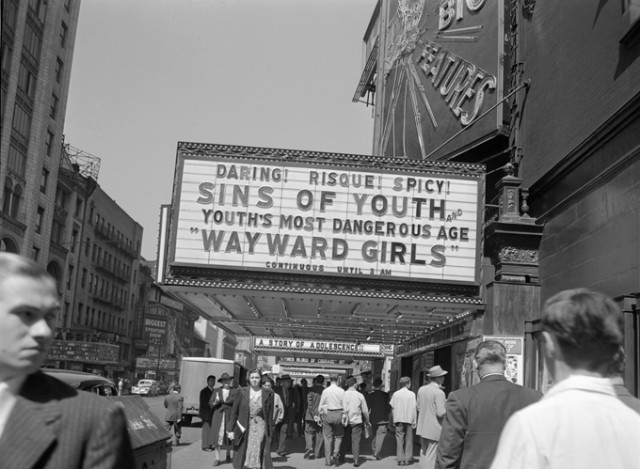
 Writer-director Matt Wolf (Wild Combination: A Portrait of Arthur Russell) and cowriter Jon Savage (England’s Dreaming) explore the explosion of youth culture in the first half of the twentieth century in the innovative documentary Teenage. Based on Savage’s 2007 book, Teenage: The Creation of Youth Culture, and various other sources, the film concentrates on the social, economic, cultural, and political development of boys and girls who came of age before, during, and after WWI, the Great Depression, and WWII. Using 135 photographs, 272 rare footage excerpts, and four dramatic re-creations, Wolf, editor Joe Beshenkovsky, and cinematographer Nick Bentgen create a virtually seamless chronological examination of how the young generation took shape from the slavelike child labor of the early 1900s and transformed throughout various movements that ultimately led to a new kind of freedom post-WWII. Narration adapted from original sources is delivered by Jena Malone as an American girl, Ben Whishaw as a British boy, Julia Hammer as a German girl, and Jessie Usher as an American boy; the re-creations feature Leah Hennessey as Brenda Dean Paul of England’s Bright Young People, Ivy Blackshire as Melita Maschmann (voiced by Daniela Leder) of Germany’s Hitler Youth, Ben Rosenfield as Tommie Scheel of the Hamburg Swings, and Malik Peters as Warren Wall, who represents the African American experience. The film delves into the beginnings of the Boy Scouts (preparing America’s youth for military service), the effects of jazz and swing music on the younger generation, fashion trends, consumerism, drugs, race, unemployment, and eventual public rebellion as “teenagers” — a word that didn’t exist until around 1921 — started to take responsibility for themselves as they lost faith in their parents, authority, and the government. Teenage, whose form and structure recall the work of such filmmakers as Bill Morrison, Guy Maddin, and Ken Burns, offers unique insight into the growth of youth culture, making compelling and sometimes surprising connections without stating the obvious or using overly familiar visuals, all set to a subtle score by Deerhunter leader Bradford Cox. Teenage opens March 14 at the Landmark Sunshine, with Wolf participating in Q&As following the 7:40 and 9:45 screenings on March 15.