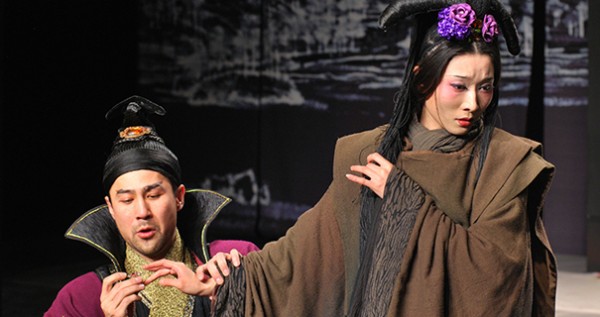
National Theatre of China makes its U.S. company debut with RICHARD III at Skirball Center (photo by Liu Weilen)
NATIONAL THEATRE OF CHINA: RICHARD III
NYU Skirball Center for the Performing Arts
566 La Guardia Pl. between Third & Fourth Sts.
March 26-30, $39-$65
212-992-8484
nyuskirball.org
In just the last two years, New York has seen numerous productions of Richard III, from Mark Rylance in the throwback Globe version on Broadway to Kevin Spacey’s star turn as part of the Bridge Project at BAM, from Ron Cephas Jones’s multiborough performance in the Public Theater’s Mobile Shakespeare Unit to Alessandro Colla in a suit and tie for Shakespeare in the Parking Lot’s outdoor production on the Lower East Side. Each of those shows had its own unique take on the Bard’s exploration of power, desire, and corruption, but perhaps the most unusual rendition is the National Theatre of China’s presentation, which comes to NYU’s Skirball Center March 26-30 as part of the second annual “Visions + Voices” festival. Streamlined to a mere hundred minutes, this Richard III will feature Chinese costumes, martial arts, acrobatics, music, and other elements of traditional Eastern staging by the National Theatre of China, in its U.S. company debut. The March 27 performance will be followed by a talk with director and National Theatre vice president Wang Xiaoying and script editor and dramaturge Luo Dajun, and the March 28 and 30 shows will be followed by conversations with Wang and actors Zhang Donglei and Zhang Xin; in addition, the panel discussion and audience Q&A “Beyond Puck: Performing Shakespeare in Asian America” will take place March 28 at 5:30 (free with advance registration) with Farah Bala, Ruy Iskander, Ching Valdes-Aran, Danielle Ma, Vandit Bhatt, Tisa Chang, and Ariel Estrada. “Visions + Voices: China” continues April 12 with a screening of Zhang Meng’s The Piano in a Factory and May 12 with Tan Dun’s “The Map” and “Concerto for String Orchestra and Pipa,” performed by the NYU Symphony Orchestra, featuring conductor Andrew Cyr, pipa virtuoso Zhou Yi, and cellist Wendy Sutter.
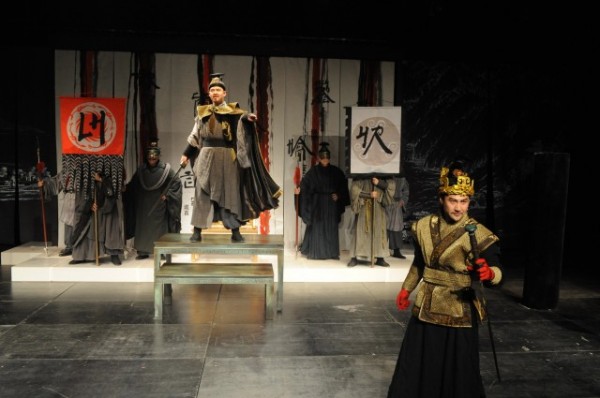
Chinese production of RICHARD III leaves a lot to the imagination (photo by Liu Weilen)
Update: The National Theatre of China’s American debut ended up being a rather curious affair. What was advertised as a one-hundred-minute Chinese production of Shakespeare’s Richard III with English surtitles ended up being around two and a half hours, with extremely limited descriptive sentences (that often worked improperly) instead of a full translation. The action, which includes acrobatics and martial arts, takes place on Liu Kedong’s spare but elegant set, featuring two carved columns and an ornate throne behind which hangs a series of calligraphy banners displaying such words as “Truth,” “Blood,” and “Conspiracy.” Zhang Dongyu portrays the title character with a sexy bravado, hunching and limping only when he’s delivering his scheming monologues; otherwise, he stands tall and proud as he woos Lady Anne (Zhang Xin) and kills off all possible challengers; following each death, blood drips down the banners, almost as if keeping score. Shakespeare’s story of the power struggles within and between the Yorks and the Lancasters, rival dynasties fighting for the English crown, moves easily across cultures, settling smoothly into an imperial Chinese milieu. But even for those who are very familiar with the details of Shakespeare’s tale, the decision to not translate any of the dialogue left many in the dark; it was particularly disconcerting when those members of the audience who understood Mandarin would laugh at a line, making everyone else feel left out — and resulting in dozens of people not returning after intermission. It also made it difficult to figure out why three witches seemed to have come over from Macbeth. But the costumes are colorfully grand, and percussionist Wang Jianan virtually steals the show, as no translation is needed for his thrilling, evocative live score.
 A real family affair, the
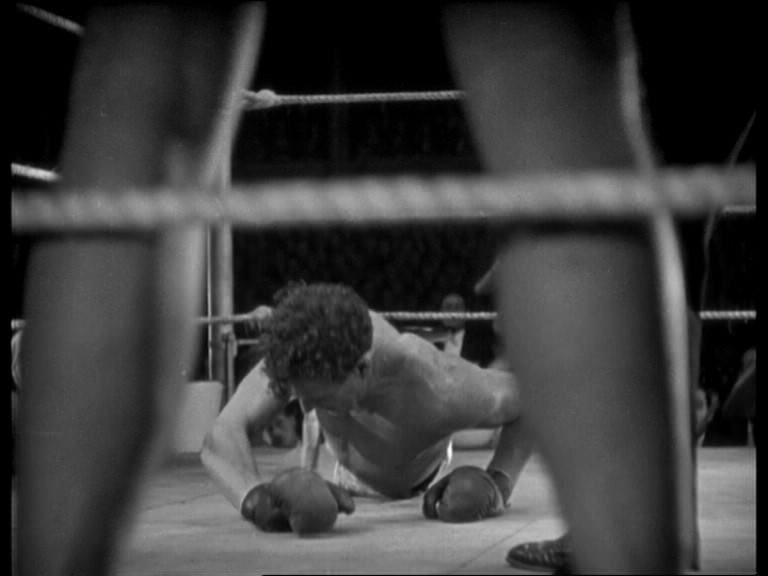
 When one thinks of Alfred Hitchcock, such psychological thrillers as North by Northwest, Psycho, Vertigo, Notorious, and Rear Window come to mind, not The Manxman, Easy Virtue, The Pleasure Garden, and The Farmer’s Wife. But it is these early, British silent films that are the focus of Film Forum’s “The Hitchcock 9,” which is part of the larger series “The Complete Hitchcock,” consisting of every other picture Sir Alfred made, including those abovementioned films. The dual festival features DCP restorations of nine romantic melodramas made by the Master of Suspense, each one with live musical accompaniment by pianist Steve Sterner. The series continues with 1927’s The Ring, a tantalizing tale of a love triangle set in the world of boxing, a favorite sport of Hitchcock’s. When Bob Corby (Ian Hunter) shows up at a county fair and takes a liking to Mabel (Lillian Hall-Davis), who sells tickets to see her fiance, “One-Round” Jack Sander (Carl Brisson), battle all comers for a cash prize, Corby decides to get in the ring with Sander to impress Mabel; little do they know that Corby is a professional. Soon the two men are also fighting outside the ring, to win the heart of their beloved. Comic relief is supplied by Gordon Harker as Jack’s trainer, who makes some very funny faces throughout. One can see Hitchcock’s visual style emerging in The Ring, as he employs little dialogue in favor of dramatic montages, ghostly superimpositions, and shadowy lighting. The intriguing work, produced at Elstree Studios and the first film to be released by Gainsborough Pictures, also deals with issues of class and financial success, themes that will become prevalent in much of Hitchcock’s oeuvre.
 A companion piece to 2008’s multilayered The Wrestler, in which a rejuvenated Mickey Rourke plays an aging athlete trying to regain control of his body and his life while attempting to reestablish a connection with his daughter, Darren Aronofsky’s Black Swan is an even more complex psychological study of just how far the mind and body can go to get what it wants and needs. Natalie Portman stars as Nina Sayers, a member of a Manhattan-based ballet company who is vying for the lead role in a new production of Tchaikovsky’s classic 1877 ballet, Swan Lake, the tragic tale of a princess transformed into a white swan who must find true human love to be released, complicated by an evil magician, a black swan rival, and a handsome prince. Nina lives a sheltered existence dominated by her failed-ballerina mother, Erica (Barbara Hershey), squeezed into a cramped New York City apartment and not allowed to have a social life. Womanizing choreographer Thomas Leroy (Vincent Cassel) is convinced that Nina can dance the white swan but has severe doubts that she has it within her to dance the black swan, even after selecting her to replace former prima ballerina Beth MacIntyre (Winona Ryder). Desperate to bring out Nina’s dark side, Leroy creates a competition between her and free-spirited dancer Lily (Mila Kunis), a sexy, tattooed young dancer who lives life on the edge. As opening night approaches, Nina must reach deep inside herself if she is to attain her dream, leaving all her fears and insecurities behind.