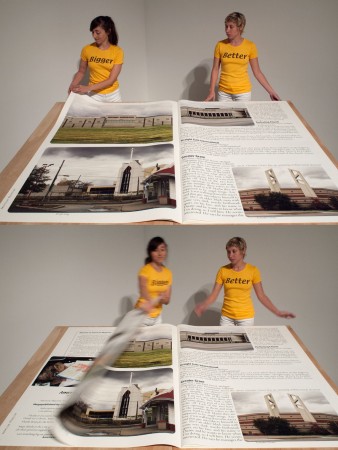
Lisa Anne Auerbach will activate her “American Megazine” on Friday nights at the Whitney Biennial (photograph © Lisa Anne Auerbach)
Whitney Museum of American Art
945 Madison Ave. at 75th St.
Through May 25, $18 (pay-what-you-wish Fridays 6:00 – 9:00)
Many programs require advance registration and/or tickets
212-570-3600
www.whitney.org
The 2014 Whitney Biennial, the last to be held in Marcel Breuer and Hamilton P. Smith’s 1960s building on the corner of Madison and Seventy-Fifth, is another mixed bag, further complicated by the curious decision to have three floors organized by three different curators, creating a more disjointed survey of the state of American art than usual. Perhaps the best time to take in this year’s model is when you get the added bonus of a special performance or program, many of which require advance RSVP or tickets. On May 7 at 7:30 ($8), the curators, Stuart Comer, Anthony Elms, and Michelle Grabner, will participate in a roundtable discussion with Jay Sanders that should shed plenty of light on their choices, but there are lots of other events as well. From April 2 to 6 in the second-floor Kaufman Astoria Studios Film and Video Gallery, Academy Records and Matt Hanner present the concurrent film loop The Bower with the three-hour audio No Jets, combining visuals of a cherry tree with audio of flight delays immediately following the events of September 11, while Gary Indiana’s Stanley Park merges images of a Cuban prison with shots of jellyfish. Zackary Drucker and Rhys Ernst’s twenty-three-minute short, She Gone Rogue, plays April 2-6 and 9-13 in the lobby gallery. On April 4, New York City teens in grades nine through twelve are invited to a free artist workshop led by the collective My Barbarian; the program continues April 11 with Joshua Mosley. On Friday nights through May 23, Lisa Anne Auerbach will activate her large-scale American Megazine on the third floor.
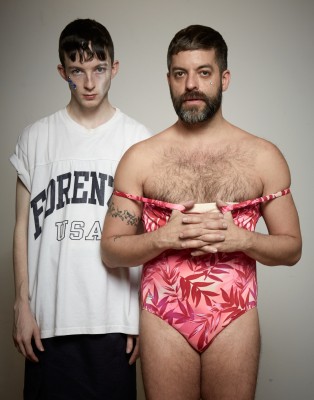
Miguel Gutierrez and Mickey Mahar team up for dance performance that examines midcareer anxiety (photo by Eric McNatt)
On April 6 at 4:00, James Benning’s re-creation of the 1969 classic Easy Rider will be shown in the Kaufman gallery in conjunction with Julie Ault’s “Afterlife: a constellation.” Composer Robert Ashley and director Alex Waterman will present the world premiere of their opera, Crash, April 10-13 ($20); their Spanish-language TV opera, Vidas Perfectas, runs April 17-20 ($20), while their reimagined speaking opera, The Trial of Anne Opie Wehrer and Unknown Accomplices for Crimes Against Humanity, with Amy Sillman, Wayne Koestenbaum, Mary Farley, and Barbara Bloom, plays April 23-27 ($20). Fred Lonidier will lead a teach-in on April 11 at 7:00 that looks at art and labor. On April 12 and 26 ($10 per family), Whitney Wees offers kid-friendly tours and workshops for families with children ages four to five, in addition to the sketching tour “Sculpture and Drawing” for families with kids ages six to ten ($10); also on April 12, Mosely will be leading an Artist’s Choice Workshop for families with children ages eight to twelve ($10), and the Open Studio program, for kids of all ages, will examine Sheila Hicks’s “Pillar of Inquiry / Supple Column.” (Other family workshops are scheduled for April 26 in the Whitney Studio, May 2 with Dan Walsh, May 10 for kids with autism and with My Barbarian, and May 17 with Sara Greenberger Rafferty.) From April 16 to 20, Taisha Paggett will debut a new performance piece in the lobby gallery. On April 17 at 7:00 ($8), Miguel Gutierrez and My Barbarian’s Alexandro Segade have put together “Take Ecstasy with Me,” an evening of performances and reflections by Kalup Linzy, Jacolby Satterwhite, Nao Bustamante, Jorge Cortiñas, A. L. Steiner, Kate Bush Dance Troupe, Juliana Huxtable, and others, inspired by the work of the late Cuban theorist José Esteban Muñoz; Gutierrez will perform the duet Age & Beauty Part 1: Mid-Career Artist/Suicide Note or &:-/ with dancer Mickey Mahar April 23 – May 4 ($20).
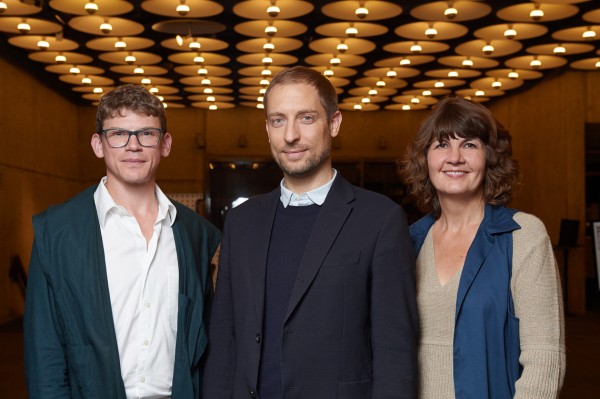
Anthony Elms, Stuart Comer, and Michelle Grabner will discuss their curatorial choices at May 7 panel discussion (photo by Filip Wolak)
On April 18 at 7:30, Kevin Beasley, with Leon Finley and Christhian Diaz, will present the interactive audio piece “Public Programs in Sonic Masses.” (Beasley will also host a teen workshop on May 2 and activate his sound sculptures on May 14 at noon, May 16 at 1:00, and May 17 at 3:00 in the lobby gallery.) On April 26 at 6:30 ($8), Triple Canopy will investigate “Media Replication Services.” Doug Ischar’s Come Lontano, Tristes Tarzan, and Alone with You will screen April 30 – May 4 in the Kaufman gallery. On May 1 at 6:30 ($8), Joseph Grigely will deliver a “Seminars with Artists” lecture about communication and miscommunication, followed by Susan Howe’s talk on the “telepathy of archives” on May 14 at 6:30 ($8) and Amy Sillman examining the materiality of color on May 22 at 6:30 ($8). On May 6 at 7:00 ($8), Ault, Benning, and William Least Heat-Moon will discuss “Histories of Place.” On May 11, Travis Jeppesen will read his novel The Suiciders in a durational performance on the third floor. And on May 19 at 7:00 ($8), Dawoud Bey will lead a roundtable Conversations of Art discussion about the portrayal of southern blacks during the civil rights movement. Tickets are available in advance for all of the above events that require an additional fee, as indicated in parentheses; some free programs require preregistration, so don’t hesitate if you want to attend any of these Whitney Biennial bonuses.
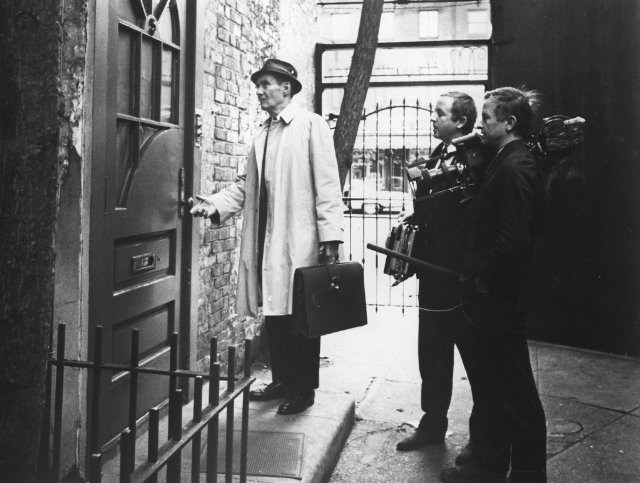
 Forty-five years ago, brothers Albert and David Maysles and Charlotte Zwerin made the highly influential black-and-white documentary Salesman, an intimate portrait of four traveling door-to-door Bible salesmen: Jamie Baker, Raymond Martos, Charles McDevitt, and particularly Boston’s Paul Brennan. “Go out there and get ’em,” their boss, who doesn’t exactly follow the teachings of Jesus, declares as they prepare to spread the word of the Lord, although more to earn a living than as a religious calling. The shots of Brennan singing “If I Were a Rich Man” in the snow are priceless, but the end will haunt you. Without Salesman, there probably never would have been a Glengarry Glen Ross and so many other films. All these years later, this fascinating piece of Americana, which was added to the National Film Registry of the Library of Congress in 1992, still feels fresh and relevant in these hard times. The Maysles brothers went on to make a series of documentaries that redefined the genre, including Gimme Shelter and Grey Gardens, and Albert’s Maysles Cinema in Harlem is devoted to nonfiction filmmaking. Salesman is screening April 4 at 4:00 at Neuehouse in the First Exposure section of the second annual First Time Fest, which celebrates the debut work of writers, directors, and producers; the eighty-seven-year-old Maysles will be on hand to discuss the seminal film. Among the other First Exposure presentations are Julie Taymor’s Titus, Peter Bogdanovich’s Targets, James Toback’s Fingers, Kelly Reichardt’s River of Grass, Michael Moore’s Roger & Me, and Jennie Livingston’s opening-night Paris Is Burning, with all of those directors present at the screenings; cinematographer Fred Elmes will discuss David Lynch’s Eraserhead. Ten films by first-time directors from around the world are in competition at this year’s festival, which runs April 3-7 at Neuehouse and Loews Village VII.
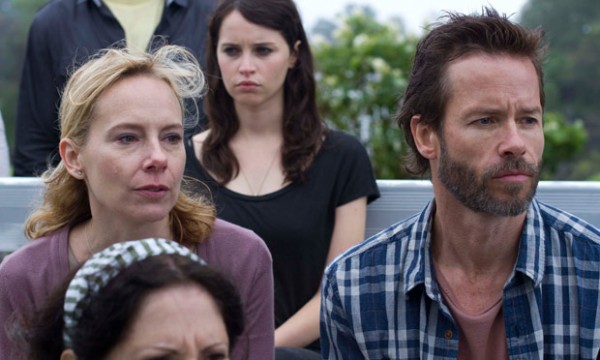
 In his 2011 Sundance award-winning Like Crazy, Drake Doremus intimately explored the intense relationship between a British exchange student (Felicity Jones) and an American classmate (Anton Yelchin) who meet at an L.A. college. Director Doremus, cowriter Ben York Jones, and Felicity Jones have teamed up again for another poignant love story, Breathe In. This time Jones (The Invisible Woman) stars as high school senior and pianist Sophie Williams, who comes to upstate New York as part of a semester abroad program. She is staying with the Reynolds family — Keith (Guy Pearce), a music teacher and part-time cellist who dreams of getting a chair at the symphony; his devoted wife, Megan (Amy Ryan), who collects cookie jars; and their daughter, high school senior Lauren (Mackenzie Davis). It doesn’t take long before a serious attraction develops between Keith and Sophie, one that builds slowly and organically while threatening to upend what had apparently been a stable, happy family. Doremus handles his purposely clichéd setup with a tender intelligence that prevents Breathe In from turning into what could have been yet another film about a frustrated older man risking everything to get in bed with a much younger woman. Doremus builds believable situations in the sensitively drawn story, in which the actors often improvise as their characters search for their place in life. Jones is alluring as the complex Sophie, Davis is impressive in her film debut, and Ryan makes the most of a relatively one-note part, but the film belongs to Pearce (The Hurt Locker, L.A. Confidential, Prometheus), an underrated actor who reinvents himself once again, playing Keith with a brittle hesitancy and understated vulnerability that intimately evoke the inner struggles and temptations we all experience. Breathe In is a poignant family drama that feels like a slice of real life.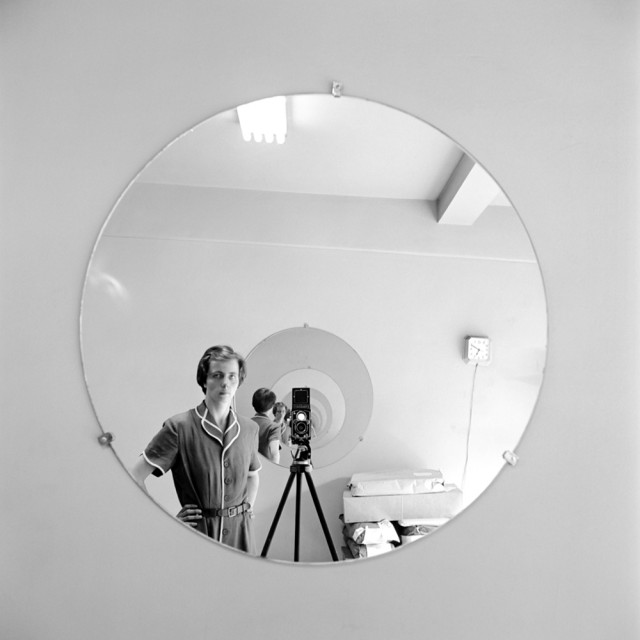
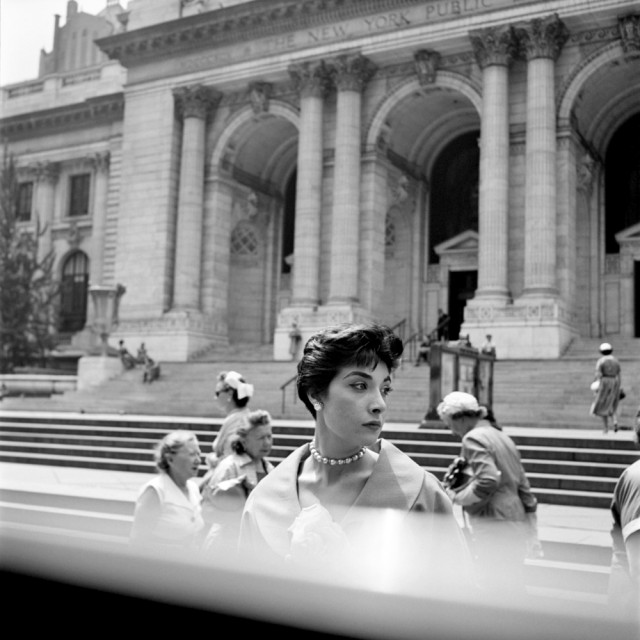
 By their very nature, street photographers take pictures of anonymous individuals, capturing a moment in time in which viewers can fill in their own details. In the wonderful documentary Finding Vivian Maier, codirectors John Maloof and Charlie Siskel turn the lens around on a street photographer herself, attempting to fill in the details of the curious life and times of Vivian Maier, about whom very little was known. “I find the mystery of it more interesting than her work itself,” says one woman for whom Vivian Maier served as a nanny decades earlier. “I’d love to know more about this person, and I don’t think you can do that through her work.” In 2007, while looking for historical photos for a book on the Portage Park section of Chicago, Maloof purchased a box of negatives at an auction. Upon discovering that they were high-quality, museum-worthy photographs, he set off on a mission to learn more about the photographer. Playing detective — while also developing hundreds of rolls of film, with thousands more to go — Maloof meets with men and women who knew Maier as an oddball, hoarding nanny who went everywhere with her camera and shared little, if anything, about her personal life. “I’m the mystery woman,” Maier says in a color home movie. Her former employers and charges, including talk-show host Phil Donahue, debate her background, the spelling and pronunciation of her name, her accent, and how she might have felt about a documentary delving into her secretive life.