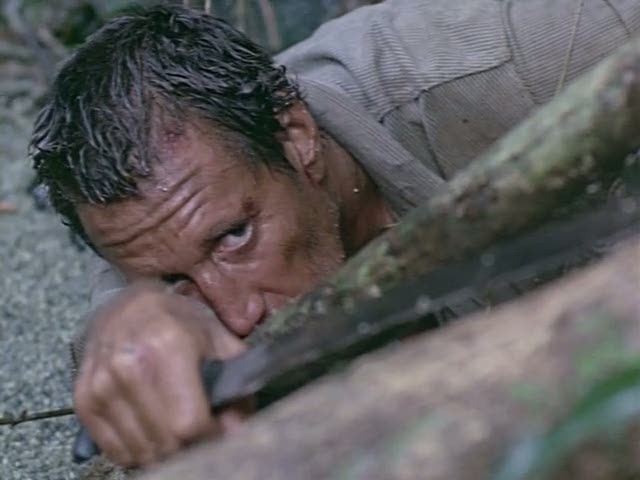
Roy Scheider goes on an existential voyage of the soul in William Friedkin’s SORCERER
SORCERER (William Friedkin, 1977)
Film Forum
209 West Houston St.
May 30 – June 5
212-727-8110
www.filmforum.org
 In the mid-1970s, Chicago-born director William Friedkin was riding high, earning an Oscar for The French Connection and another nomination for The Exorcist, two huge critical and box-office successes. For his next film, he decided to reimagine a seminal work that had had a profound influence on him, Henri-Georges Clouzot’s haunting 1953 suspense thriller, The Wages of Fear. “It turned out to be the most difficult, frustrating, and dangerous film I’ve ever made, and it took a toll on my health as well as my reputation,” Friedkin wrote in his 2013 memoir, The Friedkin Connection. Friedkin’s adaptation of Clouzut’s classic, itself based on a novel by Georges Arnaud, follows four unlikable men — a thief (Roy Scheider), a hit man (Francisco Rabal), an embezzler (Bruno Cremer), and a terrorist (Amidou) — hiding out under fake identities in a depressed, nowhere village in South America. When a nearby oil well catches fire, the company needs four men to drive two rickety trucks more than two hundred miles over treacherous terrain to deliver cases of rotting, highly unstable dynamite that will be used to blow the whole thing up and put out the fire. Oil man Corlette (Ramon Bieri) is sending two trucks — dubbed “Lazaro” and “Sorcerer” — because he thinks only one, if any, will make it through. The journey includes a harrowing twelve-minute scene as the men try to navigate a dilapidated rope bridge in a rainstorm as well as a psychedelic trip through a fantastical landscape (shot in the Bisti Badlands in New Mexico).
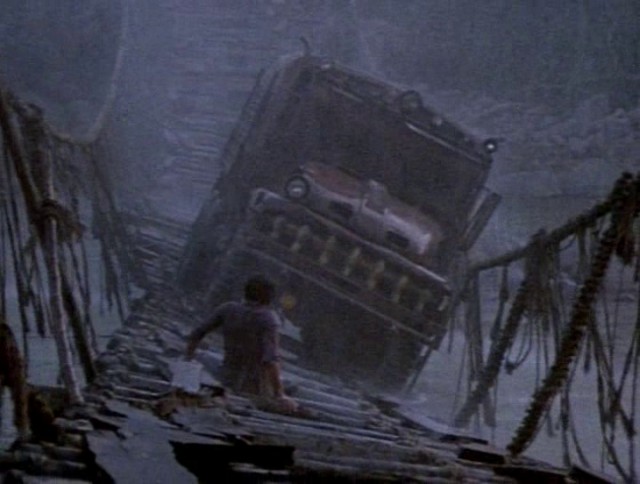
Harrowing bridge crossing is one of the most suspenseful scenes ever caught on film
What began as a dream project — Friedkin was pretty much given carte blanche by the studio, and he initially had his ideal cast lined up, consisting of Steve McQueen, Marcello Mastroianni, Lino Ventura, and Amidou — quickly turned into a nightmare as the cast changed, location problems flared up, a cinematographer had to be fired because of improper lighting, a narc forced Friedkin to get rid of some drug-using crew members, “Marvin the Torch” had to be called in to help with an explosion, and malaria ran rampant, as did the budget. When the film was finally released in June 1977, it got lost in all the Star Wars hoopla, resulting in a critical and box-office failure that shattered Friedkin, whose next three films were The Brink’s Job, Cruising, and Deal of the Century. But Friedkin has always stood behind Sorcerer: “I had persevered to make a film that I would want to see,” he wrote in his memoir, “a relentless existential voyage that would become my legacy.” After fighting for the rights to the film, he supervised a digital restoration that confirms the film as a towering achievement, a gripping, intense work of suspense that digs deep into the soul. Scheider, who was nominated for a Best Supporting Actor Oscar for The French Connection and then was extremely upset when Friedkin refused to cast him as Father Damien in The Exorcist, gives an extraordinary performance as Jackie Scanlon, a New Jersey Irish gang member now going by the name Juan Dominguez, ready to do whatever it takes to get out of the hell he is in. Friedkin and editor Bud Smith cut the film to match Tangerine Dream’s electronic score — the German group wrote the music to the script, without seeing a single frame of the finished product — creating an intense pace that never lets up. The digital restoration, which premiered at the Venice International Film Festival, was just released on Blu-ray and DVD, and is currently playing at Film Forum, restores Friedkin’s Sorcerer legacy, as critics and audiences reevaluate it as a remarkable triumph after all these years. The title is still terrible and the final scene highly questionable, but Sorcerer is an unforgettable, powerfully realistic work of magic.
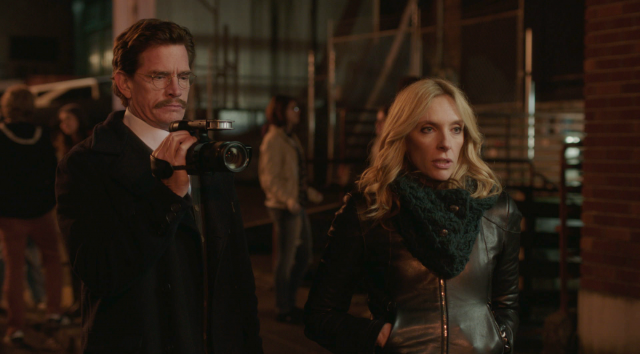
 With the music magazine she works for facing financial difficulties, longtime rock writer Ellie Klug (Toni Colette) is assigned by her editor, Giles (Oliver Platt), the one story she doesn’t want to cover: the mysterious death of Seattle musician Matthew Smith, who made one highly influential album, then drove his car over a waterfall. The main problem is that the jaded Ellie, who has a penchant for sleeping with her subjects, had a relationship with Matthew, one she wants to keep buried. But soon she is on the road with former fling Charlie (Thomas Haden Church), a straitlaced, wealthy bore who decides to make a documentary about her search. At the same time, Ellie is pursued by singer-songwriter Lucas (Ryan Eggold), a younger man who has the hots for her. When she gets a tip that Matthew might actually still be alive, she has to decide whether holding on to her career is worth dredging up the past. Inspired by cowriter and producer Emily Wachtel’s real life as a singles columnist for the Fairfield County Weekly and a contributing writer for Westport magazine, for which she used the pseudonym Ellie Klug, Lucky Them can’t decide whether it’s Eddie and the Cruisers, Velvet Goldmine, or Almost Famous, resulting in a tedious drama filled with genre clichés and dull, predictable scenes. Even a supposed shock near the end ultimately feels trite and obvious. Haden Church’s character is so ludicrously unbelievable that it drags down the entire film by itself, but he gets no help from the overwrought script, mediocre music, and stagnant direction by Megan Griffiths (Eden, The Off Hours). The film is dedicated to Paul Newman, whose widow, Joanne Woodward, is one of the executive producers; Woodward and Wachtel previously teamed up with director Treva Wurmfeld on the documentary Shepard & Dark. But this disappointing follow-up is more like a vanity project that should never have seen the light of day. Lucky Them opens May 30 at the IFC Center, with Griffiths and Wachtel participating in Q&As Friday night with Ira Glass following the 7:15 screening and Saturday night with Dick Cavett after the 7:15 show and Lauren Hutton after the 9:30 screening.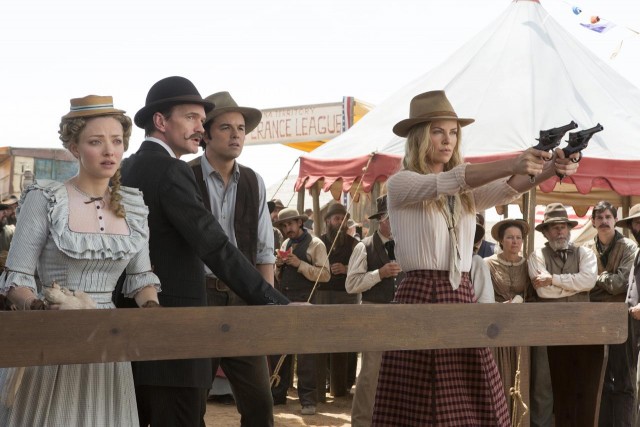
 Seth MacFarlane stars as an anachronistic twenty-first-century wimp in 1882 Arizona in the raunchy, rowdy, lewd, and crude spoof A Million Ways to Die in the West. MacFarlane, who wrote the script — which never met a fart joke it didn’t like — with Family Guy writers and producers Alec Sulkin and Wellesley Wild, stars as Albert Stark, a meek, clueless sheep farmer who gets dumped by his girlfriend, Louise (Amanda Seyfried), after he chickens out of a duel in their bare bones town of Old Stump. Determined to win her back, especially after she takes up with mustachioed mustache maven Foy (a villainous Neil Patrick Harris), Albert, who hates just about everything about the West and is constantly complaining about it, is befriended by Anna (Charlize Theron), a stranger who decides to help him win back Louise. But little does Albert know that Anna is actually the wife of vicious killer Clinch Leatherwood (Liam Neeson), who is on his way to Old Stump, violent jealousy at the ready. Meanwhile, Albert’s virgin bestie, the even meeker and milder milquetoast Edward (Giovanni Ribisi), is planning on marrying his girlfriend, Ruth (Sarah Silverman), a Christian prostitute who does dirty deeds with just about every other guy around. MacFarlane, who did such an outstanding job with his feature directorial debut,