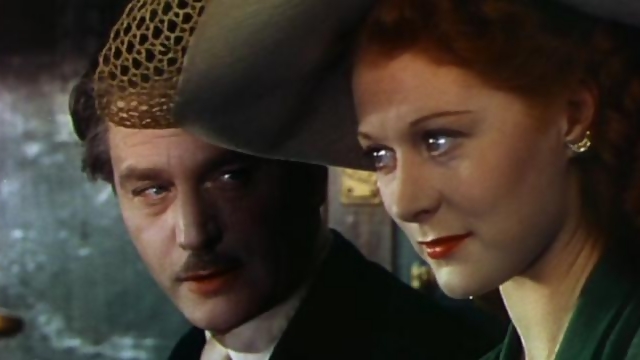
Boris Lermontov (Anton Walbrook) and Victoria Page (Moira Shearer) contemplate their future in Michael Powell and Emeric Pressburger’s THE RED SHOES
CLASSICS FOR KIDS AND THEIR FAMILIES: THE RED SHOES (Michael Powell & Emeric Pressburger, 1948)
Film Forum
209 West Houston St.
Sunday, June 8, $7.50, 11:00 am
212-727-8110
www.filmforum.com
 Michael Powell and Emeric Pressburger’s The Red Shoes is a lush, gorgeous examination of the creative process and living — and dying — for one’s art. Sadler’s Wells dancer Moira Shearer stars as Victoria Page, a young socialite who dreams of becoming a successful ballerina. She is brought to the attention of ballet master Boris Lermontov (Anton Walbrook) and soon is a member of his famed company. Meanwhile, composer Julian Craster (Marius Goring), whose music was stolen by his professor and used in a Lermontov ballet, also joins the company, as chorus master. As Vicky and Julian’s roles grow, so does their affection for each other, with a jealous Lermontov seething in between. Inspired by Sergei Diaghilev and the Ballets Russes, The Red Shoes is a masterful behind-the-scenes depiction of the world of dance, highlighted by the dazzlingly surreal title ballet, which mimics the narrative of the central plot. Based on the Hans Christian Andersen fairy tale, the fifteen-minute ballet takes viewers into a completely different fantasy realm, using such cinematic devices as jump cuts and superimposition as the drama unfolds well beyond the limits of the stage. To increase the believability of the story and make sure the dance scenes were effective, Powell and Pressburger enlisted players from the international dance community; the film’s cast includes Russian choreographer and dancer Léonide Massine as Lermontov choreographer Grischa Ljubov, French prima ballerina Ludmilla Tchérina as Lermontov star Irina Boronskaja, and Australian dancer Robert Helpmann as Ivan Boleslawsky; Helpmann also served as the film’s choreographer.
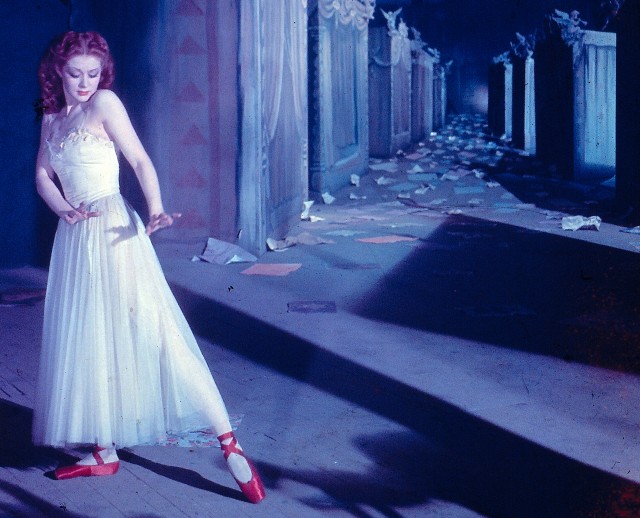
Victoria Page (Moira Shearer) gets immersed in a surreal ballet in classic dance drama THE RED SHOES
Brian Easdale won an Oscar for his score, which ranges from sweet and lovely to dark and ominous, with an Academy Award also going to Hein Heckroth’s stunning art direction and Arthur Lawson’s fabulous set design. The film was photographed in glorious Technicolor by Jack Cardiff. Upon meeting Vicky, Lermontov asks, “Why do you want to dance?” to which she instantly responds, “Why do you want to live?” No mere ballet film, The Red Shoes is about so much more. The Red Shoes is screening June 8 at 11:00 am as part of the Film Forum Jr. series for kids and families, which continues June 15 with To Kill a Mockingbird and June 22 with Oklahoma!
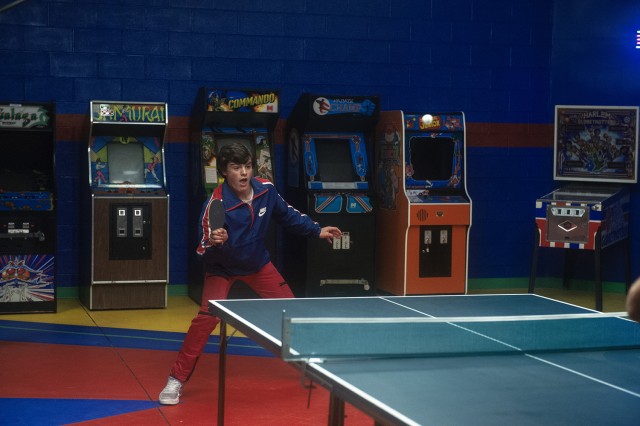
 No mere homage to ’80s films, Michael Tully’s sweetly charming Ping Pong Summer was made as if it were a teen bully movie from the decade that gave us such Reagan-era flicks as The Karate Kid, Back to the Future, My Bodyguard, Revenge of the Nerds, and Three O’Clock High. Shot in Super 16mm by cinematographer Wyatt Garfield to give it an authentic period look, Ping Pong Summer is set in Ocean City, Maryland, in 1985, where the Miracle family spends its annual summer vacation. This year they are staying in a ramshackle house by the bay instead of the ocean to save money, but shy, awkward thirteen-year-old supernerd Radford “Rad” Miracle (Marcello Conte) doesn’t really care; all he wants to do is play table tennis and listen to hip-hop. Rad and fellow geek Teduardo “Teddy” Fryy (Myles Massey) hang out at Fun Hub, where kids play air hockey, arcade games like Pac-Man, and Ping-Pong, which, it turns out, Rad is not very good at, his skills about as adept as Teddy’s lame rapping. But after being bullied once too often by obnoxious rich kid and local Ping-Pong god Lyle Ace (Joseph McCaughtry) and his sycophantic right-hand man, Dale Lyons (Andy Riddle), Rad challenges Lyle to a match, which he immediately regrets. But with the help of local weirdo Randi Jammer (real-life Ping-Pong enthusiast Susan Sarandon, cofounder of the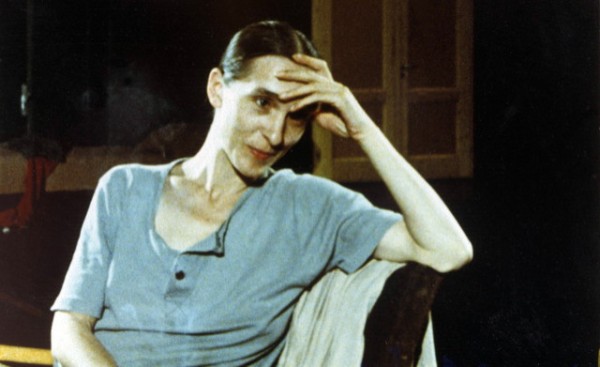
 In 1982, Belgian filmmaker Chantal Akerman followed Pina Bausch’s Tanztheater Wuppertal on a five-week tour of Europe as the cutting-edge troupe traveled to Milan, Venice, and Avignon. “I was deeply touched by her lengthy performances that mingle in your head,” Akerman says at the beginning of the resulting documentary, “One Day Pina Asked…,” continuing, “I have the feeling that the images we brought back do not convey this very much and often betray it.” Akerman (Jeanne Dielman, 23 Quai du Commerce, 1080 Bruxelles; Je tu il elle) needn’t have worried; her fifty-seven-minute film, made for the Repères sur la Modern Dance French television series, is filled with memorable moments that more than do justice to Bausch’s unique form of dance theater. From 1973 up to her death in 2009 at the age of sixty-eight, Bausch created compelling works that examined the male-female dynamic and the concepts of love and connection with revolutionary stagings that included spoken word, unusual costuming, an unpredictable movement vocabulary, and performers of all shapes, sizes, and ages. Akerman captures the troupe, consisting of twenty-six dancers from thirteen countries, in run-throughs, rehearsals, and live presentations of Komm Tanz Mit Mir (Come Dance with Me), Nelken (Carnations), 1980, Kontakthof, and Walzer, often focusing in on individual dancers in extreme close-ups that reveal their relationship with their performance. Although Bausch, forty at the time, is seen only at the beginning and end of the documentary, her creative process is always at center stage. At one point, dancer Lutz Förster tells a story of performing Gershwin’s “The Man I Love” in sign language in response to Bausch’s asking the troupe to name something they’re proud of. Förster, who took over as artistic director in April 2013, first performs the song for Akerman, then later is shown performing it in Nelken. (Bausch fans will also recognize such longtime company members as Héléna Pikon, Nazareth Panadero, and Dominique Mercy.)