Hollis Frampton breaks down cinema into its essential audio and visual forms in experimental masterpiece ZORNS LEMMA
ZORNS LEMMA (Hollis Frampton, 1970)
HAPAX LEGOMENA I: (nostalgia) (Hollis Frampton, 1971)
Anthology Film Archives
32 Second Ave. at Second St.
Thursday, August 14, 7:30
212-505-5181
www.anthologyfilmarchives.org
www.hollisframpton.org.uk
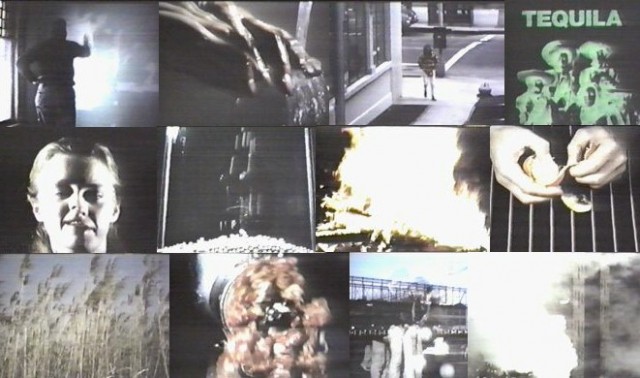
 A poet and photographer before turning to film, Ohio-born avant-garde visual artist Hollis Frampton created a unique cinema that deconstructed and reconstructed sound and image as basic structural elements, developing narratives that were more often about time, space, and memory than traditional storytelling. On August 14 at 7:30, Anthology Film Archives is screening two of his most famous works as part of its continuing Essential Cinema series. In the hour-long Zorns Lemma, which he described as a “kind of cryptic autobiography,” Frampton makes a triptych about learning the language of life and film, about how we process what we see and hear as we mature. In the first section, Canadian filmmaker Joyce Wieland reads twenty-four rhyming sentences from the eighteenth-century Puritan children’s book The Bay State Primer, each one centering on a word starting with the next letter of the ancient Greek alphabet, which does not include “J” and “V”; the accompanying visual is just the black filmstrip itself, with tics and scratches evident. In the second section, which lasts forty-five minutes, Frampton zeroes in on individual words from signs, billboards, posters, and other places around New York City, displaying them alphabetically one per second, each twenty-four-second trip from A to Z evoking the very essence of cinema, which is projected at twenty-four frames per second. As the words continue to cycle silently through, sometimes completely random, sometimes combining into intentional combinations, they are eventually replaced by moving images, roughly in reverse order of how often they are used in the English language. Thus, W-X-Y-Z become passing by city lights in the dark, a raging fire, cattails swirling in the wind, and waves going backward into the ocean. After each letter has ultimately been replaced, the third section begins, both sound and image; as a man, woman, and dog slowly make their way across a snowy landscape, the soundtrack consists of six women reading excerpts from medieval bishop Robert Grosseteste’s On Light, or the Ingression of Forms, at one word per second, accompanied by a ticking metronome. Perhaps Frampton chose six readers to evoke another of Grosseteste’s works, On the Six Days of Creation, as Zorns Lemma, named for an actual mathematical theory, is, at its very heart and soul, about the creation of cinema. It is also about duration, expectation, completion, experience, and satisfaction, and it is surprisingly gripping, even if it can occasionally get monotonous. But of course, that’s part of its charm.
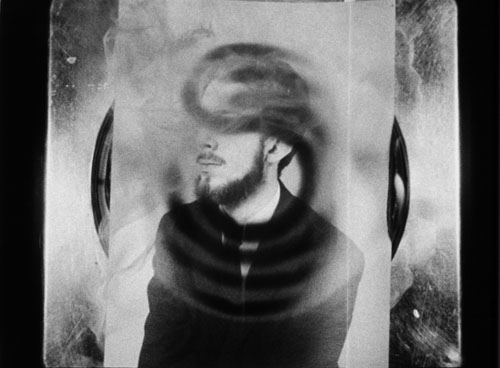
Hollis Frampton burns a photograph of himself in seminal experimental film
Zorns Lemma will be screening with another masterful work by Frampton, 1971’s (nostalgia). Over the course of nearly forty minutes, Frampton displays a dozen photographs one at a time, placed on a coiled electric burner that ignites the picture, eventually reducing it to ash as the camera remains static. Meanwhile, Michael Snow (Wavelength) narrates Frampton’s first-person words in a deadpan voice over each photograph, discussing how he (Frampton) came to took it, sharing details about his life as well as his thoughts on art, name-dropping such friends, classmates, and colleagues as onetime roommate Carl Andre, Frank Stella, Larry Poons, and Snow himself. However, Frampton is actually talking about the next photograph in the sequence, not the one that is currently disintegrating on the screen. Thus, as we see a self-portrait, he is analyzing a photograph of a cabinetmaker’s shop, which will be shown next; the self-portrait was discussed over the previous photograph, a shot of Andre in a picture frame, with a metronome. As he did with Zorns Lemma, Frampton plays with, and preys on, the viewer’s relationship with cinema, busting open the boundaries that are part of the intrinsic nature of film, becoming a treatise on time and the fallibility of memory. It is also about the impermanence of both life and art; as each photograph crumbles, he leaves the camera on it as it morphs into a kind of black ash sculpture, each one unique and original. “Language and image, each trespassing in the other’s house, secrete disquieting disjunctions, conundrums, circularities,” Frampton explained in 1979. “We are accustomed to the poetic strategy, within language, of bracketing a noun within the genus of yet another noun, which may come from an alien phylum, a foreign kingdom. Translation of that strategy into the economy of images yields artifacts . . . savagely grotesque, arch, silly . . . that seem to flee the rigors of self-reference; contradictory images, far from coalescing in a dialectical encounter, annihilate one another in a gesture that sweeps language clean of specification and seems on the point of suggesting a raw map of the preconscious work — the material ACTION — of language.” In Zorns Lemma and (nostalgia) , Frampton, who died in 1984 at the age of forty-eight, still in the midst of his epic Magellan cycle, poetically deals with “disquieting disjunctions, conundrums, [and] circularities,” resulting in a pair of captivating, disorienting, and entertainingly philosophical self-referential works that will continue to project themselves into the time and space of your own memories long after they are over.

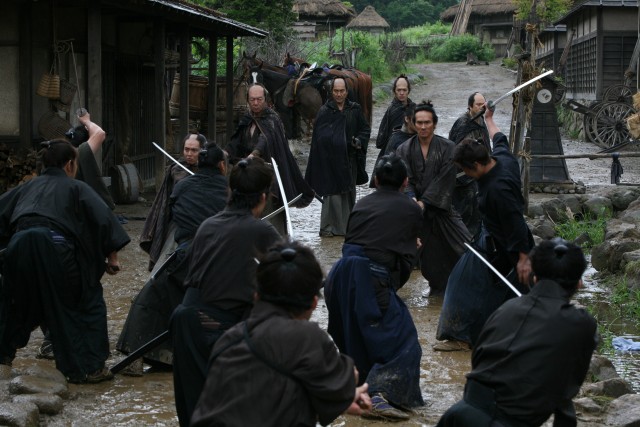
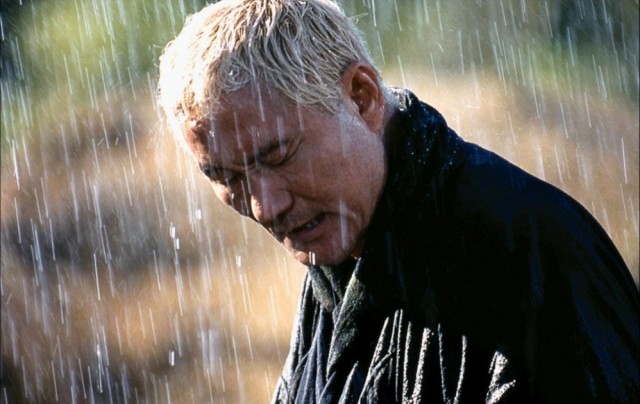
 Japanese director Takashi Miike’s first foray into the samurai epic is a nearly flawless film, perhaps his most accomplished work. Evoking such classics as Kurosawa’s Seven Samurai, Mizoguchi’s 47 Ronin, Aldrich’s The Dirty Dozen, and Eastwood’s High Plains Drifter, 13 Assassins is a thrilling tale of honor and revenge, inspired by a true story. In mid-nineteenth-century feudal Japan, during a time of peace just prior to the Meiji Restoration, Lord Naritsugu (Gorô Inagaki), the son of the former shogun and half-brother to the current one, is abusing his power, raping and killing at will, even using his servants and their families as target practice with a bow and arrow. Because of his connections, he is officially untouchable, but Sir Doi (Mikijiro Hira) secretly hires Shinzaemon Shimada (Kôji Yakusho) to gather a small team and put an end to Naritsugu’s brutal tyranny. But the lord’s protector, Hanbei (Masachika Ichimura), a former nemesis of Shinzaemon’s, has vowed to defend his master to the death, even though he despises Naritsugu’s actions. As the thirteen samurai make a plan to get to Naritsugu, they are eager to finally break out their long-unused swords and do what they were born to do.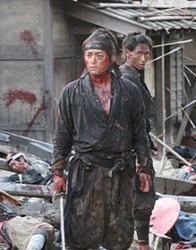
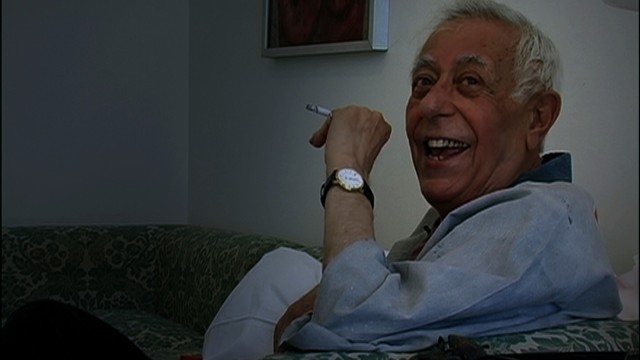
 “I really don’t understand what this film you are making about me is all about. If it’s a film about a subject, I must know what role it is I am to play,” Iranian-born, Rome-based artist Bahman Mohassess tells director Mitra Farahani in the captivating, bittersweet documentary Fifi Howls from Happiness. “I don’t know the structure of your work. How does it start? What does it want to say? And where does it end?” he continues. A successful artist in his home country, Mohassess ultimately left Iran for Italy because of regime change and political unrest, which eventually involved government destruction of his work. He was so outraged that he destroyed even more of his own creations and eventually stopped showing his paintings, sculptures, and collages. Iranian artist and documentarian Farahani (Just a Woman, Zohre and Manouchehr) went in search of Mohassess, finding him living as a near-recluse in a hotel in Rome. The iconoclastic artist opens up to Farahani, talking about his parents and the end of his era while expressing his doubt about future generations. He also shares his views on the censorship and destruction of his art, political and social mores, inheritance, legacy, the general devastation going on around the world, and death. “I am only one John the Baptist, preaching alone in the desert,” he says. “It will make no difference. It never will.” In addition, he regularly tells Farahani what she should be doing with her film, directing the director, even though he points out, “I am not directing. I am only giving you my opinion.”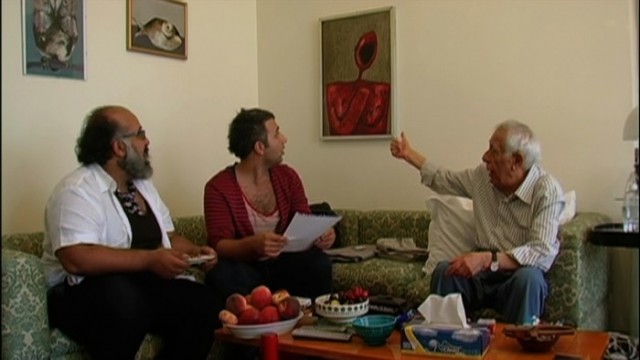
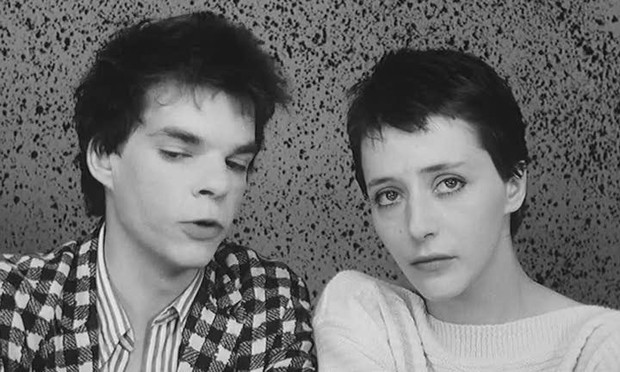
 In Daniel Peddle’s debut feature narrative, Sunset Edge, four disaffected teens go slumming in a supposedly abandoned North Carolina trailer park and run into an unexpected part of its sordid past, with the park itself serving as a character all its own, a constant threat always lurking right below the surface. Just looking for something to do, Jacob (Jacob Kristian Ingle), Blaine (Blaine Edward Pugh), Will (William Dickerson), and Haley (Haley Ann McKnight) hang around the dilapidated park and the surrounding woods, riding their skateboards, shooting paint-ball rifles, and making an enormous, vile mixture of soda and sickeningly sweet candies, trapped between childhood and adulthood. Meanwhile, unbeknownst to them, local boy Malachi Smith (Gilberto Padilla) is slowly uncovering terrible things about his family history as a mysterious old woman in white (Liliane Gillenwater) appears and disappears in the background. As the two tales begin to intersect, an uncertain immediate future awaits them all.