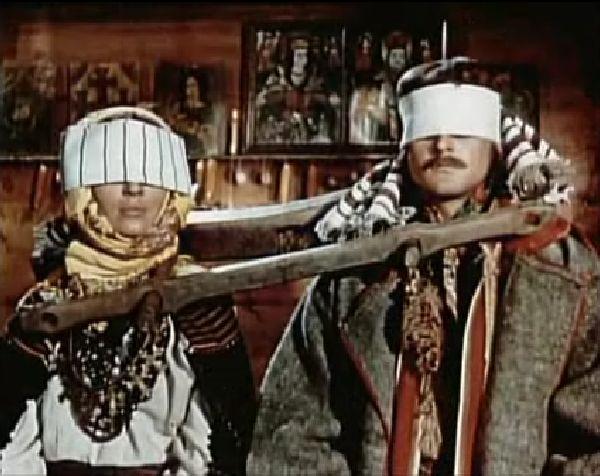
Unusual rituals are some of the many highlights of Sergei Parajanov’s SHADOWS OF FORGOTTEN ANCESTORS
SHADOWS OF FORGOTTEN ANCESTORS (TINI ZABUTYKH PREDKIV) (Sergei Parajanov, 1964)
Museum of the Moving Image
35th Ave. at 36th St., Astoria
Friday, August 8, $10, 7:00
Series runs August 8-10
718-777-6800
www.movingimage.us
www.ruralroutefilms.com
 For a decade, the Rural Route Film Festival has been taking viewers to unique places around the world, far off the beaten track and away from urban centers, instead showing works “that take the road less traveled.” The festival is kicking off its tenth anniversary in a big way, with a fiftieth anniversary screening of Sergei Parajanov’s seminal Shadows of Forgotten Ancestors. Parajanov’s reimagining of Shakespeare’s Romeo and Juliet announces exactly what it is in the opening credits: “A tale of times past, of the great love of Ivan and Marichka. . . . The folk tales and customs of the Carpathian region.” Made in 1964 in honor of the centennial of the birth of Ukrainian author Mykhailo Kotsiubynsky, whose source novel was published in 1913, Shadows follows the friendship and romance of Ivan (Ivan Mikolajchuk) and Marichka (Larysa Kadochnikova), from childhood, when they are kids splashing water on each other, through marriage, war, and tragedy. In fact, there is a lot of tragedy throughout the film, even before Ivan’s family is cursed by a witchlike woman in their Hutsul village.
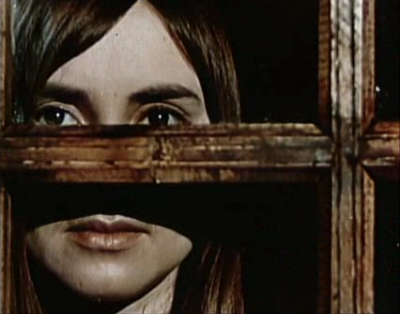
Restored Parajanov film opens the tenth annual Rural Route Film Festival at the Museum of the Moving Image
Shadows of Forgotten Ancestors is filled with fascinating scenes of Ukrainian rituals featuring extravagant costumes and marvelous masks that would make Margaret Mead proud. In one of the film’s most haunting scenes, Parajanov (The Color of Pomegranates, Ashik Kerib), moving between color and black-and-white, superimposes moments of Ivan’s past over religious imagery that sets up the second half of the story, in which things go from bad to worse. The film did not fit within the Soviet regime’s preferred social realism and ideology but it was an international success, although the director was soon blacklisted and arrested and much of his work was banned. A new fiftieth-anniversary 35mm restoration of Shadows of Forgotten Ancestors is screening at the Museum of the Moving Image on August 8 at 7:00, preceded by Sashko Danylenko’s five-minute animated “Carpathian Rap” video for the Ukrainian band Dakha Brakha and followed by a vodka reception; the Rural Route Film Festival runs August 8-10 and includes such other films as Robin Hardy’s The Wicker Man, Daniel Peddle’s Sunset Edge, and Alexsei Fedorchenko’s Celestial Wives of the Meadow Mari.
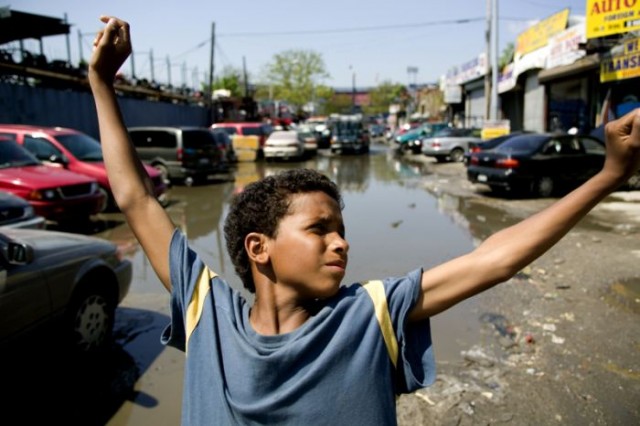
 Set amid the junkyards and auto-body shops in the shadow of Shea Stadium, Ramin Bahrani’s follow-up to his indie hit Man Push Cart is a gritty, realistic drama of family and community. Filmed in thirty days in the Iron Triangle neighborhood of Willets Point, Queens, Chop Shop stars Alejandro Polanco as Ale, a street-smart twelve-year-old boy who works for Rob (Rob Sowulski), calling cars into the repair shop, stealing spare parts, and learning virtually every aspect of the trade, legal and not. Ale lives in a small upstairs room in the garage with his sister, sixteen-year-old Isamar (Isamar Gonzalez), who by day works in a food van and at night makes extra cash by getting into cars and trucks with strange men. Neither Ale nor Izzy goes to school; instead, they’re working hard, saving up money to buy a food van and start their own business, but their life is fraught with danger and difficulty nearly every step of the way. Written by Bahrani (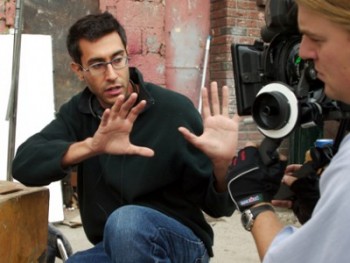

 In the summer of 2005, four navy SEALs went deep into the mountains of Afghanistan to assassinate a Taliban leader responsible for the recent death of twenty marines. Writer-director Peter Berg tells the story of Operation Red Wings and the remarkably brave quartet in Lone Survivor, an ultraviolent action thriller that very well could be used as a training and propaganda film for the next generation of super-soldiers. Close-knit navy SEALs Marcus Luttrell (Mark Wahlberg), Michael P. Murphy (Taylor Kitsch), Danny Dietz (Emile Hirsch), and Matthew Axelson (Ben Foster) are lying in wait for Ahmad Shah (Yousuf Azami) when they are discovered by a trio of goatherders. Forced to decide between letting the possibly innocent men go or killing them so the mission can continue, they choose the former and start to leave the area, but they soon find themselves in the midst of a bloody firefight, one of the most brutal ever depicted on film. Ultimately, only one of them is left, and Lt. Commander Erik S. Kristensen (Eric Bana) and the rest of the team are ready to go in and try to bring him home alive. Berg, who made the exciting Saudi Arabia-set al-Qaeda thriller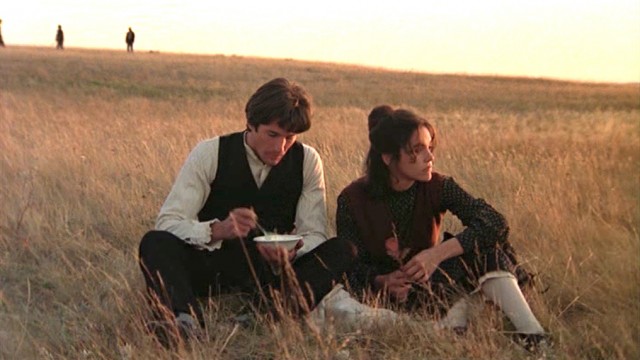
 Justifiably recognized as one of the most beautiful films ever made, writer-director Terrence Malick’s sophomore effort, Days of Heaven, is a visually breathtaking tale of love, desperation, and survival in WWI-era America. After accidentally killing his boss (Stuart Margolin) in a Chicago steel mill, Bill (Richard Gere) immediately flees to the Texas Panhandle with his girlfriend, Abby (Brooke Adams), and his much younger sister, Linda (Linda Manz). Because they are unmarried, Bill and Abby pretend to be brother and sister — evoking the biblical story of Abraham introducing his wife Sarah as his sibling — and get a job working in the wheat fields owned by a reserved, possibly ill farmer (Sam Shepard) who is instantly smitten with Abby. Soon a complex love triangle develops in which money, class, and power play a key role. As beautiful as the main characters are — Gere and Shepard particularly are shot in ways that emphasize their tender but rugged good looks — they are outshone by the gorgeous landscapes and sunsets photographed by Nestor Almendros (who won an Oscar for Best Cinematography) and Haskell Wexler, as well as Jack Fisk’s stunning art direction, all of which were directly inspired by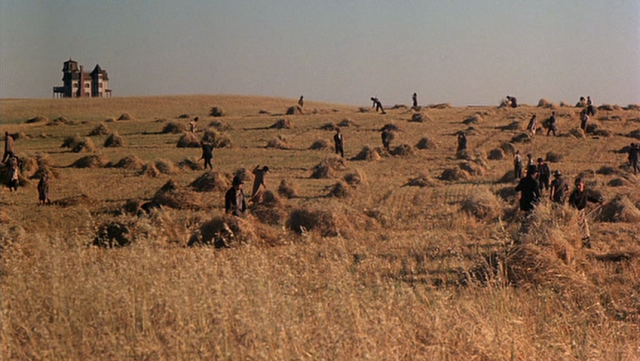

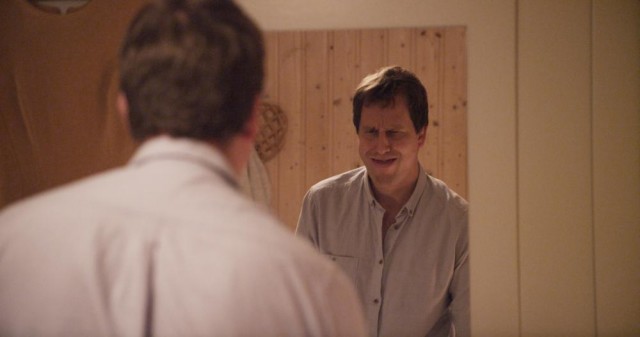
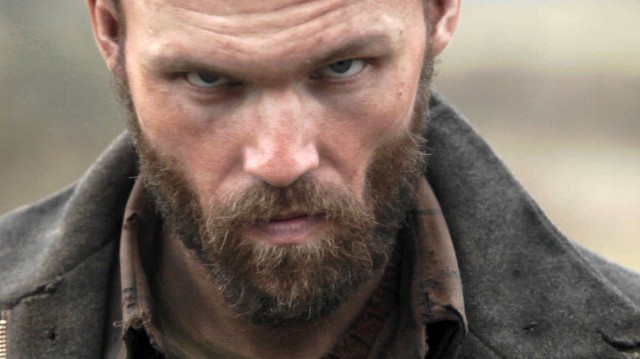
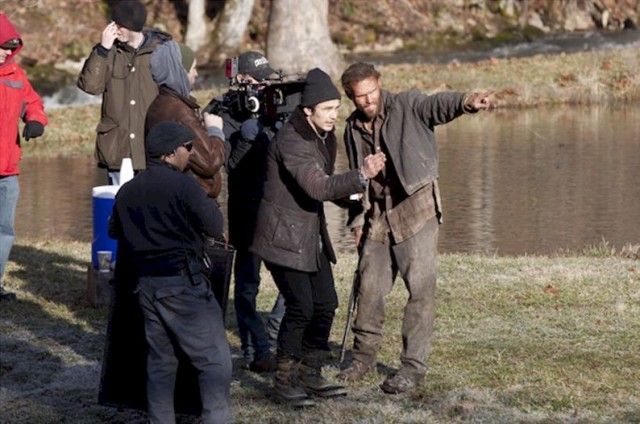
 In James Franco’s faithful, brutally compelling adaptation of Cormac McCarthy’s third novel, 1973’s Child of God, Scott Haze gives a courageous, unforgettable performance as Lester Ballard, a deeply disturbed man wreaking havoc on his small rural community in Sevier County in the Tennessee mountains. “His name was Lester Ballard, child of God, much like yourself, perhaps,” a narrator intones as the film opens. But Lester is not like everyone else. He is almost more animal than man, his speech hard to understand, his face hairy and rough, his gait hurried and uneven, a reclusive soul with no ability to differentiate between right and wrong, more at home in the woods and in caves than living among other people. When he lowers his head slightly and stares right into the camera, he evokes Charles Manson filtered through Charles Bukowski, with more than a touch of Jack Nicholson in The Shining; there doesn’t seem to be an ounce of humanity in him. (McCarthy has noted that Ballard was inspired at least in part by real-life serial killer Ed Gein, who also inspired Old Leatherface in The Texas Chainsaw Massacre and Norman Bates in Psycho.) Having been kicked off his family’s land, an angered Lester sleeps in a ramshackle cabin, venturing out primarily to kill an animal for food or to seek other carnal pleasures in his own, primal way. When he sees a young couple having sex in a car, his instinct is to get rid of the boy and take the girl for himself, with no thought of the consequences.