
Visitors are encouraged to move around rocks in Patti Smith installation in Rockaway Beach (photo by twi-ny/mdr)
MoMA PS1
Fort Tilden and Rockaway Beach
Thursday – Sunday through September 1, free, 12 noon – 6:00 pm
www.momaps1.org
rockaway! slideshow
Both MoMA PS1 director Klaus Biesenbach and multidisciplinary artist Patti Smith had close ties to the Rockaways prior to the destruction wrought by Hurricane Sandy in October 2012, each having homes there that were affected by the disaster. As part of the continuing recovery effort, the two have teamed up with the Jamaica Bay-Rockaway Parks Conservancy, the Rockaway Artists Alliance, and the National Park Service for the free public arts festival “Rockaway!” Held in conjunction with the reopening of Fort Tilden, a former U.S. Army Coast Artillery Post established nearly a century ago and a place that Smith visited often with Robert Mapplethorpe back in the 1970s, “Rockaway!” consists of several projects spread throughout the vast acreage. In the military chapel, which is undergoing restoration, Janet Cardiff has installed her delightful audio piece “The Forty Part Motet,” which has previously been shown at MoMA PS1’s home base in Long Island City and at the Cloisters, the first contemporary artwork ever presented at the Met’s medieval-themed outpost in Fort Tryon Park. “The Forty Part Motet” consists of forty speakers on stands arranged in a circle, each speaker playing the voice of one of the forty members of the Salisbury Cathedral Choir as they perform Thomas Tallis’s sixteenth-century choral composition “Spem in Alium Nunquam habui,” the English translation of which is “In no other is my hope,” a title that is particularly appropriate given the location. First walk around to hear each unique voice, then sit in the middle and let the glorious full music envelop you. “The Forty Part Motet” is on view through August 17; the rest of the show is up through September 1.

Patti Smith’s “Resilience of the Dreamer” creates a kind of fairy tale in middle of decimated building (photo by twi-ny/mdr)
In another building, Smith and her daughter, Jesse, pay tribute to one of Patti’s heroes, Walt Whitman, with the short film The Good Gray Poet, in which Patti reads the New York-born writer’s “Country Days and Nights,” “Mannahatta,” and “Crossing Brooklyn Ferry” (“Flood-tide below me! I see you face to face! . . . On the ferry-boats the hundreds and hundreds that cross, returning home, are more curious to me than you suppose”) while wandering through the Camden cemetery where he is buried. The film also includes shots of other places related to Whitman’s life, and there are various historical items in a display case and a bookshelf where visitors are invited to read more by and about the Bard of Democracy.
The centerpiece of the exhibition is Smith’s “Resilience of the Dreamer,” a gilded four-poster canopy bed positioned in the middle of building T9, a former locomotive repair facility that has been filled with junk and detritus since Sandy. The piece, which calls to mind the destruction of so many homes along the beach, their facades ripped away during the storm, exposing people’s lives, has been decaying since its installation in June; the canopy is ripping, the sheets turning yellow, dirt collecting on the bed as the elements lay waste to it through the broken windows and battered roof. In a heavily graffitied side room, Smith has collected white stones and placed them in a large birdbath, where people are encouraged to pick one out and place it somewhere else — there are rocks in virtually every nook and cranny, from light switches and windowsills to holes in the wall and floor — or even take one home as a memory. In addition, in the sTudio 7 Gallery, Smith is displaying more than one hundred small-scale black-and-white photos primarily of possessions of friends, colleagues, and influences as well as gravesites. Among the images are Robert Graves’s hat, William Burroughs’s bandanna, Virginia Woolf’s cane, Mapplethorpe’s star mirror, and the Rimbaud family atlas, as well as beds belonging to Woolf, Victor Hugo, John Keats, Vanessa Bell, and Maynard Keynes and the tombs and headstones of Susan Sontag, Herman Hesse, Percy Bysshe Shelley, and Jim Morrison. There is also a stage in the room where musical performances are held on Sunday nights; the next one will be the Jammin Jon Birthday Concert Bash on August 17 at 6:00, with fusion trio Dream Speed and experimental guitarist and Brooklyn native Jammin Jon Kiebon.
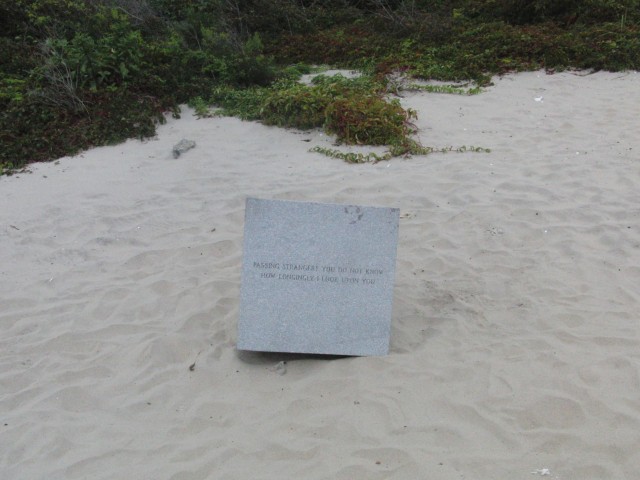
Granite cubes throughout Fort Tilden are part of Patti Smith tribute to Walt Whitman (photo by twi-ny/mdr)
Scattered throughout Fort Tilden, which is part of the Gateway National Recreation Area, are five granite cubes on which Smith has put Whitman quotes (“O madly the sea pushes upon the land, with love, with love”; “Passing stranger! You do not know how longingly I look upon you”) in addition to a dozen small mud-and-straw nests from Adrián Villar Rojas’s “Brick Farm” series, which evoke both home and protection. There’s a map to help locate these objects; wear long pants and closed-toe shoes because several of the passageways are laden with poison ivy. And be sure to walk to the top of the battery for a spectacular view, then make your way down a winding path to the beach. “Rockaway!” is a not only an exciting artistic venture but a terrific exploration of the past, present, and future of the area, so decimated by Hurricane Sandy but even more determined to rebuild its way of life.
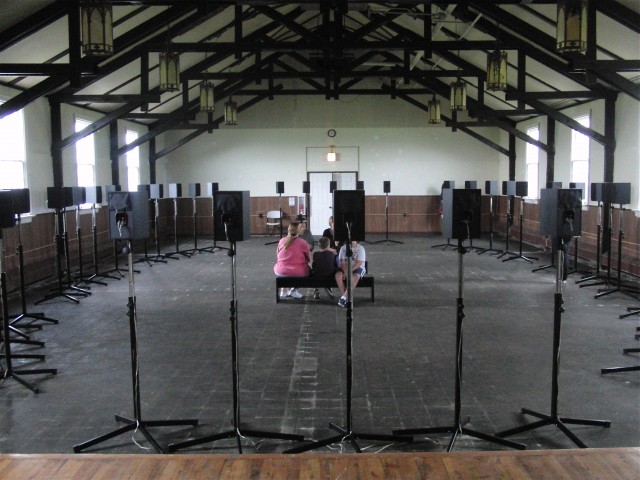
Janet Cardiff’s captivating sound installation continues through August 17 (photo by twi-ny/mdr)
(The exhibition is supplemented by a satellite show of works by more than seventy artists — from Marina Abramović and Ryan McNamara to Michael Stipe and Laurie Simmons, from Doug Aitken and Olaf Breuning to Olafur Eliasson and Ugo Rondinone — at Rockaway Beach Surf Club. There are several ways to get to Fort Tilden, all of which involve multiple modes of transportation. You can take the $3.50 Rockaway ferry from Pier 11 downtown to Beach 108th St., then get on the Q22 bus, or take the A train to Broad Channel, switch for the shuttle, then get the Q22 at 116th St. None of the options are quick and easy, but the ferry ride does go past Coney Island and the Statue of Liberty and under the Verazzano-Narrows Bridge. Yes, it’s a hassle, but it’s well worth it.)

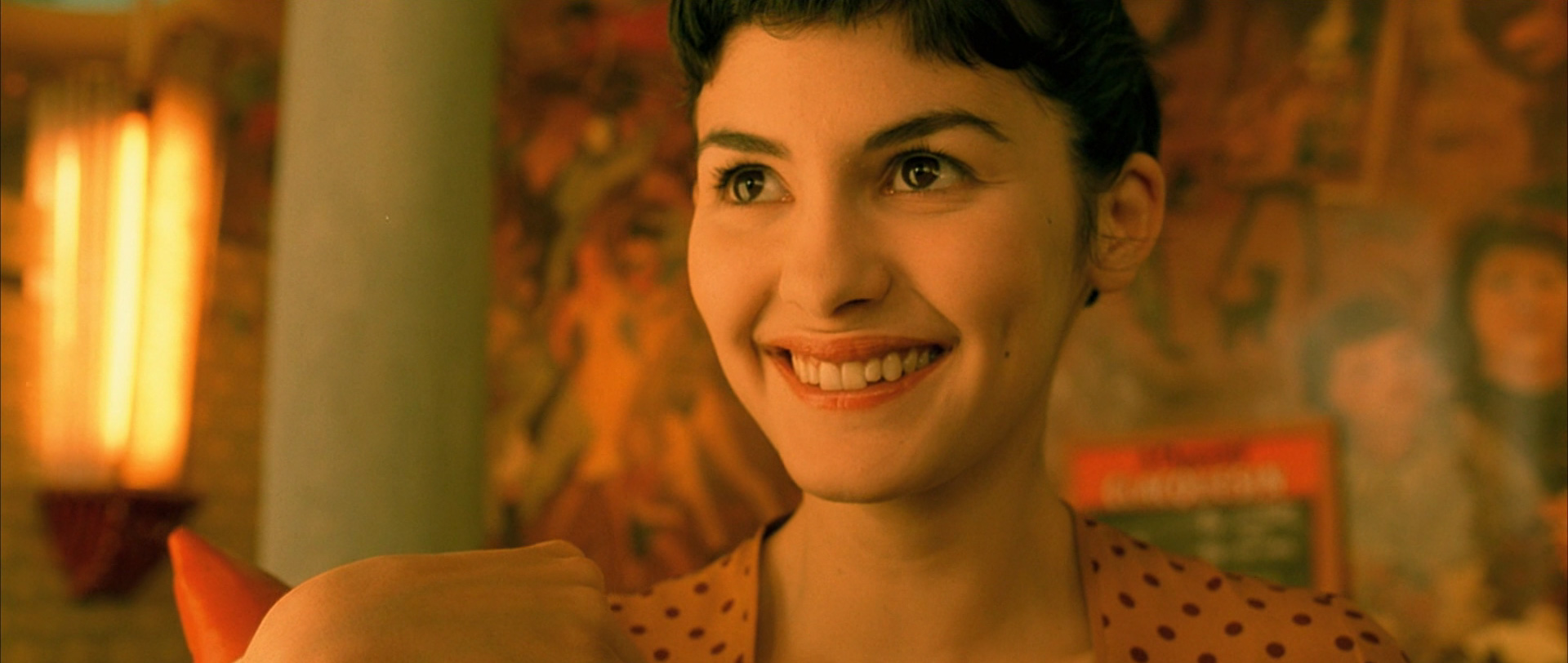
 In Jean-Pierre Jeunet’s wildly inventive romantic comedy, Audrey Tautou plays one of the most delightful, charming characters since, well, dare we say it? Audrey Hepburn, especially from Roman Holiday. Everybody in this film is nuts; Amélíe wanders — always with some strange, curious purpose — through offbeat and humorous situations filled with obsessive-compulsive oddballs doing bizarre things while sharing their crazy likes and dislikes with the audience. A difficult childhood left the grown-up Amélíe unable to interact “normally” with people, so when she discovers a boy’s treasure box hidden in her apartment, she decides to track down the owner, leading to a series of very complex and emotional good deeds she does for others while she cannot figure out her own life, which undergoes a major change when she meets Nino (Mathieu Kassovitz) — who collects ripped-up pictures people throw out after using public photo booths — and becomes friendly with the Glass Man (Serge Merlin), who cannot go outside because his bones are too brittle, so he remains in his apartment, copying the same Renoir painting year after year, unable to capture one girl’s face properly. Jeunet’s aural and visual style is reminiscent of such Coen brothers films as Raising Arizona, with fast-moving shots, sudden close-ups, and blasts of sound that enliven this masterful film. Amélíe is screening August 20 as part of the South Street Seaport “Front/Row Cinema: See/Change” series, which continues Wednesday and Saturday nights through August 31. For a day-by-day listing of free summer movie screenings throughout New York City, go
 It’s easy to see why Morgan Neville’s Twenty Feet from Stardom was such a critical and popular success, raking in more than five million dollars at the box office and winning an Oscar for Best Documentary Feature. Yes, it tells the story of a fabulous group of remarkably talented backup singers, including Darlene Love, Judith Hill, Merry Clayton, Lisa Fischer, Táta Vega, Claudia Lennear, Jo Lawry, Lynn Mabry, and David Lasley. Yes, there are some big-time superstars singing their praises, including Bette Midler, Bruce Springsteen, Sting, Stevie Wonder, Chris Botti, and Mick Jagger. And the music and inside tales are simply phenomenal, particularly the behind-the-scenes scoop on “Gimme Shelter,” which featured Clayton on the original record, while Fischer’s been singing it live onstage with the Stones for the last twenty-five years; surprising looks at Lynyrd Skynyrd’s “Sweet Home Alabama” and David Bowie’s “Young Americans”; Love discussing Phil Spector, “He’s a Rebel,” and cleaning houses; and Hill’s attempt to be both a background vocalist and the lead singer playing her own songs. (Sadly, Clayton was involved in a serious car accident this June and “has a long road of recovery ahead,” according to her website.)
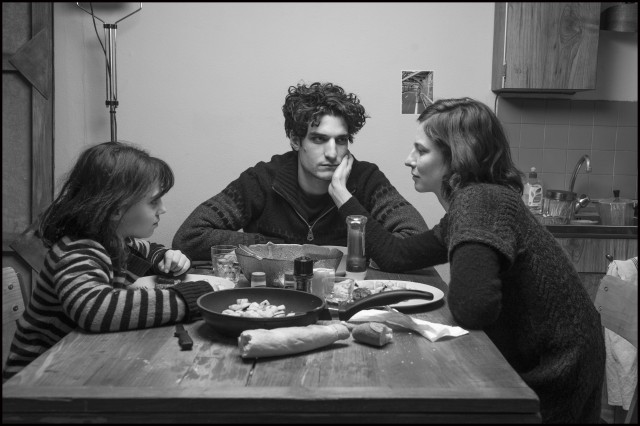

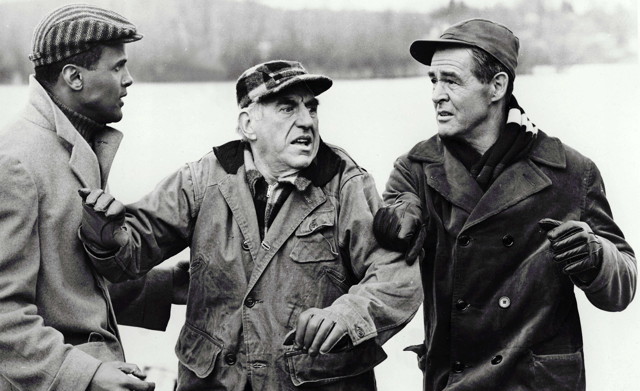
 “I want a safe thing,” Dave Burke (Ed Begley) tells Earl Slater (Robert Ryan) near the beginning of Robert Wise’s 1959 crime drama Odds Against Tomorrow. “This is a one-time job. One roll of the dice and then we’re through forever.” But it’s never that easy, either in real life or in film noir. At first Slater, a hard and fast old-time racist, doesn’t want in on the job because the third man is Johnny Ingram (Harry Belafonte), a smooth-talking black nightclub singer trying to support his ex-wife, Ruth (Kim Hamilton), and their young daughter, Eadie (Lois Thorne), while in debt to a local mobster (Will Kuluva). But Slater has problems of his own; he’s tired of being supported by his devoted girlfriend, Lorry (Shelley Winters), and helping out their extremely flirtatious neighbor, Helen (Gloria Grahame). Soon they are converging on a bank in the small upstate town of Melton, New York, thinking that one big score will settle all of life’s ills. But things rarely work out that way, especially in black-and-white heist films.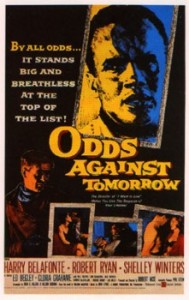
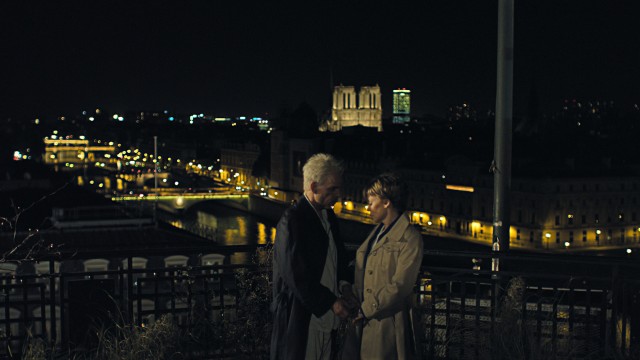
 French writer-director Léos Carax (