LAST HIJACK (Tommy Pallotta & Femke Wolting, 2014)
Film Society of Lincoln Center
Sunday, September 28, 1:30 (interactive) and 8:00 (regular screening)
Festival runs September 25 – October 12
212-875-5050
www.filmlinc.com
www.lasthijack.com
 Tommy Pallotta and Femke Wolting personalize the story of a real-life Somali pirate in the surprisingly intimate and moving Last Hijack. “I want to go back to the ocean once again, take one last ship, and use the money to build a house for my family,” Mohamed narrates as he puts together a small team to pull off a hijack that they hope will make them rich. After that, Mohamed is planning to settle down with his fiancée, Muna, who, along with her parents, is trying to convince him to give up piracy immediately. But Mohamed is determined to make one final score. Cutting-edge filmmakers Pallotta (a producer on such innovative films as Richard Linklater’s A Scanner Darkly and Waking Life and director of the documentary American Prince) and Wolting (a producer of Peter Greenaway’s Rembrandt’s J’Accuse and director of such nonfiction films as Another Perfect World, about 3D gaming, and Sneakers, about the cultural aspects of the sports shoe) gain remarkable access as Mohamed and his cohorts speak openly about their criminal activities and test their weaponry. Pallotta and Wolting cut between the nonfiction narrative and animated scenes that go on inside Mohamed’s head, where he transforms into a large bird that flies through the air and can simply just pick up the target ship with his claws. But life is not that easy, as Mohamed already knows. In the film, Pallotta and Wolting reveal the other side of the story, the one not shown in Captain Phillips or Stolen Seas, told from the point of view of the Somali pirates themselves; the codirectors don’t demonize Mohamed, nor do they turn him into some kind of folk hero. Instead, he’s just a man who needs to make what might turn out to be the most important decision of his life. The eighty-three-minute documentary version of Last Hijack is screening in the Convergence section of the New York Film Festival on September 28 at 8:00; earlier that day, at 1:30, the hour-long interactive “Online Experience” will take place, with Pallotta and Wolting incorporating data visualization, audio, and more animation and live footage to immerse the audience in the tale from multiple perspectives.

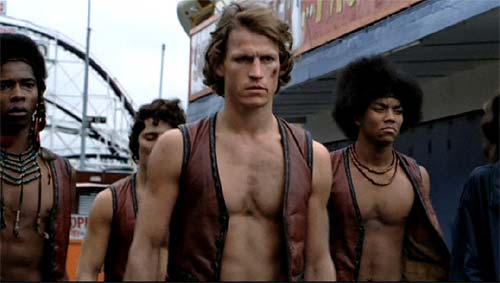
 At a huge gang meeting in the Bronx (actually shot in Riverside Park), the Warriors are wrongly accused of having killed Cyrus (Roger Hill), an outspoken leader trying to band all the warring factions together to form one huge force that can take over the New York City borough by borough. The Warriors then must make it back to their home turf, Coney Island, with every gang in New York lying in wait for them to pass through their territory. This iconic New York City gang movie is based on Sol Yurick’s novel, which in turn is loosely based on Xenophon’s Anabasis, which told of the ancient Greeks’ retreat from Persia. Michael Beck stars as Swan, who becomes the de-facto leader of the Warriors after Cleon (Dorsey Wright) gets taken down early. Battling Swan for control is Ajax (Dexter’s James Remar) and tough-talking Mercy (Too Close for Comfort’s Deborah Van Valkenburgh). Serving as a Greek chorus is Lynne (Law & Order) Thigpen as a radio DJ, and, yes, that young woman out too late in Central Park is eventual Oscar winner Mercedes Ruehl.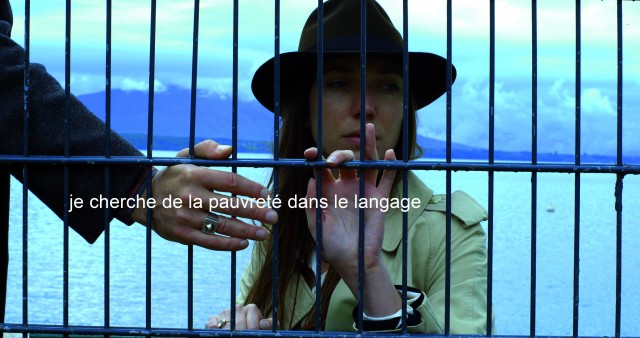
 After the New York Film Festival advance press screening of Jean-Luc Godard’s 3D Goodbye to Language, a colleague turned to me and said, “If this was Godard’s first film, he would never have had a career.” While I don’t know whether that might be true, I do know that Goodbye to Language is the 3D flick Godard was born to make, a 3D movie that couldn’t have come from anyone else. What’s it about? I have no idea. Well, that’s not exactly right. It’s about everything, and it’s about nothing. It’s about the art of filmmaking. It’s about the authority of the state and freedom. It’s about extramarital affairs. It’s about seventy minutes long. It’s about communication in the digital age. (Surprise! Godard does not appear to be a fan of the cell phone and Yahoo!) And it’s about a cute dog (which happens to be his own mutt, Miéville, named after his longtime partner, Anne-Marie Miéville). In the purposefully abstruse press notes, Godard, now eighty-three, describes it thusly: “the idea is simple / a married woman and a single man meet / they love, they argue, fists fly / a dog strays between town and country / the seasons pass / the man and woman meet again / the dog finds itself between them / the other is in one / the one is in the other / and they are three / the former husband shatters everything / a second film begins / the same as the first / and yet not / from the human race we pass to metaphor / this ends in barking / and a baby’s cries.” Yes, it’s all as simple as that. Or maybe not.