WATCHERS OF THE SKY (Edet Belzberg, 2014)
Lincoln Plaza Cinema
1886 Broadway between 62nd & 63rd Sts.
Opens Friday, October 17
212-757-2280
www.lincolnplazacinema.com
www.watchersofthesky.com
 In 1943, Polish-born lawyer Raphael Lemkin, determined to stop the mass atrocities that were being committed by governments around the world, came up with a name for what he was lobbying heavily to make an official crime recognized by the international community: genocide. In Watchers of the Sky, director and producer Edet Belzberg (Children Underground) explores Lemkin’s vision through the modern-day work of four people battling against the odds to end genocide and bring those responsible to justice. Inspired by Samantha Power’s Pulitzer Prize-winning book A Problem from Hell: America and the Age of Genocide, Belzberg follows Chad field director Emmanuel Uwurukundo of the UN Refugee Agency as he tries to find humanity among the horrific suffering in Darfur after losing most of his family in Rwanda; Transylvania-born Benjamin Ferencz, the chief U.S. prosecutor in the Einsatzgruppen Case in Nuremberg who today continues to implore the UN to do something about the horrifying crimes of aggression being perpetrated by multiple countries; Luis Moreno-Ocampo, the former chief prosecutor of the International Criminal Court whose job was to gather evidence to arrest and try Sudan leader Omar al-Bashir for war crimes; and Power, the U.S. permanent representative to the United Nations who uses Lemkin’s activism to attempt to end the inaction of the international community, which sits idly by as mass murder takes place right under its nose.
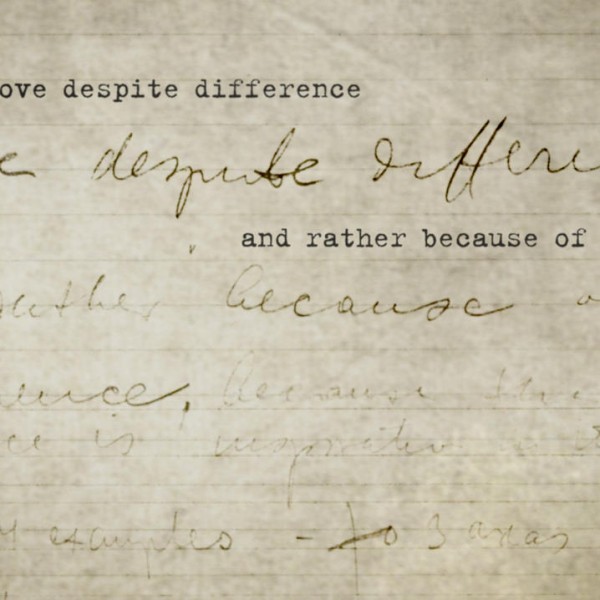
The inspiring, often shocking words of Raphael Lemkin are at the center of documentary about genocide
“What was amazing about Raphael Lemkin, a rural wunderkind of sorts, was that he saw the universal connection with victims and the universal capacity to carry out harms of great magnitude,” Power says in the film. “And that led him to have great conviction that no one was safe.” Meanwhile, Uwurukundo explains, “You feel this guilt on your heart. . . . This kind of experience you live with, you cannot explain to someone. Sometimes, it’s even, you feel ashamed that you didn’t do anything. But actually, you could not do anything,” echoing the words of Lemkin, who admitted, “How could I explain the pain of millions, the hopes for salvation from death? A tremendous conspiracy of silence poisoned the air. I was shamed by my helplessness.” Belzberg includes haunting animation, archival footage of Lemkin and excerpts from his notebooks, news reports documenting the ethnic cleansing of Armenians, Jews, Christians, Rwandans, Darfuris, Bosnians, and others, and scenes of Power, Ferencz, Ocampo-Moreno, and Uwurukundo facing what could have been faith-shattering obstacles as they try to make a difference in a mind-boggling world. “Why is the killing of a million a lesser crime than the killing of an individual?” Lemkin asked many years ago, and it’s frightening that such a question still needs to be answered today. Watchers of the Sky should be mandatory viewing for every member of the United Nations, each employee of The Hague, and all world leaders, who then must do something about these unspeakable, never-ending horrors.
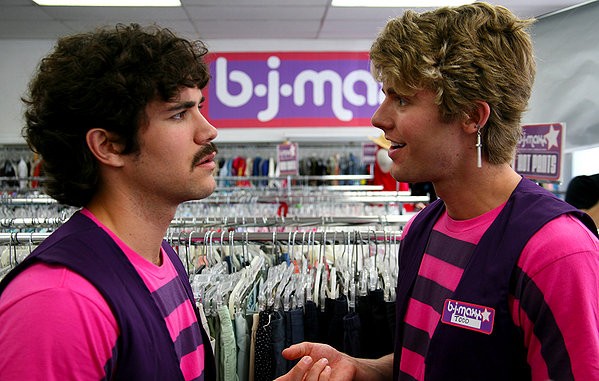
 Director Ian Thorpe’s Eternity: The Movie tries to be a good-natured riff on those lame 1980s films like Can’t Stop the Music, Fast Forward, Flashdance, and Xanadu, in which main characters dream of stardom and get their chance to make it, all set to terrible period music. Unfortunately, Eternity is more like those lame 1980s films themselves instead of a send-up of the genre. Barrett Crake stars as Todd Lucas, an eager blonde singer-songwriter who has just moved to Los Angeles from Omaha. He gets a job in “fashion” working at retailer BJ Maxx (yes, that is Eric Roberts playing his creepy boss), where he meets B. J. Fairchild (Myko Olivier) — yes, the BJ jokes are endless — a mustached brunette who specializes in playing jazzy TV cop-show themes on his sax. Todd, who’s looking for true love, and B.J., who thinks of himself as a ladies’ man, both develop a thing for bartender Gina Marie (Nikki Leonti), but when it comes right down to it, they really belong together, as writer Joey Abi-Loutfi and Thorpe continually allude to the clear and obvious gay attraction between them. The story of their rise and fall as lily-white R&B popsters Eternity, who had such synth-heavy hits as “Make Love, Not Sex” and “Sambuca & Cider,” is jaw-droppingly inane; it’s often hard to tell what is intentionally bad from what is just plain bad. Oh, and did we say that the whole thing is a one-note joke about Hall & Oates? Eternity feels like it goes on for an eternity, but don’t expect it to have much of a long life in theaters, DVD, or Netflix.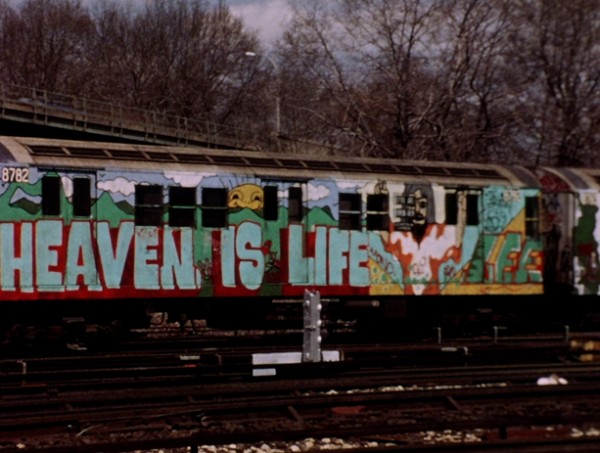
 Thirty-three years after screening at the New York Film Festival, Manfred Kirchheimer’s Stations of the Elevated is finally getting its official U.S. theatrical release, in a gorgeous new restoration showing at BAMcinématek October 17-23. In 1977, Manfred Kirchheimer, whose family escaped Nazi Germany in 1936, went to the Bronx and filmed graffiti-covered subway cars at the train depot and rushing across the elevated tracks, kids playing in a burned-out housing project, and giant billboards advertising hamburgers, cigarettes, alcohol, and suntan lotion. Shot on 16mm reversal stock, Stations of the Elevated is more than just a captivating document of a bygone era; it is a deeply poetic socioeconomic journey into class, race, art, and freedom of expression, told without a single word of narration or onscreen text. Instead, producer, director, editor, and photographer Kirchheimer (Colossus on the River, Bridge High with Walter Hess) shifts from the natural sound of the environment to a superb jazz score by Charles Mingus while cutting between shots of trains covered in tags and illustrations (and such phrases as “Heaven Is Life,” “Invasion of the Earth,” “Never Die,” and “Earth Is Hell”) by such seminal figures as Blade, Daze, Lee, Pusher, Shadow, and Slave and views of colorful billboards filmed peeking through the geometric architecture of the elevated railways and set against bright blue skies. Most often, the camera focuses on the painted eyes in the ads, looking right back at the viewer as they dominate the scene, evoking the optician’s ad in that famous novel of American class, The Great Gatsby. (The concentration on the eyes also predicts how Madison Ave. was watching the graffiti movement, eventually coopting the imagery into mainstream advertising.) Through this dichotomy of meaning and execution, Kirchheimer reveals similarities in artistic styles and how the elements influenced each other; a particularly telling moment occurs when a man is shown hand painting a billboard who could have just as well been spray painting a subway car.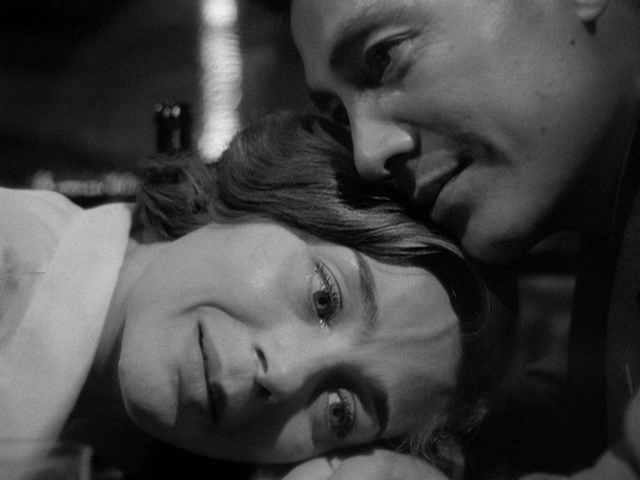
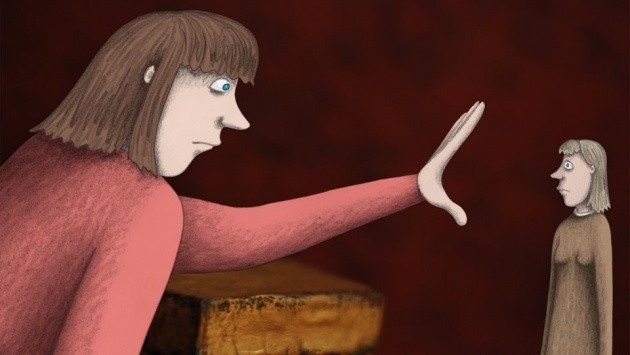
 The recent suicide of Robin Williams shook the nation, once again pointing out that depression is no laughing matter. But Latvian-born, Brooklyn-based writer-director-producer-animator Signe Baumane takes a unique approach to depression and suicide in the darkly twisted animated film Rocks in My Pockets: A Crazy Quest for Sanity. Influenced by such animation giants as Jan Švankmajer and Bill Plympton in addition to Lithuanian-Polish illustrator Stasys Eidrigevicius and Russian animator Yuri Norstein, Baumane, a self-described “Master of Self Pity,” incorporates hand-drawn animation, papier-mâché constructions, and stop-motion animation in telling the story of her family’s long history of mental illness and suicide. Inspired by her own thoughts of ending it all, Baumane (Teat Beat of Sex), in her feature-length debut, divides the film into segments about her suicidal relatives. She narrates the tales of Indulis, an entrepreneur and failed counterfeiter with an “idea-generating brain”; Anna, a university graduate and secretary who falls in love with Indulis, her married boss; Miranda, who looks at the world as if everything were a work of art; Linda, a medical student with big dreams; Irbe, a lonely music teacher who hears voices in her head; and herself as they all experience various aspects of severe depression while facing the trials and tribulations of everyday life in a changing sociopolitical climate in Eastern Europe.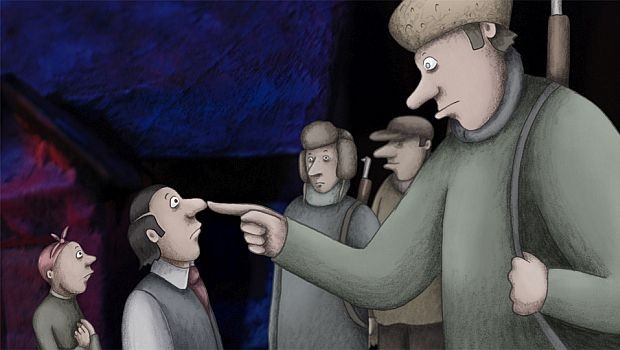
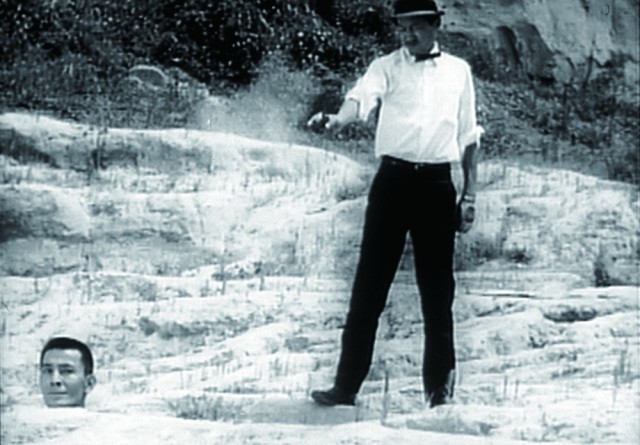
 As if the title of Atsushi Yamatoya’s rarely shown 1967 cult flick wasn’t enough — it doesn’t get much better than Inflatable Sex Doll of the Wastelands — the fetishistic Japanese noir pink film has intriguing echoes of Welles’s Touch of Evil, Godard’s Alphaville, Marker’s La Jetée, Teshigahara’s Woman in the Dunes, and Dalí and Buñuel’s Un Chien Andalou. Yamatoya, who also directed Season of Betrayal, The Pistol That Sprouted Hair, and Trap of Lust and cowrote Branded to Kill (among many others), merges the crime genre with shaky, surreal flourishes courtesy of cameraman Hajime Kai, but the result is a violently misogynistic film that is often hard to watch, filled with rape, abuse, and impossible-to-decipher plot twists. In the middle of the desert, Naka (Masayoshi Nogami), a real estate agent, has hired Jō, a hitman (Yūichi Minato), to rescue his lover and employee, Sae (Noriko Tatsumi), and kill a gang of thugs who are sexually terrorizing her. Jō is soon facing his old enemy Kō (Shōhei Yamamoto) in a showdown that happens every day at three o’clock. There are enough phone calls and crawling ants to make Dalí proud, plenty of excess nudity, a great jazz score by Yōsuke Yamashita, and a hysterical moment that at first appears to be a still shot but turns out to be the characters trying to freeze, but it’s hard to get past the outright brutal treatment and victimization of every woman in the film. Inflatable Sex Doll of the Wastelands is screening October 18 at 7:00 at Japan Society, opening the series “The Dark Side of the Sun: John Zorn on Japanese Cinema,” and will be followed by a reception commemorating filmmaker Koji Wakamatsu, one of Yamatoya’s regular collaborators, who passed away in October 2012.