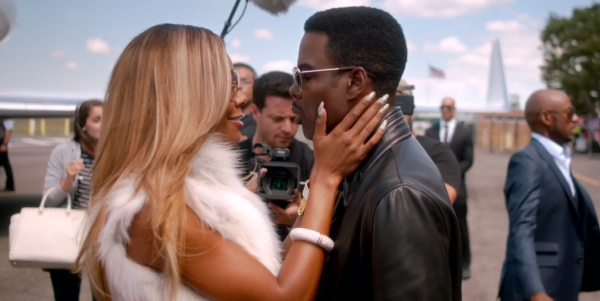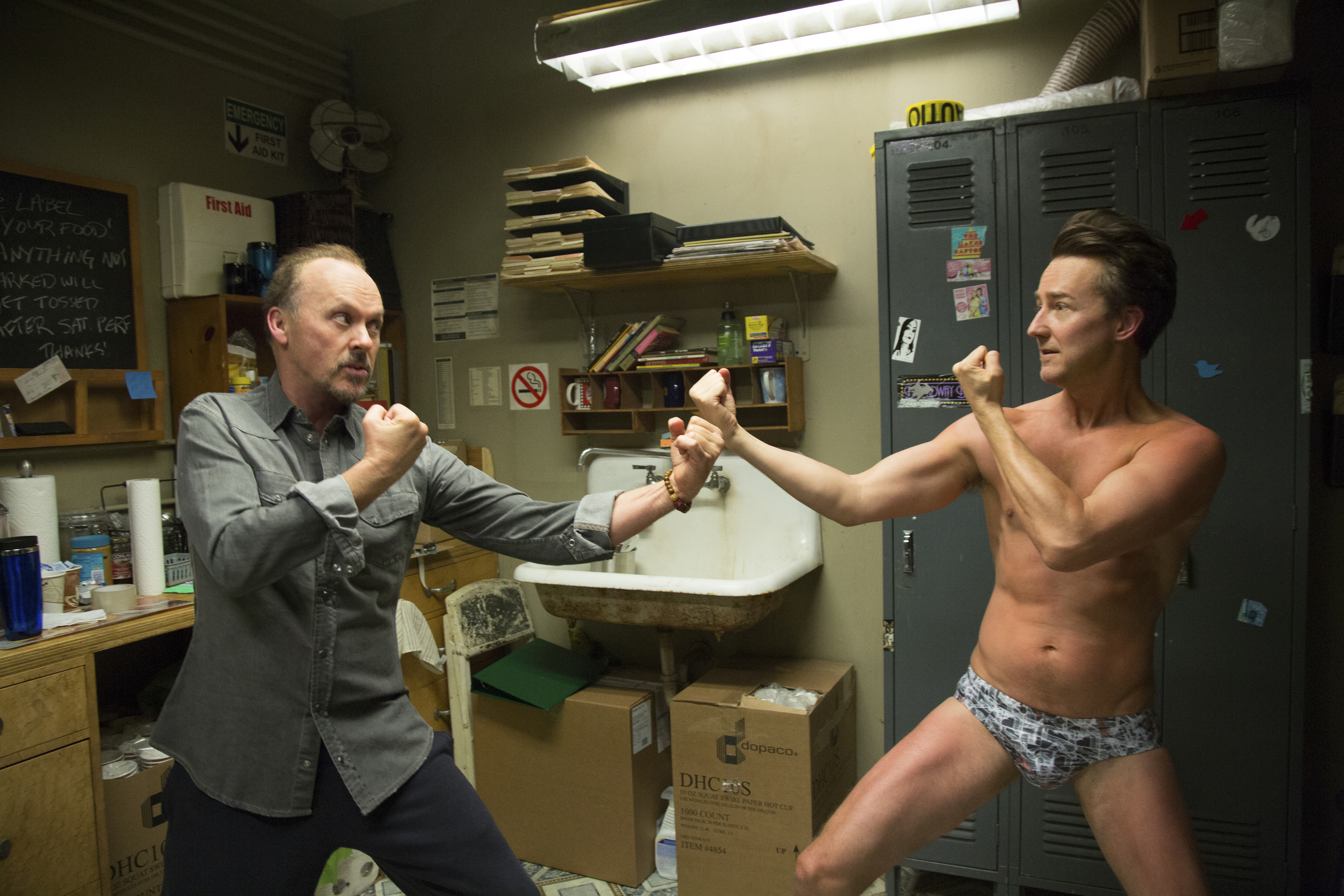
Riggan Thomson (Michael Keaton) and Mike Shiner (Edward Norton) battle it out onstage and off in BIRDMAN
BIRDMAN OR (THE UNEXPECTED VIRTUE OF IGNORANCE) (Alejandro G. Iñárritu, 2014)
Opened October 17
www.birdmanthemovie.com
 In Birdman or (The Unexpected Virtue of Ignorance), Oscar-winning cinematographer Emmanuel Lubezki’s swirling camera immerses the audience in Mexican director Alejandro G. Iñárritu’s gripping whirlwind black comedy of a former superhero action star trying to regain respect on the Broadway stage. Onetime Batman star Michael Keaton plays Riggan Thomson, an actor who left his blockbuster Birdman franchise in order to be taken more seriously. Twenty years later, he is considering refinancing his house in order to support his Broadway debut as writer, director, and star of an adaptation of Raymond Carver’s short story “What We Talk about When We Talk about Love.” As he works on the play with costars Mike Shiner (Edward Norton), Shiner’s girlfriend, Lesley (Naomi Watts), and his own girlfriend, Laura (Andrea Riseborough), he battles his inner demons, which take the form of the dark, gravelly voice of his Birdman character (voiced by Keaton). Either his somewhat obscure but vaguely Buddhist spiritual pursuits or his Birdman abilities also apparently give him the ability to move objects with his mind; the first time we see him, he is levitating in front of the window of his dressing room at the St. James Theatre. His team also includes his devoted lawyer, producer, and best friend, Jake (Zach Galifianakis), his stalwart stage manager, Annie (Merritt Wever), and his daughter and personal assistant, Sam (Emma Stone), a bitter and cynical young woman fresh out of rehab. He also has an encounter with vicious theater critic Tabitha Dickinson (Lindsay Duncan), who is licking her lips in anticipation of reviewing his show. With opening night approaching, Thomson must look deep within himself as he reevaluates his life and career.
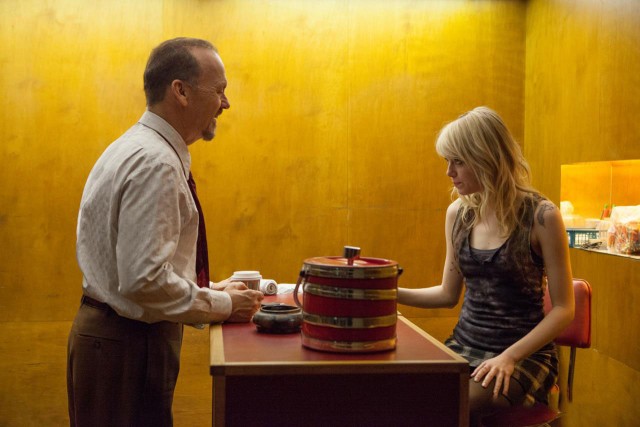
Riggan Thomson (Michael Keaton) tries to reestablish his relationship with his daughter, Sam (Emma Stone), in BIRDMAN
Iñárritu (Amores Perros, Babel) and Lubezki (Gravity, Children of Men) take viewers on a wicked, wild ride in Birdman, which is masterfully made to look as if it is one continuous two-hour shot, the handful of cuts cleverly hidden as the camera roams through the narrow hallways and small dressing rooms of the St. James and into (and above) Times Square, instilling the film with the energy and feel of live theater. The live aspect reaches a new peak when, as Thomson is winding his way backstage accompanied by Antonio Sánchez’s propulsive percussion score, he runs past a man playing the music on the drums. (Think Count Basie leading his band out on the western plains in Blazing Saddles.) Another inside joke occurs when Shiner is shown reading Jorge Luis Borges’s Labyrinths, a short-story collection filled with magical scenes of its own. Keaton gives the best, bravest performance of his career as Thomson, a comeback role that clearly hits home; it seems so tailor made for him that it is hard to believe it was not written specifically for the ’80s star of such hits as Night Shift, Mr. Mom, Gung Ho, and Beetlejuice. Keaton — who has had very limited theater experience — lets it all hang out, as does Norton, channeling his narrator character from Fight Club. The film’s supporting cast is outstanding as well, including Watts, who is now considering making her long-awaited theater debut, and Amy Ryan as Thomson’s ex-wife, but Stone’s big, expressive eyes nearly steal the movie. Birdman is so fresh and potent, so dynamic and spirited, that it’s easy to forgive it its few plot holes. It’s a biting satire of Hollywood and Broadway, of fame and stardom, a magical fantasy that relates to everyone’s fear of becoming insignificant.




 Although writer-director Rob Zombie refuses to call this a sequel to 2003’s House of 1000 Corpses, The Devil’s Rejects is a sequel to Zombie’s 2003 horror hit House of 1000 Corpses. Mad clown Captain Spaulding (Sid Haig) is back, as are murderous siblings Otis (Bill Moseley) and Baby (Sheri Moon Zombie, Rob’s wife). Mother Firefly, played by the vixenous Karen Black in the first flick, is here portrayed with delicious delight by Leslie Easterbrook (of Police Academy fame). In this gorefest, Otis and Baby are on the lam from Sheriff Wydell (William Forsythe), who is determined to avenge his brother’s death; they hole up in a skeevy motel with a quartet of hostages that includes perennial Clint Eastwood bad boy Geoffrey Lewis and Three’s Company escapee Priscilla Barnes. Zombie cleverly plays with genre cliches throughout the film; what you think is going to happen — or not happen — gets turned upside down, so you never quite know where things are heading (although you can always count on a shot of his wife’s butt). Zombie, leader of the heavy metal band White Zombie, injects a wry sense of humor by including such ’70s pop music as Elvin Bishop’s “Fooled Around and Fell in Love,” Steely Dan’s “Reelin’ in the Years,” David Essex’s “Rock On,” and even Lynyrd Skynyrd’s “Freebird,” always at extremely appropriate moments. Add a star if you love films that relish gore; delete two and a half if you can’t stand them. The Devil’s Rejects is being shown January 2 and 3 at 12:10 am as part of Nitehawk Cinema’s Nitehawk Nasties and Nitehawk Midnite Screenings series.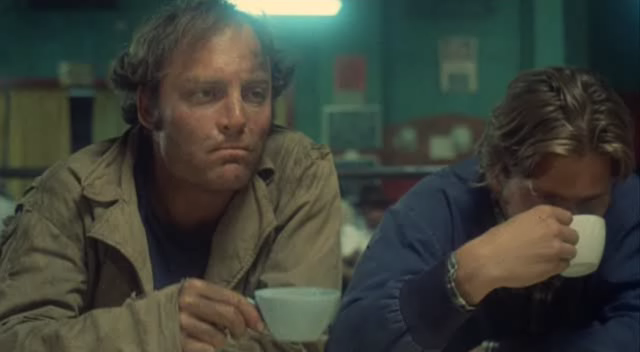
 Genre master and onetime boxer John Huston returned to the ring in Fat City, a gritty 1972 drama about a group of has-beens and never-will-be’s struggling to survive in Stockton, California. Stacey Keach stars as Billy Tully, a down-on-his-luck fighter looking to make a comeback at the ripe old age of twenty-nine. He spars at the local Y with eighteen-year-old Ernie Munger (Jeff Bridges) and likes what he sees in the kid, telling him to meet his old manager, Ruben (Cheers’ Nicholas Colosanto), who decides to take on the unseasoned youngster. While Ruben lands Ernie — who seems more interested in bragging about having scored with his girlfriend, Faye (Candy Clark), than training properly — his first few bouts, Tully gets day work picking vegetables and hangs out at a local gin joint with a seedy, whiskey-voiced barfly named Oma (an Oscar-nominated Susan Tyrrell). Legendary cinematographer Conrad Hall, who shot such wide-ranging gems as Cool Hand Luke, In Cold Blood, Butch Cassidy and the Sundance Kid, Marathon Man, and American Beauty, casts a gray pall over the proceedings as dashed hopes and dreams come falling down on these disillusioned perennial losers. In many ways Fat City, based on the novel by Leonard Gardner — who also wrote the screenplay — is an update of Elia Kazan’s On the Waterfront, but moved to the hard times of early ’70s America, when so many people had no way out. You do not have to be a fight fan to fall in love with this film. A clear influence on such auteurs as Martin Scorsese, Fat City is screening January 1, 4, and 5 as part of the Film Society of Lincoln Center series “Let There Be Light: The Films of John Huston,” which runs through January 11 and consists of forty films directed by Huston, in addition to a handful of other works he either appeared in or that demonstrate his lasting influence.