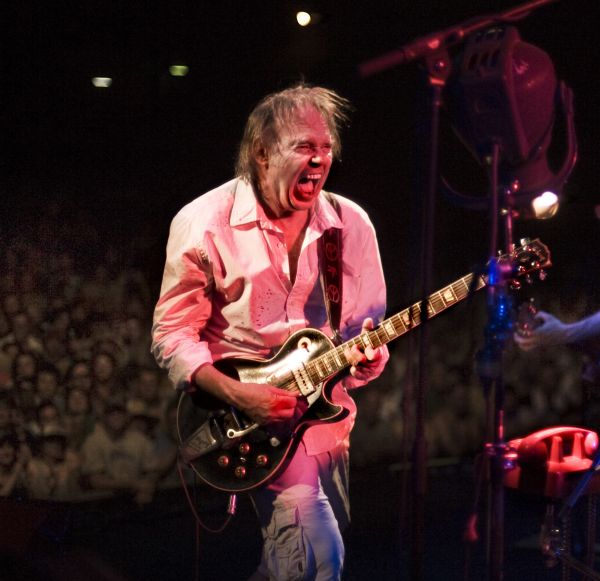
Neil Young lets it all hang out in Jonathan Demme concert film (photo by Larry Cragg)
NEIL YOUNG TRUNK SHOW (Jonathan Demme, 2009)
IFC Center
323 Sixth Ave. at Third St.
Friday, April 17, 12 noon, and Monday, April 20, 8:00
212-924-7771
www.ifccenter.com
www.trunkshowmovie.com
 In April 2005, Neil Young underwent brain surgery for an aneurysm. Four months later, he gathered together friends for two special nights at Nashville’s historic Ryman Auditorium, captured on film by Oscar-winning director Jonathan Demme, who has previously helmed such fab music docs as Stop Making Sense and Storefront Hitchcock. Neil Young: Heart of Gold was an intimate portrait of man who looked death in the face and survived; the film featured acoustic songs primarily from Young’s beautiful Prairie Wind album. But the Godfather of Grunge wasn’t about to let a little thing like a brain aneurysm stop him from rocking in the free world. As he continued his long-term project of reaching deep into his past for his archival box sets, he released Chrome Dreams II in October 2007, a sequel to an unreleased 1977 album that was rumored to include such future Young classics as “Pocahontas,” “Like a Hurricane,” “Homegrown,” and “Powderfinger.” For Chrome Dreams II, Young strapped on the electric guitar and held nothing back, joined by longtime partners in crime Ralph Molina on drums, Rick Rosas on bass, and Ben Keith on guitars and keyboards.
Young took the show on the road, playing small clubs across the country, where each song was announced by a live painting by Eric Johnson. Demme captured two searing performances at the Tower Theater in Pennsylvania, filming them guerrilla-style with eight cameras, mostly handheld, that get right up in Young’s face. While the actual concerts were divided into two separate sets, first solo acoustic, then electric with the band, which also featured backup vocals by then-wife Pegi Young and Anthony “Sweetpea” Crawford, Demme mixes them up in Neil Young Trunk Show, an exhilarating music documentary that limits behind-the-scenes patter and instead concentrates on the powerful music. At the time, Young had been at the game for nearly fifty years, but he plays with a young man’s abandon in the film, his eyes deep in thought on such gorgeous acoustic gems as “Harvest,” “Ambulance Blues,” “Sad Movies,” and “Cowgirl in the Sand” while really letting loose with extended jams on the new “Spirit Road” and “No Hidden Path” before tearing everything apart on “Like a Hurricane.” The sixty-two-year-old Canadian legend even includes an instrumental from his high school days with the Squires, “The Sultan,” complete with Cary Kemp banging a gong. As with most Young concerts, Trunk Show is not about the greatest hits; to truly enjoy it, just let the music take you away – and make sure the theater has the volume turned up loud. The movie is screening in a DCP projection April 17 & 20 as part of the weeklong IFC Center tribute “The Bernard Shakey Film Retrospective: Neil Young On Screen,” with the latter showing introduced by Demme, who also made Neil Young Journeys about Young. The series runs April 17-23 and also includes Rust Never Sleeps, Year of the Horse, Muddy Track, Journeys Through the Past, a double feature of Solo Trans and A Day at the Gallery, and other adventurous Young musical odysseys.
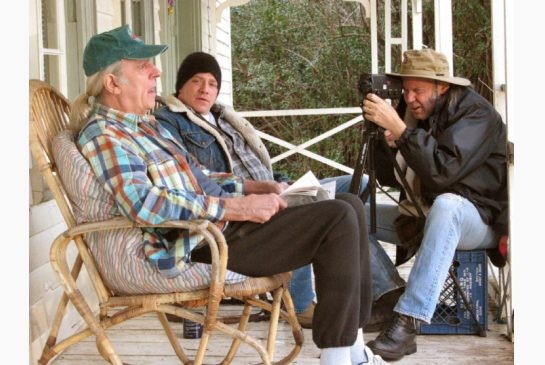
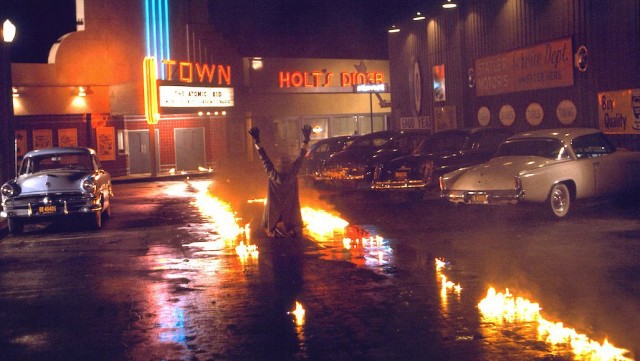
 Greendale, Neil Young’s “musical novel” about a small American town encountering a few troubles — including drugs, corporate greed, extramarital doings, the murder of a police officer, and a little red devil — is simplistic, amateurish, silly, and a lot of fun. The music, especially “Falling from Above,” “Devil’s Sidewalk,” and “Bandit,” is awesome, featuring Young’s soaring guitar and the solid backing of Crazy Horse. There’s no dialogue in the film, just the characters lip-synching to Young’s singing. With Greendale, Young has created his own little world, and for nearly ninety minutes, it’s a pleasure to be a part of it. The direction is credited to Young’s alter ego, Bernard Shakey, who is enjoying a weeklong retrospective at the IFC Center, consisting of a 35mm print of Greendale, a digital restoration of the director’s cut of Human Highway, the twentieth-anniversary of Dead Man (with director Jim Jarmusch participating in a postscreening discussion on April 23 at 7:00), a high-definition digital projection of Journey Through the Past, a 35mm print of Year of the Horse (with Jarmusch at the IFC Center for the 9:45 screening on April 23), and other musical journeys starring Young, who continues to make vibrant music as he heads toward seventy.
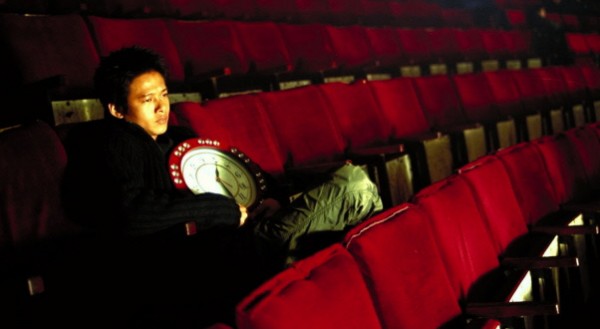
 Malaysian-born Taiwanese filmmaker Tsai Ming-liang’s What Time Is It There? is one heck of an existential hoot. When his father (Miao Tien) dies, Hsiao-kang (Lee Kang-sheng), who sells watches on the street in Taipei, becomes obsessed with a series of things: a strange woman (Chen Shiang-chyi) who insists on buying Hsiao-kang’s own watch and then leaves for Paris; Truffaut’s The 400 Blows (Tsai’s “all-time favorite film”); urinating in whatever is near his bed instead of going to the bathroom; and changing clocks to Paris time. Meanwhile, his mother (Lu Yi-ching) is determined to follow ridiculous rituals to bring her husband back, and the woman in Paris (Cecilia Yip) goes through a number of bizarre events as well. There is not a single camera movement in the film (except for in the 400 Blows film clips); the scenes are shot by Benoît Delhomme in long takes, often lingering before and after any action — when there is any action. The dialogue is spare, ironic, and hysterical. If you like your movies straightforward and linear, then this is not for you, but we loved this absolute riot of a film. And yes, that person sitting on the bench in the cemetery is exactly who you think it is. One of several Tsai films in which Lee portrays a version of Hsiao-kang, What Time Is It There? is screening April 24 at 7:00 as part of the Museum of the Moving Image’s fourteen-film tribute to Tsai’s career; other upcoming films include
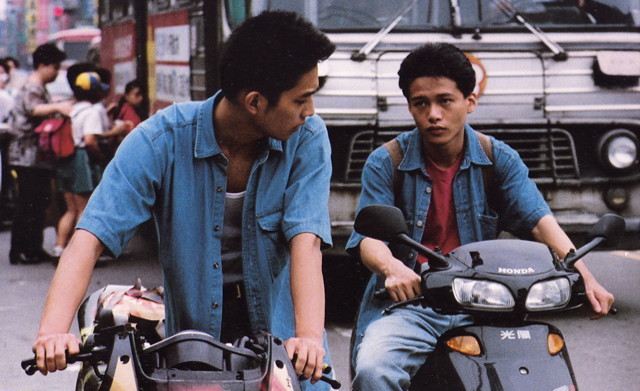
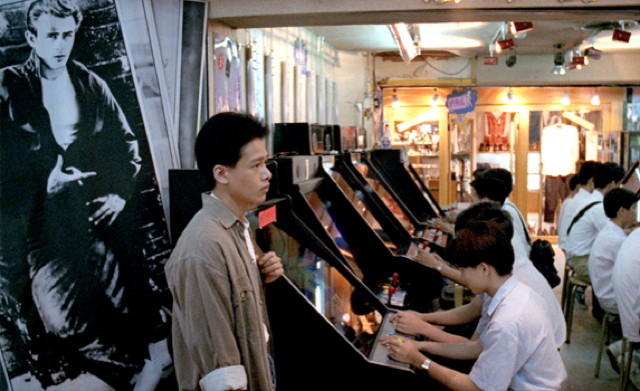
 If you’re going to make a movie with the awesome title Rebels of the Neon God, it better be a damn fine, supercool, unusual, even rebellious film. And that’s exactly what Malaysian-born Taiwanese filmmaker Tsai Ming-liang’s debut feature is, a damn fine, supercool, unusual, and rebellious film about teen angst and urban alienation in a changing Taipei. Written and directed by Tsai, who went on to make such other stunners as The River, The Hole, Vive l’Amour, and What Time Is It There?, among others, Rebels of the Neon God is a slowly paced minimalist tale of interrelated characters who come together in fascinating, unexpected ways. Lee Kang-sheng, whom Tsai discovered smoking a cigarette on the street (for the television piece Kids), stars as Hsiao-kang, a teenager who has decided to cash out of cram school without telling his parents. His father (Tien Miao), a cabdriver, and his mother (Lu Yi-ching), a spiritualist who believes that her son is the reincarnation of the rebel protection deity Nezha, don’t know what to do with their extremely quiet son, who seems to have little interest in life except for going to video arcades. Meanwhile, Ah Tze (Chen Chao-jung) is living an odd life himself, stealing change from public phone booths and becoming friendly with a young woman, Ah Kuei (Wang Yu-wen), who slept with his brother, Ah Bing (Jen Chang-bin). One afternoon, Ah Tze and Ah Kuei are on a scooter when they pull alongside Hsiao-kang and his father in a cab, and after getting honked at for blocking a lane, Ah Bing smashes the father’s side-view mirror, a deed that Hsiao-kang decides is not going to go unpunished.