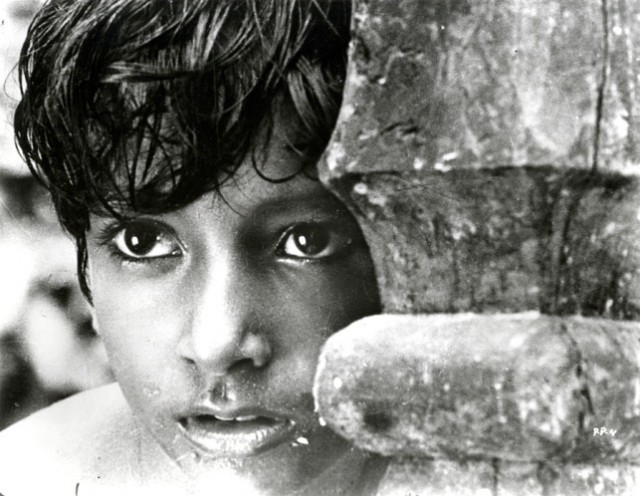
Apu (Subir Banerjee) watches life unfold in his small Indian village in Satyajit Ray’s PATHER PANCHALI
PATHER PANCHALI (SONG OF THE LITTLE ROAD) (Satyajit Ray, 1955)
Film Forum
209 West Houston St.
May 8-28
212-727-8110
filmforum.org
 A groundbreaking work in the history of world cinema, Satyajit Ray’s Pather Panchali and its two sequels, Aparajito and Apur Sansar, have been meticulously restored by the Criterion Collection and the Academy Film Archive following a nitrate fire in 1993 — the year after Ray was awarded an honorary Oscar on his deathbed — and now are being shown together as “The Apu Trilogy,” running May 8-28 at Film Forum. Inspired by a meeting with Jean Renoir in Kolkata, where Renoir was shooting The River, and watching ninety-nine films in six months while working as a graphic designer for an advertising agency in London, Ray decided to make his first film, adapting Bibhutibhushan Banerjee’s 1929 novel, which he knew well; Ray had contributed illustrations to a later edition of the book. The film took nearly five years to make as Ray faced repeated financing problems, such delays as cattle eating flowers that were needed for an important scene, and a cast and crew primarily of nonprofessionals. Despite all those issues, Pather Panchali is a stunning masterpiece, a bittersweet and captivating tale of a rural family mired in poverty, struggling to survive in extremely hard times. In a small village, Sarbajaya (Karuna Banerjee) is raising her daughter, Durga (Runki Banerjee), a rambunctious teen, and son, Apu (Subir Banerjee), while her husband, dreamer Harihar (Kanu Banerjee), a wannabe playwright and poet, goes off for months at a time, trying to find work in the city. (The actors shared a common surname but were not related in real life.) Sarbajaya is also caring for their elderly cousin, “Auntie” Indir (retired theater actress Chunibala Devi), who walks very slowly, hunched over and with impossibly leathery skin. The family goes about its business from day to day, as the kids play with friends, figure out how they can get something from the sweets man, and hang out with Auntie, who offers a fresh perspective on life. Sarbajaya is embarrassed that she cannot pay back several rupees she owes her relatively wealthy neighbor, who owns an orchard from which Durga steals fruit. It’s a meager existence, but it avoids being completely dark and bleak because of Auntie’s sense of humor and Apu’s wide-eyed innocence. The film is told from his point of view — in fact, the first time we see him, he is lying down, covered, and one of his eyes pops open, dominating the screen. It’s a difficult, challenging life, but there’s always hope.
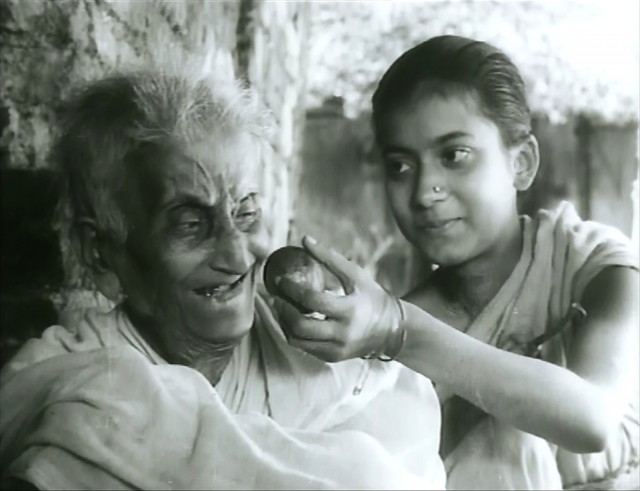
Durga (Runki Banerjee) offers Auntie (Chunibala Devi) a stolen treat in PATHER PANCHALI
The episodic Pather Panchali was heavily influenced by Italian Neorealism while also evoking works by Ozu, Kurosawa, and Renoir, providing an alternative to the flashier, popular Bollywood style. First-time writer-director Ray and first-time cinematographer Subrata Mitra maintain a lyrical, poetic pace, accompanied by a traditional score by sitar legend Ravi Shankar. The film succeeds both as a cultural testament, lending insight into the poor of India, as well as a fully realized cinematic story; it won the country’s National Film Award for Best Feature Film while also earning Best Human Document honors at Cannes. Sarbajaya, Durga, Apu, and Auntie are almost always barefoot, wearing the same clothes, scraping the bottom of the pan with their fingers for that last grain of rice, but there’s an elegance and grace, an intoxicating honesty, to their simple, laborious daily lives. Ray would go on to make such other films as Teen Kanya, Jalsaghar, Ashani Sanket, Devi, and Agantuk, but he is most remembered for “The Apu Trilogy,” which looks absolutely gorgeous in these new 4K restorations, reaffirming its lofty place in the coming-of-age pantheon alongside François Truffaut’s Antoine Doinel series. Ray’s son, director and cinematographer Sandip Ray, who collaborated with his father on several projects, will introduce the 8:00 screening of Pather Panchali on May 8.
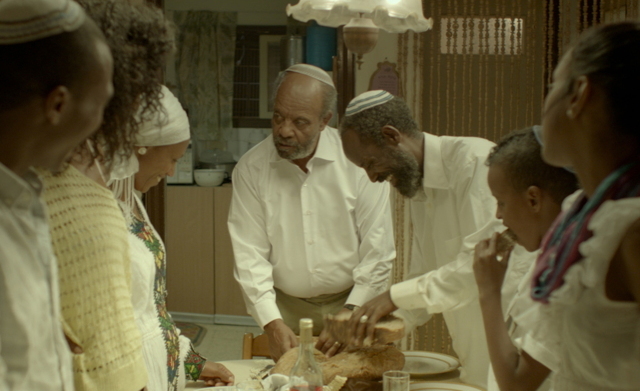
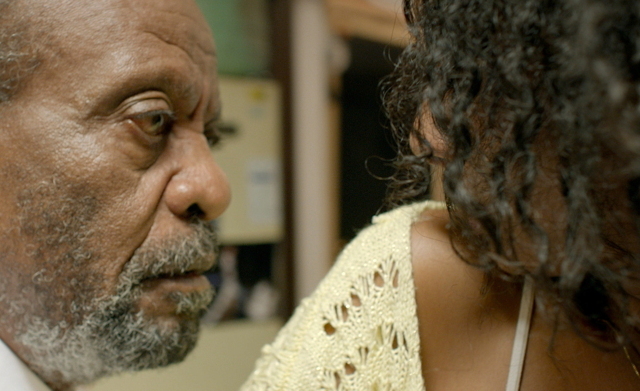
 Named Best First Film at the 2014 Jerusalem Film Festival, Bazi Gete’s Red Leaves is a compelling cinema-vérité-style tale of an Ethiopian Jewish family dealing with a very stubborn patriarch following the death of his wife. The film opens as a man tries to lead a goat to slaughter, an apt metaphor for what might become of seventy-four-year-old Meseganio Tadela (Debebe Eshetu), a solemn survivor of Sudan who suddenly tells his family that he has sold his home and will spend the rest of his life living with each of them in Tel Aviv. So he shows up unannounced at one son’s home, then another’s, leaving behind psychological wreckage that might never be undone. A stubborn man of few words, Meseganio is determined to preserve the old traditions in changing times that are quickly passing him by. His adherence gets him into trouble with his children and grandchildren, who have different priorities. Gete and cinematographer Edan Sasson use a handheld camera that puts the viewer at the Shabbat dinner table with the family as they playfully joke around with one another but afterward reveals Meseganio sitting by himself as everyone else goes on about their life without him. He can’t keep from interfering in his children’s lives, and he sticks his nose in various situations that turn volatile, from a confrontation with his granddaughter Bosna (Ruti Asarsai) to battles with his son Baruch’s (Meir Dassa) wife, Zehava (Hanna Haiela), and his other son, Moshe (Solomon Mersha). “Nothing to live for,” Meseganio’s friend Achenaf (Molla Megistu) says, but Meseganio has plenty to live for, if he would only recognize it. The final twenty minutes, and the wholly ambiguous ending, are heartbreaking and painful as the old man tries to find his way.