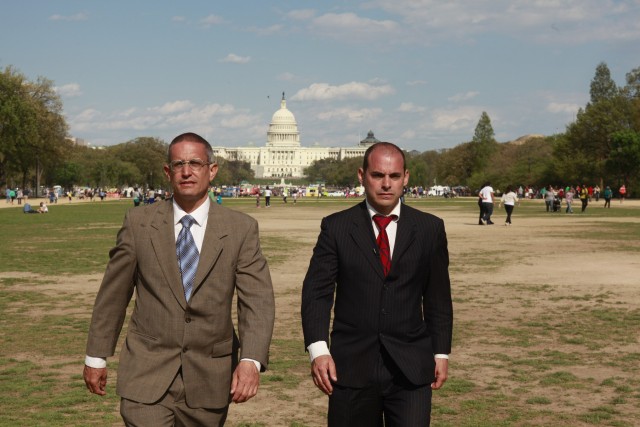
Andy Bichlbaum and Mike Bonanno travel the world calling attention to climate change in THE YES MEN ARE REVOLTING
THE YES MEN ARE REVOLTING (Laura Nix & the Yes Men, 2014)
IFC Center
323 Sixth Ave. at West Third St.
June 12-25
212-924-7771
www.ifccenter.com
theyesmenarerevolting.com
 Since 1999, culture-jamming pranksters Mike Bonanno (Igor Vamos) and Andy Bichlbaum (Jacques Servin) have been staging events to call attention to economic and environmental abuses perpetrated by big business and international governments, including Dow Chemical, the World Trade Organization, ExxonMobil, and BP. In their latest film, The Yes Men Are Revolting, the follow-up to 2003’s The Yes Men and 2009’s The Yes Men Fix the World, the daring, inventive activists find themselves facing a series of midlife crises, both personal and professional, particularly after one of their hoaxes goes embarrassingly awry. “Whenever we would do actions, I would always think, like, ‘This is the one that’s gonna change everything,’” a distraught Bichlbaum says in the film. “I would convince myself of that, and then afterwards there would be this huge depression, like, ‘Oh, we didn’t change everything.’” The action involving the presentation of a fake polar bear to an Amsterdam zoo might have failed, but it’s not long before Bonanno, who had moved to Scotland with his wife and children, and Bichlbaum, who was struggling to maintain a relationship with his boyfriend in New York City, are back together, fighting the good fight. The Yes Men Are Revolting follows the two men over the course of several years as they take on climate change, focusing on COP 15 and the partnership between Gazprom and Shell Oil, traveling from Zuccotti Park, Amsterdam, and Seattle to Uganda, Copenhagen, and Washington, DC, to call attention to the impact of Arctic drilling and polar ice cap melting on the future of the planet.
Laura Nix, who codirected the film with the Yes Men, goes behind the scenes as they construct their actions, hire actors to play media representatives and lobbyists, choose the wardrobe (and wigs), and build fake websites to help establish credibility. It’s amazing what they get away with and what people will believe — and it’s even funnier when they get caught (and sued). But at the heart of it all is a very real desire to, as their second film proclaimed, fix the world, while also maintaining their long friendship. The new movie begins with them on the Brooklyn shore, announcing the creation of the SurvivaBall, a ridiculous-looking giant costume that promises people protection from the elements “no matter what happens to the climate.” The Yes Men open the public’s eyes to so much infuriating corporate crime and corruption that you might just want to hide away in your own SurvivaBall, hoping and praying that things will get better. But don’t count on it. The Yes Men Are Revolting opens June 12 at the IFC Center, with the Friday-night screening part of the 2015 Human Rights Watch Film Festival, followed by a Q&A with Nix and the Yes Men, who on Thursday were in Columbus Circle, handing out free shaved-ice cones purportedly made from the melting polar ice cap. There will be a live video discussion with the Yes Men in person and Julian Assange after the 2:40 show on June 14, a Q&A with the Yes Men following the 8:25 shows on June 15 & 16, and a Q&A with editor Claire L. Chandler after the 8:25 screening on June 18.
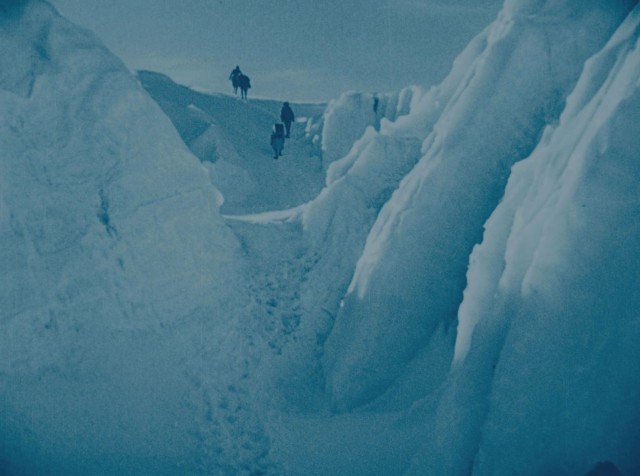
 In 1924, two British men, among the most famous mountaineers of their time, George Mallory and Andrew “Sandy” Irvine, set out with a large team to climb to the summit of Everest. Their amazing journey was documented by Captain John Noel, who used a hand-cranked camera with an impressive telephoto lens and sent the footage via yak to a lab in Darjeeling to be developed. The resulting black-and-white film, The Epic of Everest, is a poetic document of the third attempt to scale Everest, a mountain the Tibetans called “Chomo-Lung-Ma,” or Goddess Mother of the World. The eighty-seven-minute silent film has been digitally restored by the British Film Institute in a beautiful version that made its New York premiere last fall at the Rubin Museum and next will be shown June 13-14 at the Nitehawk Cinema as part of its ongoing Brunch Screenings series. The Epic of Everest, which is also ethnographically important for its (at times ethnocentric) depiction of local Tibetan culture, includes several scenes of Mount Everest tinted in blue, red, and violet; the ice-blue Fairyland section is especially breathtaking. Meanwhile, the restored intertitles display such dramatic text as “There is nowhere here any trace of life or man. It is a glimpse into a world that knows him not. Grand, solemn, unutterably lonely, the Rongbuk Glacier of Everest reveals itself.” and “Nor can one wonder at the invention that has clothed this extraordinary peak with a sacred character. What a terrifying thing it is! What an immensity of size, height and power it possesses!”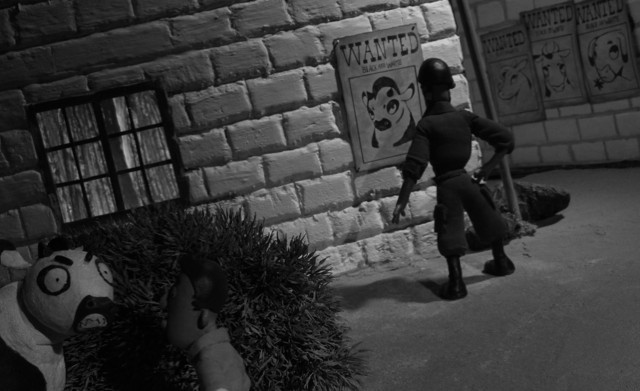
 The never-ending battle between Israel and the Palestinians is reduced to a single incident attempting to be a microcosm of the conflict in the relatively silly and uneven documentary The Wanted 18. In 1988, shortly after the first Intifada began, an Israeli kibbutz sold eighteen cows to the Palestinian town of Beit Sahour. As the small, tight-knit community rallied around the cows, seeing them as a crucial part to their goal of freedom and independence, the Israelis grew suspicious of the Palestinians’ growing self-sufficiency and declared the cows “a threat to the national security of the state of Israel.” Codirectors Amer Shomali, whose family came from Beit Sahour, and Canadian Paul Cowan (Going the Distance, Westray) tell the story of the fight over the cows through contemporary interviews, drawings, reenactments, archival footage, and stop-motion animation in which four of the cows share their thoughts on the matter: Rivka (voiced by Holly Uloth “O’Brien”), Ruth (Heidi Foss), Lola (casting director Rosann Nerenberg), and Goldie (Alison Darcy). The heavily one-sided tale delves into such issues as taxation, bigotry, boycotts, curfews, and civil disobedience, as people from Beit Sahour give first-person accounts of what happened, along with Ehud Zrahiya, who at the time was advisor to the Israeli military governor on Arab affairs. “We were concerned that Beit Sahour may become a model for other places,” Zrahiya admits. “We were certainly concerned that this might infect other places and would spread to other localities throughout the West Bank.”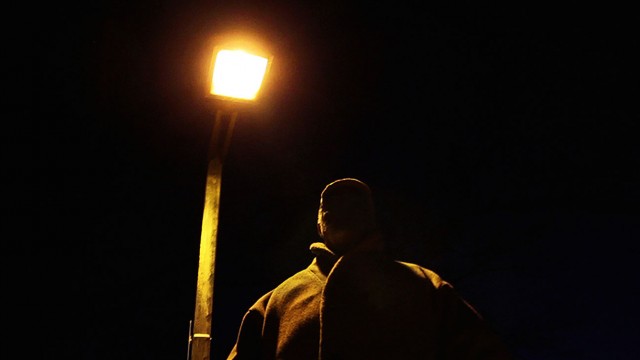
 (T)error is a great name for a horror movie, but even though it turns out that Lyric R. Cabral and David Felix Sutcliffe’s debut is not part of that genre, there still is plenty scary about it. Winner of the U.S. Documentary Special Jury Award for Break Out First Feature at Sundance, (T)error is a surprising look inside one aspect of the FBI’s counterterrorism program. Shortly after Saeed “Shariff” Torres, a friend and neighbor of filmmaker and photojournalist Cabral’s, suddenly disappeared, he contacted her, eventually letting her inside his secret career as a longtime FBI informant. A Muslim and former Black Panther revolutionary, the sixty-three-year-old school kitchen employee and father of a young son goes on camera as he takes on what he claims will be his final assignment, cozying up to a Pittsburgh man named Khalifa Ali Al-Akili, previously known as James Marvin Thomas Jr., who the FBI thinks might be involved in terrorist plots. It’s not exactly the most thrilling game of cat and mouse; Cabral and codirector Sutcliffe (Adama) follow Shariff as he goes about a lot of mundane business, arguing over how much money the FBI gave him, text-messaging back and forth with agents and his prey, examining Facebook pages, and Skyping with his son, whose face is blurred for protection. And Sharrif is not quite the kind of well-trained operative you read about in books or see in action-packed movies, making one wonder just what the FBI is thinking — and how it’s spending our money — especially after a major twist occurs about halfway through the film, turning everything around and inside out, providing a new vantage point that makes the whole sting operation even more bizarre and surreal. But it’s all too real, and rather frightening in its own very strange way. (T)error is screening June 14 at 9:00 at the IFC Center as part of the Human Rights Watch Film Festival, with Cabral and Sutcliffe participating in a Q&A with Human Rights Watch deputy Washington director Andrea Prasow. The festival runs June 11-21 at IFC, the Film Society of Lincoln Center, and the Times Center, featuring such other socially, culturally, and politically sensitive and important works as Marc Silver’s 3½ Minutes, Ten Bullets, Laurent Bécue-Renard’s Of Men and War, Laura Nix’s The Yes Men Are Revolting, and Joshua Oppenheimer’s The Look of Silence.

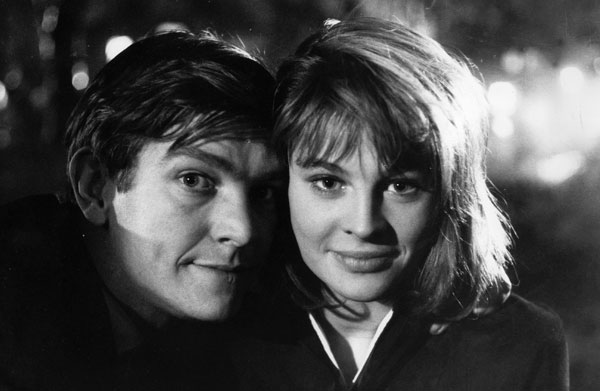
 Based on the novel by Keith Waterhouse (which he also adapted into a play with Willis Hall and which later became a musical), John Schlesinger’s Billy Liar is a prime example of the British New Wave of the 1950s and 1960s, which features work by such directors as Lindsay Anderson, Joseph Losey, Ken Russell, Nicolas Roeg, and Karel Reisz. Tom Courtenay stars as William Fisher, a ne’er-do-well ladies’ man who drudges away in a funeral home and dates (and lies to) multiple women, all the while daydreaming of being the president of the fictional country of Ambrosia. Billy lives in his own fantasy world where he can suddenly fire machine guns at people who bother him and be cheered by adoring crowds as he leads a marching band. Reminiscent of the 1947 American comedy The Secret Life of Walter Mitty, in which Danny Kaye dreams of other lives to lift him out of the doldrums, Billy Liar is also rooted in the reality of post-WWII England, represented by Billy’s father (Wilfred Pickles), who thinks his son is a no-good lazy bum. Shot in black-and-white by Denys Coop (This Sporting Life, Bunny Lake Is Missing), the film glows every time Julie Christie appears playing Liz, a modern woman who takes a rather fond liking to Billy. The film made Christie a star; Schlesinger next cast her in Darling, for which she won the Oscar for Best Actress. Billy Liar is screening on June 7 in the BAMcinématek series “Black & White ’Scope: International Cinema,” an eighteen-day, twenty-eight-film festival featuring 1950s and ’60s black-and-white films shot in CinemaScope. The series includes such other fab works as Andrzej Wajda’s Siberian Lady Macbeth, Frantisek Vlacil’s Valley of the Bees, Kaneto Shindo’s Onibaba, Jack Clayton’s The Innocents, and Masaki Kobayashi’s Samurai Rebellion.