Multiple locations
June 23-28, free – $1,500
www.nycpride.org
The theme for this year’s NYC Pride celebration is “Complete the Dream,” with nine events commemorating the Stonewall Riots of 1969 and dedicated to “a future without discrimination where all people have equal rights under the law.” The party begins with a free family screening of Finding Nemo on Tuesday night in Hudson River Park and continues with such annual traditions as the Rally, PrideFest, the March, and Dance on the Pier. The ticketed events are selling out fast, so you better act quickly if you want to shake your groove thang at some pretty crazy parties.
Tuesday, June 23
Family Night: Finding Nemo (Andrew Stanton, 2003), hosted by Miss Richfield 1981 and with remarks by the Family Equality Council, Pier 63, Hudson River Park, free, 8:30 pm
Friday, June 26
The Rally, with a live performance by Ashanti and others, Pier 26, Hudson River Park, free, 6:00 pm
Fantasy, with DJ sets by the Freemasons and Kitty Glitter, and special secret burlesque masquerade performances all evening long (in the home of Queen of the Night), the Diamond Horseshoe, 235 West 46th St., $29-$79, 10:00 pm – 5:00 am
Saturday, June 27
VIP Rooftop Party, with DJs Ben Baker, Saul Ruiz, Grind, and Cindel, Hudson Terrace, 621 West 46th St., $39-$500, 2:00 – 10:00 pm
Teaze, formerly known as Rapture on the River, exclusive party for women only, with DJs Ruby Rose, Sherock, and Whitney Day and Rich White Ladies, Pier 26, Hudson River Park at Laight St., general admission $25-$750, 3:00 – 10:00 pm
WE Party: University, Masterbeat dance party with DJs Sagi Kariv and Micky Friedmann, Hammerstein Ballroom, 311 West 34th St., $100-$1,500, 10:00 pm – 6:00 am
Sunday, June 28
PrideFest, street fair with music, food, merchandise, and live performances, Hudson St. between Abingdon Sq. & West 14th St., free, 11:00 am – 6:00 pm
The March, with more than four dozen floats and more than three hundred marching contingents, led by grand marshals J. Christopher Neal, Kasha Jacqueline Nabagesera, Sir Derek Jacobi, and Sir Ian McKellen, Lavender Line from 36th St. & Fifth Ave. to Christopher & Greenwich Sts., free, 12 noon
Dance on the Pier, with live performance by Ariana Grande and DJs Wayne G, Ralphi Rosario, and the Cube Guys, Pier 26, Hudson River Park at Laight St., $25-$1,500, 3:00 – 10:00 pm
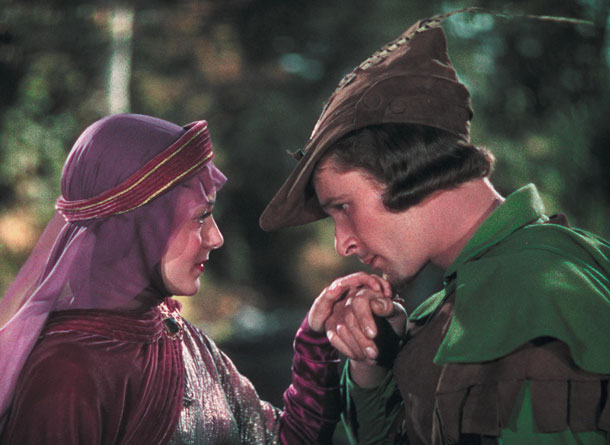
 With King Richard the Lionheart (Ian Hunter) off fighting the Crusades, his scheming brother, Prince John (Claude Rains), has taken over England, planning to become king with the help of the conniving Sir Guy of Gisbourne (Basil Rathbone) and the cowardly Sheriff of Nottingham (Melville Cooper). But one brave man stands in his way, “an impudent, reckless rogue who goes around the shire stirring up the Saxons against authority,” according to the Bishop of the Black Canons (Montagu Love). “And he has the insolence to set himself up as a protector of the people.” Sir Robin of Locksley (Errol Flynn), better known as Robin Hood, is fiercely loyal to King Richard and will do anything to preserve the sanctity of the throne and fight for the rights of the common people as he occupies Sherwood Forest with his band of merry men in tights, including Will Scarlet (Patric Knowles), Little John (Alan Hale Sr.), Friar Tuck (Eugene Pallette), and Much (Herbert Mundin). He also falls for the lovely Maid Marian (Olivia de Havilland), King Richard’s ward whom John promises to Gisbourne. Directed with appropriate flair and fanfare by Michael Curtiz (Casablanca, Mildred Pierce) and William Keighley (Each Dawn I Die, The Man Who Came to Dinner), The Adventures of Robin Hood is a rollicking romp through the famous legend, complete with exciting fight scenes, lots of male camaraderie, and just the right touch of romance. Flynn and de Havilland, who ended up making eight films together, are magnetic as Robin Hood and Maid Marian, a classic love story mired in life-threatening danger. There have been numerous versions of Robin Hood, starring such actors as Douglas Fairbanks, Russell Crowe, Kevin Costner, Patrick Bergin, Cary Elwes, and the voice of Brian Bedford, but there’s no Sir Robin quite like Flynn, who flits about with an endless supply of charm, humor, grace, and bravery. By the way, Marian’s horse, then known as Golden Cloud, was sold after the movie to Roy Rogers and was renamed Trigger, going on to have quite a career himself. Winner of Three Oscars (for art direction, editing, and original score — it lost Best Picture to Frank Capra’s You Can’t Take It with You) — The Adventures of Robin Hood is screening on June 22 at 4:30 as part of MoMA’s “Glorious Technicolor: From George Eastman House and Beyond” series, a celebration of the one hundredth anniversary of Technicolor, which continues through August 5 with such other delights as Vincente Minnelli’s Yolanda and the Thief, Roy Rowland’s The 5,000 Fingers of Dr. T. with George Pal’s And to Think That I Saw It on Mulberry Street, and Curtiz’s Sons of Liberty short with The Private Lives of Elizabeth and Essex.
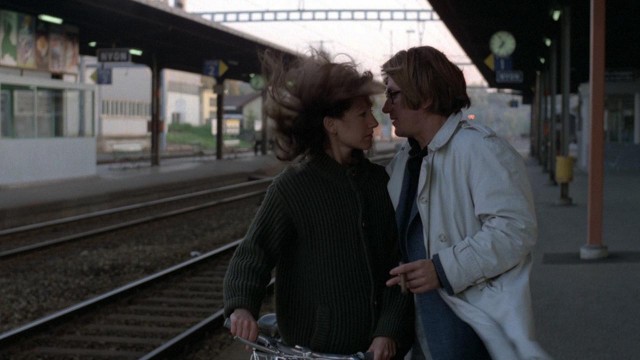
 In 1980, Jean-Luc Godard told journalist Jonathan Cott, “When you have a first love, a first experience, a first movie, once you’ve done it, you can’t repeat it,” the French auteur said about his latest film, Every Man for Himself, which he considered his “second first” film. “If it’s bad, it’s a repetition; if it’s good, it’s a spiral. It’s like when you return home — to mountains and lakes, in my case — you have a feeling of childhood, of beginning again. But in films, it’s very seldom that you have the opportunity to make your first film for the second time.” For Godard, whose real first film was 1960’s Breathless and who went on to make such other avant-garde masterworks as Contempt, Pierrot le Fou, Masculine Feminine, and Two or Three Things I Know About Her, Every Man for Himself might have been somewhat of a return to narrative, but only as Godard can do it. He still plays with form and various technological aspects, including a fascination with slow motion and an unusual, often very funny use of incidental music, and his manner of episodic storytelling would not exactly be called traditional. Sometimes it’s good, and sometimes it’s bad. Jacques Dutronc stars as mean-spirited, self-obsessed Swiss television director Paul Godard, who has recently broken up with his girlfriend, Denise Rimbaud (Nathalie Baye), who wants to leave their apartment in the city for the idyllic greenery of the country. (Yes, the characters have such names as Godard and Rimbaud, and the voice of Marguerite Duras shows up.) Paul then meets a prostitute, Isabelle Rivière (Isabelle Huppert), who is interested in Paul and Denise’s apartment, planning on bettering her life even as she still must submit to the whims of her clients, including a businessman who orchestrates a strange orgy that would make Secretary’s James Spader proud.
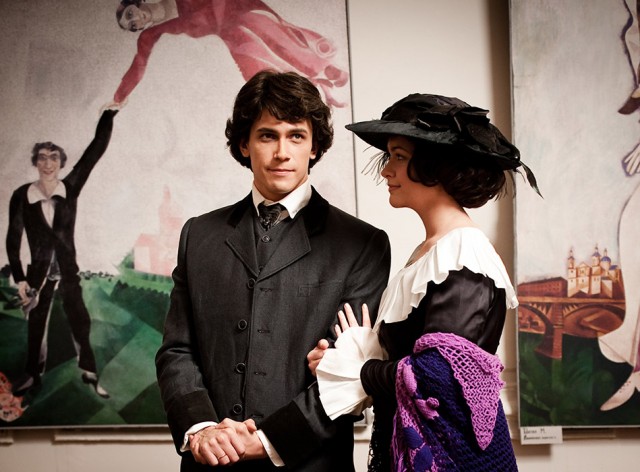
 For his first film in a dozen years, Russian writer-director Alexander Mitta tells the intriguing story of the little-known relationship between early modernist painter Marc Zakharovich Chagall and avant-garde Suprematist Kazimir Malevich. In 1917, Chagall (Leonid Bichevin), already a success in Paris, returns to his home in Vitebsk to marry his sweetheart, Bella Rosenfeld (Kristina Schneidermann), who is being wooed by their childhood friend, Naum (Semyon Shkalikov). Chagall initially wants to return to Paris with Bella and continue his burgeoning career, but with the onset of the Russian Revolution he decides that he will use the power of art to provide much-needed culture and creativity for the community, opening the Academy of Modern Art. Trouble ensues when he hires Malevich (Anatoliy Belyy) to teach there, as Malevich brings his own very different ideas about art and politics. Meanwhile, Naum, who is still in love with Bella, has become the Red Commissar, ruling Vitebsk with fear and violence. Made with the support of Chagall’s granddaughter, Meret Meyer Graber, a vice president of the Marc Chagall Committee, and inspired by his memoirs, Chagall-Malevich is a highly stylized, fanciful film, evoking the work of Wes Anderson (Rushmore, The Grand Budapest Hotel) and Michel Gondry (Eternal Sunshine of the Spotless Mind, The Science of Sleep); cinematographer Sergei Machilsky shot the movie in colors based on the paintings of Chagall and Malevich, set at sharp angles that can be both cool and disorienting. But Mitta’s (Lost in Siberia, My Friend, Kolka!) screenplay is far too sentimental and idealistic in its celebration of the brush over the gun. Chagall-Malevich might be beautiful to look at — Malevich’s bold geometric shapes are a wonderful foil for Chagall’s dreamscapes, and some of the more fantastical elements are rather funny — but the central plot is overly whimsical and often just plain silly, its palette lacking in subtlety and gradation. Chagall-Malevich opens June 12 at Cinema Village, with Schneidermann participating in a Q&A following the 7:30 show on Friday night.