Ron “Stray Dog” Hall takes his wife, and viewers, on a marvelous ride into the heart of America in Debra Granik’s charming documentary
STRAY DOG (Debra Granik, 2014)
Film Society of Lincoln Center, Elinor Bunin Munroe Film Center
144 West 65th St. between Amsterdam & Columbus Aves.
Opens Friday, July 3
212-875-5050
www.filmlinc.com
www.straydogthemovie.com
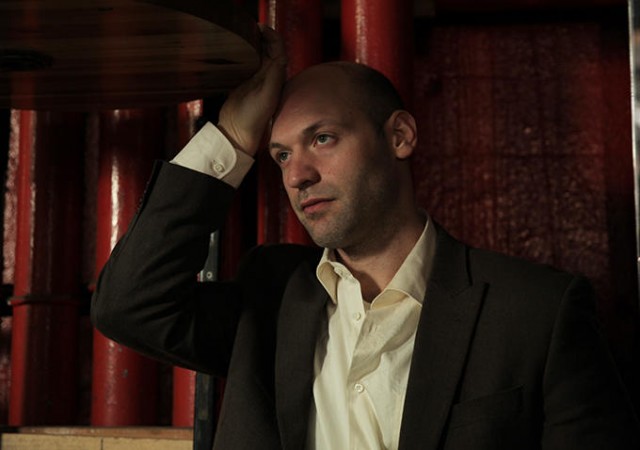
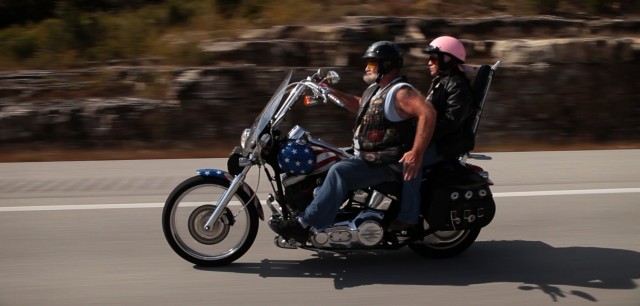
 Shortly after meeting Ron “Stray Dog” Hall at the Biker Church in Branson, Missouri, writer-director Debra Granik (Down to the Bone) cast the Vietnam vet as Thump Milton in her second feature, the Oscar-nominated Winter’s Bone. Upon learning more about him, she soon decided that he would be a great subject for a documentary, so she took to the road, following him across the country in the engaging and revealing Stray Dog. Nearly always dressed in black, including his treasured leather jacket covered in medals and patches — when he puts it in a suitcase for a trip, it’s a ritual like he’s folding the American flag — Hall is a wonderfully grizzled old man with a fluffy white beard. At home, he is learning Spanish online so he can communicate better with his new wife, Alicia, a Mexican immigrant, and her two sons (who still live across the border). He visits with his teenage granddaughter, who is making some questionable decisions about her future. In Missouri, he owns and operates the At Ease RV Park, where he gives breaks to fellow vets who can’t always afford to pay the rent. And when he goes on the road, participating in the Run for the Wall, joining up with thousands of other bikers heading for the annual service at the Vietnam Veterans Memorial in Washington, DC, he stops along the way at other ceremonies honoring soldiers who have gone missing, are POWs, or were killed in action in Vietnam, Iraq, Afghanistan, and other wars.
Hall is a gregarious, gentle man who people instantly flock to and gather around — a scene in which two of his cats sit on each of his knees is absolutely heartwarming — but he is also haunted by some of the things he did in Vietnam, suffering from nightmares that sometimes have him screaming out loud while sleeping in bed. And he wears one of his mottoes right on his arm: “Never Forgive Never Forget.” At one point he sits comfortably on a couch and says, “Just kind of being free, don’t hurt nobody, do what you want to do — a nice thing, ain’t it? You know, I’d rather live as a free man for a year than a slave for twenty.” Granik simply follows Hall as he experiences life with his surprisingly refreshing point of view; no one ever turns to the camera to make any confessions, and no talking heads are brought on board to evaluate what we’re seeing. Granik just lets this beautiful piece of Americana unfold at its own pace while also touching on such hot-button topics as immigration reform, gun control, the economic crisis, and PTSD, making no judgments as we follow the captivating exploits of a man who is part Buddha, part Santa, and all patriot. Stray Dog returns to Lincoln Center, where it was shown at the 2014 New York Film Festival, for a theatrical run beginning July 3 at the Francesca Beale Theater, with Granik participating in Q&As following the 6:45 screening on Friday and the 4:30 show on Sunday.
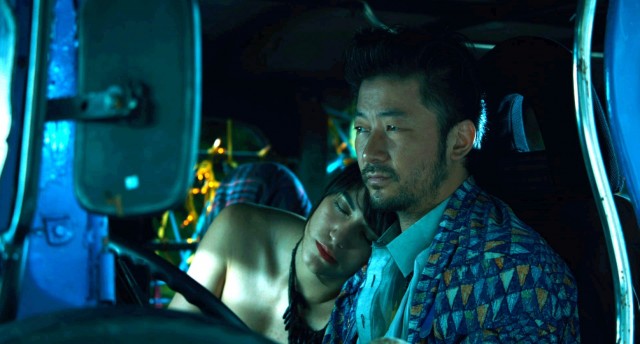
 If you’re in the mood for something very different at the fourteenth annual New York Asian Film Festival, look no further than Khavn de la Cruz’s Ruined Heart: Another Love Story Between a Criminal & a Whore. Expanding his fifteen-minute 2012 short, Khavn has created a visually arresting film that weaves its way through the gritty streets of an almost postapocalyptic Manila slum bursting with flashes of red, yellow, blue, and green. Using virtually no dialogue — the only words are from occasional poetry and several songs, and the very few times that characters speak, no translation is offered — Khavn tells the story of a Criminal (Japanese star Tadanobu Asano) on the run with a Whore (Mexican actress Nathalia Acevedo), attempting to get away from the Godfather (Filipino poet and playwright Vim Nadera). The multinational cast also includes the Friend (Andrew Puertollano) and the Lover (Russian-born actress Elena Kazan, who grew up in Berlin and now lives in Mumbai), but the real stars are Khavn’s mesmerizing score, Frances Grace Mortel’s art direction, Frances Soeder’s production design, Carlo Francisco Manatad’s frantic editing, and Christopher Doyle’s dizzying cinematography, which at times has Asano doing the camerawork himself as he runs through small passageways and back alleys.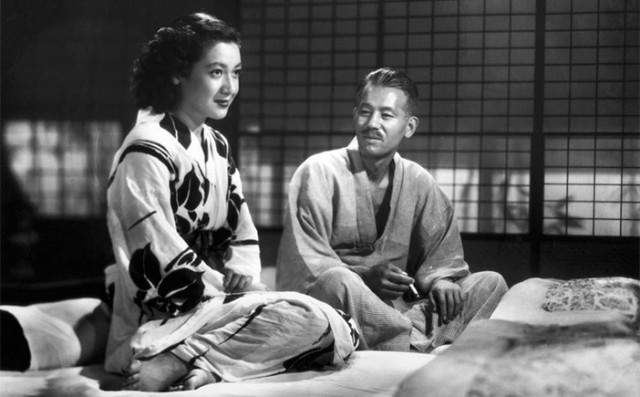
 Yasujirō Ozu’s Late Spring marked a late spring of sorts in the Japanese auteur’s career as he moved into a new, post-WWII phase of his long exploration of Japanese family life and the middle class. Based on Kazuo Hirotsu’s novel Father and Daughter, the black-and-white film, written by Ozu with longtime collaborator Kogo Noda, tells the story of twenty-seven-year-old Noriko (Setsuko Hara), who lives at home with her widower father, Shukichi Somiya (Chishu Ryu), a university professor who has carved out a very simple existence for himself. Her aunt, Masa (Haruko Sugimura), thinks Noriko should get married, but she prefers caring for her father, who she believes would be lost without her. But when Somiya starts dropping hints that he might remarry, like his friend and colleague Jo Onodera (Masao Mishima) did — a deed that Noriko finds unbecoming and “filthy” — Noriko has to take another look at her future. Late Spring is a masterpiece of simplicity and economy while also being a complex, multilayered tale whose every moment offers unlimited rewards. From the placement and minimal movement of the camera to the design of the set to the carefully choreographed acting, Ozu infuses the work with meaning, examining not only the on-screen relationship between father and daughter but the intimate relationship between the film and the viewer. Ozu, who never married, has a firm grasp on the state of the Japanese family as some of the characters try to hold on to old-fashioned culture and tradition while recovering from the war’s devastation and facing the modernism that is taking over.
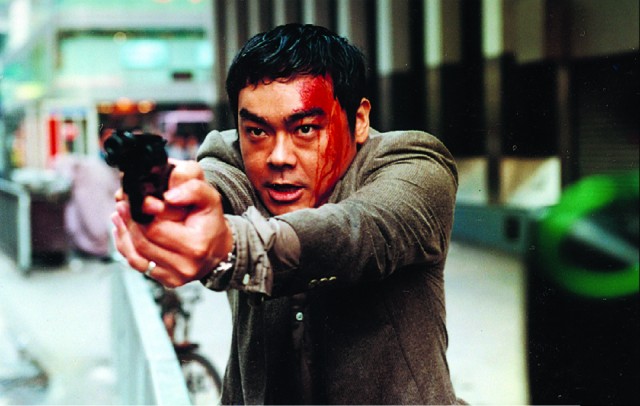
 The fourteenth annual New York Asian Film Festival is saluting legendary Hong Kong director Ringo Lam, presenting him with the Lifetime Achievement Award. Lam, who turns sixty this year, will be at Lincoln Center for screenings of two of his works, City on Fire on June 27 and Full Alert on June 28. In the latter, Lam’s follow-up to his disappointing Hollywood debut, the Jean-Claude Van Damme vehicle Maximum Risk, Lau Ching-wan stars as Officer Pao, a member of Hong Kong’s Special Crime Bureau who becomes involved in a case that turns deeply personal. After arresting explosives expert Mak Kwan (Francis Ng) for the brutal murder of an architect, Pao is determined to find the rest of Mak’s Taiwanese crew, which is led by mainland boss Jie (Jack Gao), and prevent the robbery of a mysterious vault. Pao and his team track Mak’s girlfriend, Chung Lai Hung (Amanda Lee), who knows more than she’s letting on, while Pao and Mak become immersed in a tense, psychological game of cat and mouse, exploring what it feels like to kill someone. There are numerous incredulous plot twists and a rather lame car chase, but the guerrilla filmmaking style of Lam and cinematographer Ardy Lam, ranging through the streets of a Hong Kong about to be handed over from the British to the Chinese, is supremely effective, as are the lead performances by Lau and Ng, evoking the relationships portrayed earlier by Robert De Niro and Al Pacino in Michael Mann’s Heat and later by Andy Lau and Tony Leung in Andrew Lau and Alan Mak’s Infernal Affairs. The use of mobile phones and surveillance technology feels much older than 1997, displaying how far we have come so fast. Lam saves the heavy violence for the spectacular finale, letting the emotions build before exploding. Nominated for five Hong Kong Film Awards, including Best Film, Best Director, and Best Actor (Lau), Full Alert is screening at the Walter Reade Theater on June 28 at 2:00, with Lam on hand to introduce it. The New York Asian Film Festival continues at Lincoln Center through July 6 with more than three dozen new and old films from China, Korea, Japan, the Philippines, Cambodia, and other Southeast Asian countries, including Sabu’s Chasuke’s Journey, Kinji Fukasuku’s Battles without Honor and Humanity, Im Sang-soo’s The President’s Last Bang, Wang Xiaoshuai’s Red Amnesia, Im Kwon-taek’s Revivre, and Sion Sono’s Tokyo Tribe.