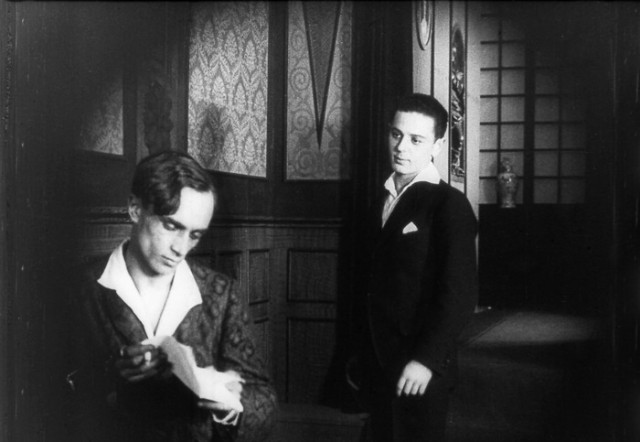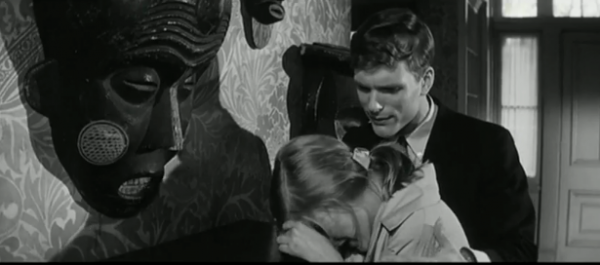
Stephen (Keir Dullea) tries to comfort his sister, Ann (Carol Lynley), in BUNNY LAKE IS MISSING
BUNNY LAKE IS MISSING (Otto Preminger, 1965)
Film Forum
209 West Houston St.
Sunday, September 20, $7, 5:30
212-727-8110
filmforum.org
 “I had heard all the rumors about Preminger, but I felt he wouldn’t do that to me. I was wrong, oh so wrong,” Keir Dullea told Foster Hirsch in the 2007 biography Otto Preminger: The Man Who Would Be King, referring to the making of the 1965 psychological noir thriller Bunny Lake Is Missing and Otto Preminger’s notorious treatment of actors. “I was playing a crazy character and the director was driving me crazy. . . . About halfway through the shoot, I began to wonder, Who do you have to f&ck to get off this picture?” On September 20, Dullea and Hirsch will be at Film Forum for a one-time-only screening of the fiftieth anniversary 4K digital restoration of Bunny Lake, which will be introduced by Dullea (2001: A Space Odyssey, David and Lisa) and followed by a Q&A with the actor, moderated by Hirsch. In the intensely creepy film, loosely based on the novel by Merriam Modell (under the pseudonym Evelyn Piper), Carol Lynley stars as Ann Lake, a young woman who has just moved to London from New York. She drops off her daughter, Bunny, for her first day of school, but when she returns later to pick her up, there is no evidence that the girl was ever there. When Superintendent Newhouse (Laurence Olivier) and his right-hand man, Sergeant Andrews (Clive Revill), begin investigating the case, they are soon wondering whether Bunny really exists, more than hinting that she might be a figment of Ann’s imagination.
Television veteran Lynley, who seemed on the verge of stardom after appearing in such films as Return to Peyton Place, Bunny Lake Is Missing, Shock Treatment, and The Poseidon Adventure but never quite reached that next level, gives one of her best performances as Ann, a tortured woman who is determined to stop her world from unraveling around her. Dullea is a model of efficiency as the cold, direct Stephen, a character invented by Preminger and screenwriters John and Penelope Mortimer. Shot in black-and-white by Denys N. Coop on location in London, the film also features cameos by longtime English actors Martita Hunt, Anna Massey, and Finlay Currie as well as the rock group the Zombies and Noël Coward, who plays Ann’s very kooky landlord, Horatio Wilson. Saul Bass’s titles, in which a hand tears paper as if the story is being ripped from the headlines, set the tense mood right from the start. The ending offers some neat twists but is far too abrupt. “No actor ever peaked with him. How could you?” Dullea added to Hirsch about Preminger (Laura, Stalag 17). “The subtlety that I felt I was able to give to my work in 2001, because Stanley Kubrick created a safe atmosphere where actors were not afraid to be foolish or wrong, was missing on Otto’s set. I don’t hate him; it’s too long ago. But the experience was the most unpleasant I ever had.” It should be quite fascinating to hear more from Dullea and Hirsch at Film Forum on September 20.

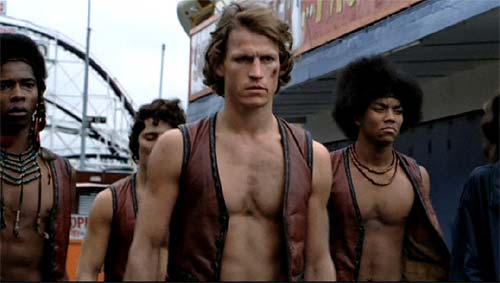
 In the classic cult film The Warriors, a Coney Island gang has to return home after a disastrous gathering in the Bronx. On September 13, many of the actors from the film will be returning to Coney as well for a special reunion screening taking place at Surf Pavilion on Stillwell Ave., including Michael Beck (Swan), Dorsey Wright (Cleon), David Harris (Cochise), Bryan Tyler (Snow), Thomas G. Waites (Fox), Terry Michos (Vermin), Deborah Van Valkenburgh (Mercy), Jery Hewitt (Furies leader Muson), Apache Ramos (of the Orphans), and others. The film opens at a huge gang meeting in the Bronx (actually shot in Riverside Park), where the Warriors are wrongly accused of having killed Cyrus (Roger Hill), an outspoken leader trying to band all the warring factions together to form one huge force that can take over New York City borough by borough. The Warriors then must make it back to their home turf, Coney Island, with every gang in New York lying in wait for them to pass through their territory. This iconic New York City gang movie is based on Sol Yurick’s novel, which in turn is loosely based on Xenophon’s Anabasis, which told of the ancient Greeks’ retreat from Persia. Beck stars as Swan, who becomes the de-facto leader of the Warriors after Cleon gets taken down early. Battling Swan for control is Ajax (James Remar) and tough-talking Mercy. Serving as a Greek chorus is Lynne (Law & Order) Thigpen as a radio DJ, and, yes, that young woman out too late in Central Park is eventual Oscar winner Mercedes Ruehl.