Warren Oates gets the starring role he always deserved in Sam Peckinpah’s dark, surreal tequila Western, BRING ME THE HEAD OF ALFREDO GARCIA
BRING ME THE HEAD OF ALFREDO GARCIA (Sam Peckinpah, 1974)
Nitehawk Cinema
136 Metropolitan Ave. between Berry St. & Wythe Ave.
Thursday, September 10, 9:30
718-384-3980
www.nitehawkcinema.com
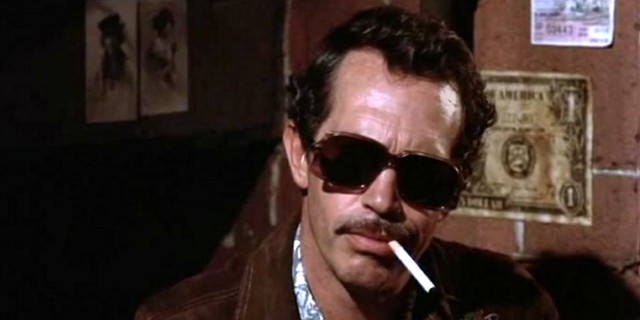
 Predictably, one of my freshman-year film classes featured weekly screenings of such all-time classics as Citizen Kane, The Godfather, and The Searchers. But when the professor assigned topics for our two papers that semester, he chose a pair of works he considered underrated, overlooked masterpieces. One was Nicholas Ray’s Bigger Than Life, in which James Mason plays a teacher overcome by a prescription drug addiction. The other was Sam Peckinpah’s Mexican cult favorite, the awesomely titled Bring Me the Head of Alfredo Garcia, which Williamsburg’s Nitehawk Cinema is presenting September 10 as part of its ongoing “One Nite Only” and “The Deuce” series. Befitting this crazy film, the evening promises prizes and surprises, a beer-infused after-party, and music by DJ Bones. Following his bitter experience with MGM over Pat Garrett and Billy the Kid, California native Peckinpah headed south to shoot a very strange tequila Western about an American loser making one last stab for love and wealth. Longtime sideman Warren Oates, who had previously appeared in Peckinpah’s Ride the High Country, Major Dundee, and The Wild Bunch, gets one of his only lead roles as Bennie, a down-on-his-luck former army officer now running a third-rate Mexico City bar and playing “Guantanamera” over and over again on the piano for tips. He is approached by a pair of dapper gentlemen, Sappensly (Robert Webber) and Quill (Gig Young), who need his help in locating a man named Alfredo Garcia, offering Bennie ten grand. What Bennie doesn’t know is that there is a one-million-dollar bounty on Garcia’s head put out by El Jefe (Emilio Fernandez), a warlord whose daughter, Theresa (Janine Maldonado), was knocked up by Garcia, a noted ladies’ man. As it turns out, Bennie’s girlfriend, a prostitute named Elita (Isela Vega), knows exactly where Garcia, a lover of hers as well, is buried, the recent victim of a fatal car accident. The film then turns into a violent and lurid road movie as Bennie and Elita encounter some extremely shady characters, including a couple of biker rapists (Kris Kristofferson and Donnie Fritts), a pair of locals also after Alfredo’s noggin, and Garcia’s family. All Bennie wants is to make some fast cash so he can take Elita away from all of this abject madness, but it’s not going to be nearly as easy as he expected, and a whole lot bloodier.
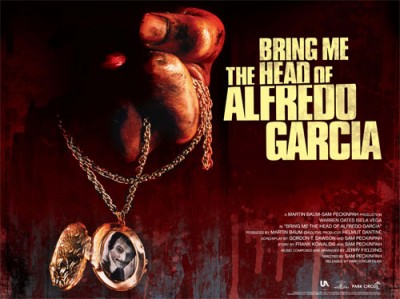
Bring Me the Head of Alfredo Garcia is an absolutely unforgettable film, featuring an absolutely unforgettable performance by Oates (Two-Lane Blacktop, Stripes), who is spectacularly seedy as Bennie, whether professing his love for Elita, trying to act suave in front of professional hit men, removing crabs from his genitals, or talking nonsense to a disembodied cranium. At one moment he is ever-so-cool, while the next he is a sweaty, pathetic derelict who just can’t catch a break. But you can’t help but love the poor schlemiel, even after he makes mistake after mistake. Garcia also has a decidedly feminist edge, depicting exceptional inner strength from Theresa and Elita. Peckinpah received total control over the film, with no studio people involved, and it shows, as he takes it places no suited executive would ever allow. “Hollywood no longer exists. It’s past history,” Peckinpah told Variety in October 1973 after having several films significantly cut and reedited by studios. “I’ve decided to stay in Mexico because I believe I can make my pictures with greater freedom here.” Peckinpah, who was battling the bottle at the time, also takes a shot at himself in the film when Bennie says, “You ought to be drunk in Fresno, California. This place is a palace.” The auteur, who made only fourteen feature films in his career — he got his start directing television series in the 1950s and ’60s, from Gunsmoke and The Rifleman to Zane Grey Theater and The Westerner — was born in Fresno in 1925; he died in Inglewood, California, in 1984 at the age of fifty-nine. Kentucky native Oates died in Los Angeles two years earlier at the age of fifty-three. But they each left behind quite a legacy, including this small gem, a bizarre, unusual, very dark and creepy Western that really, at its immense heart, is just a tender little tale of love and redemption.
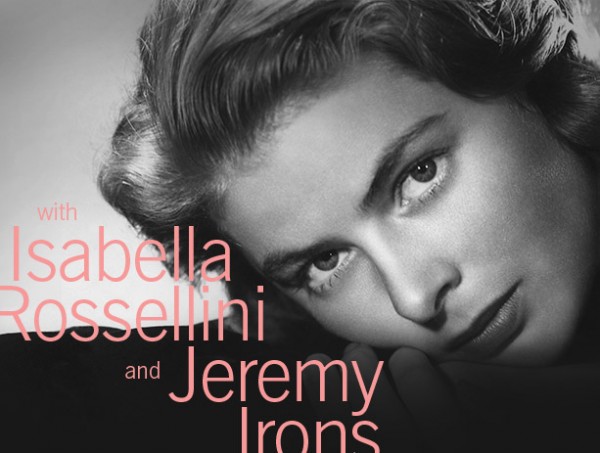
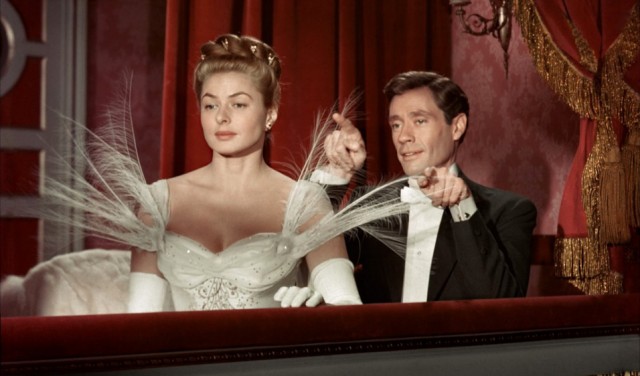
 MoMA’s “Ingrid Bergman: A Centennial Celebration” series includes several classic favorites featuring the immensely popular international star (Gaslight, Casablanca, Notorious), but the key to enjoying this festival lies in numerous lesser-known surprises. One of the most intriguing is the 1956 Jean Renoir “musical fantasy” Elena and Her Men, also known as Paris Does Strange Things. In this small gem of a film, Bergman plays Elena Sokorowska, a splendiferous Polish princess living the high life in fin de siècle Paris, quickly running out of money and strongly advised by her aunt to find a rich husband. After dispatching one lover, composer Lionel Villaret (Jean Claudio), the princess has a trio of suitors: the much older Martin-Michaud (Pierre Bertin), a stuffy, aristocratic shoe mogul; the heroic General François Rollan (Jean Marais, playing a character based on the real-life General Georges Boulanger), who is being celebrated on Bastille Day; and the playboy Count Henri de Chevincourt (Mel Ferrer), who instantly falls madly in love with her — and wishes to take her home the very day he meets her. It’s 1915, and the streets are filled with French men, women, and children singing the praises of General Rollan while wondering what will come next for the government, with talk of a coup and a dictatorship making the rounds. In the middle of it all is Princess Sokorowska, whose lavish charm beguiles nearly everyone she meets, except, of course, the general’s mistress, Paulette Escoffier (Elina Labourdette). As the men fight over her, the princess hands out daisies to bring various people good luck.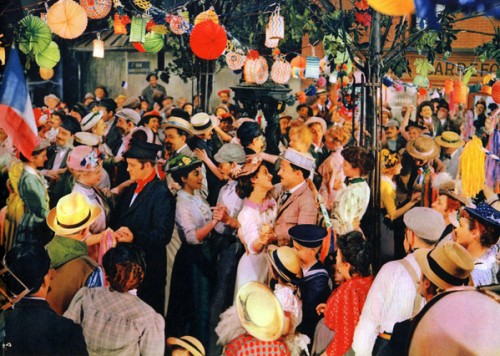
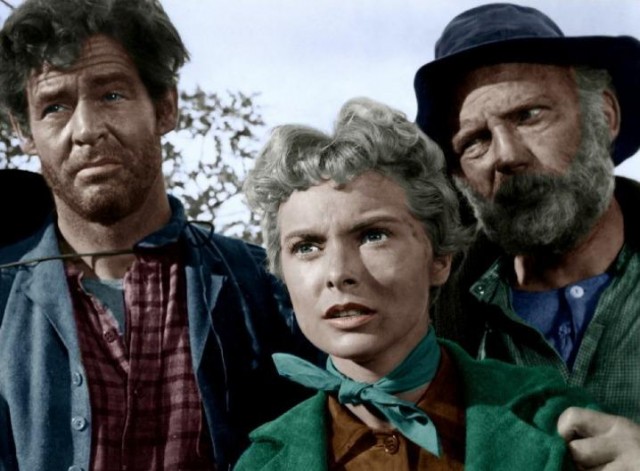
 Shortly after the Civil War, bounty hunter Howard Kemp (James Stewart) is determined to bring in wanted murderer Ben Vandergroat (Robert Ryan) and claim the reward. Joined by grizzled old prospector Jesse Tate (Millard Mitchell) and dishonorably discharged Union lieutenant Roy Anderson (Ralph Meeker), Kemp gets his man, along with Ben’s companion, the young Lina Patch (Janet Leigh), the daughter of Ben’s dead best friend. They tie up Ben’s hands, put him on a burro, and head out on the long, arduous trail to turn him over to the federal marshals. But the smug, wisecracking outlaw has other plans, continually planting various seeds to try to set Howard, Roy, and Jesse against one another. Directed by Anthony Mann (Winchester ’73, The Man from Laramie) and shot in the Rocky Mountains, The Naked Spur is not just another Western; it is a multilayered exploration of lust and greed, love and sexuality, with Lina at the center of it all. When Ben needs his sore back rubbed, he asks her, “Can you do me?” Roy thinks he can do anything he wants with any woman. And Howard can’t get over a part of his past, suffering from nightmares that haunt him. Unfortunately, the complex story is dragged down by overly conventional music — “Beautiful Dreamer”? Really? — and some ridiculously staged, hard-to-believe action scenes, but it’s still worth saddling up your horse and going along for the ride. The Naked Spur is screening September 5, 7, and 9 as part of the Anthology Film Archives series “Robert Ryan: An Actor’s Actor,” which continues with such other Ryan flicks as Daniel Mann’s About Mrs. Leslie, Nicholas Ray’s On Dangerous Ground, John Sturges’s Bad Day at Black Rock, Fred Zinnemann’s An Act of Violence, and Mann’s God’s Little Acre. Select screenings will be followed by a discussion with Cheyney Ryan, Robert’s son, and professor J. R. Jones, the author of the new book The Lives of Robert Ryan. A Dartmouth grad who was born in Chicago, Ryan was an outspoken civil rights activist who made more than fifty films during his thirty-plus-year career, which ended when he died of lung cancer in 1973 at the age of sixty-four.
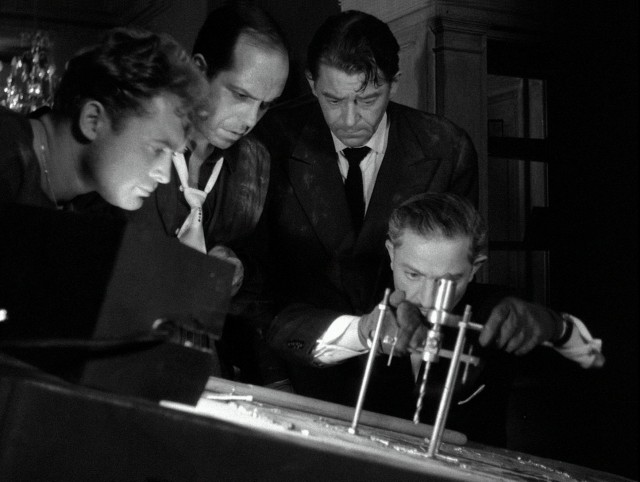
 After being blacklisted in Hollywood, American auteur Jules Dassin (The Naked City, Brute Force) headed to France, where he was hired to adapt Du Rififi Chez Les Hommes, a crime novel by Auguste le Breton that he made significant changes to, resulting in one of the all-time-great heist films. After spending five years in prison (perhaps not uncoincidentally, Dassin had not made a film in five years after Edward Dmytryk and Frank Tuttle declared him a communist to the House Un-American Activities Committee), Tony le Stephanois (Jean Servais) gets out and hooks up again with his old protégé, Jo le Suédois (Carl Möhner), who has settled down with his wife (Janine Darcy) and child (Dominique Maurin) for what was supposed to be a life of domestic tranquility. Joined by Mario Farrati (Robert Manuel), a fun-loving bon vivant with a very sexy girlfriend (Claude Sylvain), and cool and calm safecracker César le Milanais (Dassin, using the pseudonym Perlo Vita), the crew plans a heist of a small Mappin & Webb jewelry store on the Rue de Rivoli. Not content with a quick score, Tony lays the groundwork for a major take, but greed, lust, jealousy, and revenge get in the way in Dassin’s masterful film noir. The complex plan gets even more complicated as César falls for Viviane (Magali Noël), a singer who works at the L’Âge d’Or nightclub, which is owned by Pierre Grutter (Marcel Lupovici), who has taken up with Tony’s former squeeze, Mado (Marie Sabouret), and is trying to save his brother, Louis Grutter (Pierre Grasset), from a serious drug habit. (The club is named for Luis Buñuel’s 1930 film, which featured the same production designer as Rififi, Alexandre Trauner.)