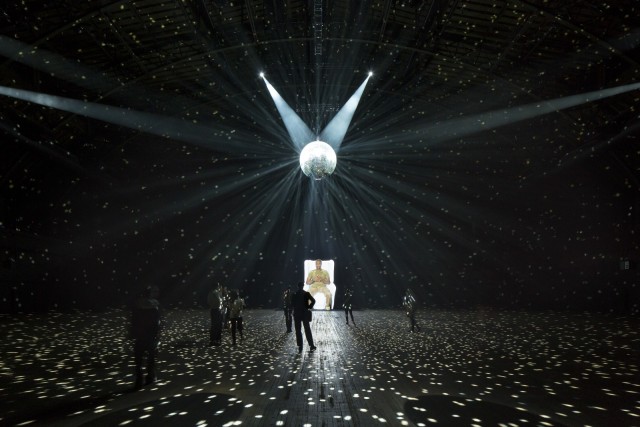
Laurie Anderson’s latest project is a dazzling immersive installation at Park Avenue Armory (photo by James Ewing)
Park Ave. Armory
643 Park Ave. between 66th & 67th Sts.
October 2-4, installation viewing $15 (12 noon – 7:00), concerts $45 (8:00)
212-933-5812
www.armoryonpark.org
habeas corpus slideshow
With “Habeas Corpus,” multimedia artist Laurie Anderson has taken a very serious topic, the seven-year incarceration of an innocent fourteen-year-old in Guantanamo, and turned it into a stunning celebration of freedom and the indomitability of the human spirit. In 2001, Mohammed el Gharani, a Chadian raised in Saudi Arabia, was arrested in Karachi while praying in a mosque a few days after September 11. He spent the next seven years being tortured in prison until lawyer Clive Stafford Smith and his Reprieve organization finally got him a trial, and U.S. District Court Judge Richard Leon granted his writ of habeas corpus and ordered his release in 2009. Anderson and el Gharani have collaborated on “Habeas Corpus,” an immersive audiovisual installation at Park Avenue Armory, but it’s about a lot more than just el Gharani’s grueling personal journey. “It’s a work about words, story, place,” Anderson said at a preview earlier this week. She pointedly noted that it asks the question “Where is America?” Near the back of the vast Wade Thompson Drill Hall, Anderson has built a sculpture that approximates the Lincoln Memorial, a giant white chair on which she has sculpted el Gharani’s body, as if his ghost is sitting there (while evoking the twelfth president, who delivered the Emancipation Proclamation). From October 2 to 4, a full-color el Gharani will be remotely projected onto the work from a studio in West Africa, where he lives; he is unable to be in New York in person because his imprisonment at Guantanamo bars his entry to the United States, despite his innocence. An amiable man who Anderson says “would make a great talk show host,” el Gharani will sit motionless in the chair every day from 12 noon to 7:00, projected live, but he will take a break once an hour, when prerecorded stories he tells about his time at Guantanamo will be shown, dealing with torture as well as developing close, important friendships.
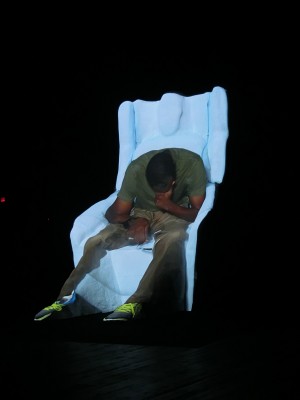
Mohammed el Gharani takes a moment while recalling his time at Guantanamo (photo by twi-ny/mdr)
Upon entering the hall, visitors step into a dark world lit by the glow of el Gharani in the chair as well as swirling lights emanating from a disco ball that causes immediate disorientation. Balance becomes precarious as you teeter toward the sculpture of el Gharani and the chair. But there’s also something exhilarating about it as you forge ahead through the loss of equilibrium. (Long strips of cardboard are provided if you need to take a seat or lie down, and you very well might have to.) Meanwhile, a droning guitar feedback score composed by Anderson’s late husband, Lou Reed, is played by his guitar tech, Stewart Hurwood, on a platform near the front that appears to be moving but is not, presenting yet another illusion, and nearby some of el Gharani’s words flash by on a wall like a ticker tape of memory and crackly snippets of military radio transmissions emanate from covered speakers. It all makes for a dizzying yet thrilling experience that delves into the nature of torture, identity, surveillance, borders, technology, personal responsibility, fighting injustice, and the very future of civilization. Make sure to allow yourself a few hours when you come to the armory in order to really absorb “Habeas Corpus”; walk around it (very carefully), contemplate its multiple meanings, meditate on its messages, and just enjoy the sheer spectacle of it. If you’re lucky, you might get a chance to walk right up to el Gharani and smile or wave at him, and he’ll smile and wave back; he’s been loving the direct interaction with the public. Also, look out for the cellist who occasionally wanders through the crowd, and that violin you hear just might be Anderson playing live, improvising with the cellist and Hurwood. Each night, Anderson will be joined by Syrian musician Omar Souleyman, Pakistani American performer Shahzad Ismaily, the Oakland-based Merrill Garbus (aka tUnE-yArDs), Hurwood, and surprise guests for what Anderson promises will be “a great dance party.” In addition, in the Mary Divver Room, el Gharani shares some of his stories in a short documentary, talking about his friend Shaker Aamer, the construction of Camp 5, how he taught himself English, and imploring Obama to keep his promise and close Guantanamo. He tells his tales very directly, not seeking sympathy or complaining about what happened to him but instead hopeful there will be positive change in the world. And Anderson’s “From the Air,” a monologue about her dog, Lolabelle, and 9/11, plays in the Colonel’s Room, projected onto miniature sculptures of chairs on which tiny versions of Anderson and her dog sit; the text (which is not the lyrics from her 1982 song of the same name) is also part of her new seventy-five-minute film, Heart of a Dog, which will screen at the New York Film Festival on October 8, with Anderson at the Walter Reade Theater to discuss the work.
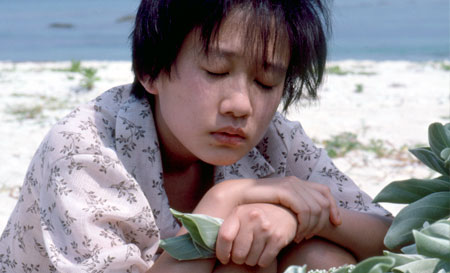
 Japan Society has picked a real gem for its October Monthly Classics presentation, writer-director Gō Takamine’s rarely shown wry black comedy, Paradise View. The thirtieth anniversary screening is also part of Japan Society’s three-month multidisciplinary program “Okinawan Vibes,” which takes a look at the southern island that was occupied by the American military from 1945 to 1972 and, in many ways, is not exactly Japan’s favorite relation; Okinawans, who have their own heritage of language, culture, and religion, have faced longtime discrimination as Japan’s largest minority group. The film opens with a gorgeous shot (the cinematographer is Takao Toshioka) of ant lover Reishu (yakuza actor Kaoru Kobayashi, not the executed child murderer) on a vast beach, collecting sea salt to make him feel better about life, which is rather bleak for everyone on Okinawa, especially now that the occupation is over. The married Reishu has apparently knocked up local simpleton Chiru (Japanese pop star Jun Togawa); island girl Nabee is breaking tradition by marrying a Japanese teacher, Ito; Bindalay (Yoko Taniyama) is quitting her music group, the Tropical Sisters, to go solo, while being stalked by a former boyfriend who dresses as a samurai; a blind man returns home after losing his second family in the Philippines; blue chickens and rainbow pigs roam the land; Reishu’s dog has developed a liking for goat balls, which make the mutt horny; and poisonous snakes are everywhere, from coffins to amphibious trucks. The wacky cast also includes Shinzoku Ogimi, Tomi Taira, and composer and musician Haruomi Hosono as the dude with the great porn stache. “The Japanese are strange creatures,” one ne’er-do-well says. An elderly woman soon laments, “We’ll all be Japanese soon,” after which the man adds, “I wonder if we’ll just end up as a backwater province.” There’s plenty of backwater strangeness in Okinawa, as short vignettes sweetly portray a collection of oddballs doing very odd things while also remaining intensely concerned about holding on to their souls. “I had a dream that a dog ate Reishu’s spirit, then threw it up. He’s lost his spirit! He’s been spirited away!” a deadpan Chiru says, capturing the essence of Okinawan native Takamine’s (Okinawan Dream Show, Untamagiru) brilliant love letter to his homeland. The Japan Society screening will be followed by a reception with Okinawan beer and snacks. The Monthly Classics film series continues on November 6 with Yoji Yamada’s The Yellow Handkerchief, in tribute to star Ken Takakura, who passed away last November at the age of eighty-three.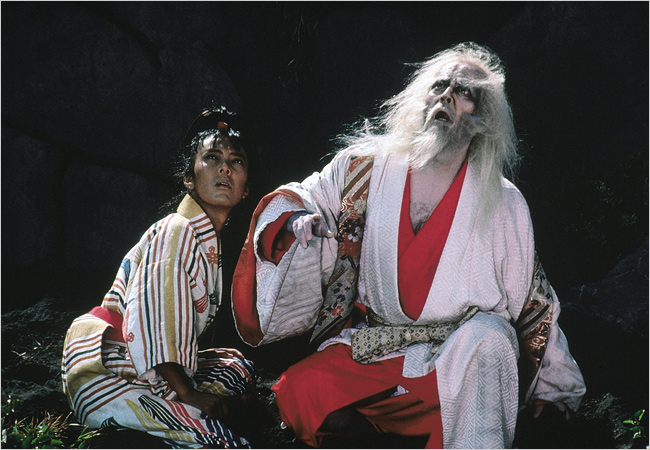
 Inspired by the story of feudal lord Mori Motonari and Shakespeare’s King Lear, Akira Kurosawa’s Ran is an epic masterpiece about the decline and fall of the Ichimonji clan. Aging Lord Hidetora (Tatsuya Nakadai) is ready to hand over his land and leadership to his three sons, Taro (Akira Terao), Jiro (Jinpachi Nezu), and Saburo (Daisuke Ryû). But jealousy, misunderstandings, and outright deceit and treachery result in Saburo’s banishment and a violent power struggle between the weak eldest, Taro, and the warrior Jiro. Hidetaro soon finds himself rejected by his children and wandering the vast, empty landscape with his wise, sarcastic fool, Kyoami (Peter), as the once-proud king descends into madness. Dressed in white robes and with wild white hair, Nakadai (