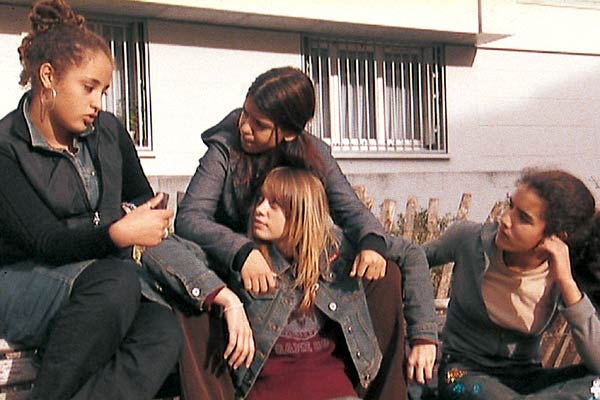
Teenagers argue over life and love in award-winning GAMES OF LOVE AND CHANCE
CINÉSALON: GAMES OF LOVE AND CHANCE (L’ESQUIVE) (Abdellatif Kechiche, 2003)
French Institute Alliance Française, Florence Gould Hall
55 East 59th St. between Madison & Park Aves.
Tuesday, October 20, $14, 4:00 & 7:30 (later screening introduced by Nicolas Bouchaud)
Series continues through October 27
212-355-6100
www.fiaf.org
FIAF’s CinéSalon series “Theater & Cinema” continues October 20 with Abdellatif Kechiche’s poignant 2003 drama, Games of Love and Chance. Winner of the César Award for Best Film, Best Director, Best Writing (Kechiche and Ghalia Lacroix), and Most Promising Actress (Sara Forestier), the film follows a group of teenagers, mostly of North African descent, in the housing projects of Seine-Saint-Denis as their everyday lives intersect with the play that is being put on in their French literature class, Marivaux’s 1730 romantic comedy, The Game of Love and Chance. In the class play, Forestier is Lydia, a bit of a diva who is portraying Lisette, a maid posing as a wealthy woman, opposite the always loud and angry Frida (Sabrina Ouazani), who is Silvia, a wealthy woman pretending to be a maid. Rachid (Rachid Hami) is initially Arlequin, but he is bribed out of the role by Krimo (Osman Elkharraz), who desperately wants to get close to Lydia. However, he has no real interest in acting, and no talent, which upsets their teacher (Carole Franck), who is looking forward to staging a quality show. Krimo’s pursuit of Lydia also creates more problems with his on-again, off-again longtime girlfriend, Magali (Aurélie Ganito), who believes the two are destined to be together no matter what. And when Krimo’s best friend, Fathi (Hafet Ben-Ahmed), gets involved, things threaten to get explosive. Kechiche, who also won the César for Best Director and Best Original Screenplay for The Secret of the Grain and the Palme d’Or for Blue Is the Warmest Colour, explores class distinction, teenage awkwardness, and artistic expression in the film, which is shot by Lubomir Bakchev primarily with a handheld camera and features powerful performances by the young cast. The differences between the language spoken in Marivaux’s play and the slang of the boys and girls in the hood can be a bit much at times, and the English subtitles are almost ridiculously outdated and stagy, but you’ll get used to it. Kechiche clearly has an eye for new talent; three of his five films featured young women who went on to win the César for Most Promising Actress (Forestier in Games of Love and Chance, Hafsia Herzi in The Secret of the Grain, and Adèle Exarchopoulos in Blue Is the Warmest Colour). Games of Love and Chance is screening in Florence Gould Hall on October 20 at 4:00 and 7:30; the later show will be introduced by actor and director Nicolas Bouchaud, who starred in The Exercise Was Beneficial, Sir at FIAF in May 2014. The series, highlighting films about theater, concludes October 27 with François Truffaut’s The Last Metro.
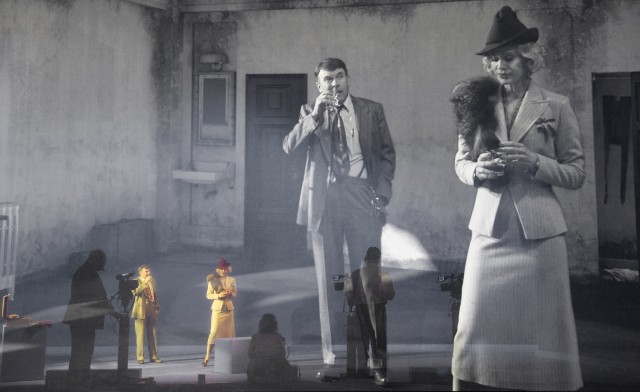
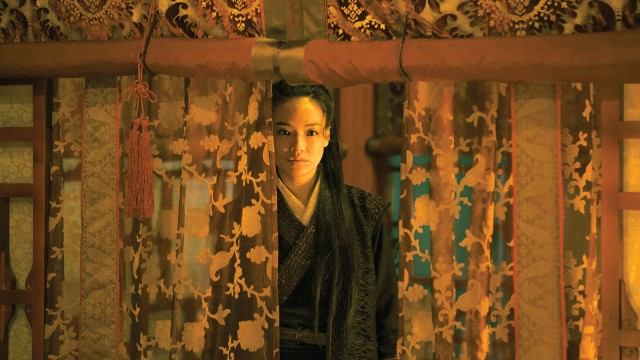
 Taiwanese master Hou Hsiao-hsien’s first film in eight years is a visually sumptuous feast, perhaps the most beautifully poetic wuxia film ever made. Inspired by a chuanqi story by Pei Xing, The Assassin is set during the ninth-century Tang dynasty, on the brink of war between Weibo and the Royal Court. Exiled from her home since she was ten, Nie Yinniang (Hou muse Shu Qi) has returned thirteen years later, now an expert assassin, trained by the nun (Fang-Yi Sheu) who raised her to be a cold-blooded killer out for revenge. After being unable to execute a hit out of sympathy for her target’s child, Yinniang is ordered to kill Tian Ji’an (Chang Chen), her cousin and the man to whom she was betrothed as a young girl, as a lesson to teach her not to let personal passions rule her. But don’t worry about the plot, which is far from clear and at times impossible to follow. Instead, glory in Hou’s virtuosity as a filmmaker; he was named Best Director at Cannes for The Assassin, a meditative journey through a fantastical medieval world. Hou and cinematographer Mark Lee Ping-Bing craft each frame like it’s a classical Chinese painting, a work of art unto itself. The camera moves slowly, if at all, as the story plays out in long shots, in both time and space, with very few close-ups and no quick cuts, even during the martial arts fights in which Yinniang displays her awesome skills. Hou often lingers on her face, which shows no outward emotion, although her soul is in turmoil. Hou evokes Andrei Tarkovsky, Akira Kurosawa, Ang Lee, and Zhang Yimou as he takes the viewer from spectacular mountains and river valleys to lush interiors (the stunning sets and gorgeous costumes, bathed in red, black, and gold, are by Hwarng Wern-ying), with silk curtains, bamboo and birch trees, columns, and other elements often in the foreground, along with mist, fog, and smoke, occasionally obscuring the proceedings, lending a surreal quality to Hou’s innate realism.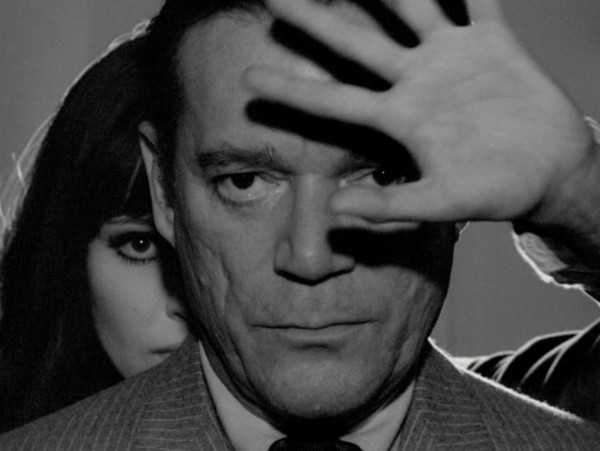
 “Sometimes, reality is too complex for oral communication. But legend embodies it in a form which enables it to spread all over the world,” a growly, disembodied, mechanical-like voice says at the beginning of Jean-Luc Godard’s futuristic sci-fi noir thriller, Alphaville: Une étrange aventure de Lemmy Caution. Godard’s 1965 black-and-white masterpiece takes place in an unidentified time period in a dark, unadorned, special-effects-free Paris. A tough-as-nails man in hat and trench coat named Lemmy Caution (Eddie Constantine) has arrived in Alphaville from the Outlands, claiming to be journalist Ivan Johnson, on assignment from the Figaro-Pravda newspaper. But his real mission is to first find fellow agent Henry Dickson (Akim Tamiroff), then capture or kill Alphaville leader and death-ray inventor Professor Vonbraun (Howard Vernon), the former Leonard Nosferatu. A Guadalcanal veteran who drives a Ford Galaxie, Caution — a character Constantine played in a series of films based on the novels of Peter Cheyney, including This Man Is Dangerous, Dames Get Along, and Your Turn, Darling — is a no-nonsense guy who takes nothing for granted. “All things weird are normal in this whore of cities,” he tells a blond seductress third class, who apparently comes with his hotel room. Documenting everything he sees with an Instamatic flash camera, Caution (perhaps a stand-in for Godard himself?) is soon visited by Natasha Vonbraun (Anna Karina), the professor’s daughter, setting off on an Orwellian journey through a grim city where poetry and emotion, and such words as “love,” “why,” and “conscience,” are banned in favor of “because” and “Silence. Logic. Security. Prudence,” where the hotel Bible is actually an ever-changing dictionary and enemies of the state are killed in swimming pools and pulled out by clones of Esther Williams, all overseen by a computer known as Alpha 60 (whose text, based on writings by Jorge Luis Borges, is eerily spoken by a man without a larynx, using a mechanized voice box).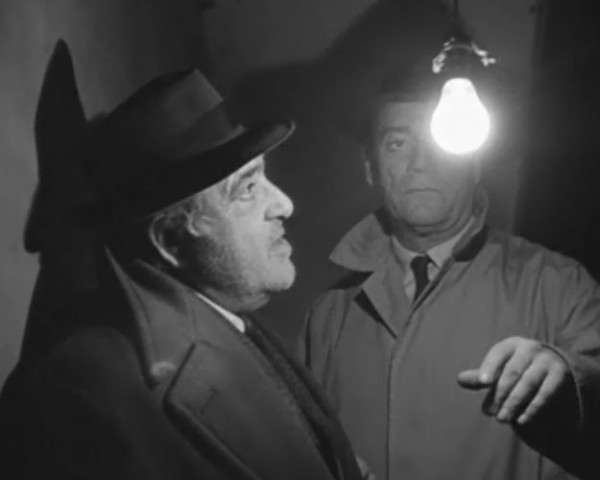
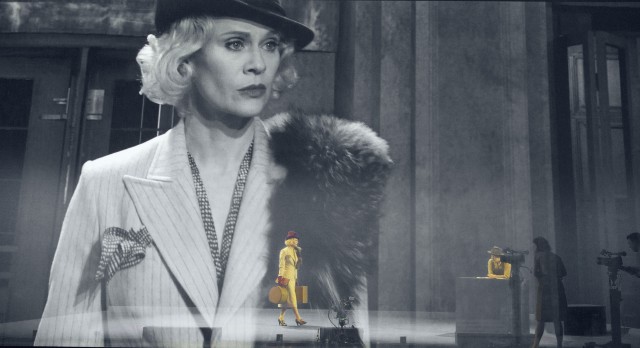
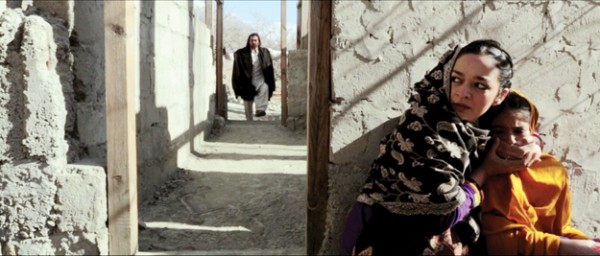
 Afia Serena Nathaniel’s Dukhtar is an important film in many ways, but it’s too bad it isn’t just a little bit better. A hit at festivals around the world and Pakistan’s submission for the Academy Awards, the Pakistan-U.S. coproduction deals with the very serious topic of women’s freedom. In modern-day Pakistan, two local tribal leaders, Daulat Khan (Asif Khan) and Tor Gul (Abdullah Jaan), are trying to end a generations-old Hatfield and McCoys-like battle. The elderly Tor Gul offers peace in exchange for Daulat Khan’s ten-year-old daughter, Zainab (Saleha Aref); he’ll take her as a wife, and the feud will end. But Daulat Khan’s own wife, Allah Rakhi (Samiya Mumtaz), who herself was forced to marry at the age of fifteen, decides that she does not want her daughter to live like that, so she and Zainab head out on the run, trying to escape the young girl’s fate. They are chased by Tor Gul’s vicious enforcer, Ghorzang Khan (Adnan Shah Tipu), as well as Daulat Khan’s brother, Shehbaz Khan (Ajab Gul), who is in love with Allah Rakhi. They hitch a ride with Sohail (Mohib Mirza) in his fabulously decorated truck, but Sohail soon realizes he is in deeper than he ever wanted to be as well. Inspired by a true story, Dukhtar features beautiful cinematography by Armughan Hassan and Najaf Bilgrami, showing off the lovely vast desert and mountain landscapes of Gilgit-Baltistan in northern Pakistan, and television veteran Mumtaz is riveting as a strong yet vulnerable woman who wants to change long-held traditions, to be a person rather than a thing, but the narrative feels choppy and too direct, telegraphing its themes, and the plot makes too many jumps and has too many holes. In her feature debut, writer, director, producer, and coeditor Afia has a gripping story to tell, but its power is muted by the more melodramatic aspects of this feminist road-trip thriller, which nonetheless has very touching and powerful moments.