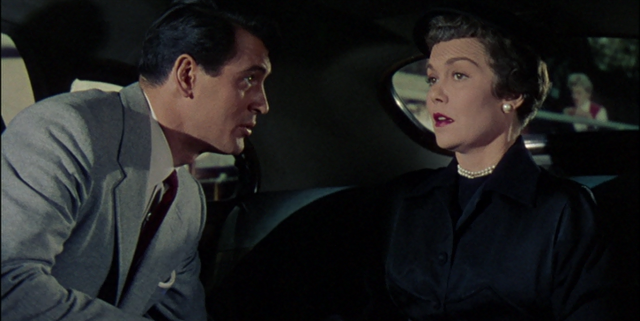
Rock Hudson and Jane Wyman star in Douglas Sirk’s gorgeous Technicolor melodrama MAGNIFICENT OBSESSION
MAGNIFICENT OBSESSION (Douglas Sirk, 1954)
ALL THAT HEAVEN ALLOWS (Douglas Sirk, 1955)
Film Society of Lincoln Center, Walter Reade Theater
165 West 65th St. between Eighth Ave. & Broadway
Magnificent Obsession: Thursday, December 24, 2:00, and Friday, December 25, 6:30
All That Heaven Allows: Thursday, December 24, 4:30, and Friday, December 25, 9:00
Series runs December 23 – January 6
212-875-5050
www.filmlinc.org
 Forget about It’s a Wonderful Life, Miracle on Thirty-Fourth Street, and endless versions of A Christmas Carol; our new favorite holiday movie is Douglas Sirk’s sensationally strange and beautiful All That Heaven Allows, and you can see it, along with the similarly sensationally strange and beautiful Magnificent Obsession, December 24 & 25 as part of the Film Society of Lincoln Center’s two-week, twenty-eight-movie retrospective “Imitations of Life: The Films of Douglas Sirk.” Released in 1954, Magnificent Obsession is a remake of John Stahl’s 1935 film, which starred Irene Dunne and Robert Taylor and was based on Lloyd C. Douglas’s book. In his breakthrough performance in the 1954 version, Rock Hudson is Bob Merrick, an errant playboy who gets seriously injured while recklessly racing his fancy speedboat. He is saved when the town’s only resuscitator is rushed over to him; however, it turns out that at the same time, a well-respected and beloved local doctor, Wayne Phillips, suffers a heart attack and dies because the resuscitator was being used for Merrick instead. Eventually riddled with guilt, Merrick attempts to befriend the doctor’s widow, Helen (an Oscar-nominated Jane Wyman), but only ends up making things worse when he helps cause an accident that blinds Helen. He then falls in love with her, which leads to a whole slew of other problems. The next year, Hudson and Wyman fell in love again in Sirk’s All That Heaven Allows. This time around, Hudson is Ron Kirby, a soft-hearted, hunky gardener who prefers a simple, outdoorsy life yet is drawn to Cary Scott (Wyman), an older widow who is firmly entrenched in her community’s country-club lifestyle. They begin a passionate affair but when they decide to wed, Cary’s children and the snooty members of the town’s social register are thoroughly appalled and do everything in their power to drive them apart because of class, wealth, and age differences.
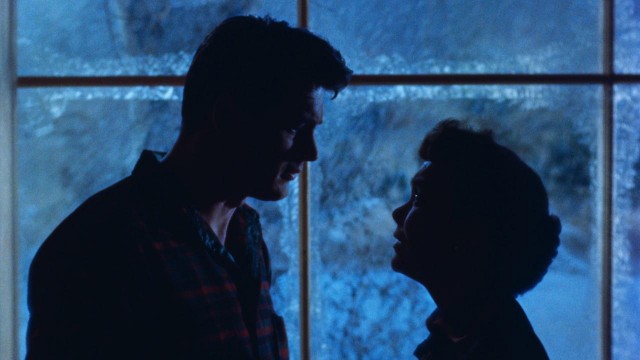
Rock Hudson and Jane Wyman star in Douglas Sirk’s gorgeous Technicolor melodrama ALL THAT HEAVEN ALLOWS
Magnificent Obsession and All That Heaven Allows have intriguing similarities and critical differences that go far beyond their stars and main plot points. The two Technicolor melodramas both feature romances between Hudson and Wyman, but age only plays a part in the latter, with Hudson made to look younger and Wyman older than they actually were. (At thirty-seven, Wyman was a mere eight years older than Hudson in real life.) Wyman is a widow in both pictures, Hudson a bachelor with his choice of young blondes. Agnes Moorehead plays Helen’s friend and nurse in Magnificent Obsession and Cary’s best friend in All That Heaven Allows. In Magnificent Obsession, Helen’s stepdaughter, Joyce (Barbara Rush), takes an immediate dislike to Merrick, while in All That Heaven Allows, Cary’s kids, high schooler Kay (Gloria Talbott) and college student Ned (William Reynolds), find their mother’s impending marriage to Kirby disgusting and distasteful, preferring she marry Harvey (Conrad Nagel), a plain, sexless widower. In 1950s America, women were still subservient to the needs of men and to raising their children, not permitted by society to lead their own lives and make decisions for themselves, especially when it comes to their sexuality. Each picture also features an essentially nonreligious belief system that is embodied by the Hudson character; in Magnificent Obsession, Merrick learns of a secretive, pay-it-forward philosophy with New Testament overtones, while in All That Heaven Allows, Kirby is inspired by the writings on naturalism and the true meaning of success espoused by Henry David Thoreau in Walden. Indeed, the outside world is central to both films; Sirk and his longtime cinematographer, Russell Metty, let the camera linger on trees, lakes, snow banks, and deer. Flowers abound indoors and out, and windows always look out on beautiful scenery, as if paintings, accompanied by Frank Skinner’s equally lush scores and Bill Thomas’s colorful costumes.
It all makes for the kind of candy-coated America that David Lynch turned upside down and inside out in Blue Velvet and that directly influenced Todd Haynes’s 2002 Sirk homage, Far from Heaven, in which white Connecticut housewife Cathy Whitaker (Julianne Moore), who is married to a closeted white executive (Dennis Quaid), becomes perhaps too friendly with her black gardener (Dennis Haysbert), a melding of All That Heaven Allows and Imitation of Life. (At one point in All That Heaven Allows, Kirby talks about how his best friend learned to be his own man. “And you want me to be a man,” Cary says. “Only in that one way,” Kirby responds, playfully looking over at Cary; it’s as if Hudson is teasing her about his real-life sexuality.) People’s double nature is reflected throughout both films, as Sirk and Metty use fireplace screens, windshields, mirrors, and even a television set to create physical separation between two characters as well as the inner and outer parts of the same character. In addition, there is a vast array of ties, cravats, scarves, ascots, bow ties, and other articles of clothing that everyone wears around their necks in both films, as if their true feelings are always being choked and hidden. They’re both magnificent films, richly textured and multilayered, not nearly as cynical and tongue-in-cheek as some claim them to be, making for an outstanding double feature for Christmas (although you have to pay separate admission for each). After watching these two masterful works of art, you’ll become obsessed with Sirk (if you’re not already), so be sure to come back for plenty more; the series includes a wide range of Sirk’s films, from such other Sirk/Hudson collaborations as Written on the Wind, Battle Hymn, Captain Lightfoot, The Tarnished Angels, and Taza, Son of Cochise to such Sirk favorites as Imitation of Life, A Time to Love and a Time to Die, and There’s Always Tomorrow, with such stars as Barbara Stanwyck, George Sanders, Ann Sheridan, Charles Boyer, Claudette Colbert, Scatman Crothers, Lauren Bacall, and Jack Palance as Attila the Hun (in Sign of the Pagan).




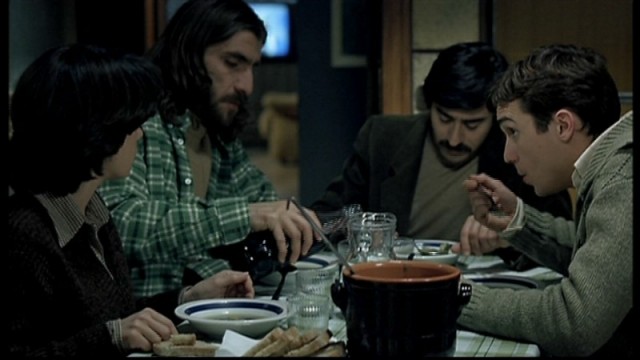
 Italian auteur Marco Bellocchio reimagines the kidnapping of Aldo Moro from the inside in Good Morning, Night, a taut, slow-paced drama that won the Little Golden Lion at the 2003 Venice Film Festival. Moro, a former Italian prime minister and president of the Christian Democratic Party, was boldly grabbed by members of the radical Red Brigades, who left a bloody mess in their wake. Bellocchio focuses on the three men and one woman who orchestrated the plot and kept Moro locked in a hidden room inside their large rented apartment. While Mariano (Luigi Lo Cascio), Ernesto (Pier Giorgio Bellocchio), and Primo (Giovanni Calcagno) take turns guarding Moro and Mariano spews Socialist rhetoric at him, Chiaras (Maya Sensa), who is Primo’s girlfriend but is pretending to be Ernesto’s wife as a cover, goes to work every day, buys supplies and newspapers, and dreams at night of Moro coming to her as a father figure. Chiaras is the moral conscience of the movie, and a complete invention on the part of Bellocchio, who has said, “I’m not interested in the factual truth.” Even so, much of the real story is still not known, and like the JFK assassination, there are lots of conspiracy theories out there about an event that shocked a nation. Pink Floyd fans get a bonus by Bellocchio’s powerful use of “The Great Gig in the Sky” and “Shine On You Crazy Diamond.” Good Morning, Night is screening on December 5 and 16 as part of the MoMA series “Italian Film, 21st-Century Style: A Tribute to Rai Cinema,” a two-week retrospective that consists of ten films from the last fifteen years released by the Italian studio, including Ermanno Olmi’s Il Mestiere delle armi (The Profession of Arms), Gianni Amelio’s Le Chiavi di casa (The Keys to the House), Emanuele Crialese’s Terraferma, and