Laurie Anderson has created a three-minute version of HEART OF A DOG that will be shown every night in January in Times Square — along with a special concert performance for dogs on January 4
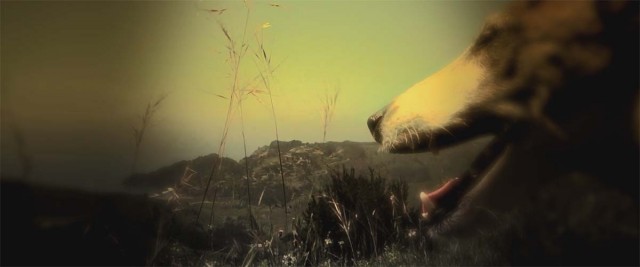
Multidisciplinary performance artist Laurie Anderson has created a special three-minute version of her latest film, the poetic and deeply personal Heart of a Dog, that will be shown every evening from 11:57 pm to 12 midnight on fifteen signs throughout Times Square as part of the monthly Midnight Moment program, which turns the Crossroads of the World into an enormous digital art gallery courtesy of the Times Square Advertising Coalition and Times Square Arts. Her first full-length film since 1986’s Home of the Brave,Heart of a Dog, which is about the death of her beloved rat terrier, Lolabelle, and the loss of her husband, Lou Reed, has been shortlisted for the Best Documentary Feature Oscar; for Midnight Moment, Anderson has edited it down to a visual collage from a section about consciousness and The Tibetan Book of the Dead. “I love Times Square. It’s a dream,” Anderson said in a statement. “Desire, speed, the explosions of color, patterns and energy. What a great way to start the New Year! The ball drops and Heart of a Dog leaps onto all those massive screens at three minutes to midnight. Who could have predicted the unraveling dreams of my dog would be magnified up there like this? And sound too!” On January 4, Anderson will present the free, one-time-only “Midnight Moment Concert for Dogs,” a performance being held in honor of 9/11 first-responder canines; from 11:00 to 11:15 pm in Duffy Square, silent-disco headphones will be distributed to the public on a first-come, first-served basis. The audience will include dogs from the NYPD, MTA, and other city agencies, along with their handlers; the public is encouraged to bring their dogs as well. At 11:30, the concert will begin, broadcast through the headphones in addition to low-decibel speakers for the dogs. At 11:57, the three-minute version of Heart of a Dog will be shown, just as it will be every night in January. It should be another fascinating work from Anderson, who continues to test the boundaries of art, music, and film time and time again.
Restoration of Orson Welles’s CHIMES AT MIDNIGHT is playing special engagement at Film Forum
CHIMES AT MIDNIGHT (FALSTAFF) (Orson Welles, 1965)
Film Forum
209 West Houston St.
January 1-19
212-727-8110 filmforum.org
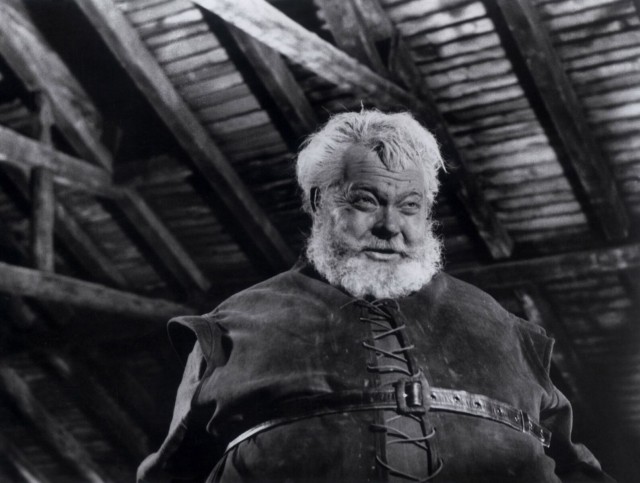
“Jesus, the days that we have seen,” Justice Shallow (Alan Webb) says to Sir John Falstaff (Orson Welles) several times at the beginning of Chimes at Midnight, as the two old friends walk through a snowy forest. “We have heard the chimes at midnight,” Falstaff replies. Welles’s career as a writer, director, and actor in theater, television, radio, and film was fraught with conflict as budget problems, scheduling issues, and fights with producers led to a slew of unfinished projects and works edited against his wishes. Welles might have achieved his legendary status with such classic films as Citizen Kane, The Magnificent Ambersons, and Touch of Evil, but his own personal favorite was the 1965 black-and-white Chimes at Midnight (aka Falstaff). Welles spent decades working on his unique retelling of the story of the big, bawdy Sir John, attempting various stage productions before finally making the film in Spain in 1964-65. The script was adapted from Shakespeare’s Henry IV, Parts 1 and 2, Richard II, Henry V, and The Merry Wives of Windsor, with historical narration by Sir Ralph Richardson from the sixteenth-century Holinshed’s Chronicles. Welles is both boisterous and sad as Falstaff, a larger-than-life braggadocio who is both friend and father figure to Hal (Keith Baxter), the Prince of Wales, whose father, Henry IV (Sir John Gielgud), gained the throne by murdering Richard II. Hal would rather cavort with Ned Poins (Tony Beckley), Falstaff, and Falstaff’s rogue circle, which includes Pistol (Michael Aldridge), Bardolph (Patrick Bedford), and Peto, than serve the king at the castle. Meanwhile, Richard II’s supporters, led by the Earl of Worcester (Fernando Rey), Henry Percy, known as Hotspur (Norman Rodway), and the Earl of Northumberland (José Nieto), plot to take back the crown. Much of the film is set in the Boar’s Head Tavern, which is run by the elderly Mistress Quickly (Margaret Rutherford) and where Falstaff engages with prostitute Doll Tearsheet (Jeanne Moreau). Everything comes crashing together during the Battle of Shrewsbury, one of the most exciting, breathtaking battle scenes ever filmed, a nearly ten-minute spectacle of fierce fighting interlaced with Falstaff’s comic bumbling and concluding with Hal and Hotspur’s climactic face-off.
Lines are drawn for classic battle after the Earl of Northumberland (Fernando Rey) meets with Prince Hal (Keith Baxter) and King Henry IV (Sir John Gielgud) in CHIMES AT MIDNIGHT
Chimes at Midnight, which Welles called his “greatest film ever,” is one of the grandest Shakespeare adaptations ever committed to celluloid, a staggering achievement despite all of the usual roadblocks in Welles’s way, including limited time with the actors (resulting in many pick-up shots of stand-ins for Gielgud and others, seen from the back — Welles has boasted about one scene in particular in which seven actors are all played by stand-ins), continual funding dilemmas (to the point where Welles convinced one producer that he was actually making Treasure Island), location issues, and poor audio dubbing (with Welles sometimes providing the dialogue for other characters; even the great Fernando Rey’s voice is dubbed in by someone else because of the Spanish actor’s strong accent). Welles plays Falstaff with a gluttonous lust for life that is intoxicating and infectious, even as his certain fate nears, echoing Welles’s personal life and professional career. “What is difficult about Falstaff, I believe, is that he is the greatest conception of a good man, the most completely good man, in all drama,” Welles explained about the role, which he called “the most difficult part I ever played,” one he performed onstage, on film, and even on The Dean Martin Show. “He was a spokesman, you might say, for Merrie England, the old Merrie England of May mornings and midsummer eves, when even villainy was innocent,” Welles added. “The film was not intended as a lament for Falstaff, but for the death of Merrie England. . . . It is more than Falstaff who is dying. It’s the old England, dying and betrayed.” Cinematographer Edmond Richard (The Trial, The Discreet Charm of the Bourgeoisie) gets right up close to Welles, exploiting his massive face and girth, while shooting other scenes from a distance, using a depth of focus that highlights the loneliness of the king in empty, shadowy rooms as he ponders his future; Richard makes the scenes in the tavern feel almost claustrophobic, concentrating on low angles and swirling movement. Baxter, who is eerily reminiscent of Anthony Perkins (Perkins, who had previously starred in Welles’s adaptation of Kafka’s The Trial, actually wanted the role, but Welles had already promised it to Baxter, who performed it onstage as well), plays Hal with a childlike delight until things start getting serious during and after the intense, mind-blowing Battle of Shrewsbury, which directly influenced such films as Braveheart and Saving Private Ryan and is still as powerful as ever. In many ways, Chimes at Midnight is the culmination of Welles’s career as a writer, director, actor, and producer, his last fiction film to be released theatrically. “If I wanted to get into heaven on the basis of one movie, that’s the one I would offer up,” he said. “I think it’s because it is to me the least flawed; let me put it that way. It is the most successful for what I tried to do. I succeeded more completely in my view with that than with anything else.”
The film has been little seen over the decades, in part because of rights issues as well as the quality of the available prints. But in honor of its fiftieth anniversary and the centennial of Welles’s birth, a beautiful digital restoration of Chimes at Midnight, more than twenty years in the making (courtesy of Janus Films and the Criterion Collection), is now touring the country, screening January 1-12 at Film Forum. “There is no film we have waited longer for or worked harder to free up, and none we are prouder to present,” Criterion president Peter Becker recently told Wellesnet. Chimes at Midnight, in which Welles’s daughter, Beatrice, also appears, now looks better than ever, as if it’s a brand-new film, earning reconsideration as the masterpiece it truly is. And there’s more to come, as work continues on a full 4K restoration and preservation that, Becker noted, will take years to complete. The film, which won the Grand Technical Prize at Cannes and a Twentieth Anniversary Prize for Welles, takes on new meaning all these years later, knowing what became of Welles and his legacy. It’s very much a film about family, friendship, loyalty, and aging; even though Welles was only forty-nine at the time he made the film, he was already considered old and past his prime. This new restoration of Chimes at Midnight, however, shows the film to be an ageless classic, Welles firmly at the height of his estimable powers. (Baxter will be at Film Forum on January 6 to introduce the 7:30 screening and participate in a Q&A after.)
Matthew (Michael Pitt), Isabelle (Eva Green), and Theo (Louis Garrel) frolic in their own erotic fantasy world during the 1968 Paris riots in THE DREAMERS
THE DREAMERS (Bernardo Bertolucci, 2003)
Videology Bar & Cinema
308 Bedford Ave.
Saturday, January 2, $5, 12 midnight
718-782-3468 videologybarandcinema.com
Bernardo Bertolucci’s sexiopolitical look at Paris in the tumultuous year of 1968 focuses on three individuals: Matthew (Dawson Creek’s Michael Pitt), a shy American studying in France; Theo (French heartthrob Louis Garrel), a cigarette-smoking oh-so-French moody lad; and Isabelle (Penny Dreadful’s Eva Green), Theo’s “twin” who likes to walk around naked and flirt with both Matthew and Theo. The trio acts out scenes from films, plays dangerously erotic games, and drinks a lot of wine as the outside world comes crashing down around them. Green (Casino Royale, Kingdom of Heaven) is mesmerizing in her film debut, Pitt (Funny Games, Seven Psychopaths) reveals that he has few shortcomings, and the NC-17 rating is sure to attract an interesting crowd. And look out for a cameo appearance by Jean-Pierre Léaud playing himself. This is Bertolucci’s third film set in Paris, following The Conformist and Last Tango in Paris, and it’s another winner. (Bertolucci, who is now seventy-four, has made only one film since The Dreamers, the 2012 Italian drama Me and You.) The Dreamers is screening at midnight on January 2 at Videology in Brooklyn; future midnight screenings include Carlos Reygadas’s Post Tenebras Lux on January 15, Harmony Korine’s Trash Humpers on January 16, Ken Russell’s Lisztomania on January 22, and Pier Paolo Pasolini’s epic Salò, or the 120 Days of Sodom on January 29-30.
Zhang Jinsheng (Zhang Yi) shows his love for Shen Tao (Zhao Tao) in materialistic ways in Jia Zhangke’s MOUNTAINS MAY DEPART
MOUNTAINS MAY DEPART (SHAN HE GU REN) (Jia Zhangke, 2015)
MoMA Film, Museum of Modern Art
11 West 53rd St. between Fifth & Sixth Aves.
Friday, January 1, 7:30
Series runs through January 15
Tickets: $12; may be applied to museum admission within thirty days, same-day screenings free with museum admission, available at Film and Media Desk beginning at 9:30 am
212-708-9400 www.moma.org
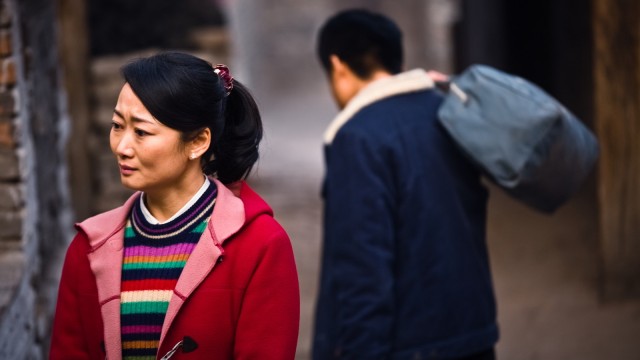
Master Chinese writer-director Jia Zhangke returned to the New York Film Festival this year with Mountains May Depart, a melancholic look at love and relationships in which one decision can change the rest of your life, as well as an allegory about China itself and its path in the world. Jia’s wife and muse, Zhao Tao, stars as Shen Tao, a flighty, flakey young woman flirting with coal miner Liangzi (Liang Jin Dong) and burgeoning capitalist Zhang Jinsheng (Zhang Yi) in 1999 China, the country on the cusp of an economic crisis. It’s easy to see the young woman’s romantic decision as a microcosm of China’s economic decisions, as the working class battles the wealthy elite, and the effects of both are profound. The setup is reminiscent of the love triangle at the center of François Truffaut’s Jules et Jim, but Jia takes it much further, continuing the story in 2014, and then into 2025, a bleak future where individual happiness is painfully elusive. Jia (Still Life, The World, 24 City) and his longtime cinematographer, Yu Lik-wai, shoot the three time periods in different screen ratios, exemplifying how much things evolve as Chinese capitalism and globalism take over, affecting — and disaffecting — the next generation. But the past is always snapping at the characters’ heels; much of the film takes place in the Yellow River basin, where ancient structures recall China’s history, and in Jia’s vision of the future, vinyl LPs are back in fashion (although handheld devices are much cooler). Music plays a key role in the film, primarily Sally Yeh’s Cantonese song “Take Care” and the Pet Shop Boys’ cover of the Village People’s “Go West,” the latter a title that gets to the heart of the film.
Mia (Sylvia Chang) takes stock of her complicated life in MOUNTAINS MAY DEPART
Zhao is marvelous as the bittersweet Shen, from singing at the colorful Fenyang Spring Festival Gala as the new millennium approaches to trying to restore her relationship with her son (Dong Zijian), who her husband insisted be named Dollar. Her eyes are filled with emotion as she proceeds on a course that was never what she dreamed. In the third section, Sylvia Chang shines as Mia, a sensitive, divorced teacher from Hong Kong who grows close to Dollar in a future world in which English has eclipsed Chinese, so fathers and sons literally do not speak the same language. Navigating the four physical sufferings of Buddhist thought — birth, old age, sickness, and death, Jia avoids showing many key moments in the lives of the characters, often leaving it up to the audience to uncover what has happened over the years and decades, which has a certain grace, although the ambiguous ending is more than a bit frustrating, even if it makes sense as a parable for China as a whole. But it’s all encapsulated in the briefest of kisses in a helicopter that will both brighten and break your heart. And keep an eye out for the guy with the Guangdong Broadsword. Mountains May Depart is screening January 1 at 7:30 in MoMA’s annual series “The Contenders,” which consists of films the institution believes will stand the test of time; the festival continues through January 15 with such other 2015 works as George Miller’s Max Mad: Fury Road, David Robert Mitchell’s It Follows, Michael Moore’s Where to Invade Next, and John Crowley’s Brooklyn.
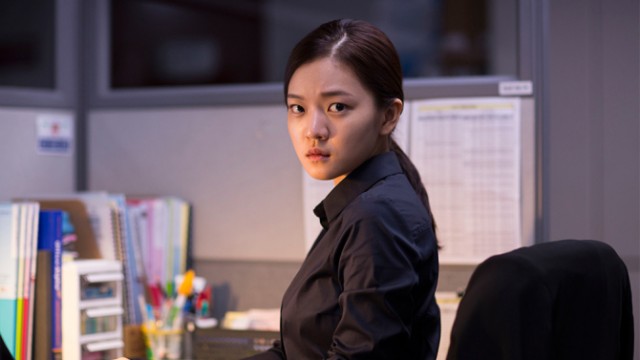
A lowly intern (Ko Ah-sung) discovers some strange goings-on in Hong Won-chan’s OFFICE
OFFICE (오피스) (OPISEU) (HUA LI SHANG BAN ZU) (Hong Won-chan, 2015)
Museum of the Moving Image
35th Ave. at 36th St., Astoria
Sunday, January 3, $12 (includes gallery admission), 4:30
Series runs January 1-10
718-777-6800 www.movingimage.us
Following its prestigious midnight film screening at Cannes this past May, Hong Won-chan’s debut feature, Office, was the opening-night selection of the 2015 New York Korean Film Festival in November at the Museum of the Moving Image. If you missed it then, you have another chance to see it in Queens on January 3, as it is one of eight films that comprise the museum’s “Curators’ Choice” series, its annual survey of some of the best films of the year. In the contemporary thriller, written by Choi Yun-jin (Steel Cold Winter), Seoul salaryman Kim Byung-Guk (Bae Seong-woo) calmly comes home from work one night and butchers his family with a hammer. The next morning, Detective Jong-hoon (Park Sung-woong) arrives at the office with plenty of questions, but no one has much to say about the killer, who was part of sales team #2 — although they are clearly hiding something. Only frazzled, insecure, wide-eyed intern Lee Mirae (Ko Ah-sung), who had a friendly relationship with Kim, wants to tell the truth, but she keeps her mouth shut, harassed by her boss (Ryu Hyun-kyung) and director Kim (Kim Eui-sung). When it is discovered that the murderer returned to the office after committing his vicious crime and may still be in the building, the tension ramps up, as does the body count.
Hong, who has written such films as Confession of Murder and The Chaser, does a good job skewering the work environment and office politics, a world of identical cubicles where personal lives and relationships take a backseat to the drive to succeed at all costs, even with a killer on the loose, and nearby. “All organizations are the same,” Detective Jong-hoon tells Mirae. “Even us police. . . . It’s all pointless.” Mirae, effectively played by Ko (Snowpiercer,The Host) with a tentative charm, represents the average Korean worker who tries her best but seems doomed never to take that next step onto the fast track. Fraught with concern over Kim’s whereabouts, she is also threatened by the hiring of another, highly competitive intern, Da-min (Son Su-hyun), who is much better liked by everyone. The narrative grows confusing as it jumps back and forth between the present and the past, and there are plot holes that require viewers to make various leaps of faith, but Office is still an intriguing, sharp-looking mystery with a handful of cool shocks and scares that might make you wonder who in your office could be capable of completely flipping out one day. Office is screening January 3 at 4:30; the series, programmed by chief curator David Schwartz and associate film curator Eric Hynes, includes such other cool films as Laurie Anderson’s Heart of a Dog, Hou Hsiao-hsien’s The Assassin, Olivier Assayas’s Clouds of Sils Maria, and Stevan Riley’s Listen to Me Marlon.
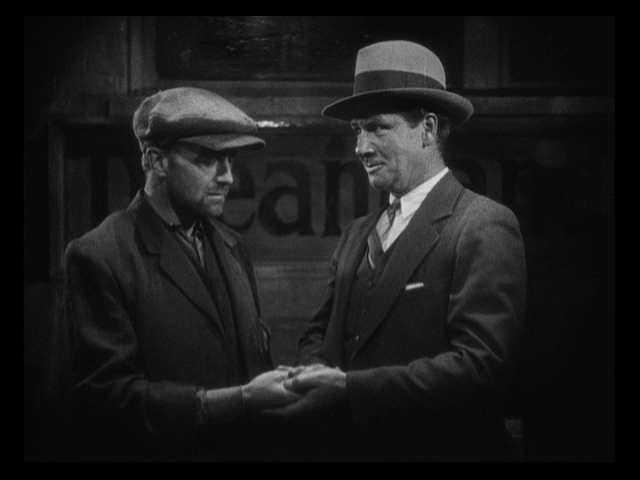
Bull Weed (George Bancroft) offers Rolls Royce (Clive Brook) a new life in Josef von Sternberg’s UNDERWORLD
UNDERWORLD (Josef von Sternberg, 1927)
MoMA Film, Museum of Modern Art
11 West 53rd St. between Fifth & Sixth Aves.
Friday, January 1, 4:00
Series runs January 1-17
Tickets: $12, may be applied to museum admission within thirty days
212-708-9400 www.moma.org
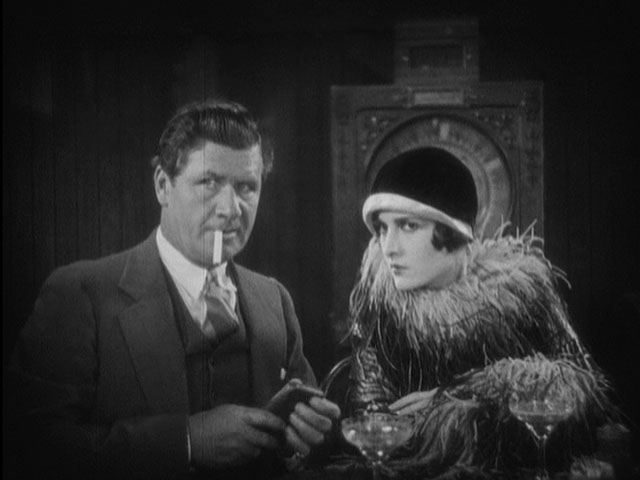
Throughout the year, MoMA shows “Modern Matinees” at 1:30 on many weekday afternoons, treating visitors with an afternoon to spare to some amazing “deep cuts” from its vast cinema library. “Modern Matinees: The Film Library Grows” is its current series, celebrating the eightieth anniversary of the Department of Film and honoring the legacy of founding curator Iris Barry. It concludes December 31 with William A. Wellman’s classic gangster picture, The Public Enemy. But as a treat for those who can’t get away for a weekday afternoon screening, MoMA is now bringing back some of its favorites in “Modern ‘Matinees’: Fashionably Late,” presenting the films at more convenient times, including on holiday and weekend afternoons and weekday evenings. “Fashionably Late” begins January 1 at 4:00 with Josef von Sternberg’s 1927 silent black-and-white Underworld, which is generally considered the first modern gangster picture and was a major influence on such films as The Public Enemy and Mervyn LeRoy’s Little Caesar, the latter scheduled for January 1 at 7:00. Sternberg’s fourth film, Underworld is set in “a great city in the dead of night. . . . streets lonely, moon-flooded. . . . buildings empty as the cliff-dwellings of a forgotten age.” The opening shot is of a superimposed clock, emphasizing that it is two o’clock in the morning, a time when most are tucked safely in their bed at home. But not Bull Weed (George Bancroft), who has just pulled off a bank heist, only to be spotted by Rolls Royce (Clive Brook), a down-on-his-luck drunken bum. At Bull’s hangout, the Dreamland Café, his girl, Feathers (Evelyn Brent), enters, and a single strand from her extravagant getup floats down, the camera following it until it is grabbed by Rolls Royce, who is sweeping the floor. Bull’s main rival, Buck Mulligan (Fred Kohler), tries to get the attention of Feathers, upsetting his own moll, Meg (Helen Lynch). Walking out of the nightclub, Bull is greeted by an electronic billboard proclaiming, “The City Is Yours.” (Howard Hawks goes one better in his seminal 1932 film, Scarface, in which the title character, Antonio “Tony” Camonte, played by Paul Muni, is encouraged by an electronic sign that tells him, “The World Is Yours.”) Laughing, Bull playfully asks Feathers, “What’ll you have?” She scoffs at him, then Rolls Royce, a former lawyer, says, “Attila, the Hun, at the gates of Rome.” To which Bull replies, “Who’s Attila? The leader of some wop gang?” The stage has been set for the rest of the film, built around jealousy and envy as both Buck and Rolls Royce, who Bull decides to rehabilitate, fall hard for Feathers, but Bull is not about to just sit back and take it.
Bull Weed (George Bancroft) is protective of his moll, Feathers (Evelyn Brent), in classic gangster picture
Underworld is an expressionist noir melodrama that became the template for the gangster-film genre, launching many of the major tropes, from characterization to narrative development. It’s shot in shadowy glory by Bert Glennon (Lloyd’s of London, Rio Grande) from the dark streets to a glamorous annual armistice ball and a spectacular shootout finale. Journalist, novelist, and playwright Ben Hecht (Notorious, Wuthering Heights), who based Bull on real-life Chicago criminal “Terrible” Tommy O’Connor, won the Best Writing (Original Story) Academy Award at the first Oscars; Robert N. Lee wrote the screenplay, with the adaptation by Charles Furthmann and titles by George Marion Jr. Von Sternberg went on to make such classic sound films as The Blue Angel, Shanghai Express, Blonde Venus, and The Scarlett Empress with Marlene Dietrich. He directed only one full picture by himself after 1941, the 1953 Japanese war drama Anatahan; he died in Hollywood in 1969 at the age of seventy-five. “Modern ‘Matinees’: Fashionably Late” continues through January 17 with such diverse works as John Ford’s The Iron Horse, René Clair’s Un Chapeau de paille d’Italie (The Italian Straw Hat), William Dieterle’s The Life of Emile Zola, and John Huston’s The Maltese Falcon.
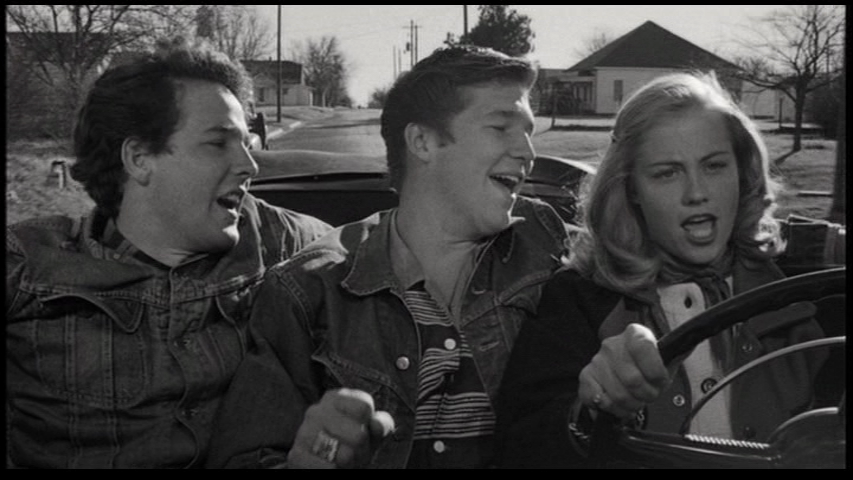
Timothy Bottoms, Jeff Bridges, and Cybill Shepherd prepare for adulthood in THE LAST PICTURE SHOW
THE LAST PICTURE SHOW (Peter Bogdanovich, 1971)
Museum of the Moving Image
35th Ave. at 36th St., Astoria
Saturday, December 26, and Sunday, December 27, $12, 7:00
Series runs through December 27
718-777-6800 www.movingimage.us
Peter Bogdanovich’s The Last Picture Show is a tender-hearted, poignant portrait of sexual awakening and coming-of-age in a sleepy Texas town. Adapted from the Larry McMurtry novel by the author and the director, the film is set in the early 1950s, focusing on Sonny Crawford (Timothy Bottoms), a teenager who works at the local pool hall with Billy (Timothy’s brother Sam), a simple-minded boy who needs special caring. Sonny’s best friend, Duane Jackson (Oscar-nominated Jeff Bridges), is dating the prettiest girl in school, Jacy Farrow (Cybill Shepherd, in her film debut), who is getting ready to test out the sexual waters, sneaking away on a date with Lester Marlow (Randy Quaid), who takes her to a naked-swimming party in a wealthier suburb of Wichita Falls. Meanwhile, Sonny breaks up with his girlfriend, Charlene Druggs (Sharon Taggart), and becomes drawn to the sad, unhappy Ruth Popper (an Oscar-winning Cloris Leachman), the wife of his football coach (Bill Thurman). The outstanding all-star cast also features Oscar-nominated Ellen Burstyn as Lois, Jacy’s mother; Eileen Brennan as a waitress in the local diner who makes cheeseburgers for Sonny; Clu Gulager as a working man who has a thing for Lois; Frank Marshall, who went on to become a big-time producer, as high school student Tommy Logan; and Oscar winner Ben Johnson as Sam the Lion, the moral center of the town and owner of the pool hall, diner, and movie theater, which shows such films as Father of the Bride and Red River. Cinematographer Robert Surtees shoots The Last Picture Show in a sentimental black-and-white that gives the film an old-fashioned feel, as if it’s a part of Americana that is fading away. Bogdanovich also chose to have no original score, instead populating the tale with country songs by Hank Williams, Bob Wills and the Texas Playboys, Lefty Frizzell, Tony Bennett, and others singing tales of woe.
In many ways the film is the flip side of George Lucas’s 1973 hit American Graffiti, which is set ten years later but looks like it’s from another century; it also has a lot in common with François Truffaut’s 1962 classic Jules and Jim. Nominated for eight Oscars including Best Picture and Best Director, The Last Picture Show is an unforgettable slice-of-life drama that will break your heart over and over again. It is screening December 26 & 27 at 7:00 in the Museum of the Moving Image series “The Hollywood Classics Behind Walkers,” which is being held in conjunction with the exhibition “Walkers: Hollywood Afterlives in Art and Artifact,” consisting of Hollywood-related photography, drawing, sculpture, print, and video by such artists as Francis Alÿs, Richard Avedon, Jim Campbell, Gregory Crewdson, Douglas Gordon, Isaac Julien, Ellen Mark, Tom Sachs, Hiroshi Sugimoto, and many others. Also screening December 26 & 27 is Sam Peckinpah’s classic Western, The Wild Bunch.
 “Jesus, the days that we have seen,” Justice Shallow (Alan Webb) says to Sir John Falstaff (Orson Welles) several times at the beginning of Chimes at Midnight, as the two old friends walk through a snowy forest. “We have heard the chimes at midnight,” Falstaff replies. Welles’s career as a writer, director, and actor in theater, television, radio, and film was fraught with conflict as budget problems, scheduling issues, and fights with producers led to a slew of unfinished projects and works edited against his wishes. Welles might have achieved his legendary status with such classic films as Citizen Kane, The Magnificent Ambersons, and Touch of Evil, but his own personal favorite was the 1965 black-and-white Chimes at Midnight (aka Falstaff). Welles spent decades working on his unique retelling of the story of the big, bawdy Sir John, attempting various stage productions before finally making the film in Spain in 1964-65. The script was adapted from Shakespeare’s Henry IV, Parts 1 and 2, Richard II, Henry V, and The Merry Wives of Windsor, with historical narration by Sir Ralph Richardson from the sixteenth-century Holinshed’s Chronicles. Welles is both boisterous and sad as Falstaff, a larger-than-life braggadocio who is both friend and father figure to Hal (Keith Baxter), the Prince of Wales, whose father, Henry IV (Sir John Gielgud), gained the throne by murdering Richard II. Hal would rather cavort with Ned Poins (Tony Beckley), Falstaff, and Falstaff’s rogue circle, which includes Pistol (Michael Aldridge), Bardolph (Patrick Bedford), and Peto, than serve the king at the castle. Meanwhile, Richard II’s supporters, led by the Earl of Worcester (Fernando Rey), Henry Percy, known as Hotspur (Norman Rodway), and the Earl of Northumberland (José Nieto), plot to take back the crown. Much of the film is set in the Boar’s Head Tavern, which is run by the elderly Mistress Quickly (Margaret Rutherford) and where Falstaff engages with prostitute Doll Tearsheet (Jeanne Moreau). Everything comes crashing together during the Battle of Shrewsbury, one of the most exciting, breathtaking battle scenes ever filmed, a nearly ten-minute spectacle of fierce fighting interlaced with Falstaff’s comic bumbling and concluding with Hal and Hotspur’s climactic face-off.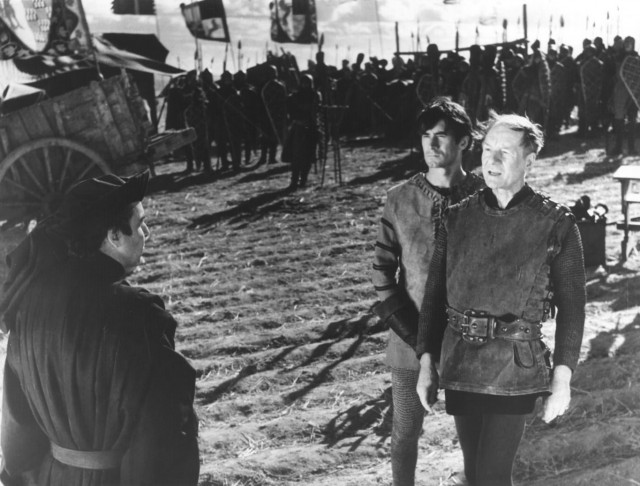

 Bernardo Bertolucci’s sexiopolitical look at Paris in the tumultuous year of 1968 focuses on three individuals: Matthew (Dawson Creek’s Michael Pitt), a shy American studying in France; Theo (French heartthrob Louis Garrel), a cigarette-smoking oh-so-French moody lad; and Isabelle (Penny Dreadful’s Eva Green), Theo’s “twin” who likes to walk around naked and flirt with both Matthew and Theo. The trio acts out scenes from films, plays dangerously erotic games, and drinks a lot of wine as the outside world comes crashing down around them. Green (Casino Royale, Kingdom of Heaven) is mesmerizing in her film debut, Pitt (Funny Games, Seven Psychopaths) reveals that he has few shortcomings, and the NC-17 rating is sure to attract an interesting crowd. And look out for a cameo appearance by Jean-Pierre Léaud playing himself. This is Bertolucci’s third film set in Paris, following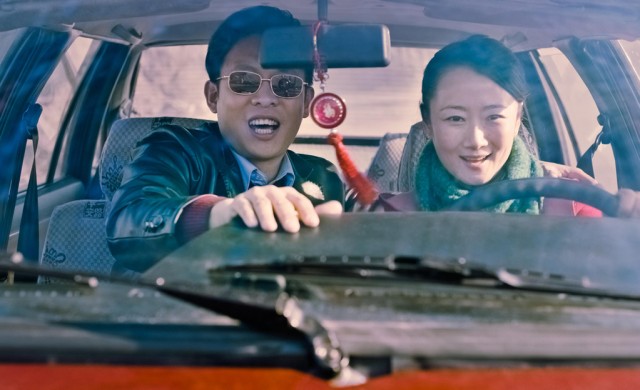
 Following its prestigious midnight film screening at Cannes this past May, Hong Won-chan’s debut feature, Office, was the opening-night selection of the 2015 New York Korean Film Festival in November at the Museum of the Moving Image. If you missed it then, you have another chance to see it in Queens on January 3, as it is one of eight films that comprise the museum’s “Curators’ Choice” series, its annual survey of some of the best films of the year. In the contemporary thriller, written by Choi Yun-jin (Steel Cold Winter), Seoul salaryman Kim Byung-Guk (Bae Seong-woo) calmly comes home from work one night and butchers his family with a hammer. The next morning, Detective Jong-hoon (Park Sung-woong) arrives at the office with plenty of questions, but no one has much to say about the killer, who was part of sales team #2 — although they are clearly hiding something. Only frazzled, insecure, wide-eyed intern Lee Mirae (Ko Ah-sung), who had a friendly relationship with Kim, wants to tell the truth, but she keeps her mouth shut, harassed by her boss (Ryu Hyun-kyung) and director Kim (Kim Eui-sung). When it is discovered that the murderer returned to the office after committing his vicious crime and may still be in the building, the tension ramps up, as does the body count.