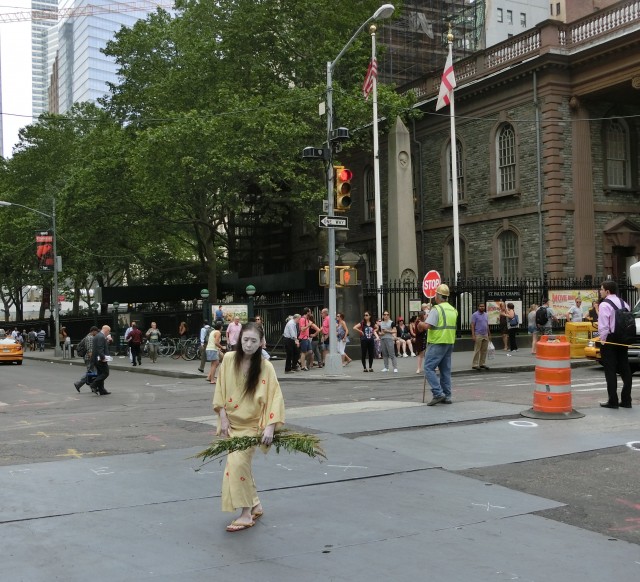
Eiko makes her way to the Fulton Center subway hub in June 2015 for “A Body in a Station” (photo by twi-ny/mdr)
PLATFORM 2016: A BODY IN PLACES
Danspace Project
St. Mark’s Church in-the-Bowery
131 East Tenth St. between Second & Third Aves.
February 17 – March 23, free – $20
866-811-4111
www.danspaceproject.org
www.eikoandkoma.org
Based in New York City since 1976, Eiko Otake and Takashi Koma have been creating uniquely fragile and evocative dances and “living installations” for forty years, taking place on proscenium stages as well as site-specific indoor and outdoor locations around the world. Here in New York City, they’ve performed Grain in an East Village loft, Event Fission on the Hudson River landfill near the World Trade Center, Water in Lincoln Center’s reflecting pool on Hearst Plaza, and Offering, Tree Song, and Cambodian Stories Revisited in the graveyard of St. Mark’s Church-in-the-Bowery. In 2014, Eiko began her solo project, A Body in Places, consisting of free, site-specific works in nontraditional venues, including the new Fulton Center subway hub.
The Tokyo-born Eiko is returning to St. Mark’s as the focal point of Danspace Project’s 2016 Platform series, consisting of live performances, discussions, art, movie screenings (at Anthology Film Archives), special duets, and more, curated by Judy Hussie-Taylor and Lydia Bell. This tenth Platform festival runs February 17 to March 23 and will include “Talking Duets” with such artists as Ishmael Houston-Jones, John Kelly, and Elizabeth Streb; “Precarious” guest solos by Eiko, Beth Gill, Donna Uchizono, Koma, and more; Delicious Movement Workshops for participants as well as observers; a book club examining works by such writers as Kenzaburō Ōe, Tamiki Hara, and C. D. Wright; an art installation and readings with writer Claudia La Rocco, visual artist Paul Chan, painter and rapper DonChristian Jones, and others; a twenty-four-hour remembrance on the fifth anniversary of the Fukushima disaster; and weekday solos by Eiko in unannounced locations around St. Mark’s Church. Eiko recently discussed Platform with twi-ny as she prepared for this exciting month-long multidisciplinary program.
twi-ny: How did the idea of your being the centerpiece of Platform come about? It’s quite a major undertaking.
Eiko: A year ago, when Danspace’s executive director, Judy-Hussie Taylor, invited me to “the third Platform focused on a single choreographer,” I was surprised. First, I hardly consider myself as a choreographer and more a performer with a multidisciplinary practice. We had previously talked about Danspace possibly sponsoring a long and intimate run of my solo performance (and this does happen as a part of Platform). However, her proposal of the shift to a multifaceted project was unexpected. “Platform is all about relationships,” says Judy. But, while I have choreographer/dancer friends, I do not have the kind of dense relationship with the dance community that other choreographers have. While many choreographers work with dancers and each other and they frequent the same studios and classes, I have, for decades, worked with only Koma without a dance studio or classes.
But through many long and dense dialogues with the patient and persuasive Judy, as well as Lydia Bell, Danspace Project’s program director, who was Eiko & Koma’s Retrospective Project coordinator from 2009 to 2011, the Platform programs have evolved! Some were my ideas and some were Judy’s and/or Lydia’s. Together, the programs are now very expansive in scope, with many activities and participants. I am endlessly thankful and in awe of Judy, Lydia, the rest of the Danspace staff, and the participating artists.
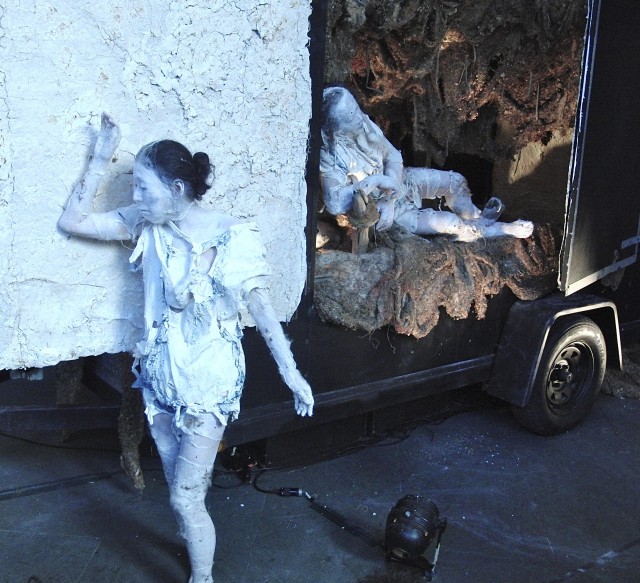
Eiko & Koma perform “The Caravan Project” at MoMA in 2011 (photo by twi-ny/mdr)
twi-ny: As you noted, the Platform series will focus on your recent solo work; what made you decide to do the solo project in the first place, and how did Koma take it when you first told him about it?
Eiko: After working as Eiko & Koma since 1972, we had four very intense years creating and touring the Retrospective Project, followed by the Archive Project. That made me see and remember so many works Eiko & Koma had created. So while I felt proud, I also started to look for ways that I can work differently. Teaching also encouraged me to think independently. I wanted to find ways to work outside of theaters. Koma happened to have suffered a series of injuries that required care, so it actually made sense that I work alone. He is now feeling better and working on his own solo project.
twi-ny: How did you go about choosing which dancers and choreographers you wanted to participate in “Precarious: Solos,” which was inspired by a quote Hussie-Taylor selected from Judith Butler’s Precarious Life: The Powers of Mourning and Violence?
Eiko: “Precarious: Solos” was more or less Judy’s idea and it is a continuation of what she has done under the same title. My contribution was to encourage all artists to present not group works but solos with low tech.
twi-ny: What was it about the quote [“When we lose certain people, or when we are dispossessed from a place, or a community, we may simply feel that we are undergoing something temporary, that mourning will be over and some restoration of prior order will be achieved. But maybe when we undergo what we do, something about who we are is revealed, something that delineates the ties we have to others, that shows us that these ties constitute what we are, ties or bonds that compose us. . . .”] that made you and Judy want that to be the inspiration behind the solos?
Eiko: The Butler quote also came from Judy, and she thinks my work with Fukushima resonates with her thoughts.
twi-ny: What are some of the unique characteristics of St. Mark’s Church and the surrounding neighborhood that have gotten you excited about performing there again?
Eiko: St. Mark’s Church is a uniquely familiar and austere space with a rich history. I love to go there and I love to perform there. Because the church is open to so many activities, it is not easy to present heavy set pieces there, but that limitation served well with many choreographers. The East Village is also where we have hung around with friends. I love that diversity, and I owe to the memories. There have been many, many artists and activists in the area, some dead. And I had many, many nights of seeing and talking.
twi-ny: You’ve taken A Body in Places to Fukushima, Philadelphia, New York City, Hong Kong, and Chile. How did your performance change with each location? With the exception of Fukushima, where you had only one “witness,” did people react the same way to you, or does the response differ from city to city?
Eiko: You forgot Middletown, Connecticut! I teach one course a year at Wesleyan University, and its Center for the Arts has supported my experimentation since 2006. Wesleyan has been an incubator of many of the things Eiko & Koma and I have created. So for the Body in Places project, it helped me to create a photo exhibition, “A Body in Fukushima,” and it also presented my project at four different locations: a school library, a town library, an observatory, and an un-lived-in old house with a gallery. In general, I would say individual differences in response to my work are always bigger than city, country, and race differences. But performing in Middletown means I have young students as viewers who are invested in and interested in what I do. To perform there is a challenging practice, and I deliberately planned multiple performances in possible locations so as to train myself toward this platform through real performance practices.
In Hong Kong, I performed at the site where people who participated in the 2014 Umbrella Revolution had camped out for three months, stopping a major highway. Everyone who saw me perform there knew and remembered the place as a site with such important public memory. In Chile, my friends Forrest Gander and C. D. Wright came and invited Chilean poets to see me perform. [Ed. note: Wright, who was married to Gander, passed away last month at the age of sixty-seven.] Two poets recited poems each night as part of my performances. These and many more memories make each place I danced a very unique place for me and for viewers.
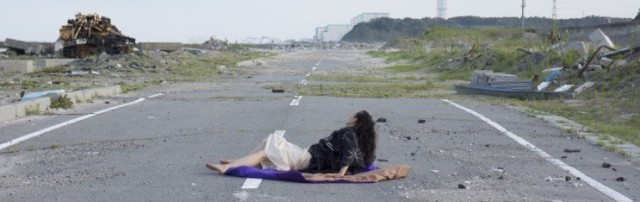
Eiko performs “A Body in Fukushima” in 2014 (photo by William Johnston)
twi-ny: You and Koma have lived in New York City for nearly forty years now. What is your impression of how the city has changed since 1976? How different might your edition of Platform have been if this were 1976, 1986, 1996, or 2006?
Eiko: Of course, the city is sooooo different. It is so much more expensive to live here, and because of that the city is bigger as friends now live in far places. But I love New York for its intensity. I would not be able to do this Platform any earlier than now.
twi-ny: Without giving away some of the locations where you will be performing your daily solos, what are some of your favorite public spots in New York City?
Eiko: I like many places I performed in this project and as Eiko & Koma. To name a few: St Mark’s Church graveyard, Bryant Park, community gardens, the Whitney Museum, the Fulton Center, Governors Island, etc., etc. But these are very different places from where I will perform for this Platform. It is winter and I need to be indoors and in intimate places.
twi-ny: You have written, “I fight without any potential to win but I fight because they should not stand unopposed.” Do you really see no way to win this fight?
Eiko: I meant I do not know really how to win, as I am not a political activist. But I think it is important for artists to know what you are against, whether you have a prospect to win or not.
twi-ny: Which battles are most important to you right now?
Eiko: I am against corporate greed and human arrogance.
twi-ny: Your movement is intensely slow, often set to silence or natural, environmental sounds. When you’re not performing in front of a crowd, do you ever just blast music and dance like crazy?
Eiko: No. I do not have the desire to do that now. But when I am really down I can listen to some special song, like Nina Simone’s “Everyone’s Gone to the Moon.”
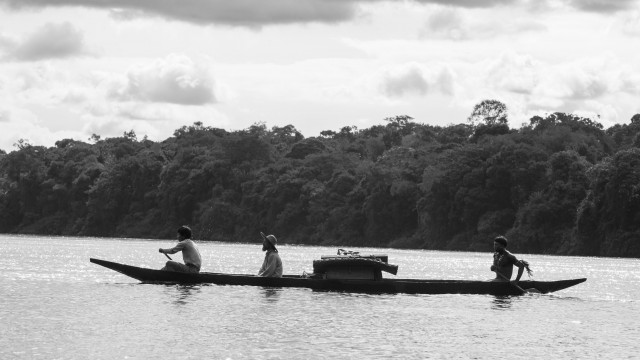
 Colombian writer-director Ciro Guerra takes viewers on a spectacular journey through time and space and deep into the heart of darkness in the extraordinary Embrace of the Serpent. Guerra’s Oscar-nominated film, the first to be shot in the Colombian Amazon in thirty years, opens with a 1909 quote from explorer Theodor Koch-Grünberg: “It is not possible for me to know if the infinite jungle has started on me the process that has taken many others to complete and irremediable insanity.” Inspired by the real-life journals of Koch-Grünberg and botanist and explorer Richard Evans Schultes, Guerra poetically shifts back and forth between two similar trips down the Vaupés River, both led by the same Amazonian shaman, each time guiding a white scientist on a perilous expedition in a long, narrow canoe. Shortly after the turn of the twentieth century, ailing white ethnologist Theo (Jan Bijvoet) and his native aid, Manduca (Yauenkü Migue), seek the help of Karamakate (Nilbio Torres), a shaman wholly suspicious of whites and who believes he is the last of his tribe. However, Theo claims he knows where remnants of Karamakate’s people live and will show him in return for helping him find the magical and mysterious hallucinogenic Yakruna plant that Theo thinks can cure his illness. Forty years later, white botanist Evan (Brionne Davis) enlists Karamakate (Antonio Bolívar Salvador) to locate what is thought to be the last surviving Yakruna plant, which he hopes will finally allow him to dream in order to heal his soul. Evoking such films as Werner Herzog’s Fitzcarraldo and Aguirre, the Wrath of God and Francis Ford Coppola’s Apocalypse Now, Embrace of the Serpent makes the rainforest itself a character, shot in glorious black-and-white by David Gallego (Cecilia, Violencia) in a sparkling palette reminiscent of the work of Brazilian photographer Sebastião Salgado. As the parallel stories continue, the men encounter similar locations that have changed dramatically over time, largely as a result of rubber barons descending on the forest and white missionaries bringing Western religion to the natives. It’s difficult to watch without being assailed by imperialist concepts of the “noble savage,” mainly because the Amazon — and our Western minds — have been so profoundly affected by those ideas. “Before he can become a warrior, a man has to leave everything behind and go into the jungle, guided only by his dreams,” the older Karamakate says. “In that journey he has to discover, completely alone, who he really is.”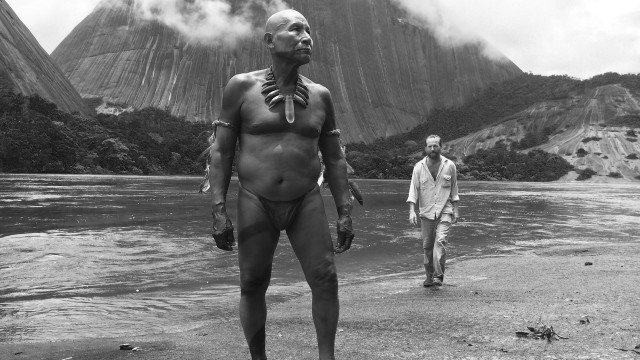
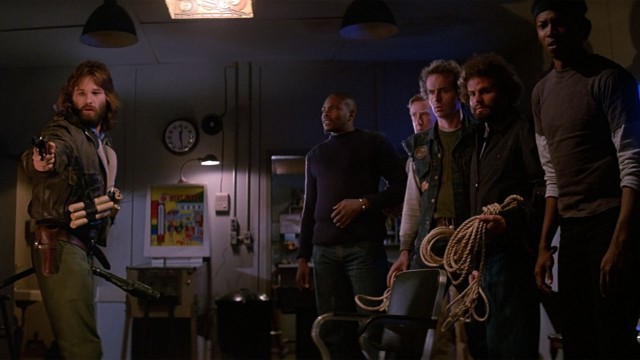
 “What were they doing flying that low, shooting at a dog, at us?” meteorologist Bennings (Peter Maloney) asks Dr. Copper (Richard Dysart) after watching a Norwegian helicopter pilot pursue a dog in the Antarctic, at the beginning of John Carpenter’s The Thing. “Stir crazy. Cabin fever. Who knows?” the doc answers, more than justifying Nitehawk Cinema’s inclusion of the cult film in its February Midnite series Cabin Fever. Carpenter’s 1982 remake of Christian Nyby’s 1951 Cold War sci-fi classic, The Thing from Another World, adds touches of Invasion of the Body Snatchers and Alien, with Kurt Russell leading an all-star cast of familiar character actors set up like a Vietnam War platoon. Russell is the cowboy-hat-wearing R. J. MacReady, part of a group of men at U.S. National Science Institute Station 4 in the frozen Antarctic. The crew also includes soft-spoken biologist Dr. Blair (Wilford Brimley), pot-smoking hippie assistant mechanic Palmer (David Clennon), nice guy geophysicist Vance Norris (Charles Hallahan), dedicated dog handler Clark (Richard Masur), funkster cook Nauls (T. K. Carter), assistant biologist Fuchs (Joel Polis), excitable communications officer Windows (Thomas G. Waites), serious station commander M. T. Garry (Donald Moffat), and skeptical chief mechanic Childs (Keith David). Soon some kind of monster from outer space is on the loose, able to disguise itself as other living creatures, making everyone suspicious of one another, the paranoia growing along with the terror and violence.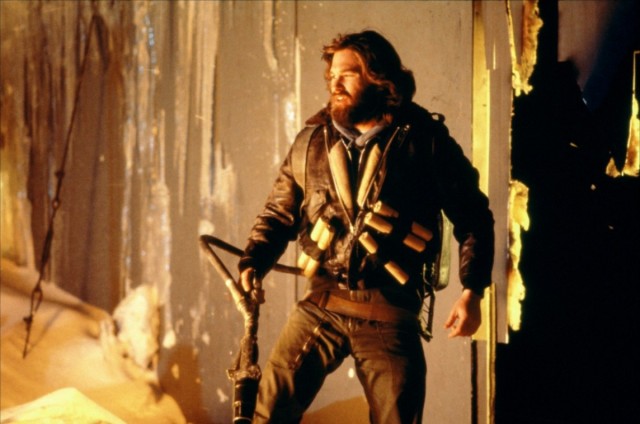

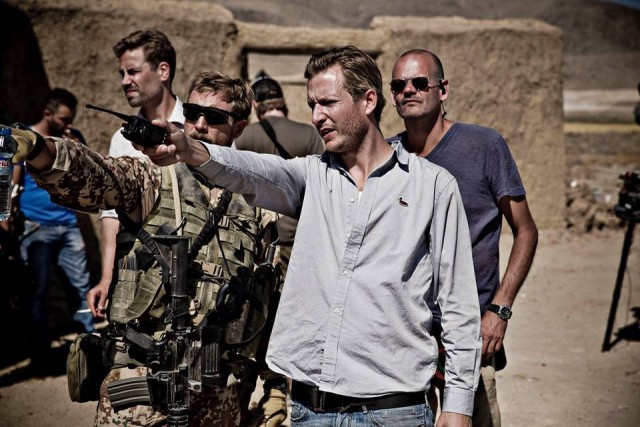
 Danish writer-director Tobias Lindholm puts you right in the middle of the action in The War, his searing portrait of the modern state of battle as seen through the eyes of a dedicated family man who makes a decision in the heat of the moment that jeopardizes his future. The first part of the film takes place in Afghanistan, where the Danish army, which has not been involved in its own war in more than 150 years, is supporting the efforts of the United States and England. A small company, led by Claus Michael Pedersen (Pilou Asbæk), is protecting a desert area where the Taliban is believed to be infiltrating a nearby village. Lindholm and cinematographer Magnus Nordenhof Jønck, who have previously worked together on R and A Hijacking, make the audience feel like it’s right there as a soldier is blown up by an IED, the men encounter an Afghan family that might or might not be collaborating with the Taliban, and a terrorist uses children as a human shield. The story occasionally shifts back home, where Pedersen’s wife, Maria (Tuva Novotny), is caring for their three children by herself. The two worlds come crashing together after Pedersen makes a judgment call while trying to rescue Lutfi “Lasse” Hassan (Dulfi Al-Jabouri), who’s been shot by a sniper as their compound is under attack. It’s all far more subtle, and more believable, than, say, the opening of Steven Spielberg’s Saving Private Ryan or Clint Eastwood’s American Sniper; it’s not so much about the horrors, violence, and heroism of war in general but its potential after-effects in an ever-more-complex politically correct climate.