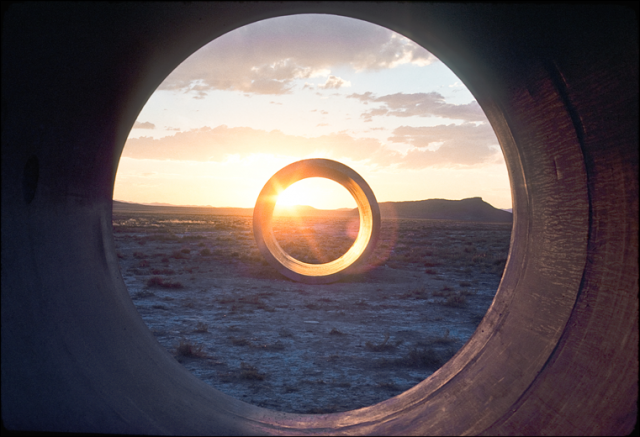
James Crump shines a light on the iconoclastic earthworks artists — and such massive projects as Nancy Holt’s “Sun Tunnels,” above — in TROUBLEMAKERS
TROUBLEMAKERS: THE STORY OF LAND ART (James Crump, 2014)
IFC Center
323 Sixth Ave. at West Third St.
Opens Friday, January 8
212-924-7771
www.ifccenter.com
troublemakersthefilm.com
 In the 1960s, a small group of experimental artists rejected the gallery system and the traditional art market by turning the planet into their canvas, creating monumental, often apocalyptic “earthworks” in far-off locations in the American Southwest that were nearly impossible to find. Director James Crump explores who these iconoclastic pioneers were and what they accomplished — and, in some cases, are still doing — in Troublemakers: The Story of Land Art. “The idea of land art is to relate to the idea of the globe, especially after the spaceship, the first picture of the earth, [gave] you the idea that earth is an object, so the idea for these artists after 1963 is that you can shape something, which is a sphere,” explains arte povera expert and art historian Germano Celant, who goes on to talk about the influence of airplane flight and Marcel Duchamp. “So the idea of looking from a high level is changing the perspective, your knowledge about art. And you can design it, you can draw. The area of view is a change in the history of art. It’s all this kind of convergence of information — technology, information, and history — that makes land art.” Crump (Black White + Gray) concentrates primarily on three artists, Robert Smithson, Michael Heizer, and Walter De Maria, combining rarely shown archival footage, photographs, and film clips with old and/or new interviews of artists Carl Andre, Vito Acconci, Charles Ross, Willoughby Sharp, Lawrence Weiner, and Nancy Holt (Smithson’s widow) and gallerists Paula Cooper and Virginia Dwan.
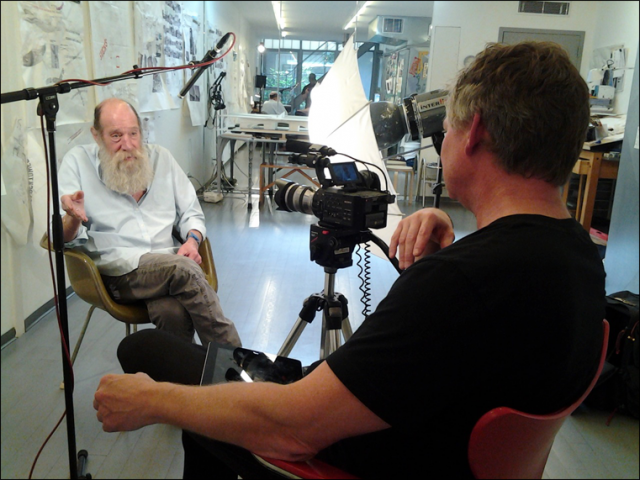
James Crump interviews Lawrence Weiner about the land-art movement in TROUBLEMAKERS
Dwan, a major supporter of the land artists, shares compelling stories about the individuals, both their personalities and their working process, while Acconci discusses the movement from a more philosophical angle, referring to the minimalist, conceptual earthworks as “an exchange with nature” that was “a new kind of religious pilgrimage.” Using bulldozers, excavators, and even earthquakes as their brushes, these artists carved, dug, and constructed massive projects in places that very few people would ever get to see, more concerned with the earth, the sun, and the vast landscape of the planet than with creating art that could be shown in galleries and museums and sold to collectors and corporations. Crump examines such remarkable projects as Smithson’s “Spiral Jetty,” Heizer’s “Double Negative,” De Maria’s “The Lightning Field,” Holt’s “Sun Tunnels,” and Ross’s forty-plus-year work-in-progress, “Star Axis,” some of which you can still see today. But earthworks, which were in part a response to the Vietnam War, were not a rejection of the city itself; Troublemakers shows many of the artists hanging out at Max’s Kansas City on Park Ave., where they ate, drank, and made professional connections. But one artist who avoided that scene was Heizer, who just had a show at Gagosian in Chelsea and did not participate in the making of the documentary. “It’s not worth anything,” he says about his art. “In fact, it’s an obligation.” A refreshing look at an utterly intriguing moment in twentieth-century art — and at a movement that takes on new meaning as the planet is in peril as a result of climate change — Troublemakers opens January 8 at the IFC Center; Crump will participate in a Q&A following the 4:25 screening on January 9.