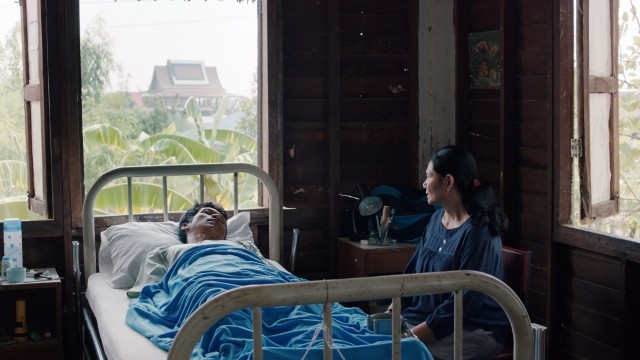
Itt (Banlop Lomnoi) and Jen (Jenjira Pongpas) synchronize their lives in Apichatpong Weerasethakul’s CEMETERY OF SPLENDOR
CEMETERY OF SPLENDOR (Apichatpong Weerasethakul, 2015)
IFC Center
323 Sixth Ave. at West Third St.
March 4-10
212-924-7771
www.ifccenter.com
strandreleasing.com
 Cemetery of Splendor is another strange, magical tale from Thai director Apichatpong Weerasethakul, a film that exists on the edge of sleep and wakefulness, like a dream you’ve just had but can’t quite remember all the details of, yet you know it has soothed your soul. In the jungles of Khon Kaen (Weerasethakul’s hometown) in Thailand, an elementary school has been turned into a makeshift hospital treating soldiers who have a mysterious sleeping ailment. (The story was inspired by an actual quarantine of members of the Royal Thai Army in 2012.) Built on the site of a long-ago palace and its cemetery of kings, the clinic uses light therapy to help the sleeping patients, each of whom has a curved fixture by their bed that emits neon lights that continually change color. Jen (Jenjira Pongpas, who also plays a woman named Jen in Weerasethakul’s Mekong Hotel), who attended the school as a child and walks with a pair of crutches because her legs are two different lengths, visits her old friend Nurse Tet (Petcharat Chaiburi), who runs the clinic with Dr. Prasan (Boonyarak Bodlakorn). “The soldiers just sleep,” Nurse Tet says. “The army doesn’t know what to do with them.” Jen develops a bond with one of the patients, Itt (Banlop Lomnoi), eventually communicating through a psychic medium, Keng (Jarinpattra Rueangram), who works with the police contacting the spirits of murder victims and helping find missing persons. At times, Itt wakes up, his sense of smell sharpened, able to “tell the temperature of the lights,” only to fall asleep again. Karma, meditation, past lives, and religious statues and spirits entering human bodies become part of the unusual narrative, all while a parcel of land is curiously being dug up with construction equipment nearby.
Cinematographer Diego Garcia’s (Bestia de Cardo, Neon Bull) camera rarely ever moves, remaining still and at a distance as we are immersed in the slow-paced poetry of the film, lovingly edited by Weerasethakul regular Lee Chatametikool (Blissfully Yours, Uncle Boonmee Who Can Recall His Past Lives). Palme d’Or winner Weerasethakul (Syndromes and a Century, Tropical Malady) primarily uses natural sound until the end, when the pace suddenly picks up and cinematic music takes over. At one point, people sitting on small benches near the shore of a large lake, surrounded by thin trees, participate in a kind of choreographed dance, getting up from one bench and moving to another over and over, for no apparent reason. Later, Jen and Keng come upon a pair of statues in the woods, one of a happy couple on a bench, the other of the same man and woman, now skeletons but still content. It’s a fitting metaphor not only for the film but for life itself, emphasizing love, impermanence, death, and rebirth. Cemetery of Splendor is playing March 4 to 10 in the IFC Center series “Mysterious Splendors: The Films of Apichatpong Weerasethakul,” running alongside his previous work, Mekong Hotel.
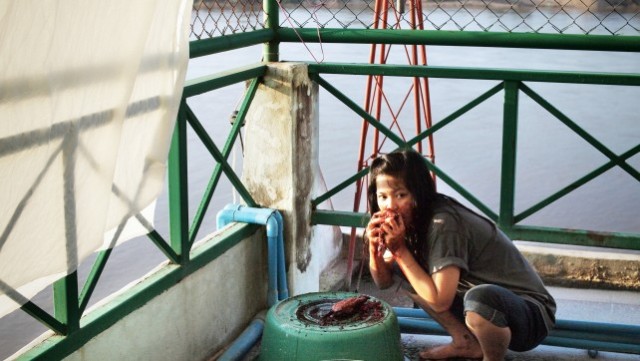
 At the end of the closing credits of Thai director Apichatpong Weerasethakul’s Mekong Hotel, a disclaimer reads, “All characters appearing in this work are actual persons. Any resemblance to other real beings, living or dead, is not coincidental.” As with so many of the Palme d’Or-winning director’s films, Mekong Hotel walks the fine line between fact and fiction, fantasy and reality. The slight work, a meditative tone poem that runs fifty-seven minutes, was shot at the Sam Oar Guesthouse and Resort in Nong Khai in northeast Thailand, near the Friendship Bridge that links Thailand and Laos. Weerasethakul (Blissfully Yours, Syndromes and a Century) plays himself in the film, a director auditioning a guitarist (real-life musician and composer Chai Bhatana), whose playing serves as the musical score for the elegiac tale. (Assistant director Chatchai Suban also makes a cameo.) Meanwhile, an otherworldly narrative is taking place, between Tong (Sakda Kaewbuadee), a banana plantation owner whose dog was just eaten, and Phon (Maiyatan Techaparn), a young woman who lives next door with her mother, Jen (Jenjira Pongpas), a Pob ghost who has a hankering for entrails. (The relationship between the mother and daughter was inspired by one of Weerasethakul’s unrealized projects, Ecstasy Garden.) The slow, contemplative mood never changes as the characters discuss love, a coming flood, refugees, spirits, and jet skiing, often in abstract ways. Weerasethakul wrote, directed, produced, edited, and photographed the film, which features beautiful cinematography, the camera never moving as the characters walk in and out of the frame and the lovely views of the Mekong River linger. Unfortunately, the sum of the intriguing parts don’t make for a cohesive whole; Weerasethakul has been justly celebrated for his short films and full-length works, but Mekong Hotel falls somewhere in between, lost in a kind of no-man’s land. Still, there’s much to admire about this film, especially for the auteur’s longtime fans. Mekong Hotel is having its theatrical premiere at the IFC Center from March 4 to 10 in the series “Mysterious Splendors: The Films of Apichatpong Weerasethakul,” running alongside his latest film, Cemetery of Splendor.


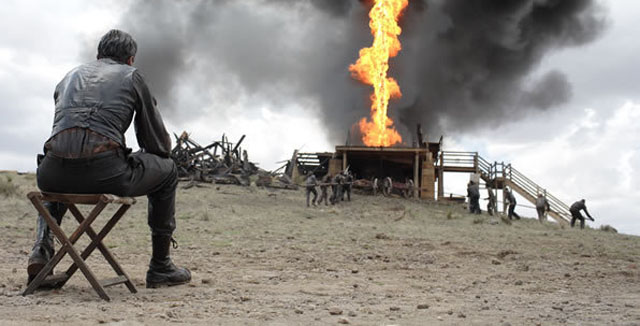
 Daniel Day-Lewis gives a spectacular, Oscar-winning performance as an independent oil man in Paul Thomas Anderson’s There Will Be Blood. Day-Lewis, in remarkable voice, absolutely embodies Daniel Plainview, a determined, desperate man digging for black gold in turn-of-the-century California. His first strike comes at a heavy price as he loses one of his men in a tragic accident, so he adopts the worker’s infant son, raising H.W. (Dillon Freasier) as his own. The growth of his company leads him to Little Boston, a small town that has oil just seeping out of its pores. But after not allowing Paul Sunday (Paul Dano), the charismatic preacher who runs the local Church of the Third Revelation, to say a prayer over the community’s first derrick, Plainview begins his descent into hell. Using Upton Sinclair’s 1927 novel Oil! as a starting point (and employing echoes of Orson Welles’s Citizen Kane and The Magnificent Ambersons in addition to the obvious reference, George Stevens’s classic 1956 oil flick Giant), writer-director Anderson (Boogie Nights, The Master) has created a thrilling epic about greed, power, and corruption as well as jealousy, murder, and, above all, family, where oil gushes out of the ground with fire and brimstone. Robert Elswit’s beautiful, Oscar-winning cinematography is so gritty and realistic, audiences will be reaching for their faces to wipe the oil and blood off. The piercing, classically based score, composed by Radiohead guitarist Jonny Greenwood, builds to a mind-blowing crescendo by the end of the film — which concludes with a controversial finale. Shot in the same location — Marfa, Texas — where Giant was set, There Will Be Blood is an unforgettable journey into the dark heart of one man’s soul. There Will Be Blood is being shown March 5 & 6 at the rather ungodly hour of eleven in the morning as part of the Nitehawk Cinema series “Country Brunchin’” and “Nitehawk Brunch Screenings” and will be preceded by a live performance by New York duo
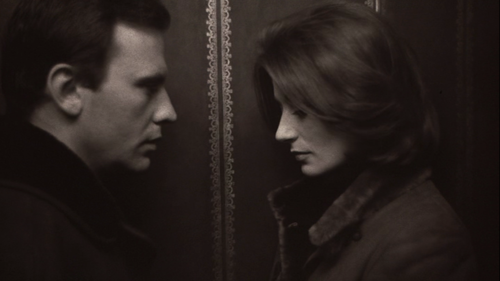
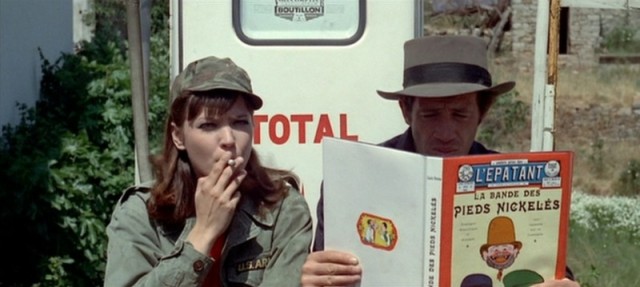
 Winner of both the Oscar for Best Foreign Language Film and the Palme d’Or at Cannes, Claude Lelouch’s A Man and a Woman is one of the most popular, and most unusual, romantic love stories ever put on film. Oscar-nominated Anouk Aimée stars as Anne Gauthier and Jean-Louis Trintignant as Jean-Louis Duroc, two people who each has a child in a boarding school in Deauville. Anne, a former actress, and Jean-Louis, a successful racecar driver, seem to hit it off immediately, but they both have pasts that haunt them and threaten any kind of relationship. Shot in three weeks with a handheld camera by Lelouch, who earned nods for Best Director and Best Screenplay (with Pierre Uytterhoeven), A Man and a Woman is a tour-de-force of filmmaking, going from the modern day to the past via a series of flashbacks that at first alternate between color and black-and-white, then shift hues in curious, indeterminate ways. Much of the film takes place in cars, either as Jean-Louis races around a track or the protagonists sit in his red Mustang convertible and talk about their lives, their hopes, their fears. The heat they generate is palpable, making their reluctance to just fall madly, deeply in love that much more heart-wrenching, all set to a memorable soundtrack by Francis Lai. Lelouch, Trintignant, and Aimée revisited the story in 1986 with A Man and a Woman: 20 Years Later, without the same impact and success. A recently restored print of the original will be shown on March 2 at 7:30 as part of the BAMcinématek series “BAMcinématek: Gallic 60s,” in honor of the film’s fiftieth anniversary. The two-day treat continues March 3 with Jean-Luc Godard’s Pierrot le Fou.