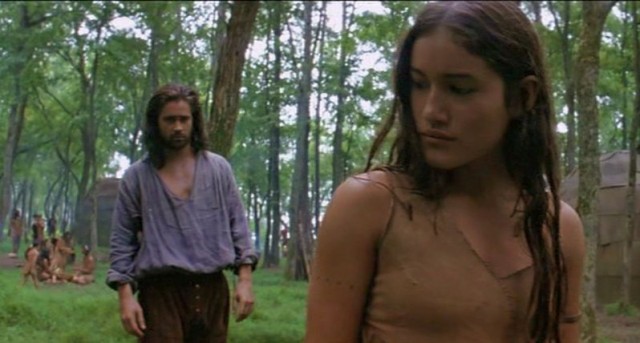
Colin Farrell and Q’orianka Kilcher nearly ignite the screen in THE NEW WORLD
THE NEW WORLD (Terrence Malick, 2005)
Museum of the Moving Image
35th Ave. at 36th St., Astoria
Friday, March 11, $12, 7:00
Series runs March 11 – April 1
718-777-6800
www.movingimage.us
 Although production designers play a critical role in the making of a film, it’s something that the public tends to take for granted; the best of the best are not exactly household names. The Museum of the Moving Image seeks to rectify that in at least one case with its new series, “See It Big! Jack Fisk,” a celebration of the work of Oscar-nominated production designer, art director, and carpenter Jack Fisk. The fifteen-film series runs March 11 to April 1, kicking off with Terence Malick’s The New World. At the time the film was released in 2005, the iconoclastic American auteur had directed a mere four films in his forty-year career, each a gem in its own way — 1973’s Badlands, 1978’s Days of Heaven, 1998’s The Thin Red Line, and 2005’s The New World, and all of which Fisk worked on. Spectacularly photographed by cinematographer Emanuel Luzbeki (who has won three consecutive Oscars as of the 2016 Academy Awards), The New World reimagines the story of Captain John Smith (Colin Farrell) and Pocahontas (Q’orianka Kilcher) as an epic tale of unrequited desire, a fiercely passionate, if not completely accurate, love story for the ages. In 1607, a crew led by Captain Christopher Newport (Christopher Plummer) has landed in what will come to be known as Jamestown. The disgraced Smith, who was nearly hanged for mutiny, is ordered to meet with “the naturals” in order to develop a favorable relationship. But Smith falls deeply for Pocahontas, Chief Powhatan’s (August Schellenberg) beautiful young daughter, who shares his feelings, leading to a dangerous love that threatens to leave death and destruction in its wake. Large stretches of the film feature no dialogue, instead consisting of gorgeously framed shots with gentle, poetic narration from Smith, Pocahontas, and, later, John Rolfe (Christian Bale). The scenes between Farrell and Kilcher nearly ignite the screen, their eyes burning into each other. Malick and Luzbeki focus on lush, rolling fields and rushing rivers that are more than just beautiful scenery; the gorgeous landscape of this new world is filled with promise, with hope, even though we know what eventually, tragically happens. The film, which experienced well-documented casting, editing, and distribution dilemmas, bogs down considerably when Smith’s place in the newly named Rebecca’s life is taken over by Rolfe, but it all builds to a heart-wrenching conclusion. The New World is screening March 11 at 7:00; the series is being held in conjunction with the upcoming release of Malick’s latest film, Knight of Cups, which is being shown April 1 and on which Fisk, who has worked on every one of Malick’s feature films, served as production designer.

Ben Affleck and Olga Kurylenko explore a poetic love in TO THE WONDER (photo courtesy of Magnolia Pictures)
TO THE WONDER (Terrence Malick, 2012)
Museum of the Moving Image
35th Ave. at 36th St., Astoria
Saturday, March 12, $12, 2:00
Series runs March 11 – April 1
718-777-6800
www.movingimage.us
www.magpictures.com
 The Museum of the Moving Image’s “See It Big! Jack Fisk” series features all seven collaborations between two-time Oscar nominee Fisk (There Will Be Blood, The Revenant) and Terence Malick, including what might be their least successful, To the Wonder. The polarizing auteur followed up his Oscar-nominated, Palme d’Or-winning The Tree of Life with To the Wonder, one of the most beautifully shot, elegantly paced, and innately poetic films you’re ever likely to see — but it’s also one of the most confusing, annoying, and frustrating. An unnamed American man (Ben Affleck) and Ukrainian woman (Olga Kurylenko) are exploring their newfound love in Paris, she reciting melodramatic romantic thoughts in voice-over, he looking on like a man harboring a secret, barely speaking. They travel to the spectacular island abbey known as Mont St. Michel, home to the ancient buildings called la Merveille (“the marvel,” or “the wonder”), where they walk across a mysterious landscape of soft ground that might give way and swallow them up at any moment. The man asks the woman and her ten-year-old daughter (Tatiana Chiline) to move with him to his home in rural Bartlesville, Oklahoma, where he works as an environmental inspector evaluating drilling projects. There, a local priest (Javier Bardem) is questioning his own faith, and the man soon meets up with a former flame (Rachel McAdams). Or something like that. The plot, if you can even call it that, is just an excuse for Malick, cinematographer Emmanuel Lubezki, and production designer Fisk to create spectacular visual imagery, and every minute of it is indeed dazzling. But unfortunately, it’s nearly impossible to care about the characters amid a purposefully vague and ambiguous narrative — at least we’re hoping it’s purposeful, because otherwise it’s simply amateurish. The central problem is the man; Affleck tries his best, but the character lacks any kind of depth or believability. You’re likely to want to smack some sense into him. And the priest seems to come from a completely different movie. In his forty-year career, Malick (The New World, Badlands, The Thin Red Line) had written and directed only five features prior to this film, and never fewer than five years apart. Perhaps he should have taken more time with To the Wonder, his second film in two years, to figure out what he wanted to say about love and faith and not just beauty. The film is screening at the Museum of the Moving Image on March 12 at 2:00; the series continues through April 1 with such other works as Brian De Palma’s Carrie, Malick’s Badlands, David Lynch’s The Straight Story, and Fisk’s directorial debut, Raggedy Man, all of which star his wife, Sissy Spacek, whom he met on the set of Badlands.

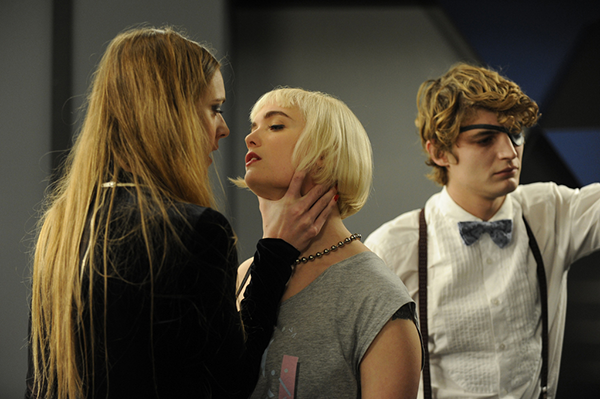
 An orgy doesn’t go quite as planned in Yann Gonzalez’s dark, lurid, and silly directorial debut, You and the Night. The erotic tragicomedy evokes the films of Derek Jarman along with Stanley Kubrick’s Eyes Wide Shut and, primarily, Jean Cocteau’s Orpheus as seven characters gather one evening for a night of debauchery in the name of love, desperate to fill the gaps in their sad lives. “It’s our secret vice. A little break from the eternal, maddening class struggle,” the Star (Fabienne Babe) tells a pair of cops who show up looking for a runaway boy. The party is hosted by trans gypsy maid Udo (Nicolas Maury); the other guests are Ali (Kate Moran), an older woman joined by her younger lover, Matthias (Niels Schneider); the Stud (soccer star Éric Cantona), who boasts of his enormous manhood (and then proves it); the Teen (Alain Fabien Delon, son of French screen idol Alain Delon), who has not developed his own identity yet; and the Slut (Julie Brémond), who can’t wait to do anyone and everyone. Over the course of the night, they share their dreams, relate their pasts, and search for love, set to a score by French electronic band M83, which is led by Anthony Gonzalez, Yann’s brother. The movie’s supposed to be dreamy and poetic, but instead it’s cold and artificial, often bathed in an unfeeling blue light that furthers the distance between the characters and the audience. It’s often hard to tell what’s supposed to be “real” and what’s meant to be tongue-in-cheek, although Béatrice Dalle’s cameo as a whip-touting commissioner is, well, it just is. You and the Night is screening in FIAF’s “EDM Anthems: French Touch on Film” series on March 15 at 4:00 and 7:30; the series continues on Tuesdays through April 26 with such other films as Mia Hansen-Løve’s Eden, Nicolas Winding Refn’s Drive, and Céline Sciamma’s Girlhood, which are either set in the club scene or feature EDM-based soundtracks.

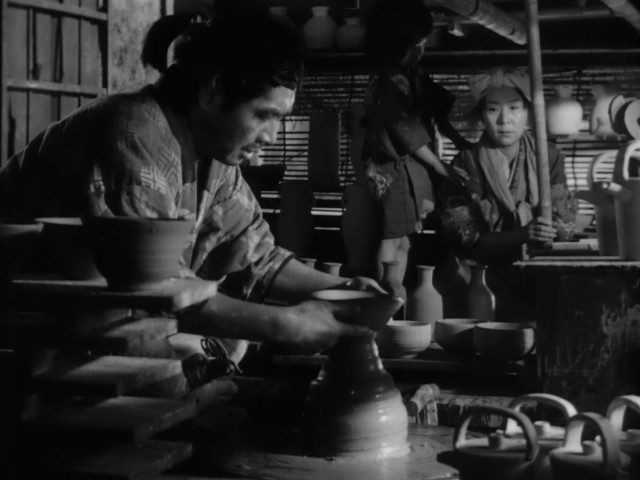
 Asia Society’s “Of Ghosts, Samurai, and War: A Series of Classic Japanese Film” series heads into its second weekend with one of the most important and influential — and greatest — works to ever come from Japan. Winner of the Silver Lion for Best Director at the 1953 Venice Film Festival, Kenji Mizoguchi’s seventy-eighth film, Ugetsu, is a dazzling masterpiece steeped in Japanese storytelling tradition, especially ghost lore. Based on two tales by Ueda Akinari and Guy de Maupassant’s “How He Got the Legion of Honor,” Ugetsu unfolds like a scroll painting beginning with the credits, which run over artworks of nature scenes while Fumio Hayasaka’s urgent score starts setting the mood, and continues into the first three shots, pans of the vast countryside leading to Genjurō (Masayuki Mori) loading his cart to sell his pottery in nearby Nagahama, helped by his wife, Miyagi (Kinuyo Tanaka), clutching their small child, Genichi (Ikio Sawamura). Miyagi’s assistant, Tōbei (Sakae Ozawa), insists on coming along, despite the protestations of his nagging wife, Ohama (Mitsuko Mito), as he is determined to become a samurai even though he is more of a hapless fool. “I need to sell all this before the fighting starts,” Genjurō tells Miyagi, referring to a civil war that is making its way through the land. Tōbei adds, “I swear by the god of war: I’m tired of being poor.” After unexpected success with his wares, Genjurō furiously makes more pottery to sell at another market even as the soldiers are approaching and the rest of the villagers run for their lives. At the second market, an elegant woman, Lady Wakasa (Machiko Kyō), and her nurse, Ukon (Kikue Mōri), ask him to bring a large amount of his merchandise to their mansion. Once he gets there, Lady Wakasa seduces him, and soon Genjurō, Miyagi, Genichi, Tōbei, and Ohama are facing very different fates.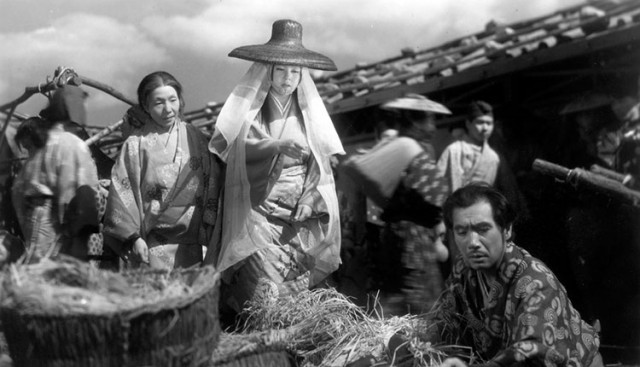
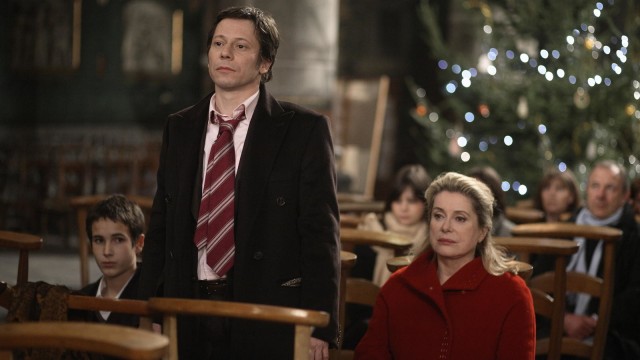
 One of the best films of 2008, A Christmas Tale is yet another extraordinary work from French post-New Wave filmmaker Arnaud Desplechin (La Sentinelle, Esther Kahn). Desplechin, who examined family dysfunction in the masterful