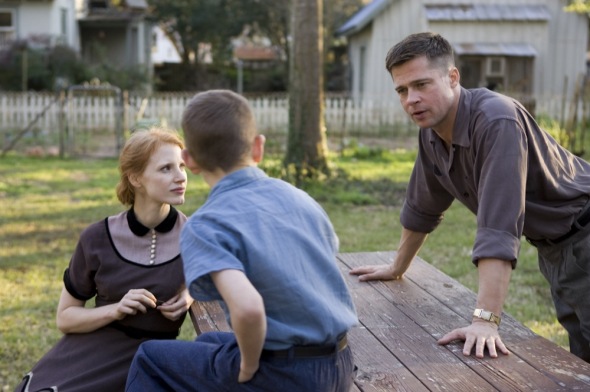
Jessica Chastain, Hunter McCracken, and Brad Pitt star in Terrence Malick’s epic masterpiece, THE TREE OF LIFE
THE TREE OF LIFE (Terrence Malick, 2011)
Museum of the Moving Image
35th Ave. at 36th St., Astoria
Sunday, March 27, $12, 7:00
Series runs through April 1
718-777-6800
www.movingimage.us
www.twowaysthroughlife.com
 As of 2005, iconoclastic writer-director Terrence Malick had made only five feature films in his forty-plus-year career, but his 2011 effort, The Tree of Life, is his very best. Following Badlands (1973), Days of Heaven (1978), The Thin Red Line (1998), and The New World (2005), The Tree of Life is an epic masterpiece of massive proportions, a stirring visual journey into the beginning of the universe, the end of the world, and beyond. The unconventional nonlinear narrative essentially tells the story of a middle-class Texas family having a difficult time coming to grips with the death of one of their sons in the military. Malick cuts between long flashbacks of Mr. and Mrs. O’Brien (Brad Pitt and Jessica Chastain) in the 1950s and 1960s, as they meet, marry, and raise their three boys, to the present, when Jack (Sean Penn), their eldest, now a successful architect, is still searching for answers. The sets by production designer Jack Fisk transport viewers from midcentury suburbia to the modern-day big city and a heavenly beach, all gorgeously shot by cinematographer Emmanuel Lubezki. Every frame is so beautiful, it’s as if they filmed the movie only at sunrise and sunset, the Golden Hour, when the light is at its most pure. The Tree of Life is about God and not God, about faith and belief, about evolution and creationism, about religion and the scientific world. The film opens with a quote from the Book of Job: “Where were you when I laid the earth’s foundation . . . while the morning stars sang together and all the sons of God shouted for joy?” Early on Mrs. O’Brien says in voice-over, “The nuns taught us there are two ways through life: The way of nature, and the way of grace. You have to choose which one to follow.” Malick doesn’t get caught up in those questions, instead focusing on the miracles of life and death and everything in between.
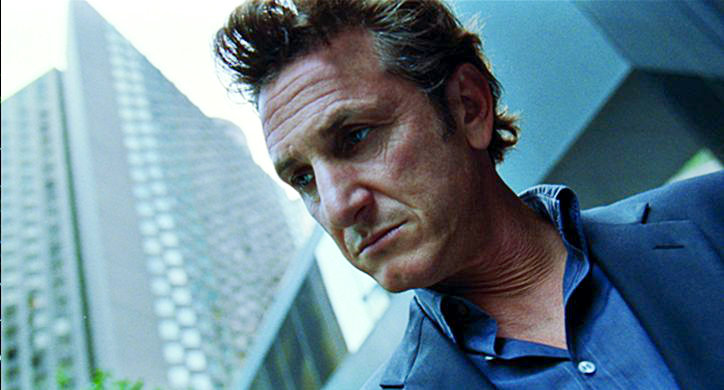
Sean Penn plays an architect searching for answers in THE TREE OF LIFE
With the help of Douglas Trumbull, the special effects legend behind 2001: A Space Odyssey, Blade Runner, and Close Encounters of the Third Kind — and who hasn’t been involved in a Hollywood film in some thirty years — Malick travels through time and space, using almost no CGI. Instead, he employs images from the Hubble telescope along with Thomas Wilfred’s flickering “Opus 161” art installation, which evokes a kind of eternal flame that appears in between the film’s various sections. Malick brings out the Big Bang, dinosaurs, and the planets during this inner and outer head trip of a movie that will leave you breathless with anticipation at where he is going to take you next, and where he goes is never where expected, accompanied by Alexandre Desplat’s ethereal orchestral score. But perhaps more than anything else, The Tree of Life, which won the Palme d’Or at the 2011 Cannes Film Festival, is about the act of creation, from the creation of the universe and the world to the miracle of procreation (and the creation of cinema itself). Mr. O’Brien is an inventor who continually seeks out patents but always wanted to be a musician; he plays the organ in church, but his dream of creating his own symphony has long been dashed. And Jack is an architect, a man who creates and builds large structures but is unable to get his own life in order. In creating The Tree of Life, Malick has torn down convention, coming up with something fresh and new, something that combines powerful human emotions with visual wizardry, a multimedia poem about life and death, the alpha and the omega. When the film opened five years ago, we wrote that “it would be a shame not to experience this supreme work of art on the big screen,” and you can do just that when the Museum of the Moving Image shows it on March 27 at 7:00 as part of the series “See It Big! Jack Fisk,” which began March 11 and includes all seven collaborations between two-time Oscar nominee Fisk (There Will Be Blood, The Revenant) and Malick. The series concludes April 1 with Malick’s latest, Knight of Cups.
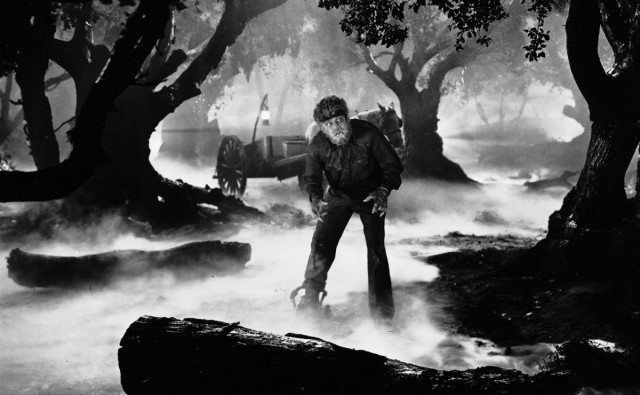
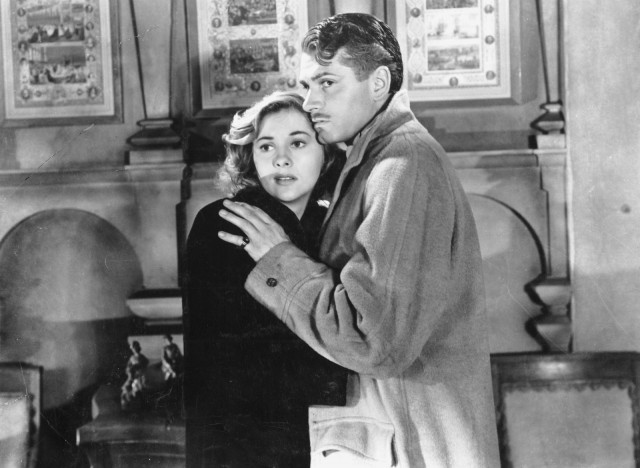
 The third jewel in Universal’s horror crown (following 1931’s Dracula and Frankenstein), The Wolf Man stars Lon Chaney Jr. in his signature role, the goofily charming Larry Talbot, who just happens to have a problem on certain evenings when there is a particularly bright, full moon. Talbot has returned home to the family mansion after the sudden death of his brother, who appeared to have been mauled by some kind of wild animal. Reunited with his erudite father, Sir John (The Invisible Man’s Claude Rains), Larry quickly gets the hots for local antiques dealer Gwen Conliffe (Evelyn Ankers), but when their first date involves the tragic death of Gwen’s friend Jenny (Fay Helm) and Bela the Gypsy (Bela Lugosi), Larry becomes a suspect in the murders. And when he keeps waking up with ripped clothing and blood on him, he begins to think that maybe he has indeed done some very terrible things. The Wolf Man is the only one of Universal’s three primary horror classics that is not based on a popular novel; instead, Curt Siodmak wrote a fascinating original script that delves deep into the psyche of its protagonist, whose physical and mental transformation echoes the rage inside us all. The all-star cast also features Ralph Bellamy as Colonel Montford, the town constable; Patric Knowles as Frank Andrews, Gwen’s fiancé; and the great Maria Ouspenskaya as the mysterious Gypsy woman Maleva. The Wolf Man might not have the chills and thrills of Dracula and Frankenstein, but it still more than holds its own after all these years. (Oh, and if you’re expecting the famous scene when Chaney’s face goes all hairy, that actually occurs in the sequel, Frankenstein Meets the Wolf Man.) The Wolf Man is being shown at 11:45 am on March 26 & 27 in the Nitehawk Cinema series “Nitehawk Brunch Screenings” and “March Midnite & Brunch: Bark at the Moon,” which also includes Joe Dante’s The Howling on March 25 & 26 at 12:15 am.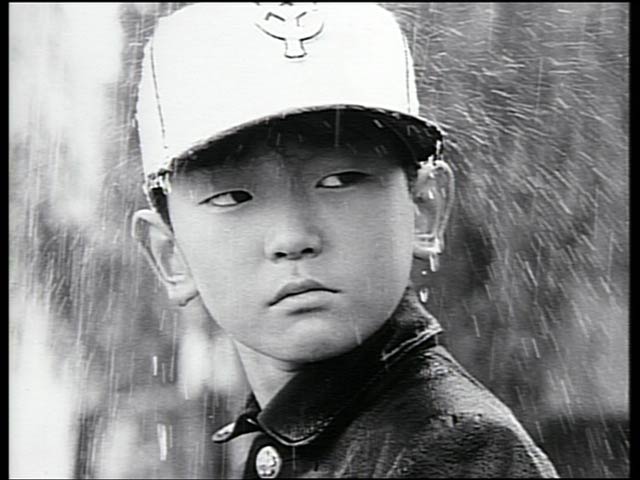
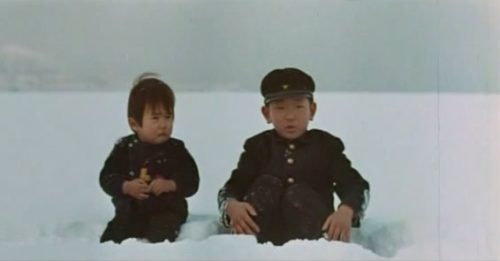
 Controversial outlaw filmmaker Nagisa Oshima takes a unique, poignant look at the continuing problems in postwar Japan in the underseen 1969 drama Boy. After a major search for an actor to play the nameless title character, Oshima found Tetsuo Abe in an orphanage, and the young boy delivered one of the most memorable performances ever by a child. Inspired by actual events, the film follows wounded war veteran Takeo Omura (Fumio Watanabe), his second, common-law wife, Takeko Taniguchi (Akiko Koyama), their baby (Tsuyoshi Kinoshita), and Omura’s son from his previous marriage, played by Abe and referred to only as “kiddo.” The family travels across Japan, surviving by means of a classic con: First the stepmother, then the boy pretend to be hit by cars so they can extort money from the drivers. Meanwhile, the boy creates an alternate fantasy life that he shares with his baby brother, involving aliens and monsters, the only time he gets to be like a real kid. Otherwise, he is often by himself, never going to school, wandering lonely through the snow or walking down an empty path on one side of the screen as children play boisterously on the other side. As the authorities close in on the family, tragedy awaits.