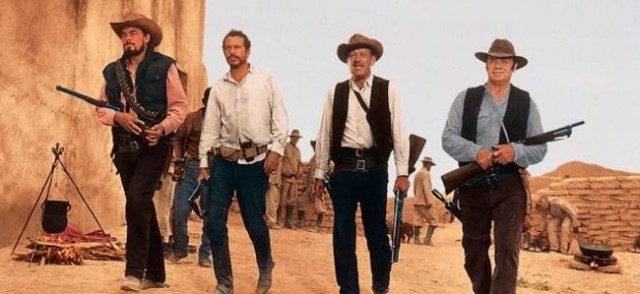
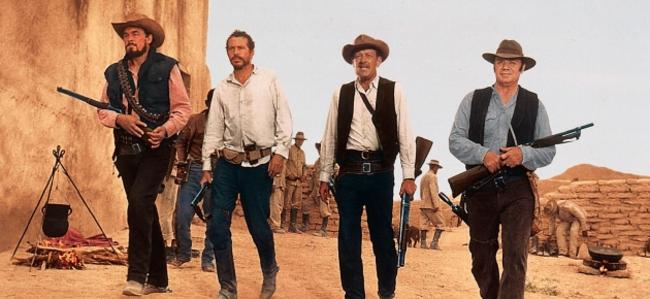
Ben Johnson, Warren Oates, William Holden, and Ernest Borgnine play friends to the bloody end in THE WILD BUNCH
THE WILD BUNCH (Sam Peckinpah, 1969)
Film Society of Lincoln Center, Walter Reade Theater
165 West 65th St. between Eighth Ave. & Broadway
Thursday, March 31, 8:30, and Friday, April 1, 1:30
Series runs March 31 – April 7
212-875-5050
www.filmlinc.org
 Sam Peckinpah cemented his reputation for graphic violence and eclectic storytelling with the genre-redefining 1969 Western The Wild Bunch. When a robbery goes seriously wrong, Pike Bishop (William Holden), Dutch Engstrom (Ernest Borgnine), Freddie Sykes (Edmond O’Brien), Angel (Jaime Sánchez), and brothers Lyle (Warren Oates) and Tector Gorth (Ben Johnson) set out to get even, planning an even bigger score by going after a U.S. Army weapons shipment on a railroad protected by detective Pat Harrigan (Albert Dekker) and his hired gun, Deke Thornton (Robert Ryan), who is given nothing but “egg-suckin’, chicken-stealing gutter trash” to work with, including the hapless Coffer (Strother Martin) and T.C. (L. Q. Jones). The aging Pike, who sees this as his last score, is worried about being in cahoots with the unpredictable General Mapache (Emilio Fernández), a local warlord battling Pancho Villa’s freedom forces. But at the center of the film is the cat-and-mouse game between Pike and Thornton, the latter determined to capture his former partner, who left him to rot in jail years earlier. It all comes to a head in Agua Verde, which might translate to “Green Water” but will soon be bathed in red blood in one of the most violent shoot-outs ever depicted on celluloid.
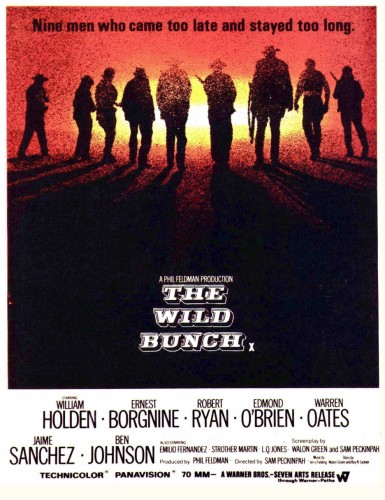
Peckinpah fills the film with plenty of drinking and whoring, and even torture, while exploring friendship and loyalty, embodied by Dutch’s selfless dedication to Pike. The Wild Bunch might be famous for its intense violence, much of it shot in slow motion, but it also has a lot more going for it, from its Oscar-nominated score by Jerry Fielding to its terrific cast and suspenseful twists and turns. (Western fans might get a kick out of knowing that Mapache’s right-hand man, Lt. Herrera, is portrayed by Mexican actor and director Alfonso Arau, who later played El Guapo in John Landis’s comic Western The Three Amigos.) The Wild Bunch is screening March 31 (introduced by Garner Simmons, author of Peckinpah: A Portrait in Montage) and April 1 in the fabulously titled Film Society of Lincoln Center series “Bring Me the Head of Sam Peckinpah,” which includes all of the major movies made by the iconoclastic director, who died in 1984 at the age of fifty-nine. Also in the series, which continues through April 7, are The Ballad of Cable Hogue, Bring Me the Head of Alfredo Garcia, Cross of Iron, The Deadly Companion, The Getaway, Junior Bonner, The Killer Elite, Convoy, Major Dundee, The Osterman Weekend, Pat Garrett and Billy the Kid, Ride the High Country, and the unforgettable Straw Dogs, works that feature performances by such stars as Steve McQueen, Maureen O’Hara, Dustin Hoffman, Charlton Heston, Ali McGraw, Joel McCrea, Randolph Scott, Bob Dylan, James Coburn, Robert Preston, Ida Lupino, Kris Kristofferson, Warren Oates, Jason Robards, Susan George, James Caan, and Robert Duvall.

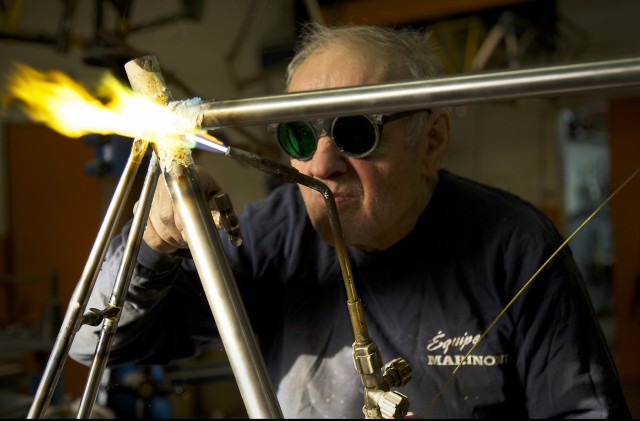
 In Tony Girardin’s debut feature-length documentary, Marinoni: The Fire in the Frame, friends and colleagues of Giuseppi Marinoni’s describe the Italian Canadian cycling legend as “explosive,” “authentic,” “iconoclastic,” “hard-headed,” and “cantankerous,” and the film shows him to be all that and more. Born in Bergamo, Italy, in 1937, Marinoni became a champion cyclist in his home country, then moved to Montreal in the mid-1960s after participating in races there. After he retired from racing, he turned his attention to building bicycle frames, training in Italy with Mario Rossin before opening his own business in Montreal in 1974, where he gained renown as a master craftsman. But he doesn’t necessarily like to talk about his life and career; it took the Montreal-based Girardin three years to convince Marinoni to agree to be filmed, and it’s clear that the septuagenarian is never fully comfortable being onscreen, whether building one of his coveted frames — he’s made more than thirty thousand, all by hand — or training to break the hour record for his age group, seventy-five to seventy-nine, a solo competition in which a cyclist attempts to go the farthest distance in sixty minutes. “Marinoni embodies what I love most about cycling: passion,” Girardin says at the start of the film. “It’s a culmination of life, love, and many things, but ultimately the challenge is to ride as far as is humanly possible.” Marinoni might never warm up to the camera — “You watching me is stressful!” he says to Girardin in French (he also speaks Italian but not English) — but other cyclists, promoters, and bike shop owners can’t wait to gush over how much they admire the man and his frames. Among those singing his praises are Andy Lamarre, Colette Pépin, Ken MacDonald, Julie Marceau, Federico Corneli, Marian Jago, Charle Lamarre, Marissa Plamondon-Lu, and Rossin.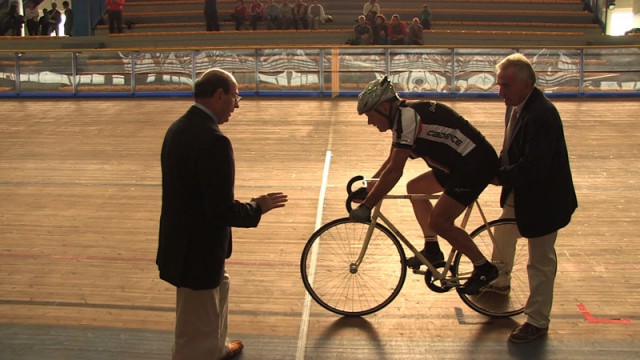
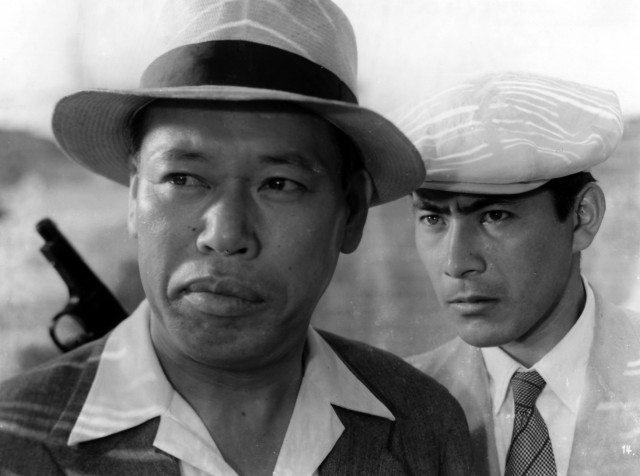
 Akira Kurosawa’s thrilling police procedural, Stray Dog, is one of the all-time-great film noirs. When newbie detective Murakami (Toshirō Mifune) gets his Colt lifted on a trolley, he fears he’ll be fired if he does not get it back. But as he searches for the weapon, he discovers that it is being used in a series of robberies and murders — for which he feels responsible. Teamed with seasoned veteran Sato (Takashi Shimura), Murakami risks his career — and his life — as he tries desperately to track down his gun before it is used again. Kurosawa makes audiences sweat, showing postwar Japan in the midst of a brutal heat wave, with Murakami, Sato, dancer Harumi Namiki (Keiko Awaji), and others constantly mopping their brows — the heat is so palpable, you can practically see it dripping off the screen. (You’ll find yourself feeling relieved when Sato hits a button on a desk fan, causing it to turn toward his face.) In his third of sixteen films made with Kurosawa, Mifune plays Murakami with a stalwart vulnerability, working beautifully with Shimura’s cool, calm cop who has seen it all and knows how to handle just about every situation. (Shimura was another Kurosawa favorite, appearing in twenty-one of his films.)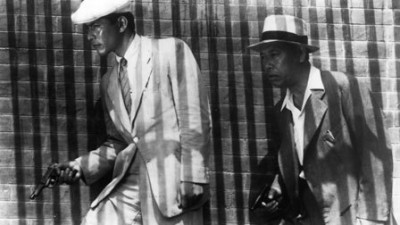

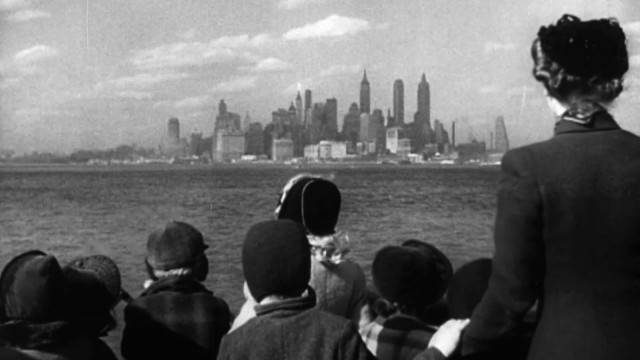
 After screening in January at the twenty-fifth annual New York Jewish Film Festival, Projections of America will be shown on March 29 as part of the JCC in Manhattan series “CineMatters: Films at the JCC,” which focuses on works that deal with social justice and action. In Projections of America, director Peter Miller takes a revealing look at a little-known part of the U.S. propaganda effort during WWII, detailing how the U.S. Office of War Information used specially made short documentary films to show the rest of the world the positive aspects of the American way of life, particularly as U.S. soldiers helped liberate many cities and countries in Eastern and Western Europe. “The films were idealized versions of what America could be, created by politically engaged filmmakers who, while fighting tyranny abroad, wanted also to fundamentally change America itself,” narrator John Lithgow explains. At the center of it all was Oscar-winning screenwriter Robert Riskin, who had written eight Frank Capra films, including It Happened One Night, Mr. Deeds Goes to Town, and Meet John Doe. Riskin, fellow scribe and chief of production Philip Dunne (How Green Was My Valley, The Ghost and Mrs. Muir), and Pulitzer Prize-winning playwright, screenwriter, and FDR speech writer Robert E. Sherwood (The Petrified Forest, Abe Lincoln in Illinois) enlisted such directors and producers as John Houseman and Josef von Sternberg and such stars as Ingrid Bergman in making such short propaganda films as Swedes in America, Cowboys, Steel Town, The Valley of the Tennessee, and Watchtower over America, which people flocked to in Europe, North Africa, and even Germany. “It all came together as the greatest collection of filmmakers working toward one common goal that we will ever see,” notes film historian Cecile Starr.