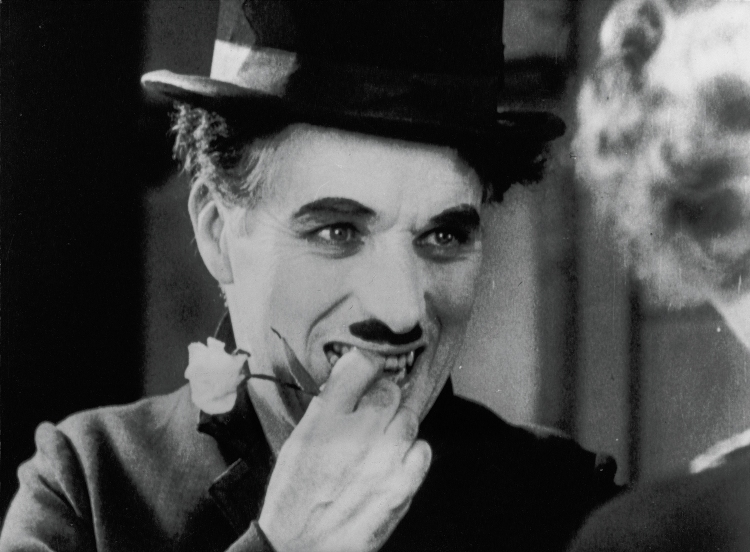
Charlie Chaplin is tickled that CITY LIGHTS is an IFC Center classic pick
WEEKEND CLASSICS: CITY LIGHTS (Charles Chaplin, 1931)
IFC Center
323 Sixth Ave. at West Third St.
April 29-30, May 1, 11:00 am
Series continues weekends through June 26
212-924-7771 www.ifccenter.com
A genuine American treasure, City Lights is one of Charlie Chaplin’s most thoroughly entertaining masterpieces. Serving as writer, director, editor, producer, and composer, Chaplin also stars as the Little Tramp, a destitute man who instantly falls in love upon seeing a blind Flower Girl (Virginia Cherrill). When she mistakes him for a millionaire with a fancy car, he decides to pretend to be rich so she might like him, but when he actually becomes pals with the business tycoon (Harry Myers), he thinks he might eventually be able to get the money for her to get a new operation that could restore her eyesight. The only problem is that the millionaire, who parties wildly with the Little Tramp every evening, taking him to ritzy nightclubs and even giving him his car at one point, remembers nothing the next morning, and doesn’t want anything to do with him. It all leads to an unforgettable conclusion that pulls at the heartstrings. Despite the availability of sound, Chaplin chose to make City Lights a silent picture, although he did incorporate sound effects and, in one section, distorted speech. Although the film features several hysterical slapstick bits, including the opening, when the Little Tramp is sleeping on a statue entitled “Peace and Prosperity” as it is unveiled, and a scene in which he saves the millionaire from a suicide attempt, virtually every minute comments on the social reality of depression-era America and the widening gap between the rich and the poor. Metaphors abound as the Little Tramp tries his best to maintain a smile and search out love during the bleakest of times. City Lights is screening at 11:00 am April 29, 30, and May 1 in the “Weekend Classics” film series “Classic IFC Center,” consisting of favorite films selected by the theater’s managers, projectionists, and floor staff; City Lights was chosen by administrative staffer Asha P., who notes, “If only one of Charles Chaplin’s films could be preserved, City Lights would come the closest….” The festival continues through June 26 with such other greats as Black Narcissus, Ace in the Hole, The Godfather, Shadow of a Doubt, and Loves of a Blonde.
Rarely screened 1983 documentary delves into Pina Bausch’s creative process (photo courtesy Icarus Films)
“ONE DAY PINA ASKED…” (UN JOUR PINA A DEMANDÉ) (Chantal Akerman, 1983)
BAMcinématek, BAM Rose Cinemas
30 Lafayette Ave. between Ashland Pl. & St. Felix St.
Thursday, April 28, 7:00 & 9:30
Series continues through May 1
718-636-4100 www.bam.org
In 1982, Belgian filmmaker Chantal Akerman followed Pina Bausch’s Tanztheater Wuppertal on a five-week tour of Europe as the cutting-edge troupe traveled to Milan, Venice, and Avignon. “I was deeply touched by her lengthy performances that mingle in your head,” Akerman says at the beginning of the resulting documentary, “One Day Pina Asked . . . ,” continuing, “I have the feeling that the images we brought back do not convey this very much and often betray it.” Akerman (Jeanne Dielman, 23 Quai du Commerce, 1080 Bruxelles; Je tu il elle) needn’t have worried; her fifty-seven-minute film, made for the Repères sur la Modern Dance French television series, is filled with memorable moments that more than do justice to Bausch’s unique form of dance theater. From 1973 up to her death in 2009 at the age of sixty-eight, Bausch created compelling works that examined the male-female dynamic and the concepts of love and connection with revolutionary stagings that included spoken word, unusual costuming, an unpredictable movement vocabulary, and performers of all shapes, sizes, and ages. Akerman captures the troupe, consisting of twenty-six dancers from thirteen countries, in run-throughs, rehearsals, and live presentations of Komm Tanz Mit Mir (Come Dance with Me),Nelken (Carnations),1980,Kontakthof, and Walzer, often focusing on individual dancers in extreme close-ups that reveal their relationship with their performance. Although Bausch, forty at the time, is seen only at the beginning and end of the documentary, her creative process is always at center stage. At one point, dancer Lutz Förster tells a story of performing George and Ira Gershwins’ “The Man I Love” in sign language in response to Bausch’s asking the troupe to name something they’re proud of. Förster, who took over as artistic director in April 2013, first performs the song for Akerman, then later is shown performing it in Nelken. (Bausch fans will also recognize such longtime company members as Héléna Pikon, Nazareth Panadero, and Dominique Mercy.)
Documentary includes inside look at such Tanztheater Wuppertal productions as NELKEN (photo courtesy Icarus Films)
As was her style, Akerman often leaves her camera static, letting the action occur on its own, which is particularly beautiful when she films a dance through a faraway door as shadowy figures circle around the other side. It’s all surprisingly intimate, not showy, rewarding viewers with the feeling that they are just next to the dancers, backstage or in the wings, unnoticed, as the process unfolds, the camera serving as their surrogate. And it works whether you’re a longtime fan of Bausch, only discovered her by seeing Wim Wenders’s Oscar-nominated 3D film Pina, or never heard of her. “This film is more than a documentary on Pina Bausch’s work,” a narrator says introducing the film. “It is a journey through her world, through her unwavering quest for love.” ”One Day Pina Asked…” is screening April 28 at 7:00 and 9:30 at BAM Rose Cinemas as part of the month-long BAMcinématek series “Chantal Akerman: Images between the Images,” which pays tribute to the influential, experimental director, who died in October 2015, reportedly by suicide; the earlier showing will be preceded by two Akerman shorts featuring cellist Sonia Wieder-Atherton, 2002’s Avec Sonia Wieder-Atherton and 1989’s Trois strophes sur le nom de Sacher. Not coincidentally, Bausch’s Tanztheater Wuppertal has been performing at BAM since 1984. The film series continues through May 1 with such other films by Akerman as La Captive, Jeanne Dielman, and From the East.
Actress, singer, and dancer Sophia Anne Caruso is taking New York City by storm (photo courtesy Sophia Anne Caruso)
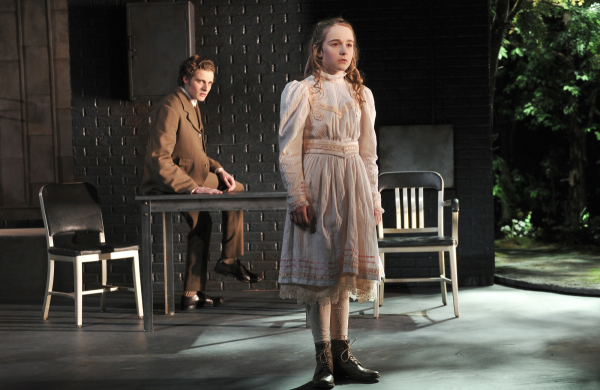
Multidimensional actress Sophia Anne Caruso might be just fourteen years old, but she already displays the confidence and demeanor of a seasoned pro — which she essentially is, having acted professionally nonstop for the last five years. Born and raised in Spokane and now living with her parents in New Jersey, Caruso came to New York for a project when she was eleven and decided to stay. In her brief but busy career, she has played Helen Keller in The Miracle Worker, in a production directed by Patty Duke, who originated the role on Broadway in 1959; starred as Birgitta in NBC’s The Sound of Music Live! opposite Carrie Underwood, Christian Borle, and Audra McDonald; appeared at the Kennedy Center with Boyd Gaines, Rebecca Luker, and Tiler Peck in the Susan Stroman-directed Little Dancer a musical about Edgar Degas and Marie van Goethem, the ballerina who posed for his famous “Little Dancer Aged Fourteen” painting; and played AnnaSophia Robb’s little sister in the Lifetime movie Jack of the Red Hearts.
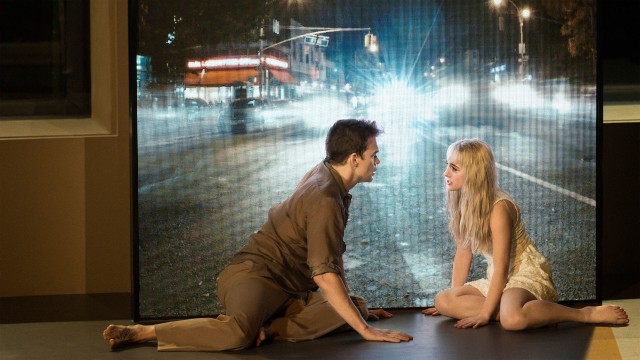
Here in New York City, she earned a Lucille Lortel nomination as Best Featured Actress in a Play for her performance as a young virtual reality fantasy figure for men in The Nether and a Lortel nod for Outstanding Lead Actress in a Musical and an Outer Critics Circle nomination for Outstanding Featured Actress in a Musical for Lazarus, playing the Girl in the New York Theatre Workshop world premiere by David Bowie and Enda Walsh, directed by Ivo van Hove. Currently she is on Broadway in a show that cannot be named, as a surprise character not listed in the Playbill and which cannot be mentioned in reviews. Sophia also just teamed with opera singer, ballet dancer, photographer, and musician Kenneth Edwards on a cover of Fleetwood Mac’s “The Chain” in the Elizabeth Street Garden. Homeschooled by her parents, Sophia likes ghost stories, has never been to a concert, and is hypercritical of herself, intent on mastering her craft. She is also charming, thoughtfully positive, and wise beyond her years; as she notes, “I was a morbid little child.” On a recent early weekday evening shortly before her call time, Sophia and I met in a Theater District hotel lounge and talked about vintage clothing, cast albums, stalkers, the freedom her parents give her, and how much she loves what she does.
twi-ny: You were born and raised in Spokane, Washington. Are you still partly based there?
Sophia Anne Caruso: My dad moved out here. He was still living in Spokane in our old house, but he finally sold it and moved here.
twi-ny: That must be great.
SAC: It’s a relief to have everyone together again. Long distance was hard for us, especially for me and my dad, because I’m a daddy’s girl.
twi-ny: What did you think of New York City when you first got here?
SAC: In Spokane, I got bored all the time, and it didn’t quite feel like home. But when I came here, I wasn’t scared, I wasn’t overwhelmed; it felt like home. Broadway, the theater area — the first show that I saw, when I was nine, was Billy Elliot, and I fell in love with theater. That’s when I knew, I want to move to New York and be on Broadway.
twi-ny: Around that time, in Seattle, you played Helen Keller in The Miracle Worker, directed by Patty Duke, who just passed away. What did you learn from her?
SAC: She gave me my very first real acting job; that’s when I fell in love with acting and I knew that I wanted to be an actress. Acting is my favorite thing to do, and she helped me realize that. She mentored me a little bit; at the time, I didn’t understand why she was sometimes harsh on me, but now, as an older me, I’m looking back, I’m thinking, that’s why. She taught me that I have to stay consistent, that when you’re doing a professional job, it’s to the centimeter. You have to be exact; it has to be perfect. She taught me that it’s not all fun and games, although a lot of it is. But it’s also my job.
twi-ny: Not to concentrate too much on death, but you were also in Lazarus, and while you were in the midst of the run, David Bowie died. What was that experience like?
SAC: I got to work with him directly; he came into rehearsals often, he gave me notes, we talked. I like to say that I knew him and that I collaborated with him, for sure. I was not aware of his illness; none of the cast was. His death came as a very big surprise to us, and the hard part, but also the good part, of the day after was that we were all together. We were recording our cast album, which was hard because our voices were in shock because of crying and the strain, but being there was bonding. Nothing would have been worse than staying home alone during that day, but we decided to do the cast album. We listened to the recording, and I think that there’s something so special about it.
Sophia Anne Caruso earned several award nominations for her role in LAZARUS opposite Michael C. Hall (photo by Jan Versweyveld)
twi-ny: In the show you sing “No Plan” and “Life on Mars.”
SAC: It’s an honor to sing his music. I’ve always been inspired by his music, and I’ve always loved it. My mom owned vintage stores, and she always had funky seventies stuff. She was always playing Bowie.
twi-ny: Your parents are clearly bringing you up with a certain amount of freedom to develop your own identity.
SAC: Yes, my family is sort of exceptional. My mom is not religious; she’s very free, she likes to travel. My dad is on the more right-wing side, but he has given me freedom to choose what I want, who hasn’t ever pushed me to go towards religion or anything else. They’ve really let me become who I am, who I want to be. They have let me have a lot of freedom, with my choices and my style. Like, I love vintage fashion, and maybe I don’t choose the most attractive clothes or what they would consider appropriate, but it’s me, and it’s what I love, and they support me. It’s a hard business to get through, and they have been there through everything. Nothing is better than having parents like that.
twi-ny: Regarding your choices, your last three plays in New York City were The Nether, about virtual reality and child abuse; Lazarus, in which you play a very complicated character who is no mere child; and now you’re on Broadway in a heavy play that we cannot mention by name because you play a surprise character. What draws you to those roles? And why do your parents let you do them? A lot of parents would say, “Uh-uh, no way.”
SAC: I personally think blondes make the best victims, in my opinion. [laughs] I have sort of become the go-to girl for those things, so they come to me. I chose to do The Nether because I think it’s a very important topic. I didn’t just do it because it’s edgy. I love that it was edgy and that it was out there, but what was most important to me was getting that message out there. If you look around [referring to other people in the lounge], he’s on a computer, he’s on his phone. There was this revealing moment: I was on the train, underground, and nobody was on their phone. We came aboveground, got service, and everybody got their phone out, and I was, like, “Oh my God, what has this world come to?” And that is what made me leap at The Nether. I was, like, I gotta do this show now.
twi-ny: You also played a scary part on Celebrity Ghost Stories.
SAC: I loved doing that! I thought it was so fun. They put me in these sort of seventies clothes, and they had this old haunted house in this very old neighborhood, and that was really fun for me. I try not to let the work affect me; I don’t think it does. I have a certain anxiety about it. Like with The Nether, a question that I ask myself now is, Did that inspire people to act those things, or did that prevent things? And that’s something that scares me as I get older; I think I didn’t have that problem as much when I was younger.
SAC: Both. I’ve had stalkers after The Sound of Music Live!, because that was very big, and I had a couple of strange stalkers after The Nether, but I ignore it. I just don’t respond to anything creepy and delete it immediately.
twi-ny: Does it affect your decision in what plays to do?
SAC: No, it doesn’t. That’s something that comes with being an actor or somebody who’s in the public eye. People become obsessed with your image, not who you are.
twi-ny: Did it scare you when it first happened?
SAC: I was never a sheltered kid, so it absolutely scared me a little bit. Because sheltered kids, they don’t know what happens, they don’t understand how bad the world is, and I always knew those things; my parents have always informed me on things. I watched the news as a kid, and I was never stupid; I knew how serious stalkers could be. And I now have people who protect me from that.
twi-ny: How does it feel to be making your Broadway debut in a show where you’re not in the main Playbill and you’re not allowed to be mentioned in reviews?
SAC: Does it bug me?
twi-ny: Right. You can’t tell people what you’re doing.
SAC: It doesn’t bother me. I’m part of creating a great piece of art, and that’s all that really matters to me. And the fact that I get to go out on the stage and do something, that I’m in the theater. It’s just when I’m not in the theater that I’m miserable. When I’m not working, I’m miserable. But I’m honored to be working with fantastic actors. All that really matters to me is I’m part of telling an important story.
twi-ny: You posted a very interesting picture on Instagram recently in which you’re holding up a bunch of very adult plays that you were getting ready to read, including Equus, This Is Our Youth, and Killer Joe, and you even mentioned in the comments that Sarah Kane is your favorite playwright. Obviously, you’re drawn to this type of material.
SAC: Yes, I am drawn to it. People say that I have a dark sense of humor and I have deep thoughts, and I do, but I like to challenge my mind too. So Sarah Kane is something . . . At first, it takes me a minute to wrap my mind around it. When I finish reading the play, it’s one of those things where it makes me think as an actor. So I like to read those plays because I think it helps make me become a better actor. I don’t ever use them for auditions, but I do a couple of Sarah Kane monologues. . . . . For me, at least, I go to the theater to feel, not to be entertained all the time.
twi-ny: You did Little Dancer, about Degas, at the Kennedy Center. Did you become interested in his work at all, or is that separate?
SAC: When I was doing it, in the rehearsal room we always had prints of his pictures on the wall, and it really inspired the piece. There would be certain moments in the show where there would be a beat in the music and [director Susan Stroman] would say, “Hit the Degas pose.” So we would look at the dancers [in the paintings] and we would make that exact pose.
twi-ny: You’re fourteen, and you’ve already worked with Audra McDonald, Carrie Underwood, Michael C. Hall, Bernadette Peters, Famke Janssen, David Bowie, Susan Stroman, Ivo van Hove, Karen Ziemba, John Oliver, Anne Kauffman; that’s a pretty impressive list for anyone, but especially for a young teenager.
SAC: Age is just a number. I don’t really see myself as my age. I feel very special to have worked with them, but I think of them as equals; I don’t think of them as stars. I think of them as brilliant minds and things, but I don’t think much of it, to be frank, and I try not to make too much of it because then I psyche myself out and get all weird about it, and I get anxious when I’m around someone like that.
twi-ny: You can’t be a fan; you’re a colleague.
SAC: Yeah. That’s the thing that was hard for me with Michael Hall. I was such a fan, ’cause I watched his work on Dexter and Six Feet Under and I loved that stuff. I had so many questions to ask him, and I was ready to talk, because he inspires me as an actor, but I had to not picture him as Dexter anymore; I had to picture him as [his Lazarus character] Thomas Newton and Michael, my friend. I mean, that wasn’t really a struggle, but it was interesting to navigate through that.
twi-ny: What is it like working with van Hove?
SAC: One of my very favorite directors. He taught me this thing that I’ve used from then on, which was, the first day, you go in memorized. It’s so smart, too. Because then you can just focus on the acting and what you want to do. You don’t have to worry about holding a paper or looking down at your notes on the paper. That was one of my bad habits. [In the past] I would have all my notes on the paper and I would look at them. Between every scene I would be like, I have to remember this, I have to remember that. But on the first day of rehearsals [for Lazarus], I had my notes on all my papers, and Ivo goes, “You don’t need this,” and I never got my papers back.
twi-ny: He took them away from you?
SAC: Yeah. I got rid of the papers and he let my instincts fly and that was it.
twi-ny: What else is coming up?
SAC: I’m scheduled to do Runaways by Elizabeth Swados for Encores. I actually was looking through records today and I found this vinyl of the original cast album and I was like, “I need this!”
Karidja Touré is extraordinary as a teenager desperate to make a better life for herself in GIRLHOOD
GIRLHOOD (BANDE DE FILLES) (Céline Sciamma, 2014)
French Institute Alliance Française, Florence Gould Hall
55 East 59th St. between Madison & Park Aves.
Tuesday, April 26, $14, 4:00 & 7:30
212-355-6100 www.fiaf.org strandreleasing.com
FIAF’s two-month CinéSalon series “EDM Anthems: French Touch on Film” comes to a poignant conclusion April 26 with Céline Sciamma’s sensitive, gripping, award-winning Girlhood. In her outstanding film debut, Karidja Touré earned a César nomination as Most Promising Actress for playing Marieme, a sixteen-year-old girl who is trying to find a workable path to a worthwhile adulthood but is continually thwarted by socioeconomic and cultural issues. Marieme wants to go to college, but a guidance counselor tells her that her grades aren’t good enough and that she should instead choose a vocational school. She’s clearly bright, but she has to spend much of her time taking care of her younger sisters while her mother works as a cleaning lady and her lazy older brother, Djibril (Cyril Mendy), plays video games and keeps a tight watch on the women in the family. Distressed by her options as a young black woman in France, Marieme starts hanging out with a gang of tough girls led by Lady (Assa Sylla), who christens Marieme “Vic” for victory. Vic, Lady, Adiatou (Lindsay Karamoh), and Fily (Mariétou Touré) battle other small gangs, head to the city to steal fancy clothing, and flirt with the local boys in the Parisian suburbs of Bagnolet and Bobigny. Vic is attracted to Ismaël (Idrissa Diabaté), a friend of Djibril’s who is hesitant to get involved with her, but the two soon start a kind of relationship. Amid gang fights, drug dealing, neighborhood gossip, and romantic entanglements, Vic desperately searches for her identity and refuses to give up on her dreams.
Sciamma never takes the easy way out in this fresh and potent coming-of-age story. Girlhood is beautifully photographed by Crystel Fournier, who also shot Sciamma’s Water Lilies and Tomboy, using a vibrant palette to illuminate the girls’ strong emotions. The pulsating electronic soundtrack by Para One, aka Jean Baptiste de Laubier, adds to the emotional upheavals experienced every day by the characters. Karidja Touré and Assa Sylla have a terrific chemistry; the film really comes alive when they are together, through good times and bad. And despite the serious subject matter, Sciamma also lets things get loose and crazy, like when the four girls dance to Rihanna’s “Diamonds” in a hotel room. Girlhood doesn’t go out of its way to make any overt political statements about race, poverty, or the aftermath of colonialism; instead it is an intelligent, deeply moving story of one girl who is unwilling to sacrifice her power and settle for less than what she wants. The film is screening at FIAF on April 26 at 4:00 and 7:30, with the later showing introduced by DJ Bearcat.
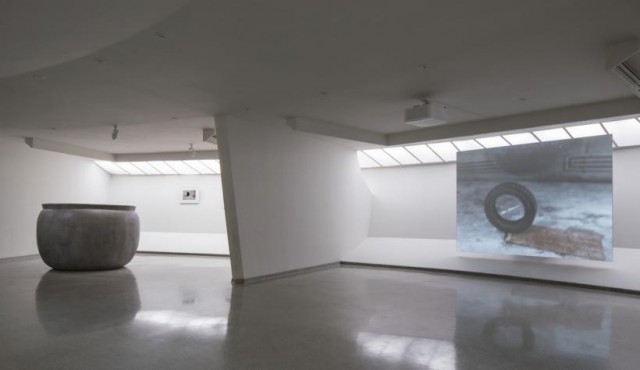
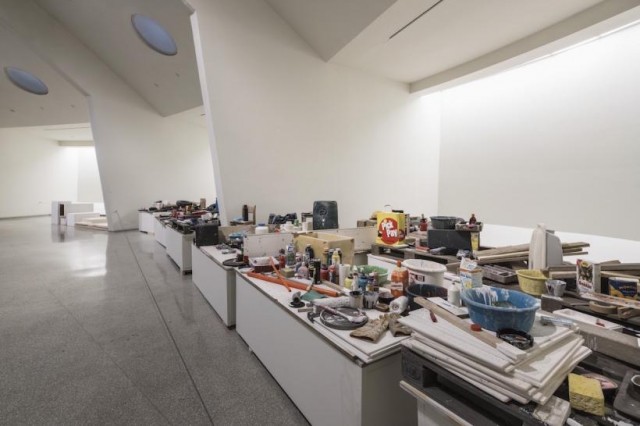
Peter Fischli and David Weiss’s engaging, subversive DIY style is on full display in their first major museum retrospective, “How to Work Better,” on view at the Guggenheim through April 27. Known as Fischli/Weiss, the Zürich-born artists began their long collaboration in the late 1970s, continuing through Weiss’s death in 2012 at the age of sixty-five. The duo specialized in reimagining everyday objects, using synthetic rubber, unfired clay, and polyurethane, with a kitschy sense of humor. The exhibition pairs series from throughout their career, bringing together disparate elements to create a dialogue that gets to the heart of their method and process as they investigate form and structure. The sculptures of “Walls, Corners, and Tubes” are seen with “Kanalvideo,” a psychedelic trip through the sewers of Zürich. “Cars” and “Hostesses” turn the titles into miniature representations in white plaster. One floor is dedicated to “Suddenly This Overview,” a collection of hundreds of unfired clay miniatures that they called “The Subjective Tableaux,” exploring the whole of human existence, featuring such works as “Mick Jagger and Brian Jones Going Home Satisfied after Composing ‘I Can’t Get No Satisfaction,’” “Panic in the Audience When Lumière Shows His Film,” and “The Russians Launch the First Rocket into Space.” Fischli and Weiss essentially re-created their studio in numerous polyurethane installations, crafting art materials, soda cans, cleaning supplies, jars of food, and other objects out of polyurethane, forcing viewers to questions everything they see.
The duo asks its own questions in “Question Projections,” in which a seemingly endless stream of inquiries are projected onto a dark wall, asking, among other things, “Is it more important for the world or for me to be doing well?,” “Why does nothing never happen?,” “Where are all those rats coming from?,” and “Is hunger an emotion?” The survey also highlights Fischli and Weiss’s films starring their alter egos, Rat and Bear — Order and Cleanliness, The Least Resistance, and The Right Way — in addition to their most popular work, The Way Things Go, a thirty-one-minute video in which everyday objects, from tires, bottles, and balloons to ladders, candles, and garbage bags, form a supposedly seamless chain reaction that is actually made up of twenty-three shots. Among the other series and installations accumulated in “How to Work Better,” which was initiated while Weiss was still alive, are “Visible World,” “The Raft,” “Sausage Series,” and “Fotografías,” celebrating the full range of the artists’ oeuvre. “Fischli and Weiss deliberately drew attention to the intersection of art and manual labor throughout their practice,” curator Nancy Spector writes in the catalog. “Even though they consistently presented themselves as carefree observers of the world at large . . . the artists also slyly exposed the concerted effort behind their artmaking.” But most of all, “How to Work Better” is fun. In conjunction with the show, the text-based wall mural “How to Work Better” can be seen on the corner of Houston and Mott Streets through May 1; the Public Art Fund project offers ten pieces of advice, including “Do one thing at a time,” “Learn to ask questions,” and “Accept change as inevitable.” On Monday, April 25, Fischli, who will turn sixty-four in June, will deliver a talk at the New School about his and Weiss’s public works, one of which stands outside the Guggenheim: “Haus,” an inviting structure that offers no way inside.
Subjects must hide their identity in documentary about gay Orthodox and Hasidic Jews
TREMBLING BEFORE G-D (Sandi Simcha DuBowski, 2001) IFC Center
323 Sixth Ave. at Third St.
Tuesday, April 26, 7:30
Series continues Tuesdays and/or Thursdays through May 31
212-924-7771 www.tremblingbeforeg-d.com stfdocs.com
Being gay and an Orthodox Jew just doesn’t mix. Sandi Simcha DuBowski’s award-winning documentary, Trembling Before G-d, takes a close look at gay Orthodox and Hasidic Jews in Brooklyn, Miami, Jerusalem, and London who are either rejected by their religious community or remain hidden in the closet, unable to express in public who they are. Many of the subjects use fake names and are shot in silhouette or by a handheld camera that never shows their full faces, in order to protect their identity; these powerful images get right to the heart and soul of the matter. The naysayers point out that the Bible clearly states that homosexuality is wrong, and they still believe that gays can be “cured” through therapy and atonement ceremonies for sexual sins or by eating figs. The film is having a special fifteenth-anniversary screening at the IFC Center as part of the Stranger than Fiction series and will be followed by what should be a lively and fascinating Q&A with DuBowski and subjects Rabbi Steve Greenberg, Michelle, Naomi, and Mark that should explore whether anything has changed in the last decade and a half. The series continues through May 31 with such other documentaries as Lynn True’s In Transit, Holly Morris’s The Babushkas of Chernobyl, and Ido Haar’s Presenting Princess Shaw, with Princess Shaw present for a Q&A.
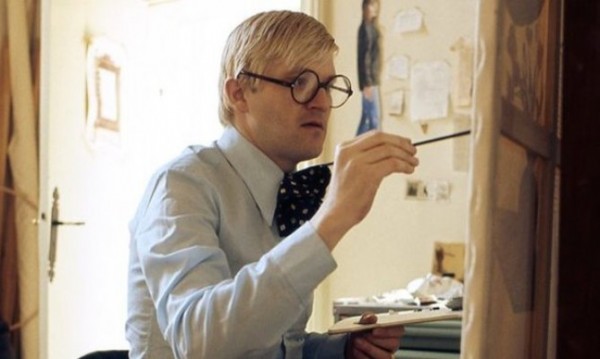
Documentary celebrates the life and career of British artist David Hockney
HOCKNEY (Randall Wright, 2015) Metrograph, 7 Ludlow St. between Canal & Hester Sts., 212-660-0312 Film Society of Lincoln Center, Francesca Beale Theater, Walter Reade Theater,
West 65th St. between Amsterdam Ave. & Broadway
Opens Friday, April 22 hockneyfilm.tumblr.com
“Why are you popular?” artist David Hockney is asked in an old interview in the 2014 documentary Hockney. “I’m not that sure,” the painter and photographer answers with a laugh. “I’m interested in ways of looking, because people will respond. Everybody does look; it’s just a question of how hard.” Award-winning director Randall Wright, who in 2002 made David Hockney: Secret Knowledge, examining the artist’s theories about the use of cameras and photographic-like visualization techniques in art going back centuries, this time takes a loving, more wide-ranging look at Hockney’s professional and personal worlds. Combining new interviews with old footage and home movies and photographs from Hockney’s private archives — which have never been made public before — Wright reveals Hockney to be an absolutely charming and engaging man with a genuine passion for life but not without his demons. “The paintings all related, whether superficially or intensely, on his life, and his trying to deal with his homosexuality, and trying to deal with his fantasies, and trying to deal with the issues of a sexual identity,” fellow British artist and longtime Hockney friend Mark Berger explains. “And he used wit to play with these identities. He was really like a little high school girl about it.” Wright and cinematographer Patrick Duval insert beautiful shots of many of Hockney’s paintings, slowly moving over the canvases as Hockney and, often, the subjects being depicted discuss them. Among the glorious works shown, from portraits and realistic paintings to more experimental, surreal, and abstract pieces, are “A Bigger Splash,” “Portrait of My Father,” “Christopher Isherwood and Don Bachardy,” “We Two Boys Together Clinging Together,” “Picture of a Hollywood Swimming Pool,” “Beverly Hills Housewife,” “Celia with a Foot on a Chair,” and such Polaroid composites as “Still Life Blue Guitar 4th April 1982.”
David Hockney opens up his personal archives for illuminating documentary
The film reveals Hockney to be a Warholian-like figure with a much more open and fun-loving personality — complete with odd glasses, bottle-blonde hair with bangs, and a love of photography — enjoying the party life as he goes from his hometown, “dingy Bradford” in England, to New York and Los Angeles; he currently lives in England and California and still paints seven days a week at the age of seventy-eight. It’s quite a thrill to see Hockney at work in his studios, putting brush to canvas. “I paint what I like and when I like” is one of numerous Hockney quotes that Wright uses on title cards, setting them on different monochrome backgrounds and interspersing them throughout the film. Wright (Lucian Freud: A Painted Life) also explores in-depth Hockney’s relationships with such friends and/or lovers as Peter Schlesinger and Henry Geldzahler. One drawback is that the director identifies his interview subjects, Hockney’s friends, colleagues, and relatives, only by name, so it is not always clear what their relationship to the artist is; most viewers are not likely to know who Bachardy, Arthur Lambert, Tchaik Chassay, Melissa North, Wayne Sleep, John Kasmin, or even Ed Ruscha and Jack Larson are or how Margaret Hockney is related to David. (Larson is the recently deceased actor who played Jimmy Olsen on the Superman television series and became a collector of Hockney’s work, while Margaret is David’s sister.) But that’s only a minor quibble in a wonderful documentary that celebrates not only the artist but his work and process, which comes alive on the screen, digital technology allowing the paintings and photographs to pop with their brilliant colors. If you didn’t appreciate Hockney’s talent before, this documentary will change your mind about it. And if you already were a fan of him and his work, this film will make you love him even more.
 A genuine American treasure, City Lights is one of Charlie Chaplin’s most thoroughly entertaining masterpieces. Serving as writer, director, editor, producer, and composer, Chaplin also stars as the Little Tramp, a destitute man who instantly falls in love upon seeing a blind Flower Girl (Virginia Cherrill). When she mistakes him for a millionaire with a fancy car, he decides to pretend to be rich so she might like him, but when he actually becomes pals with the business tycoon (Harry Myers), he thinks he might eventually be able to get the money for her to get a new operation that could restore her eyesight. The only problem is that the millionaire, who parties wildly with the Little Tramp every evening, taking him to ritzy nightclubs and even giving him his car at one point, remembers nothing the next morning, and doesn’t want anything to do with him. It all leads to an unforgettable conclusion that pulls at the heartstrings. Despite the availability of sound, Chaplin chose to make City Lights a silent picture, although he did incorporate sound effects and, in one section, distorted speech. Although the film features several hysterical slapstick bits, including the opening, when the Little Tramp is sleeping on a statue entitled “Peace and Prosperity” as it is unveiled, and a scene in which he saves the millionaire from a suicide attempt, virtually every minute comments on the social reality of depression-era America and the widening gap between the rich and the poor. Metaphors abound as the Little Tramp tries his best to maintain a smile and search out love during the bleakest of times. City Lights is screening at 11:00 am April 29, 30, and May 1 in the “Weekend Classics” film series “Classic IFC Center,” consisting of favorite films selected by the theater’s managers, projectionists, and floor staff; City Lights was chosen by administrative staffer Asha P., who notes, “If only one of Charles Chaplin’s films could be preserved, City Lights would come the closest….” The festival continues through June 26 with such other greats as Black Narcissus, Ace in the Hole, The Godfather, Shadow of a Doubt, and Loves of a Blonde.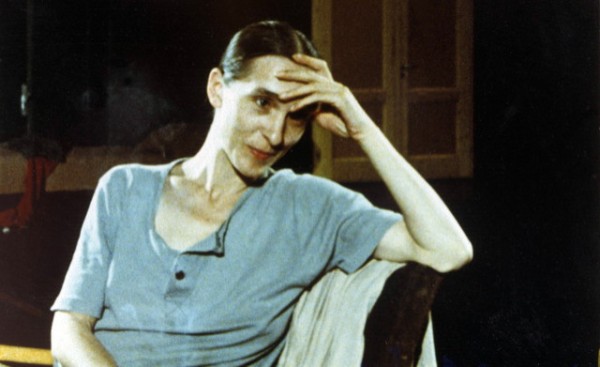
 In 1982, Belgian filmmaker Chantal Akerman followed Pina Bausch’s Tanztheater Wuppertal on a five-week tour of Europe as the cutting-edge troupe traveled to Milan, Venice, and Avignon. “I was deeply touched by her lengthy performances that mingle in your head,” Akerman says at the beginning of the resulting documentary, “One Day Pina Asked . . . ,” continuing, “I have the feeling that the images we brought back do not convey this very much and often betray it.” Akerman (Jeanne Dielman, 23 Quai du Commerce, 1080 Bruxelles; Je tu il elle) needn’t have worried; her fifty-seven-minute film, made for the Repères sur la Modern Dance French television series, is filled with memorable moments that more than do justice to Bausch’s unique form of dance theater. From 1973 up to her death in 2009 at the age of sixty-eight, Bausch created compelling works that examined the male-female dynamic and the concepts of love and connection with revolutionary stagings that included spoken word, unusual costuming, an unpredictable movement vocabulary, and performers of all shapes, sizes, and ages. Akerman captures the troupe, consisting of twenty-six dancers from thirteen countries, in run-throughs, rehearsals, and live presentations of Komm Tanz Mit Mir (Come Dance with Me), Nelken (Carnations), 1980, Kontakthof, and Walzer, often focusing on individual dancers in extreme close-ups that reveal their relationship with their performance. Although Bausch, forty at the time, is seen only at the beginning and end of the documentary, her creative process is always at center stage. At one point, dancer Lutz Förster tells a story of performing George and Ira Gershwins’ “The Man I Love” in sign language in response to Bausch’s asking the troupe to name something they’re proud of. Förster, who took over as artistic director in April 2013, first performs the song for Akerman, then later is shown performing it in Nelken. (Bausch fans will also recognize such longtime company members as Héléna Pikon, Nazareth Panadero, and Dominique Mercy.)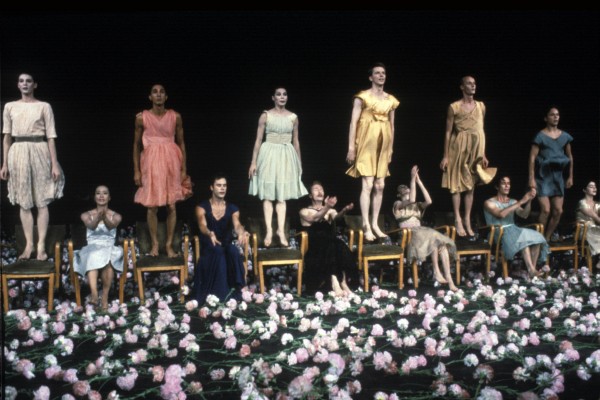



 Being gay and an Orthodox Jew just doesn’t mix. Sandi Simcha DuBowski’s award-winning documentary, Trembling Before G-d, takes a close look at gay Orthodox and Hasidic Jews in Brooklyn, Miami, Jerusalem, and London who are either rejected by their religious community or remain hidden in the closet, unable to express in public who they are. Many of the subjects use fake names and are shot in silhouette or by a handheld camera that never shows their full faces, in order to protect their identity; these powerful images get right to the heart and soul of the matter. The naysayers point out that the Bible clearly states that homosexuality is wrong, and they still believe that gays can be “cured” through therapy and atonement ceremonies for sexual sins or by eating figs. The film is having a special fifteenth-anniversary screening at the IFC Center as part of the Stranger than Fiction series and will be followed by what should be a lively and fascinating Q&A with DuBowski and subjects Rabbi Steve Greenberg, Michelle, Naomi, and Mark that should explore whether anything has changed in the last decade and a half. The series continues through May 31 with such other documentaries as Lynn True’s In Transit, Holly Morris’s The Babushkas of Chernobyl, and Ido Haar’s Presenting Princess Shaw, with Princess Shaw present for a Q&A.