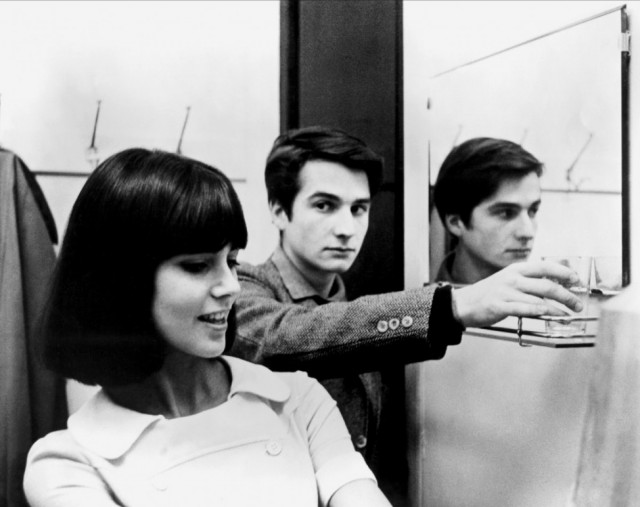
Paul (Jean-Pierre Léaud) has his eyes on the prize in Godard’s MASCULIN FÉMININ
MASCULIN FÉMININ (Jean-Luc Godard, 1966)
BAMcinématek, BAM Rose Cinemas
30 Lafayette Ave. between Ashland Pl. & St. Felix St.
Friday, May 6, 2:00 & 7:00
Series runs May 4-17
718-636-4100
www.bam.org
 In a 1966 interview with Pierre Daix about Masculin feminin, director Jean-Luc Godard said, “When I made this film, I didn’t have the least idea of what I wanted.” Initially to be based on the Guy de Maupassant short stories “The Signal” and “Paul’s Mistress,” the film ended up being a revolutionary examination of the emerging youth culture in France, which Godard identifies as “the children of Marx and Coca-Cola.” Godard threw away the script and worked on the fly to make the film, which stars Jean-Pierre Léaud as Paul, a peculiar young man who quickly becomes obsessed with budding pop star Madeleine, played by real-life Yé-yé singer Chantal Goya. (Godard discovered her on a television variety show.) Paul chases Madeleine, getting a job at the same company, going to the movies and nightclubs with her and her friends, and meeting her in cafés, where he wants to talk about the troubles of contemporary society and she just wants to have a good time. “Man’s conscience doesn’t determine his existence. His social being determines his conscience,” Paul proclaims. He continually argues that there is nothing going on even as strange events occur around him to which he is completely oblivious, including a lover’s spat in which a woman guns down a man in broad daylight. (Sounds of rapid-fire bullets can be heard over the intertitles for each of the film’s fifteen faits précis, evoking a sense of impending doom.) Paul has bizarre conversations with his best friend, Robert (Michel Debord), a radical who asks him to help put up anarchist posters. Posing as a journalist, Paul brutally interviews Miss 19 (Elsa Leroy), a young model with a very different view of society and politics. Godard has also included a playful battle of the sexes in the center of it all: Paul wants Madeleine, much to the consternation of Madeleine’s roommate, Elisabeth (Marlène Jobert), who also has designs on her; meanwhile, Robert goes out with another of Madeleine’s friends, the more grounded Catherine (Catherine-Isabelle Duport), who is interested in Paul. It all makes for great fun, taking place in a surreal black-and-white world dominated by rampant consumerism.
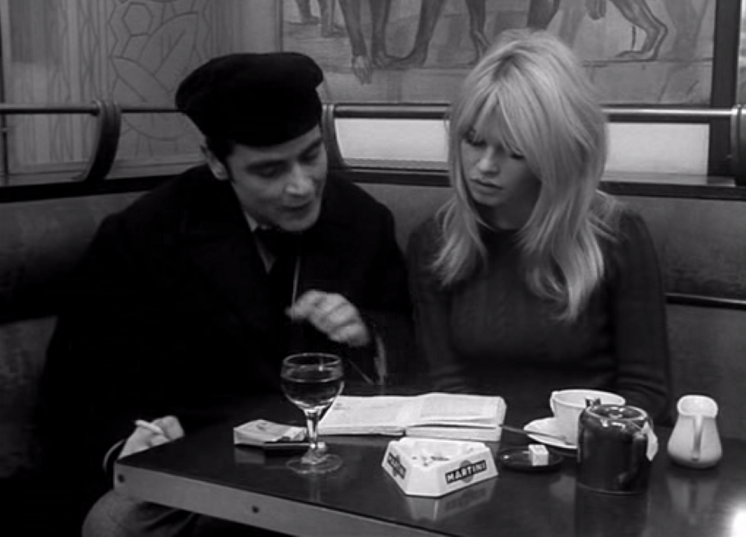
Brigitte Bardot makes an unexpected cameo in MASCULIN FÉMININ
In addition, Godard comments on the state of cinema itself. As they watch a Bergman-esque Swedish erotic film (directed by Godard and starring Eva-Britt Strandberg and Birger Malmsten), Paul dashes off to the projectionist, arguing that the aspect ratio is wrong. And in a café scene, French starlet Brigitte Bardot and theater director Antoine Bourseiller sit in a booth, playing themselves as they go over a script, bringing together the real and the imaginary. “I no longer have any idea where I am from the point of view of cinema,” Godard told Daix. “I am in search of cinema. It seems to me that I have lost it.” Well, he apparently found it again with the seminal Masculin feminin, which is screening with Agnès Varda’s 1975 eight-minute short, Women Reply: Our Bodies Our Sex, on May 6 in the BAMcinématek series “Labor of Love: 100 First Dates.” The festival, inspired by Moira Weigel’s new book, Labor of Love: The Invention of Dating, consists of great date flicks that are also about searching for a significant other. The lineup also features such favorites as Nora Ephron’s You’ve Got Mail paired with Edwin S. Porter’s 1904 How a French Nobleman Got a Wife through the New York Herald, Richard Brooks’s Looking for Mr. Goodbar, William Friedkin’s Cruising, Max Ophüls’s La Ronde, and Mary Harron’s American Psycho. Be careful which film you choose to see if you’ll be taking a date, as it will reveal a whole lot about you….
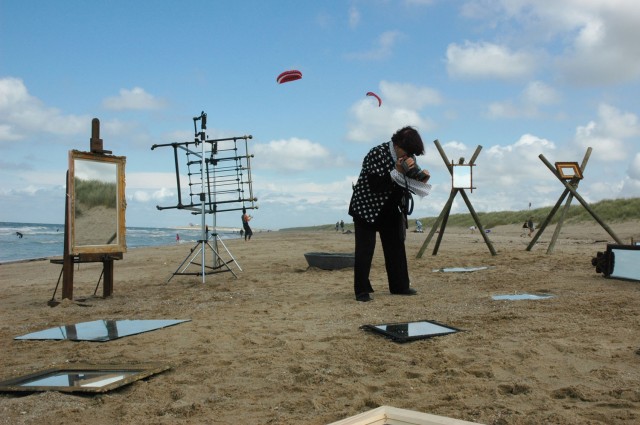
 “The whole idea of fragmentation appeals to me,” filmmaker, photographer, and installation artist Agnès Varda says in the middle of her unusual cinematic autobiography, the César-winning documentary The Beaches of Agnès. “It corresponds so naturally to questions of memory. Is it possible to reconstitute this personality, this person Jean Vilar, who was so exceptional?” She might have been referring to her friend, the French actor and theater director, but the exceptional Belgian-French Varda might as well have been referring to herself. Later she explains, “My memories swarm around me like confused flies. I hesitate to remember all that. I don’t want to.” Fortunately for viewers, Varda (Jacquot de Nantes, The Gleaners and I) does delve into her past in the film, sharing choice tidbits from throughout her life and career, in creative and offbeat ways that are charmingly self-effacing. Using cleverly arranged film clips, re-creations, photographs, and an array of frames and mirrors, the eighty-year-old Varda discusses such colleagues as Jean-Luc Godard, Chris Marker, and Alain Resnais; shares personal details of her long relationship with Jacques Demy; visits her childhood home; rebuilds an old film set; speaks with her daughter, Rosalie Varda, and son, Mathieu Demy; talks about several of her classic films, including La Pointe Courte,


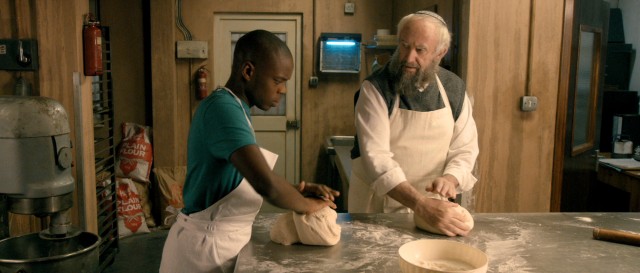
 John Goldschmidt’s Dough is a sweet-natured, goodhearted buddy movie that can’t quite escape its leavened story, never quite rising to its potential. (Pardon the puns, but the film opens in New York City during Passover, when observant Jews cannot eat bread products made with yeast.) The great Jonathan Pryce stars as Nat Dayan, a kosher baker in London’s East End who specializes in bagels, challah, and muffins for a devoted but dwindling clientele. When a large chain supermarket moves in next door, ruthless developer Sam Cotton (Philip Davis) hires away Nat’s assistant in a direct attempt to force him out of business. Desperately seeking a new employee — and regularly expressing disappointment that his son, Stephen (Daniel Caltigirone), chose a law career over the family legacy — Nat agrees to hire Ayyash (Jerome Holder), the teenage son of his cleaning woman, Darfur refugee Safa (Natasha Gordon). Ayyash is a low-level drug dealer trying to make a good impression on Victor (Ian Hart), the brutal, violent local drug kingpin. The white and Jewish Nat and the black and Muslim Ayyash mix like, well, oil and water at first as the former teaches the latter how to bake, but when Ayyash accidentally drops some pot into the dough mixer, customers go crazy for the resulting challah, giving renewed energy to Nat and his customers. Meanwhile, the old curmudgeon is being courted by the recently widowed Joanna Silverman (Pauline Collins), the bakery’s landlady.