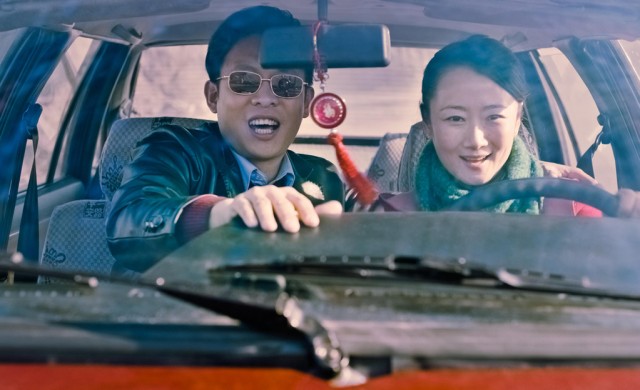
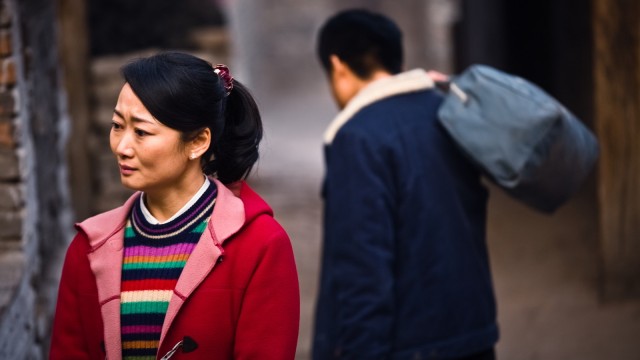
Zhang Jinsheng (Zhang Yi) shows his love for Shen Tao (Zhao Tao) in materialistic ways in Jia Zhangke’s MOUNTAINS MAY DEPART
Anthology Film Archives
32 Second Ave. at Second St.
May 23-29
212-505-5181
anthologyfilmarchives.org
In conjunction with the theatrical premiere of Walter Salles’s Jia Zhangke, a Guy from Fenyang, a documentary running May 27 through June 2 about the life and career of one of the leaders of China’s Sixth Generation of filmmakers, Anthology Film Archives is presenting three other works by the extraordinary writer-director, who goes back and forth between fiction and nonfiction (sometimes in the same film) while exploring the very real problems the Chinese people are facing in the massive transition to modernity. The Cannes Film Festival favorite has made such films as Platform, Unknown Pleasures, The World, Useless, 24 City, and I Wish I Knew; the Anthology series will show 2006’s Golden Lion-winning Still Life, 2013’s A Touch of Sin, and 2015’s Mountains May Depart.
MOUNTAINS MAY DEPART (SHAN HE GU REN) (Jia Zhangke, 2015)
Anthology Film Archives
Monday, May 23, 7:30, and Saturday, May 28, 4:30
www.kinolorber.com
 Master Chinese writer-director Jia Zhangke returned to the New York Film Festival last year with Mountains May Depart, a melancholic look at love and relationships in which one decision can change the rest of your life, as well as an allegory about China itself and its path in the world. Jia’s wife and muse, Zhao Tao, stars as Shen Tao, a flighty, flakey young woman flirting with coal miner Liangzi (Liang Jin Dong) and burgeoning capitalist Zhang Jinsheng (Zhang Yi) in 1999 China, the country on the cusp of an economic crisis. It’s easy to see the young woman’s romantic decision as a microcosm of China’s economic decisions, as the working class battles the wealthy elite, and the effects of both are profound. The setup is reminiscent of the love triangle at the center of François Truffaut’s Jules et Jim, but Jia takes it much further, continuing the story in 2014, and then into 2025, a bleak future where individual happiness is painfully elusive. Jia (Still Life, The World, 24 City) and his longtime cinematographer, Yu Lik-wai, shoot the three time periods in different screen ratios, exemplifying how much things evolve as Chinese capitalism and globalism take over, affecting — and disaffecting — the next generation. But the past is always snapping at the characters’ heels; much of the film takes place in the Yellow River basin, where ancient structures recall China’s history, and in Jia’s vision of the future, vinyl LPs are back in fashion (although handheld devices are much cooler). Music plays a key role in the film, primarily Sally Yeh’s Cantonese song “Take Care” and the Pet Shop Boys’ cover of the Village People’s “Go West,” the latter a title that gets to the heart of the film.
Mia (Sylvia Chang) takes stock of her complicated life in MOUNTAINS MAY DEPART
Zhao is marvelous as the bittersweet Shen, from singing at the colorful Fenyang Spring Festival Gala as the new millennium approaches to trying to restore her relationship with her son (Dong Zijian), who her husband insisted be named Dollar. Her eyes are filled with emotion as she proceeds on a course that was never what she dreamed. In the third section, Sylvia Chang shines as Mia, a sensitive, divorced teacher from Hong Kong who grows close to Dollar in a future world in which English has eclipsed Chinese, so fathers and sons literally do not speak the same language. Navigating the four physical sufferings of Buddhist thought — birth, old age, sickness, and death, Jia avoids showing many key moments in the lives of the characters, often leaving it up to the audience to uncover what has happened over the years and decades, which has a certain grace, although the ambiguous ending is more than a bit frustrating, even if it makes sense as a parable for China as a whole. But it’s all encapsulated in the briefest of kisses in a helicopter that will both brighten and break your heart. And keep an eye out for the guy with the Guangdong Broadsword.
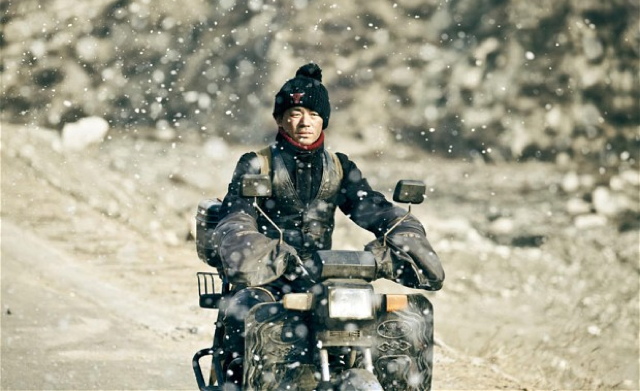
Zhao San (Wang Baoqiang) is one of four protagonists who break out into sudden acts of shocking violence in Jia Zhangke’s A TOUCH OF SIN
A TOUCH OF SIN (TIAN ZHU DING) (Jia Zhangke, 2013)
Anthology Film Archives
Tuesday, May 24, 7:30, and Sunday, May 29, 2:00
www.kinolorber.com
During his sixteen-year career, Sixth Generation Chinese filmmaker Jia Zhangke has made both narrative works (The World, Platform, Still Life) and documentaries (Useless, I Wish I Knew), with his fiction films containing elements of nonfiction and vice versa. Such is the case with his latest film, the powerful A Touch of Sin, which explores four based-on-fact outbreaks of shocking violence in four different regions of China. In Shanxi, outspoken miner Dahai (Jiang Wu) won’t stay quiet about the rampant corruption of the village elders. In Chongqing, married migrant worker and father Zhao San (Wang Baoqiang) obtains a handgun and is not afraid to use it. In Hubei, brothel receptionist Ziao Yu (Zhao Tao, Jia’s longtime muse and now wife) can no longer take the abuse and assumptions of the male clientele. And in Dongguan, young Xiao Hui (Luo Lanshan) tries to make a life for himself but is soon overwhelmed by his lack of success. Inspired by King Hu’s 1971 wuxia film A Touch of Zen, Jia also owes a debt to Max Ophüls’s 1950 bittersweet romance La Ronde, in which a character from one segment continues into the next, linking the stories. In A Touch of Sin, there is also a character connection in each successive tale, though not as overt, as Jia makes a wry, understated comment on the changing ways that people connect in modern society. In depicting these four acts of violence, Jia also exposes the widening economic gap between the rich and the poor and the social injustice that is prevalent all over contemporary China — as well as the rest of the world — leading to dissatisfied individuals fighting for their dignity in extreme ways. A Touch of Sin is a gripping, frightening film that earned Jia the Best Screenplay Award at Cannes.
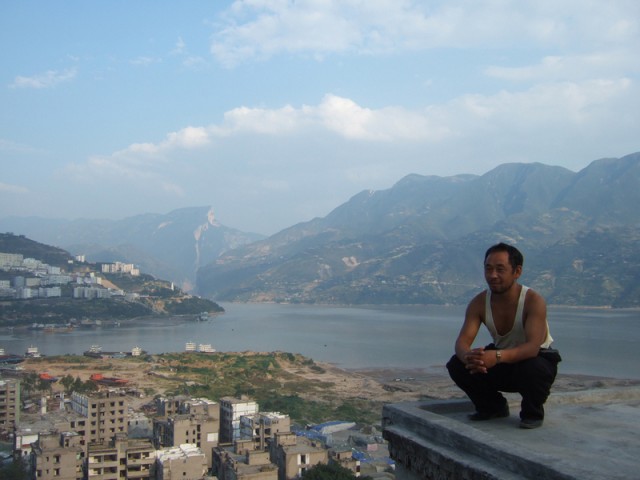
Jia Zhangke’s STILL LIFE examines displaced families caused by the construction of the Three Gorges Dam
STILL LIFE (SANXIA HAOREN) (Jia Zhangke, 2006)
Anthology Film Archives
Saturday, May 28, 2:00
Sunday, May 29, 4:45
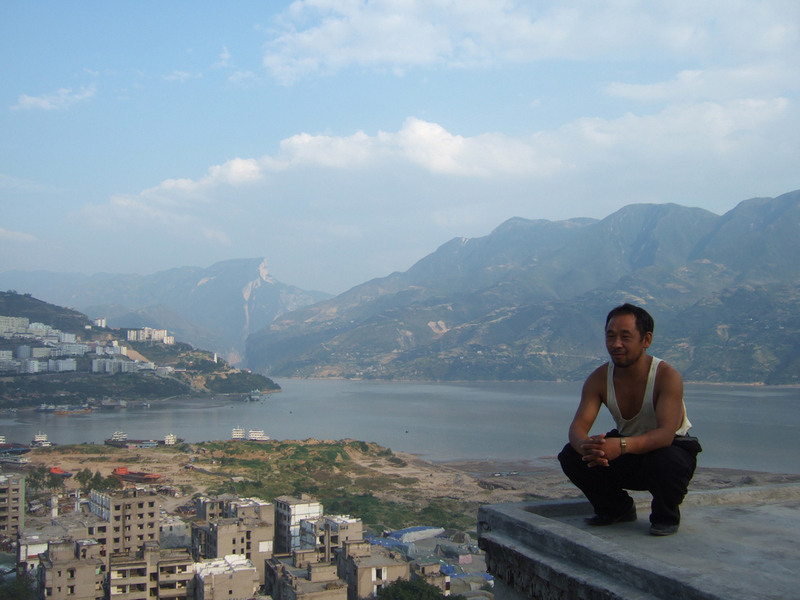
Sixth Generation Chinese film director Jia Zhangke won the Golden Lion for Best Film at the Venice Film Festival for the small gem Still Life, his beautiful, elegiac, documentary-like examination of displaced family. Jia sets his film around the ongoing, controversial Three Gorges Dam project, which has forced millions of residents from their homes. Han Sanming, a miner from Shanxi, arrives in the former town of Fengjie, looking for the daughter he hasn’t seen in sixteen years, since she was a baby. Meanwhile, a young nurse, Shen Hong (Zhao Tao), is seeking out her husband, a construction executive whom she hasn’t heard from in two years. Using nonprofessional actors, Jia (Platform, The World) tells their heartbreaking stories virtually in slow motion, with many scenes driven by Han’s tired eyes, featuring little or no dialogue. He gets a job helping tear down buildings, in direct contrast to his desire to rebuild his relationship with his long-lost family. Jia’s gentle camera reveals how China, in its quest for modernization and financial power, has left behind so many of its people, the heart and soul of the land that has literally been torn out from under them.
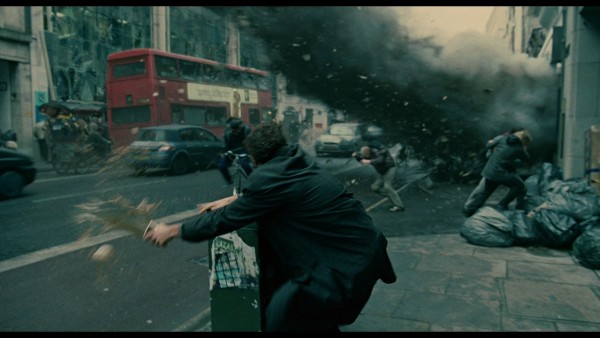
 It’s 2027, and there hasn’t been a baby born in the world in eighteen years. For some unknown reason, women have become infertile, leading to chaos around the globe. Only England perseveres, but it is on the brink of destruction as warring factions prepare for doomsday. Onetime revolutionary Theo (an as-even-keeled-as-ever Clive Owen) has settled down into a mundane life, but he’s thrust back into the middle of things when he is kidnapped by a radical organization run by his ex-wife, Julian (Julianne Moore), and her right-hand man, the hard-edged Luke (Chiwetel Ejiofor). Theo is forced to escort Kee (Claire-Hope Ashitey), a young fugee (refugee), through the danger zone and to the Human Project, a supposed safe haven that might not actually exist. Also staring extinction in the face are Theo’s brother, Nigel (Danny Huston); Theo’s hippie friend, Jasper (a longhaired Michael Caine); and homeland security officer Syd (Peter Mullan). Inspired by the novel by P. D. James, the chilling Children of Men is a violent, prescient, nonstop thrill ride, moviemaking of the highest order, cowritten and directed by Alfonso Cuarón (Y Tu Mamá También, Gravity) and photographed in vibrant filth and muddiness by Emmanuel Lubezki (Birdman, The Tree of Life). Nominated for three Academy Awards (Best Cinematography, Best Film Editing, Best Adapted Screenplay), Children of Men is one of the best of the dystopian science fiction films of the twenty-first century, predicting a future that is not as impossible as one might think. Stay through the credits for a tiny but critical coda. Children of Men is screening May 28 and 29 at 11:30 am as part of the Nitehawk Cinema series “May Brunch and Midnite: The Waste Land,” which also features Shaun of the Dead at 12:20 am Friday and Saturday night.

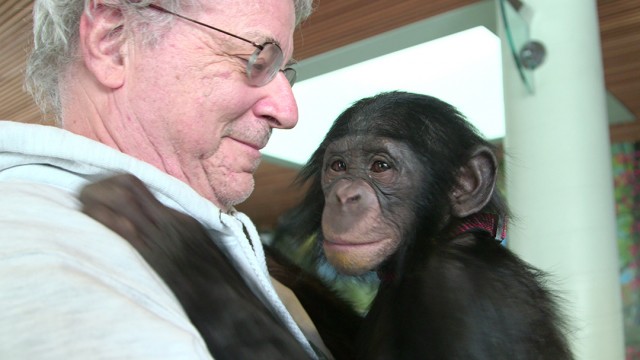
 Award-winning husband-and-wife documentarians D. A. Pennebaker and Chris Hegedus have been collaborating for forty-five years, working on films about such subjects as Bill Clinton’s presidential campaign (The War Room), Carol Burnett (Moon over Broadway), soul music (Only the Strong Survive), pastry chefs (Kings of Pastry), and Elaine Stritch (Elaine Stritch at Liberty). For their latest film, Unlocking the Cage, they spent three years following animal rights lawyer Steven M. Wise, the president and founder of the Nonhuman Rights Project, as he sought to establish “personhood” for several chimpanzees in order to free them from their caged existence and move them to more acceptable animal sanctuaries. Wise and his team, Natalie Prosin and attorneys Elizabeth “Liddy” Stein and Monica Miller, scour the internet searching for chimpanzees to represent as well as sanctuaries where the animals can be released. (The Nonhuman Rights Project focuses on great apes, elephants, and such cetaceans as dolphins and whales because of their autonomy, intelligence, and emotional capacity.) The concept is fascinating, and the film hits its high points when Pennebaker and Hegedus show some of the chimpanzees interacting with humans in compelling ways, watching television or figuring something out on a computer. Unfortunately, far too much of Unlocking the Cage deals with often murky legal discussions and courtroom arguments that drag on and on.