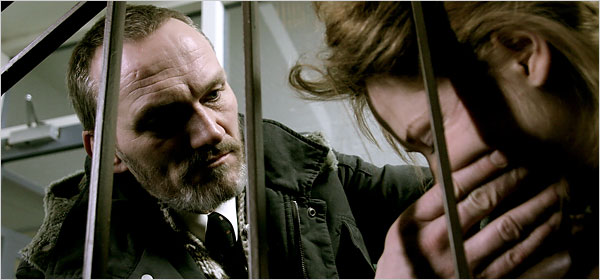
Inspector Erlendur (Ingvar E. Sigurdsson) finds more than he bargained for in tense thriller based on award-winning Icelandic book
JAR CITY (MYRIN) (Baltasar Kormákur, 2006)
IFC Center
323 Sixth Ave. at West Third St.
Tuesday, June 21, 8:00, and Wednesday, June 22, 11:20 am
Series runs June 17-23
212-924-7771
www.ifccenter.com
 Writer-director Baltasar Kormákur’s adaptation of Arnaldur Indriðason’s award-winning novel Jar City is a bleak but compelling police procedural that focuses on a fact-based controversial government initiative that is cataloging genetic research on all Icelandic families. When an aging man named Holberg (Thorsteinn Gunnarsson) is murdered in his home, brooding inspector Erlendur (Ingvar E. Sigurdsson) heads the investigation into the death, leading him to a thirty-year-old rape, a dirty cop, a trio of criminals (one of whom has been missing for a quarter century), a woman who killed herself shortly after her four-year-old daughter died, and a doctor who collects body parts. The divorced Erlendur also has to deal with his troubled daughter (Augusta Eva Erlendsdottir), a pregnant drug addict who hangs out with some very sketchy company. Meanwhile, a mysterious man (Atli Rafn Sigurdarson) is up to something following the traumatic death of his young daughter. Kormakur weaves together the story line of the two fathers side by side — in the book, the unidentified man appears only near the conclusion, although who he is still remains a mystery for most of the film — centering on the complex relationship between parents and children and what gets passed down from generation to generation, both on the outside and the inside. Sigurdsson plays Erlendur with a cautious seriousness, the only humor coming from the way he treats his goofy partner, Sigurdur Oli (Bjorn Hlynur Haraldsson). Iceland’s entry for the 2007 Best Foreign Language Film Oscar and winner of the Crystal Globe at the Karlovy Vary International Film Festival, Jar City is a dark, tense intellectual thriller. Indriðason has turned Erlendur into a continuing character in such follow-ups as Silence of the Grave and Voices; we were hoping Kormákur and Sigurdsson would do the same, but instead the director has gone on to make such Hollywood fare as Contraband, 2 Guns, and Everest. Jar City will be screening on June 22 and 23 in the IFC Center series “Cold Cases: The Department Q Trilogy and the New Nordic Noir,” which runs through June 23 and includes such other cool films as Daniel Espinosa’s Easy Money, Henrik Ruben Genz’s Terribly Happy, and Morten Tyldum’s Headhunters.

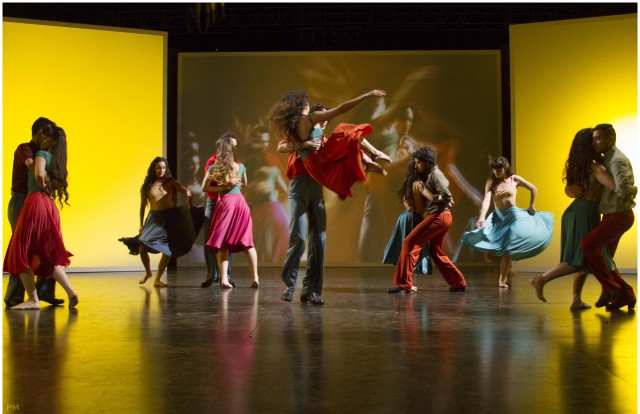
 Spanish writer-director Carlo Saura celebrates the history and tradition of Argentinian music and dance in the joyous documentary Argentina. The eighty-four-year-old Saura, whose previous films include Carmen, Tango, El amor brujo, and Flamenco, Flamenco, and production designer Pablo Maestre Galli built stages in a vast, empty barn in La Boca barrio of Buenos Aires City to honor such local and regional art forms as Zamba, Vidala, Chacarera, Malambo, Copla, and Chamamé. Using archival footage, silhouette-creating scrims, mirrors, and live projections, Saura and cinematographer Félix Chango Monti follow a series of set pieces with no narration or explanation, creating a simple and beautiful record of Argentinian music and dance. Among the lovely performances are pianist Horacio Lavandera playing Carlos Guastavino’s “Bailecito,” “Bagualas” featuring Mariana Carrizo, Melania Pérez, and Tomas Lipan, “La Felipe Varela” with Chaqueño Palavecino and Jimena Teruel, “Añoranzas” by Soledad Pastorutti, Metabombo’s “Ritmo de Malambo” with Carlos “Pajarín” Saavedra and Jorge “Koki” Saavedra, and “En el fondo del mal” by Gabo Ferro and Luciana Jury.


 First it took a long time for French-Vietnamese writer-director Tran Anh Hung (The Scent of Green Papaya) to convince Japanese novelist Haruki Murakami to let him adapt his 1987 novel, Norwegian Wood — Tran had been interested in turning the book into a movie ever since he first read it in 1994, but Murakami notoriously does not allow his novels to become films — and then, once the film was made and played at prestigious festivals in Venice, Toronto, and Dubai, still took more than a year to find a U.S. distributor. Norwegian Wood is a moving, faithful adaptation of Murakami’s elegiac novel about unrequited love, romantic communication, and death. After his best friend, Kizuki (Kengo Kora), commits suicide, Watanabe (Death Note’s Ken’ichi Matsuyama) and Kizuki’s girlfriend, Naoko (Babel’s Rinko Kikuchi), who previously were part of an inseparable trio with Kizuki, go their separate ways. After a short time, they meet up accidentally in Tokyo, where Watanabe is attending university and Naoko is trying to get over her loss. But an event on her twentieth birthday causes Naoko to take off again, this time seeking professional help at a sanitarium. Watanabe can’t stop thinking about Naoko, jeopardizing a possible relationship with the aggressive, sexually open Midori (Kiko Mizuhara), who already has a boyfriend but is extremely interested in Watanabe. Meanwhile, Watanabe disapproves of how his friend Nagasawa (Tetsuji Tamayama) continually cheats on his girlfriend, Hatsumi (Eriko Hatsune), who is devoted to him. With the student riots of the late 1960s swirling around them, Watanabe, Naoko, Midori, Nagasawa, Hatsumi, and Naoko’s roommate, Reiko (Reika Kirishima), take long, hard looks at what they want out of life and love, and they don’t always like what they find. Beautifully shot by Mark Lee Ping-Bing and featuring a subtle score by Radiohead’s Jonny Greenwood (There Will Be Blood), Norwegian Wood is a slow-paced, psychologically intense drama. Watanabe and Naoko are often shown walking amid vast natural landscapes of green forests and snow-covered mountains, but they are tied up tight within themselves, trapped in their own memories. The carefully composed sex scenes give depth and intelligence to the main characters without overplaying their emotions. The story itself might be relatively slight — it lacks the range of Murakami’s later books — but Tran has done a fine job bringing it to the screen. Norwegian Wood is screening at MoMA on June 17 and 29 at 7:30 in the series “Luminosity: The Art of Cinematographer Mark Lee Ping-Bing,” which runs June 16-30 and includes such other Lee-lensed treasures as Yang Chao’s Crosscurrent, Wang Tung’s Strawman, Tran’s The Vertical Ray of the Sun, and Hou Hsiao-hsien’s Flowers of Shanghai, Dust in the Wind, The Assassin, and The Puppetmaster. In addition, Lee will sit down with Department of Film associate curator La Frances Hui for