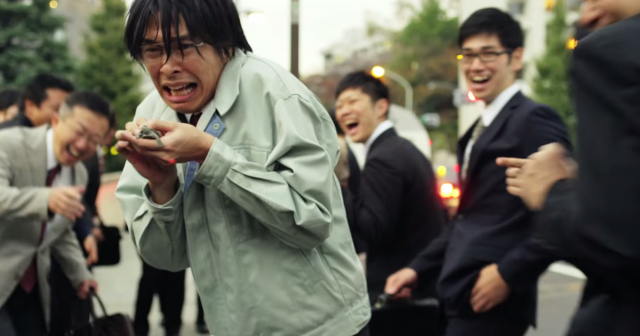
The hapless and pathetic Ryohei Suzuki (Hiroki Hasegawa) becomes obsessed with an unusual turtle in Sion Sono’s LOVE & PEACE
FESTIVAL OF NEW JAPANESE FILM: LOVE & PEACE (RABU & PISU) (ラブ&ピース) (Sion Sono, 2015)
Japan Society
333 East 47th St. at First Ave.
Saturday, July 16, 7:30
Series runs July 14-24
212-715-1258
www.japansociety.org
love-peace.asmik-ace.co.jp
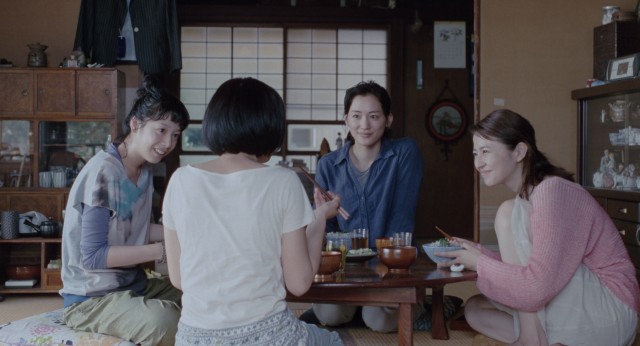
 Unpredictable Japanese writer-director Sion Sono defies expectations once again with Love & Peace, a wacky tokusatsu tale that has been gestating for more than two decades but has finally hit the big screen, with all its crazy madness. One of six films Sono (Himizu, Why Don’t You Play in Hell?) Sono made in 2015, Love & Peace is a deranged romp about Ryohei Suzuki (Hiroki Hasegawa), a thirty-three-year-old onetime pop star who quit making music because no one came to his three concerts. So instead he became a clerk and Japan’s poster child for failure, a laughingstock made fun of everywhere he goes. He is a hapless, pathetic fool who walks around with a perpetual stomachache, his coworkers put stickers on him that say “Hazardous Waste,” and is castigated on television. “His name repulses me,” one television announcer says. “Why does he exist?” demands another. But Ryo’s life takes a turn when he becomes obsessed with a tiny turtle he names Pikadon, a Japanese phrase that references the Hiroshima and Nagasaki nuclear bombs; “pika” means “brilliant light,” and “don” means “boom.” Through some magic initiated from a very strange man (Toshiyuki Nishida) who operates a kind of haven for misfit toys, Pikadon starts growing, morphing into an animated character, and as he gets bigger, so does Ryo’s career, as he goes back to making music. Through it all, he is supported by mousey coworker Yuko (Kumiko Aso), although he has no idea how to pursue romance. By the way, if any of that plot description made sense, we apologize, because Love & Peace makes very little sense, but that doesn’t prevent it from being a lot of fun in a completely berserk, bonkers way.
Love & Peace is being promoted as a family film, but it’s not exactly typical fare for kids. In true Takashi Miike style, Sono stirs a huge pot that incorporates elements from Godzilla and Pokemon, Rudolph the Red-Nosed Reindeer and the Quay Brothers, Babe and Ted, and Teenage Mutant Ninja Turtles and Toy Story, with a soundtrack that relies heavily on Walter Carlos’s march from A Clockwork Orange. It also features a collection of talking dolls and animals that would be outcasts in Pee-Wee’s Playhouse, including the downtrodden Maria, the toy robot PC-300, and the worried Sulkie the Cat. In the meantime, Japan is getting excited about the 2020 Summer Olympics, which will be held in Tokyo, believing it will bring prosperity to all, but that pie-in-the-sky Pollyanna attitude is a pipe dream that glosses over the country’s various economic and social dilemmas. Well, maybe. We’re not really sure quite what happens, but we couldn’t look away for a second. Love & Peace is screening on July 16 at 7:30 at Japan’s tenth annual Japan Cuts Festival of New Japanese Film and will be introduced by Sono via video. For an added treat, the North American premiere of Arata Oshima’s documentary The Sion Sono is being shown on July 16 at 2:30, followed by the New York premiere of Sono’s sci-fi drama The Whispering Star. Japan Cuts runs July 14-24, consisting of more than two dozen films, Q&As, a panel discussion, and more.
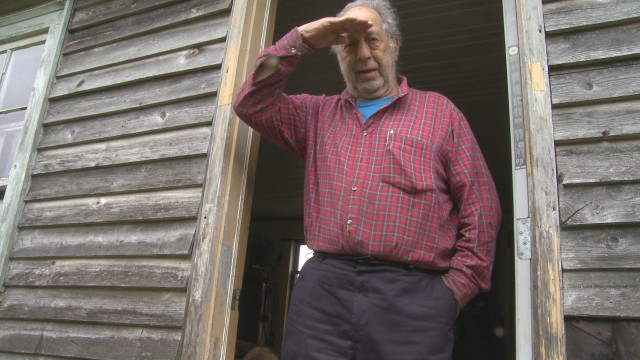
 “I hate these fucking interviews,” innovative, influential, ornery, and iconoclastic photographer and filmmaker Robert Frank says while preparing to be interviewed in 1984; the scene is shown in Laura Israel’s new documentary, Don’t Blink — Robert Frank. “I’d like to walk out of the fucking frame,” he adds, then does just that. But in Don’t Blink, Frank finds himself walking once more into the frame as Israel, his longtime film editor, attempts to get him to open up about his life and career. Born in Zurich in 1924, Frank immigrated to the United States in 1947, became a fashion photographer, and had his artistic breakthrough in 1958 with the publication of the controversial photo book The Americans, which captured people unawares from all over the country, using no captions, just image, to get his point across. (In 2009,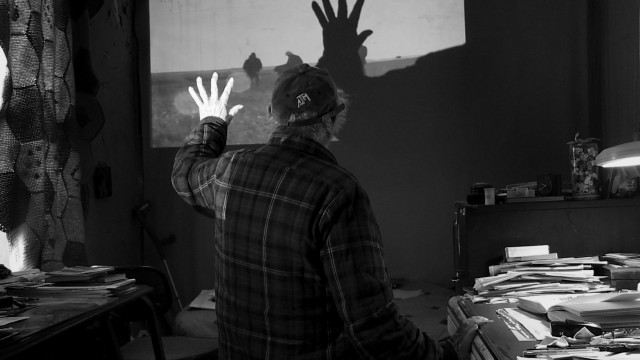
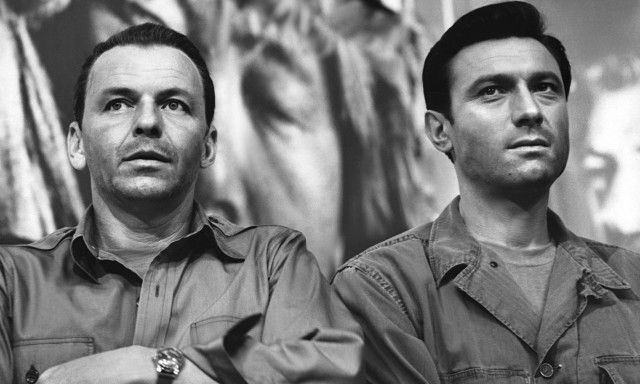
 BAMcinématek is celebrating the craziness about to take place at this month’s Republican and Democratic National Conventions with the three-week series “Four More Years: An Election Special,” consisting of twenty fiction and nonfiction films (although it’s sometimes hard to tell the difference) set in the lunatic world that is American politics. The festival kicks off July 15-16 with one of the greatest political thrillers ever made, John Frankenheimer’s unconventional Cold War conspiracy noir, The Manchurian Candidate. Ten years after fighting in Korea, Maj. Bennett Marco (Frank Sinatra) remains in the military, working in intelligence. He is haunted by terrifying nightmares in which his unit, led by Sgt. Raymond Shaw (Laurence Harvey), is at a woman’s gardening club lecture that turns into a Communist brainwashing session orchestrated by the menacing Dr. Yen Lo (Khigh Dheigh) of the Pavlov Institute. Meanwhile, the decorated but clearly tortured Shaw has to deal with his power-hungry mother, Mrs. Iselin (Angela Lansbury), who is manipulating everyone she can to ensure that her second husband, the McCarthy-like Sen. John Yerkes Iselin (James Gregory), becomes the Republican vice presidential nominee. As Marco gets to the bottom of the mystery, the clock keeps ticking toward an inevitable crisis with lives on the line and the very future of democracy at stake.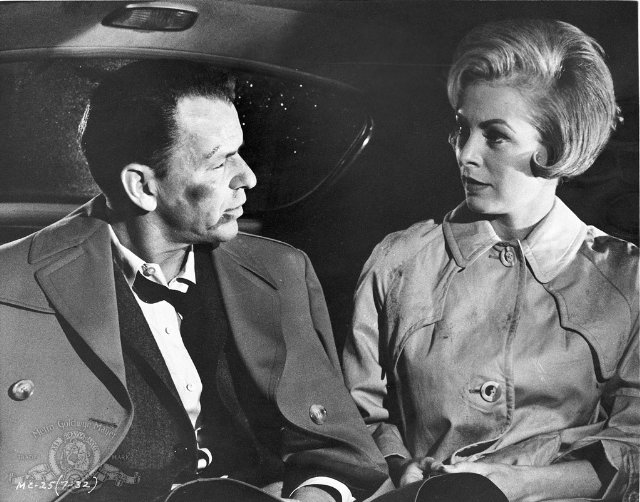
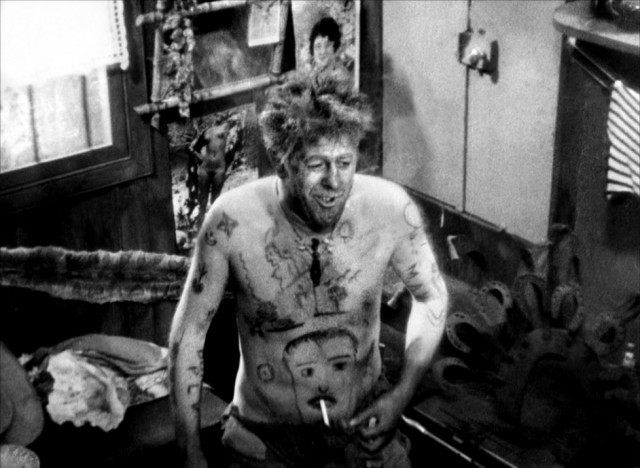
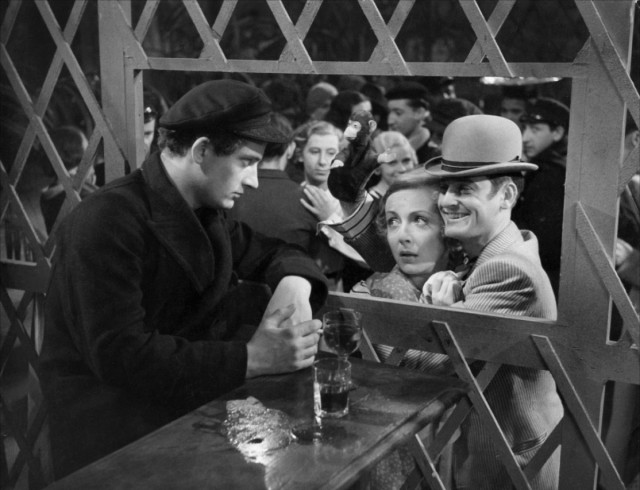
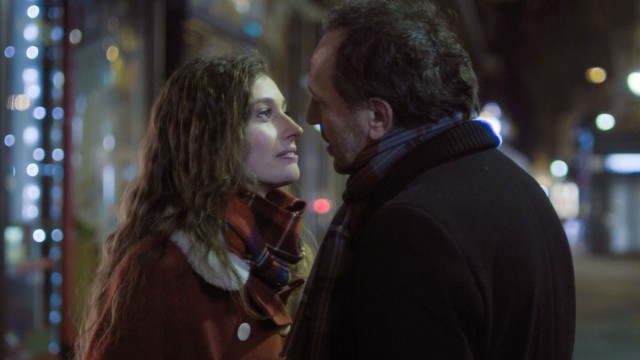
 “I like mixing fiction and reality,” writer, director, and star Arnaud Viard says in his second film, Paris, Love, Cut, the French title of which is Arnaud fait son 2ème film, or “Arnaud Makes His Second Film.” As the movie opens, Viard, sitting on the toilet, says directly into the camera, “Sometimes, in life, nothing works. You struggle . . . Nothing. Then, one day, it all flows. Just like that. Fluid. Magnificent. As if you were constipated, then suddenly . . . not at all. Last time things flowed was when I made my first film.” A longtime television actor who made his biggest impact as Jean-François in the French series Que du bonheur, Viard released his debut feature, Clara et moi, in 2004, then experienced difficulties raising money for his follow-up. In Paris, Love, Cut, Viard plays a version of himself, a longtime television actor who made his biggest impact as Jean-François in the French series Happy Times and who released his debut feature in 2004, then experienced difficulties raising money for his follow-up. Viard is trying to have a baby with his girlfriend, Chloé (Irène Jacob), but she is having trouble getting pregnant, echoing his inability to give birth to his second film, which he decides will be about a man unable to get an erection. He takes a job teaching an acting class, where he falls for twenty-one-year-old student Gabrielle (Louise Coldefy), whose goal is to become a famous actress. As he meets with his producer (Christophe Rossignon), other directors, his ailing mother (Nadine Alari), a sex coach (Chris Esquerre), a psychoanalyst (Pierre Aussedat), a tax agent (Marie-Christine Laurent), his sisters, and various dates, he has a generally positive take on life; he is soft-spoken and gentle, with a fun sense of humor whether being audited or going to a party thrown by his students, one of whom (Hamza Meziani) gets to the heart of the matter when he delivers a monologue from Alfred de Musset’s Don’t Fool with Love: “All men are liars, false, fickle, hypocritical, cowardly, contemptible, sensual. All women are faithless, deceitful, vain, curious, and depraved. The world is a bottomless sewer where shapeless beasts writhe on mountains of filth. But one thing is holy and sublime, the union of two beings, so imperfect and horrible.”