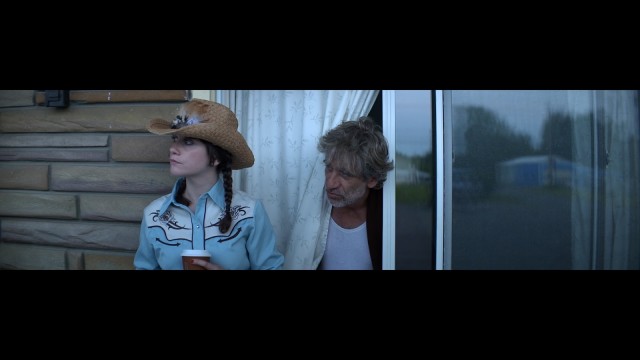
Tilda Swinton pays tribute to her friend John Berger in THE SEASONS IN QUINCY
THE SEASONS IN QUINCY: FOUR PORTRAITS OF JOHN BERGER (Colin MacCabe, Christopher Roth, Bartek Dziadosz & Tilda Swinton, 2015)
Film Forum
209 West Houston St.
Opens Wednesday, August 31
212-727-8110
filmforum.org
seasonsinquincy.com
 I remember the first time I saw the BBC series Ways of Seeing, thoroughly entranced by the host, a curly-haired British art critic with the cutest little lisp of his “R”s who promised that, while looking at European painting in a whole new way, “we shall discover something about ourselves and the situation in which we are living.” Years later, I was distraught when I couldn’t find my paperback copy of the companion book; my wife quickly ordered it and it was soon in my hands, where I devoured every word and image again and again. So I was terrifically excited when I heard about the new documentary The Seasons in Quincy: Four Portraits of John Berger, which opens August 31 at Film Forum. Perhaps my expectations were too high, but I came away from the four-part film feeling disappointed and let down; I selfishly wanted only Berger (pronounced with a soft “g”) but instead got too much of his friends and colleagues. And to make matters worse, the directors are too often what Berger tried so hard to avoid being throughout his long, influential career: pretentious. The film begins in winter with “Ways of Listening,” in which director Colin MacCabe focuses on Berger and his longtime friend, Oscar-nominated actress Tilda Swinton, as they talk at Berger’s farm in the small French town of Quincy, where he moved in the 1970s after becoming fed up with England. Filmed in 2010, the segment works best when Berger tells personal stories about his father and war; Swinton listens while peeling apples, the camera on her as much as on him. It occasionally feels as if she can’t decide whether to share Berger or keep him to herself; they already have a special connection, sharing the same birthday, albeit thirty-four years apart. But I wanted to make my own connection with Berger, a down-to-earth intellectual with a lust for life and a wide-ranging legacy, an artist, critic, “radical humanist,” social commentator, political activist, husband, father, farmer, and self-described “revolutionary writer” who prefers to simply be known as a storyteller.
In “Spring,” Christopher Roth focuses on Berger’s comparison of humans and animals, explored in his essay “Why Look at Animals?” But Roth’s blending of shots of nature with members of his crew, other farmers, and Jacques Derrida are disjointed, attempting too hard to create the kind of poetry that simply rolls off Berger’s tongue. The section also delves into time and death; sadly, Berger’s beloved wife, Beverly Bancroft, had recently passed away, in 2013. “Every shepherd knows that the herd outlasts the herdsman,” Berger says in a 1980 clip from Mike Dibb’s Parting Shots from Animals. For summer’s “A Song for Politics,” directors MacCabe and Bartek Dziadosz head indoors for a political discussion featuring Berger with MacCabe, German artist and director Roth, Indian poet and activist Akshi Singh, and American novelist and poet Ben Lerner. Berger makes some fascinating points, but I was hoping to see and hear more from him instead of from the others on the panel. “Let’s be quite clear,” Berger says, gesticulating with his right hand, “hope has nothing, nothing to do with optimism.”

John Berger and Tilda Swinton go on an intellectual journey in THE SEASONS IN QUINCY
The ninety-minute film concludes with Swinton’s fall-set “Harvest,” in which the actress and her twins, Xavier Swinton Byrne and Honor Swinton Byrne, travel through the Scottish Highlands to Quincy and meet up with Berger’s son, Yves, a painter and farmer. Meanwhile, Berger talks about the internet and Beverly and tells the kids to pick raspberries in her memory as such words as “from,” “via,” and “to” show up onscreen, emphasizing life’s journey. The craggy-faced Berger, who is now eighty-nine and boasts an impressive head of white hair, has a marvelous way of telling a story; his mind refuses to work like the rest of ours, interpreting and enjoying the world in unique and creative ways that are beautiful to watch and listen to. Unfortunately, aside from a smattering of marvelous bits here and there and some wonderful archival clips, this series of meandering narratives doesn’t quite do the extraordinary man justice. But then again, maybe I was just too optimistic. The Seasons in Quincy: Four Portraits of John Berger opens August 31 at Film Forum, with MacCabe participating in a Q&A following the 7:10 show on Wednesday night.
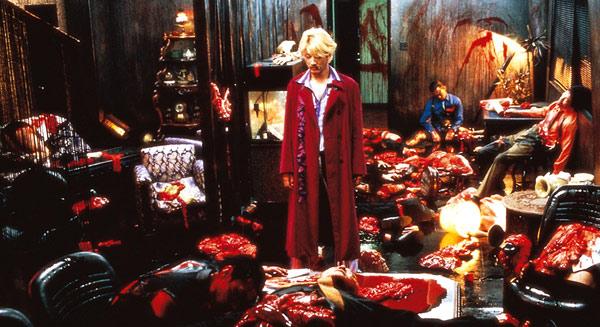
 Takashi Miike, who about fifteen few years ago had New York filmgoers rushing to Film Forum to see Audition — and then rushing to get out because of the violent torture scenes — did it again with Ichi the Killer, a faithful adaptation of Hideo Yamamoto’s hit manga. When Boss Anjo goes missing while beating the hell out of a prostitute, his gang, led by Kakihara (Tadanobu Asano), a multipierced blond sadomasochist, tries to find him by threatening and torturing members of other gangs. As the violence continues to grow — including faces torn and sliced off, numerous decapitations, innards splattered on walls and ceilings, body parts cut off, and self-mutilation — the killer turns out to be a young man named Ichi (Nao Omori), whose memory of a long-ago brutal rape turns him into a costumed avenger, crying like a baby as he leaves bloody mess after bloody mess on his mission to rid the world of bullies. This psychosexual S&M gorefest, which is certainly not for the squeamish, comes courtesy of the endlessly imaginative Miike, who trained with master filmmaker Shohei Imamura and seems to love really sharp objects. The excellent — and brave — cast also includes directors Sabu and Shinya Tsukamoto, composer Sakichi Satô, and Hong Kong starlet Alien Sun. The film is screening as part of the Nitehawk Midnite Screenings series “Crime,” which continues through October 30 with such other very different thrillers as William Friedkin’s The French Connection, Abel Ferrara’s Bad Lieutenant, George Lucas’s THX 138, John Boorman’s Point Blank, Richard Brooks’s In Cold Blood, Luc Besson’s The Fifth Element, and Gordon Parks Jr.’s Super Fly.
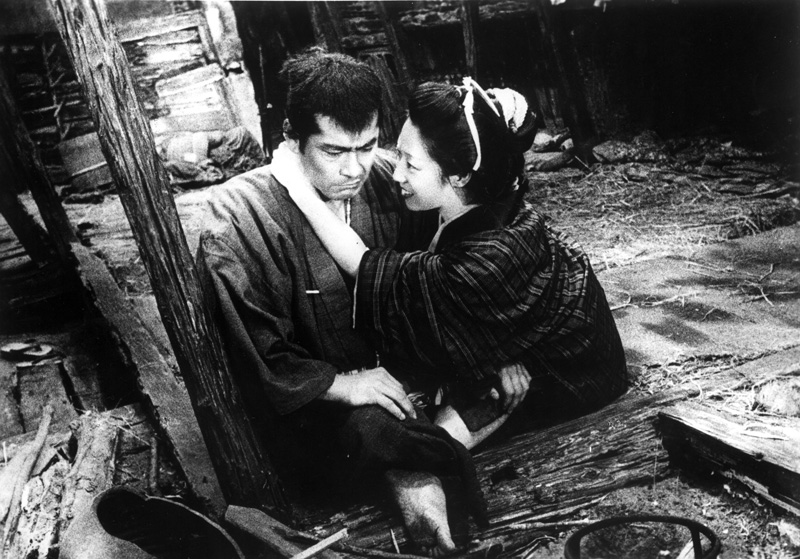
 Loosely adapted from Maxim Gorky’s social realist play, The Lower Depths is yet another masterpiece from Japanese auteur Akira Kurosawa. Set in an immensely dark and dingy ramshackle skid-row tenement during the Edo period, the claustrophobic film examines the rich and the poor, gambling and prostitution, life and death, and everything in between through the eyes of impoverished characters who have nothing. The motley crew includes the suspicious landlord, Rokubei (Ganjiro Nakamura), and his much younger wife, Osugi (Isuzu Yamada); Osugi’s sister, Okayo (Kyôko Kagawa); the thief Sutekichi (Toshirō Mifune), who gets involved in a love triangle with a noir murder angle; and Kahei (Bokuzen Hidari), an elderly newcomer who might be more than just a grandfatherly observer. Despite the brutal conditions they live in, the inhabitants soldier on, some dreaming of their better past, others still hoping for a promising future. Kurosawa infuses the gripping film with a wry sense of humor, not allowing anyone to wallow away in self-pity. The play had previously been turned into a film in 1936 by Jean Renoir, starring Jean Gabin as the thief. A staggering achievement, The Lower Depths is screening September 1 as part of Metrograph’s Kurosawa x 11 series, which runs August 31 through September 8 and consists of such other gems as Throne of Blood, Rashomon, Sanjuro, I Live in Fear, High and Low, and Seven Samurai, a virtual crash course in all things Kurosawa.
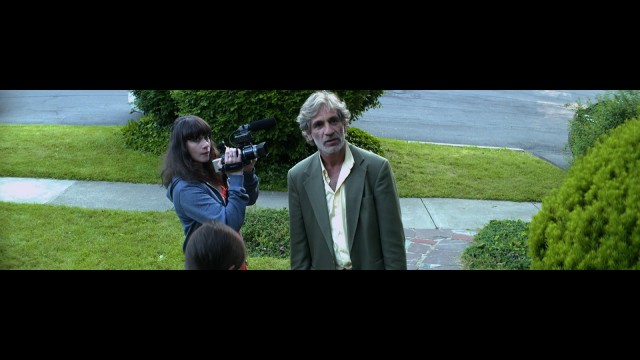
 In Dani Menkin’s Is That You?, young film student Myla (Naruna Kaplan de Macedo) is making a documentary, asking strangers what they regret. If she asked me, I might just have told her that I regret having watched Is That You? Nominated for an Israeli Academy Award for Best Picture and winner of Best Indie Film, Dani Menkin’s Is That You? is a convoluted road-trip movie that manipulates its paper-thin plot until almost none of it makes sense. Israeli film, television, and stage favorite Alon Aboutboul (London Has Fallen, The Dark Knight Rises) stars as Ronnie, an outdated analog man in an ever-more-digital world. After losing his job as a projectionist in an Israeli art house, Ronnie heads to the States, determined to find his lost love, Rachel, who he has not seen in nearly forty years. He picks up an old used car (no fancy new styles for him) from his brother, Jacob (Rani Bleier), and sets out on his mission. The lemon soon breaks down, and Ronnie is offered help by Myla, whose film is called The Road Not Taken. Moved by Ronnie’s story, Myla joins him on his journey, taking her brother’s SUV, without permission. As Ronnie and Myla try to track down Rachel, who can’t seem to settle down in one place for very long, they stop along the way so Myla can interview people on the street and in their homes, getting them to share what they would change in their lives if they could. But the hardest person to get to open up is Ronnie himself.