EMBRACE OF THE SERPENT takes viewers on an extraordinary journey into the heart of darkness and beyond
EMBRACE OF THE SERPENT (EL ABRAZO DE LA SERPIENTE) (Ciro Guerra, 2015)
Socrates Sculpture Park
32-01 Vernon Blvd.
Wednesday, August 24, free, live music at 7:00, screening at sunset
718-956-1819
www.socratessculpturepark.org
embraceoftheserpent.oscilloscope.net
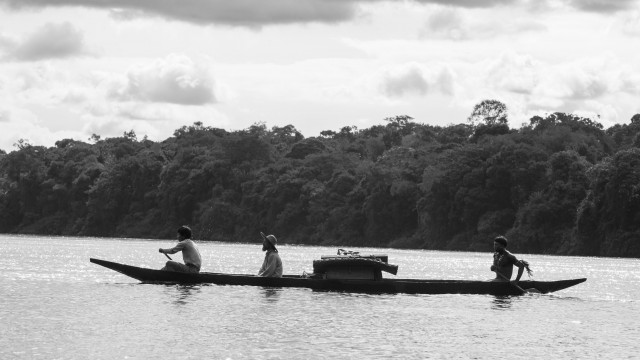
 Colombian writer-director Ciro Guerra takes viewers on a spectacular journey through time and space and deep into the heart of darkness in the extraordinary Embrace of the Serpent. Guerra’s Oscar-nominated film, the first to be shot in the Colombian Amazon in thirty years, opens with a 1909 quote from explorer Theodor Koch-Grünberg: “It is not possible for me to know if the infinite jungle has started on me the process that has taken many others to complete and irremediable insanity.” Inspired by the real-life journals of Koch-Grünberg and botanist and explorer Richard Evans Schultes, Guerra poetically shifts back and forth between two similar trips down the Vaupés River, both led by the same Amazonian shaman, each time guiding a white scientist on a perilous expedition in a long, narrow canoe. Shortly after the turn of the twentieth century, ailing white ethnologist Theo (Jan Bijvoet) and his native aid, Manduca (Yauenkü Migue), seek the help of Karamakate (Nilbio Torres), a shaman wholly suspicious of whites and who believes he is the last of his tribe. However, Theo claims he knows where remnants of Karamakate’s people live and will show him in return for helping him find the magical and mysterious hallucinogenic Yakruna plant that Theo thinks can cure his illness. Forty years later, white botanist Evan (Brionne Davis) enlists Karamakate (Antonio Bolívar Salvador) to locate what is thought to be the last surviving Yakruna plant, which he hopes will finally allow him to dream in order to heal his soul. Evoking such films as Werner Herzog’s Fitzcarraldo and Aguirre, the Wrath of God and Francis Ford Coppola’s Apocalypse Now, Embrace of the Serpent makes the rainforest itself a character, shot in glorious black-and-white by David Gallego (Cecilia, Violencia) in a sparkling palette reminiscent of the work of Brazilian photographer Sebastião Salgado. As the parallel stories continue, the men encounter similar locations that have changed dramatically over time, largely as a result of rubber barons descending on the forest and white missionaries bringing Western religion to the natives. It’s difficult to watch without being assailed by imperialist concepts of the “noble savage,” mainly because the Amazon — and our Western minds — have been so profoundly affected by those ideas. “Before he can become a warrior, a man has to leave everything behind and go into the jungle, guided only by his dreams,” the older Karamakate says. “In that journey he has to discover, completely alone, who he really is.”
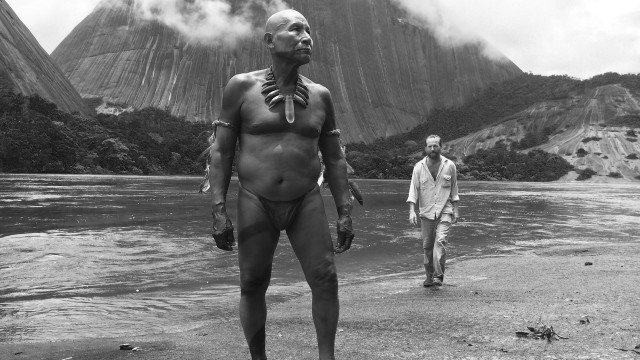
Guide Karamakate (Antonio Bolívar Salvador) and botanist Evan (Brionne Davis) explore dreams in Ciro Guerra’s EMBRACE OF THE SERPENT
Winner of the Directors’ Fortnight Art Cinema Award at the Cannes Film Festival and nominated for a Best Foreign Language Film Academy Award, Embrace of the Serpent is an unforgettable spiritual quest into the ravages of colonialism, the evils of materialism, the end of indigenous cultures, and what should be a sacred relationship between humanity and nature. Written by Guerra (2004’s Wandering Shadows, 2009’s The Wind Journeys) and Jacques Toulemonde (Anna), it is told from the point of view of the indigenous people of the Amazon, whom Guerra worked closely with in the making of the film, assuring them of his intentions to not exploit them the way so many others have. Aside from the Belgian Bijvoet and the Texan Davis, the rest of the cast is made up of members of tribes that live along the Vaupés. Guerra actually brought along a shaman known as a payé to perform ritual ceremonies to ensure the safety of the cast and crew and to protect the jungle itself. “What Ciro is doing with this film is an homage to the memory of our elders, in the time before: the way the white men treated the natives, the rubber exploitation,” Torres, in his first movie, says about the film. “I’ve asked the elders how it was and it is as seen in the film; that’s why we decided to support it. For the elders and myself it is a memory of the ancestors and their knowledge.” Salvador, who previously had bad experiences with filmmakers, notes, “It is a film that shows the Amazon, the lungs of the world, the greater purifying filter, and the most valuable of indigenous cultures. That is its greatest achievement.” Embrace of the Serpent is a great achievement indeed, an honest, humanistic, maddening journey that takes you places you’ve never been. Embrace of the Serpent is screening August 24 in Long Island City, concluding Socrates Sculpture Park’s seventeenth annual free summer Outdoor Cinema series, programmed by Film Forum, and will be preceded by a live performance by Bulla en el Barrio, with South American food available for purchase from La Carreta Paisa.
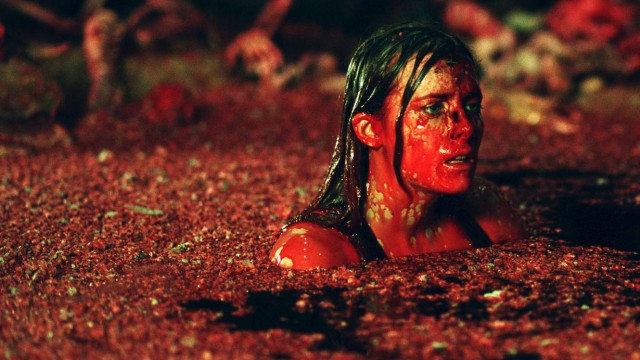
 Ostensibly a female Deliverance gone underground, Neil Marshall’s The Descent is a piss-poor piece of putrefaction. A year after Sarah (Shauna Macdonald) loses her husband and daughter in a terrible car accident, an adventurous group of friends go spelunking in the Appalachians (though the film was actually shot in England, at Pinewood Studios). But Juno (Natalie Mendoza) has pulled a fast one; instead of the well-traversed caves they thought they were going to, Juno has taken them to unexplored territory, where lying in wait for them are fast-moving mutant Gollums with hardy appetites. There is actually one genuine scare, but everything else is manipulatively mundane and morbidly mangled. Inexplicably, The Descent was a hit in its home country, garnering a handful of British film awards and nominations, and there was even a sequel made in 2009. Oh, and by the way, what ever became of the child’s laughter? The Descent is being shown August 26 at 12:10 am as part of the Nitehawk Cinema series “Nitehawk Midnite Screenings” and “Hot Horror,” but you must have something better to do with your time than descend into this disappointing maelstrom.
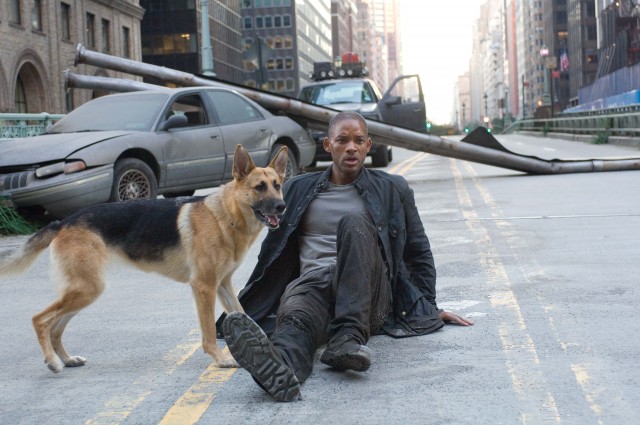
 Director Francis Lawrence’s modern-day update of Richard Matheson’s classic 1954 novel, I Am Legend, is a tense, nonstop thriller, liberally adapted by screenwriters Mark Protosevich (The Cell) and Akiva Goldsman (I, Robot). While the book was a claustrophobic masterpiece, the film opens things up dramatically, with Robert Neville (Will Smith), the last survivor of a supposed cancer cure that turned into a deadly virus, riding the streets of New York City every day in a fancy car with his dog, Sam. In addition to hunting wild game that leaps through Midtown, Neville, an army scientist who is still searching for an antidote in his makeshift basement laboratory, kills cells of infected vampiric beings that have more in common with the violent creatures of 28 Days Later than the slow-moving zombies of Night of the Living Dead. Every night Neville barricades himself and Sam into their apartment overlooking Washington Square Park and dreams of the events that brought him to this point, centered on his desperate attempt to save his wife (Salli Richardson) and daughter (Willow Smith, Will’s real-life daughter). I Am Legend was actually filmed in New York, with pivotal scenes shot in and around Madison Square Park, Grand Central Terminal, the South Street Seaport, and a barren Park Ave., lending it a stark, frightening reality. Smith excels as Neville, his eyes quickly shifting from hope to disappointment, from promise to pain, and Lawrence (Constantine, The Hunger Games: Catching Fire) does a marvelous job of translating the book’s inner monologue into a postapocalyptic visual nightmare. (The story was previously made into the 1964 film The Last Man on Earth, starring Vincent Price.) I Am Legend is screening August 24 at the Central Park Conservancy Film Festival, which runs August 22 to 27, beginning with School of Rock (August 22) and The Last Dragon (August 23) in Marcus Garvey Park, then moving to Central Park for I Am Legend, Tootsie (August 25), Desperately Seeking Susan (August 26), and Stuart Little (August 27).