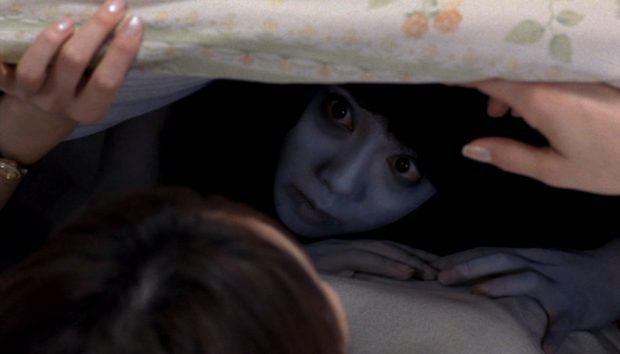
There is something scary under the bed — and just about everywhere else — in JU-ON: THE GRUDGE and rest of “13 Cats” series at BAM
JU-ON: THE GRUDGE (Takashi Shimizu, 2002)
BAMcinématek, BAM Rose Cinemas
30 Lafayette Ave. between Ashland Pl. & St. Felix St.
Thursday, October 27, 9:30
718-636-4100
www.bam.org
 “Black cats feature in the mythology of many cultures, and superstitions about them are still familiar to most of us in modern times. They are a prime example of the contrariness of many of our superstitious beliefs; some swear they’re lucky, others see them as a sign of certain doom,” Chloe Rodes writes in Black Cats and Evil Eyes: A Book of Old-Fashioned Superstitions. BAMcinématek certainly had the latter in mind when it programmed its Halloween series “13 Cats,” a baker’s dozen of feline horror stories running through November 3 at BAM Rose Cinemas. The frightfest kicked off October 21-23 with the Hayao Miyzazaki favorite Kiki’s Delivery Service and also includes the Nobuhiko Obayashi cult classic Hausu, Roger Corman’s The Tomb of Ligeia, David Lowell Rich’s Eye of the Cat, Kaneto Shindô’s Kuroneko, and both Jacques Tourneur’s and Paul Schrader’s Cat People. On October 27, Takashi Shimizu’s Ju-On: The Grudge will cross movie fans’ path in Brooklyn. After making two Ju-Ons for Japanese video, Shimizu wrote and directed this feature-length haunted-house movie that he later also turned into an American version starring Sarah Michelle Gellar. A terrifying ghost (Takaka Fuji) who emits bizarre sounds keeps killing just about anyone who enters her suburban home, where a husband murdered his wife and their black cat, and their young son went missing. But don’t worry; the white-faced kid (Yuya Ozeki) continually shows up in the strangest of places, as does a very creepy woman. (Don’t look under the sheets.) The more Rika (Megumi Okina) gets involved, the spookier things get. And poor Izumi (Misa Uehara) and Hitomi (Misaki Itô). You’re likely to have trouble falling asleep after watching this truly scary, extremely confusing film, which Shimizu was afraid would be too laughable.
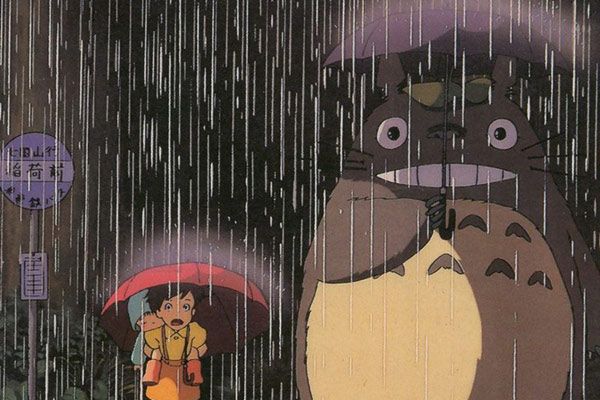
Hayao Miyazaki’s MY NEIGHBOR TOTORO wonderfully captures the joys and fears of being a child
MY NEIGHBOR TOTORO (Hayao Miyazaki, 1988)
BAMcinématek, BAM Rose Cinemas
30 Lafayette Ave. between Ashland Pl. & St. Felix St.
October 28-30
718-636-4100
www.bam.org
www.nausicaa.net
 In many ways a precursor to Hayao Miyazaki’s masterpiece, Spirited Away, the magical My Neighbor Totoro is a fantastical trip down the rabbit hole, a wondrous journey through the sheer glee and universal fears of childhood. With their mother, Yasuko (voiced by Lea Salonga), suffering from an extended illness in the hospital, Satsuki (Dakota Fanning) and her younger sister, Mei (Elle Fanning), move to a new house in a rural farming community with their father, anthropology professor Tatsuo Kusakabe (Tim Daly). Kanta (Paul Butcher), a shy boy who lives nearby, tells them the house is haunted, and indeed the two girls come upon a flurry of black soot sprites scurrying about. Mei also soon discovers a family of totoros, supposedly fictional characters from her storybooks, living in the forest, protected by a giant camphor tree. When the girls fear their mother has taken a turn for the worse, Mei runs off on her own, and it is up to Satsuki to find her. Working with art director Kazuo Oga, Miyazaki paints My Neighbor Totoro with rich, glorious skies and lush greenery, honoring the beauty and power of nature both visually as well as in the narrative. The scene in which Satsuki and Mei huddle with Totoro (Frank Welker) at a bus stop in a rainstorm is a treasure. (And just wait till you see Catbus’s glowing eyes.) The movie also celebrates the sense of freedom and adventure that comes with being a child, without helicopter parents and myriad rules suffocating them at home and school. (Note: BAM will be screening the English-language version in the “13 Cats” series.)
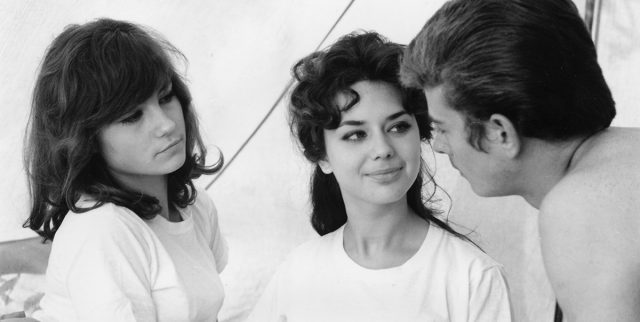
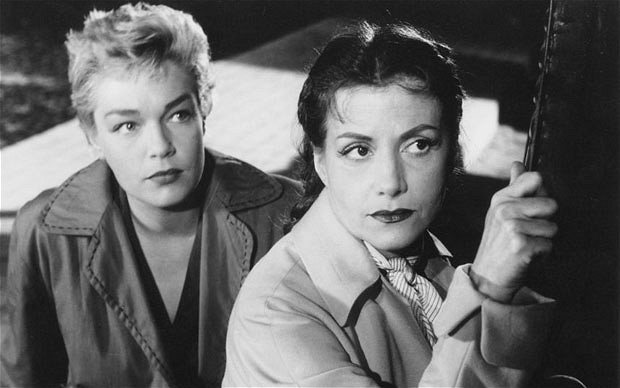
 FIAF’s two-month CinéSalon series “Beyond the Ingénue” comes to a close October 25 with one of the lesser-known French New Wave classics, Jacques Rozier’s shamefully seldom screened Adieu Philippine. Rozier’s first film is a freewheeling adventure as Michel (Jean-Claude Aimini), a young man working in a television studio, cavorts with a pair of eighteen-year-old best friends, Juliette (Stefania Sabatini) and Liliane (Yveline Céry), while waiting to be called up to serve in the Algerian War. Rozier opens the film by taking viewers into the studio, where they are shooting a lively jazz performance by French violinist Maxim Saury and his band, the bouncy rhythm meeting the behind-the-scenes chaos. Pretending to be more important than he really is, Michel invites Juliette and Liliane to come in, and soon the trio is hitting cafés and nightclubs, camping on the beach, and trying to hook up with would-be filmmaker Pachala (Vittorio Caprioli). But what started out as fun gets somewhat more serious as jealousy creeps in and the war intervenes.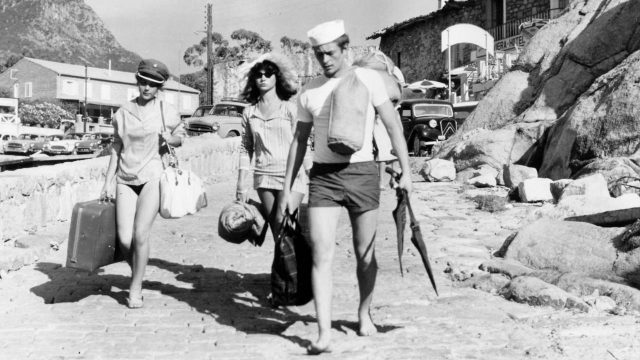

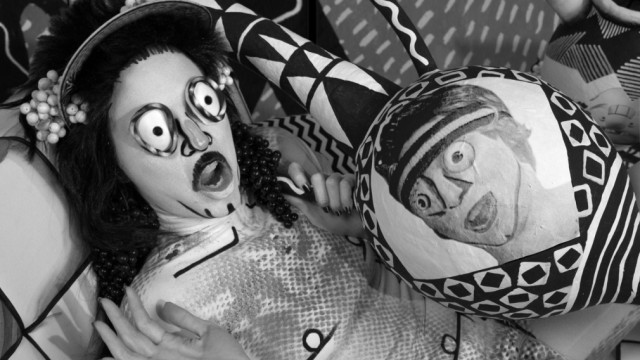
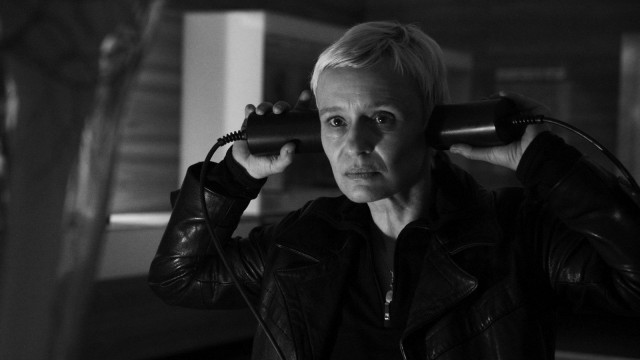


 João Pedro Rodrigues reimagines the story of Fernando Martins de Bulhões, also known as Anthony of Lisbon and Saint Anthony of Padua, in the utterly bizarre and infectiously weird adventure drama The Ornithologist. Rodrigues, who also dealt with the thirteenth-century priest’s legacy in the 2013 zombie short Morning of Saint Anthony’s Day, puts ornithologist Fernando (Paul Hamy) through a series of tests after his canoe capsizes while he’s on a bird-watching expedition. He is found near death on the shore by a pair of Chinese pilgrims (Han Wen and Chan Suan), walking Camino de Santiago, who decide to do something very odd with him. His Stations of the Cross journey continues as he meets a deaf and mute goatherd (Xelo Cagiao), a group of colorful, masked caretos, and a trio of topless women on horseback (Juliane Elting, Isabelle Puntel, and Flora Bulcao), who in different ways challenge his sexuality and spirituality. Rodrigues (The Last Time I Saw Macao, To Die Like a Man) infuses the wild tale with references to Christianity, paganism, ritual, superstition, and Greek mythology as Fernando’s physical and psychological strength is tested in oddball events that get stranger and stranger until the director, who was already dubbing in Hamy’s Portuguese lines with his own, starts switching places with the actor.