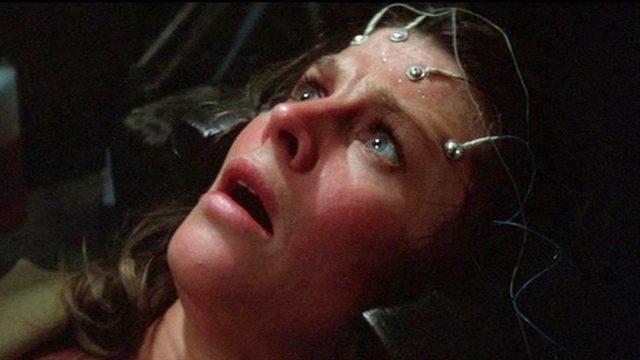
Julie Christie is trapped in a suburban nightmare in Donald Cammell’s DEMON SEED
DEMON SEED (Donald Cammell, 1977)
Anthology Film Archives
32 Second Ave. at Second St.
Sunday, November 6, 3:00, and Tuesday, November 8, 9:00
Series runs through November 13
212-505-5181
anthologyfilmarchives.org
 In his 1964 book, Understanding Media: The Extensions of Man, Marshall McLuhan declared, “In a culture like ours, long accustomed to splitting and dividing all things as a means of control, it is sometimes a bit of a shock to be reminded that, in operational and practical fact, the medium is the message. This is merely to say that the personal and social consequences of any medium — that is, of any extension of ourselves — result from the new scale that is introduced into our affairs by each extension of ourselves, or by any new technology.” Screen Slate and Anthology Film Archives have teamed up on a series that shows that concept at work in a very specific way. Continuing through November 13, “Screen Slate Presents: The Medium Is the Massacre” consists of a dozen horror films and specially chosen shorts that ratchet up the fear factor using cutting-edge technology and new media. Based on the novel by Dean R. Koontz, Donald Cammell’s creepy, claustrophobic 1977 futuristic thriller Demon Seed offers a very different look at motherhood. The film stars a surprisingly game Julie Christie as Susan Harris, a frustrated housewife whose husband, Alex (Fritz Weaver), is the leader of a team that has built a master computer known as Proteus (voiced by Robert Vaughn). When Alex goes off for several months to further Proteus’s already impressive attributes, the supercomputer starts developing a mind of its own, locking Susan in the house and deciding she must give birth to its child.
Cammell, who codirected Performance with Nicolas Roeg, fills Demon Seed with trippy, psychedelic visuals (the fab animated sequence is by Jordan Belson and Bo Gehring with Ron Hays) and cool technological flourishes, along with an electronic score by Ian Underwood and Lee Ritenour supplementing Jerry Fielding’s central musical themes. The film delves into suburban paranoia with Toffler-esque flare and an Orwellian fear of artificial intelligence. The film harkens back to Stanley Kubrick’s 2001: A Space Odyssey and Joseph Sargent’s Colossus: The Forbin Project while influencing such future films as John Badham’s WarGames, which also names its supercomputer “Joshua” and casts Weaver look-alike John Wood as computer creator Dr. Stephen Falken. Demon Seed is screening with Ericka Beckman’s 1999 experimental short Hiatus and Soda_Jerk’s one-minute Undaddy Mainframe on November 6 and 8 at Anthology. “Demon Seed with video effects by Ron Hays was perhaps the first film to integrate video with other special effect film processes,” Denise Gallant wrote in a 1982 issue of American Cinematographer. Programmed by Jon Dieringer of Screen Slate, “The Medium Is the Massacre” continues through November 13 with such other tech-savvy frightfests as David Cronenberg’s Videodrome (Cronenberg was directly influenced by McLuhan, who lectured at the university he attended), John Flynn’s Brainscan, Tobe Hooper’s Poltergeist, and Kiyoshi Kurosawa’s Pulse, each accompanied by at least one related short film. “Whenever the dragon’s teeth of technological change are sown, we reap a whirlwind of violence,” McLuhan also said, in a March 1969 Playboy interview.
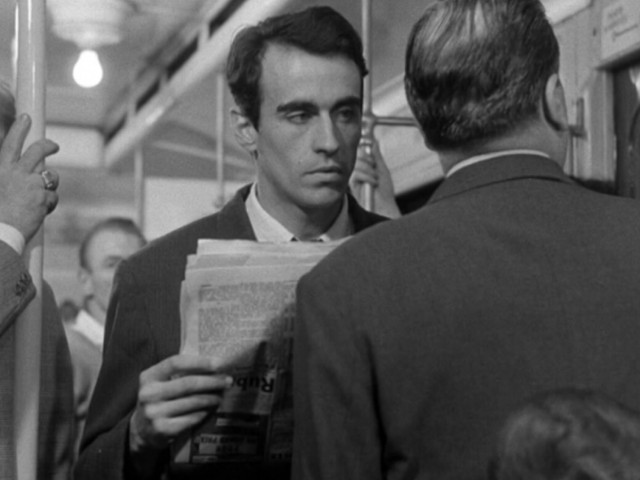
 Robert Bresson’s 1959 Pickpocket is a stylistic marvel, a brilliant examination of a deeply troubled man and his dark obsessions. Evoking Raskolnikov in Dostoevsky’s Crime and Punishment, Martin LaSalle made his cinematic debut as Michel, a ne’er-do-well Parisian who lives in a decrepit apartment, refuses to visit his ailing mother (Dolly Scal), and decides to become a pickpocket. But it’s not necessarily the money he’s after; he hides the cash and watches that he steals in his room, which he is unable to lock from the outside. Instead, his petty thievery seems to give him some kind of psychosexual thrill, although his pleasure can seldom be seen in his staring, beady eyes. As the film opens, Michel is at the racetrack, dipping his fingers into a woman’s purse in an erotically charged moment that is captivating, instantly turning the viewer into voyeur. Of course, film audiences by nature are a kind of peeping Tom, but Bresson makes them complicit in Michel’s actions; although there is virtually nothing to like about the character, who is distant and aloof when not being outright nasty, even to his only friends, Jacques (Pierre Leymarie) and Jeanne (Marika Green), the audience can’t help but breathlessly root for him to succeed as he dangerously dips his hands into men’s pockets on the street and in the Metro. Soon he is being watched by a police inspector (Jean Pélégri), to whom he daringly gives a book about George Barrington, the famed “Prince of Pickpockets,” as well as a stranger (Kassagi) who wants him to join a small cadre of thieves, leading to a gorgeously choreographed scene of the men working in tandem as they pick a bunch of pockets. Through it all, however, Michel remains nonplussed, living a strange, private life, uncomfortable in his own skin. “You’re not in this world,” Jeanne tells him at one point.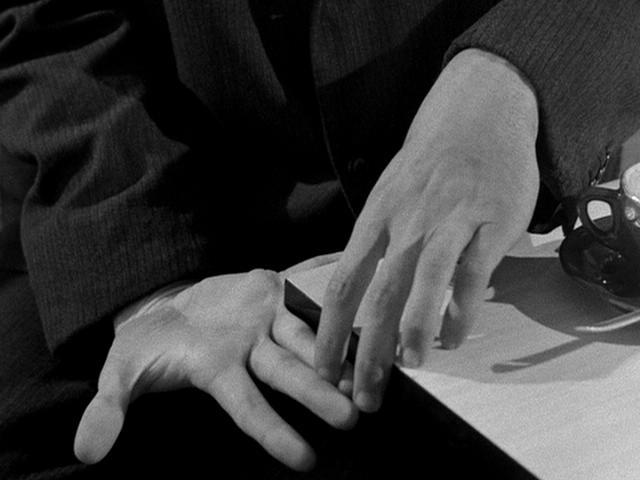
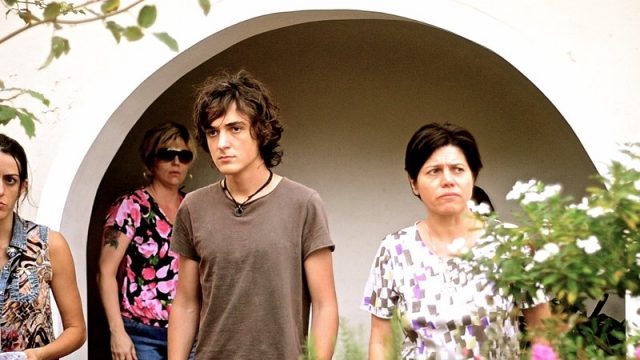
 Brazilian writer-director Anna Muylaert once again intricately explores the nature of class, identity, and family in her fifth feature film, the powerful and poignant Don’t Call Me Son. In last year’s award-winning The Second Mother, Muylaert told the story of a live-in housekeeper who was like a surrogate mother to the family she works for, but things change when her estranged teenage daughter comes to stay with her. In Don’t Call Me Son, a family is torn apart when it is discovered that the mother, Arcay (Dani Nefusi), actually stole her children, son Pierre (Naomi Nero) and daughter Jaqueline (Lais Dias), when they were babies, and the kids’ biological parents have been searching desperately for them ever since and have now found them. Pierre is a seventeen-year-old gender-bending bisexual musician who seems relatively comfortable in his own skin, at least for a seventeen-year-old gender-bending bisexual musician, until Arcay is arrested and imprisoned for kidnapping. She might not have been a model mother, but she was his mother, and he is devastated when he is suddenly forced to move in with his biological parents, Glória (also played by Nefusi) and Matheus (Matheus Nachtergaele), who are overjoyed to have him back but were expecting someone a little bit more traditional; however, Pierre’s new younger brother, Joca (Daniel Botelho), appears to be happy he now has such a cool, if tortured, sibling. Meanwhile, Jaqueline is taken away to live with her real parents. As Glória and Matheus persist in calling Pierre by the name they gave him at birth, Felipe, the teen acts out as he tries to figure out who he is and redefine his place in a world that has been turned upside down and inside out.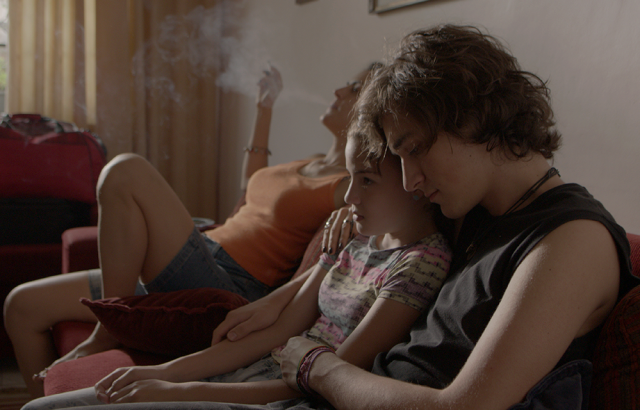
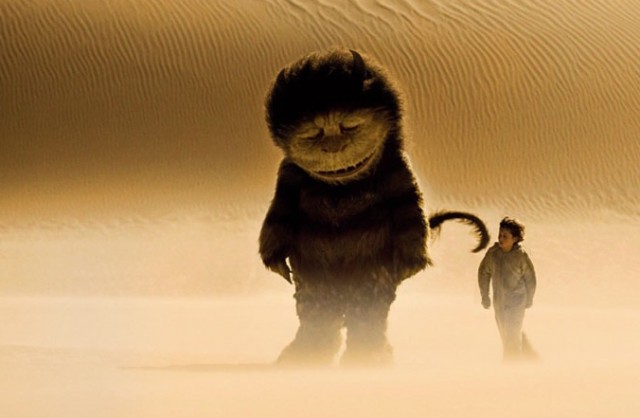
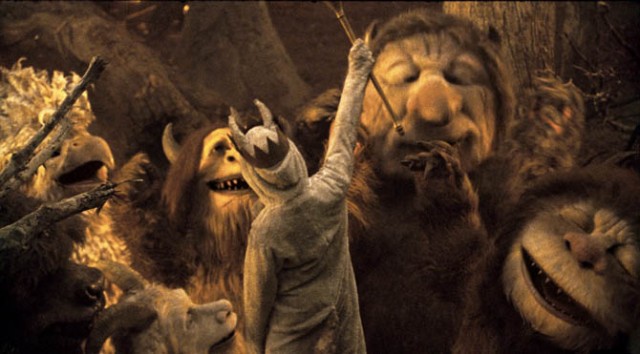
 The endlessly inventive Spike Jonze (Being John Malkovich, Adaptation.) has done the seemingly impossible, expanding Maurice Sendak’s classic 1963 children’s book, Where the Wild Things Are, into a fun and fantastical feature-length film. Written by Jonze and Dave Eggers (A Heartbreaking Work of Staggering Genius), the movie uses the ten sentences of the book and Sendak’s magical characters and transforms them into a world of wonder. Acting out after his sister’s friends crush his igloo and his divorced mother (Catherine Keener) ignores him in favor of a new boyfriend (Mark Ruffalo), nine-year-old Max (Max Records) runs away and sails across the ocean, landing on a faraway island where seven giant monsters live. In search of a leader, they name Max king, but he gets more than he bargained for as the ruler of the cynical Judith (voiced by Catherine O’Hara), the dumpy Ira (Forest Whitaker), the independent KW (Lauren Ambrose), the mysterious Bull (Michael Berry Jr.), the sad sack Alexander (Paul Dano), the dependable Douglas (Chris Cooper), and, most importantly, the manic-depressive Carol (James Gandolfini).