this week in film and television

MANIFESTO

Cate Blanchett

Cate Blanchett plays multiple characters in Julian Rosefeldt’s MANIFESTO

Park Ave. Armory, Wade Thompson Drill Hall
643 Park Ave. at 67th St.
Daily through January 8, $20
212-933-5812
www.armoryonpark.org

As visitors go from screen to screen in Julian Rosefeldt’s thirteen-channel installation, Manifesto, at the Park Ave. Armory, they’re bombarded with declarations from cultural missives by artists and philosophers dating back more than 150 years. Various words and phrases stick out, hanging in the air like bees buzzing around flowers: “originality,” “conflict,” “infinite and shapeless variation,” “decay,” “revolution,” “recklessness,” “absolute reality,” “glorious isolation,” “obsession,” freedom,” “everlasting change,” “the unconsciousness of humanity.”

I am against action; I am for continuous contradiction: for affirmation, too. I am neither for nor against and I do not explain because I hate common sense. I am writing a manifesto because I have nothing to say.

Art requires truth, not sincerity.

Logic is a complication. Logic is always wrong.

The words are all spoken by Oscar-winning actress Cate Blanchett (Notes on a Scandal, Blue Jasmine), who plays thirteen characters in twelve of the films, which each runs ten and a half minutes and are looped concurrently. She does not appear in the shorter prologue but does provide the narration. Among the characters she portrays are a homeless man, a grade school teacher, a factory worker, a punk rocker, a scientist, a news anchor, a choreographer, and a puppeteer.

Our art is the art of a revolutionary period, simultaneously the reaction of a world going under and the herald of a new era.

Originality is nonexistent.

Purge the world of intellectual, professional, and commercialized culture!

Rosefeldt (Trilogy of Failure, Deep Gold, The Ship of Fools), a photographer and filmmaker who was born in Munich and lives and works in Berlin, has an MA in architecture, so location plays a key role in the films, many of which take place in spectacular surroundings, interiors and exteriors, that would make Andreas Gursky drool, including an abandoned Olympic village, the Klingenberg CHP Plant, the Palasseum housing project, a former fertilizer factory, the ZDF Hauptstadtstudio, and the Humboldt Universität Department of Engineering Acoustics (in which a 2001-like monolith floats in the air). Each film begins and ends with Christoph Krauss’s camera lingering on the often jaw-dropping visuals.

We must create. That’s the sign of our times.

Fluxus is a pain in art’s ass.

Existence is elsewhere.

Julian Rosefeldt, Manifesto, 2015 © Julian Rosefeldt and VG Bild-Kunst, Bonn

A homeless man screams out his thoughts on art in Julian Rosefeldt’s MANIFESTO (© 2015 Julian Rosefeldt and VG Bild-Kunst, Bonn)

The statements are delivered in unique and inventive ways, with Blanchett, looking vastly different in each scene courtesy of Bina Daigeler’s costumes, Morag Ross’s makeup, and Massimo Gattabrusi’s hairstyling, playing a mourner giving a eulogy, a mother saying grace, a teacher presenting a lesson, a choreographer yelling at her troupe, a financial analyst spouting data, a crane operator incinerating garbage, and a CEO offering a new concept at a private board meeting in a seaside villa.

I am for art that is put on and taken off, like pants; which develops holes, like socks; which is eaten, like a piece of pie, or abandoned with great contempt, like a piece of shit.

No to the heroic. No to the anti-heroic.

Temporal and geographical alienation are forbidden.

Each section is dedicated to a separate artistic theory, discussing Pop Art, Conceptual Art / Minimalism, Fluxus, Surrealism / Spatialism, Dadaism, Suprematism / Constructivism, Stridentism / Creationism, Abstract Expressionism, Architecture, Futurism, Situationism, and Film. Heard today in this context, the statements range from the very funny to the extremely dry and boring, from the downright elitist to the realistic and relevant, from the sublime to the ridiculous.

Farewell to absurd choices.

Nothing is original.

In this period of change, the role of the artist can only be that of the revolutionary: it is his duty to destroy the last remnants of an empty, irksome aesthetic, arousing the creative instincts still slumbering unconscious in the human mind.

MANIFESTO (photo by James Ewing)

Close-ups of Cate Blanchett appear simultaneously in thirteen-screen installation at Park Ave. Armory (photo by James Ewing)

The quotations come from a wide variety of sources, from little-known essays to major influential texts. They include Karl Marx and Friedrich Engels’s Manifesto of the Communist Party, Kazimir Malevich’s Suprematist Manifesto, Dziga Vertov’s WE: Variant of a Manifesto, André Breton’s Manifesto of Surrealism, Lucio Fontana’s White Manifesto, Stan Brakhage’s Metaphors on Vision, Elaine Sturtevant’s Man Is Double Man Is Copy Man Is Clone, Lars von Trier and Thomas Vinterberg’s Dogma 95, and Claes Oldenburg’s I am for an art . . . , in addition to writings by Francis Picabia, Barnett Newman, Yvonne Rainer, Kurt Schwitters, Tristan Tzara, Sol LeWitt, Paul Eluard, Wassily Kandinsky and Franz Marc, Guillaume Apollinaire, and Werner Herzog.

The past we are leaving behind us as carrion. The future we leave to the fortune-tellers. We take the present day.

All of man is fake. All of man is false.

I believe in the pure joy of the man who sets off from whatever point he chooses, along any other path save a reasonable one, and arrives wherever he can.

About two-thirds of the way through each film, all of the characters portrayed by Blanchett, seen in extreme close-up, suddenly speak their lines in monotone unison, a kind of choral cacophony of chanting and singing that echoes throughout the massive Wade Thompson Drill Hall, an exhilarating moment that makes up for some of the pompous diatribe and intellectual masturbation that preceded it. It also is a grand statement for the critical importance of art, especially during tough times when countries face cultural and sociopolitical battles that threaten personal freedoms and liberties. But the best reason to experience Manifesto, which continues through January 8, is to watch a remarkable actress in a marvelous and memorable tour de force; Blanchett fans will also want to catch her in Anton Chekhov’s The Present, which is running on Broadway through March 19.

CHRISTMAS AT METROGRAPH: SILENT NIGHT, DEADLY NIGHT

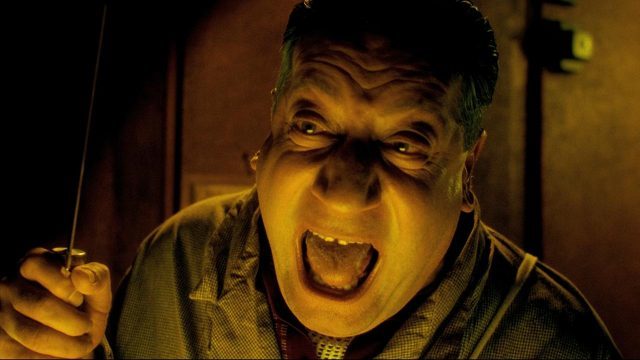
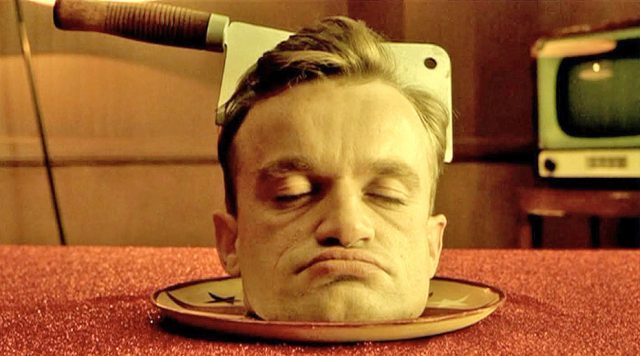
Santa goes a little psycho on holiday flasher flick, SILENT NIGHT, DEADLY NIGHT

Santa goes a little psycho on holiday flasher flick, SILENT NIGHT, DEADLY NIGHT

SILENT NIGHT, DEADLY NIGHT (Charles E. Sellier Jr., 1984)
Metrograph
7 Ludlow St. between Canal & Hester Sts.
Tuesday, December 20, 9:30
Series runs through January 1
212-660-0312
metrograph.com

“Punishment is good,” Mother Superior (Lilyan Chauvin) tells eight-year-old Billy (Danny Wagner) in Charles E. Sellier Jr.’s Silent Night, Deadly Night. Some might think that watching this 1984 slasher flick is pretty severe punishment itself, while others will revel in its tongue-in-cheek campiness; you can decide for yourself when it screens December 20 at 9:30 as part of the “Christmas at Metrograph” series at the Lower East Side theater, which features such other nontraditional seasonal faves as Die Hard, Eyes Wide Shut, and the Gee Whiz It’s Christmas compilation of various shorts, including Christ Mass Sex Dance and Holidaze. Not exactly a holiday classic, Silent Night, Deadly Night, the working title of which was Slayride, was mired in controversy upon its initial release, with critics and such groups as the PTA, the Catholic Conference, and Citizens Against Movie Madness attacking the film for setting a killer Santa Claus loose on an unsuspecting public. The movie begins in 1971, when five-year-old Billy (Jonathan Best) looks on in horror as his parents (Tara Buckman and Geoff Hansen) are brutally murdered by an insane criminal Kris Kringle (veteran character actor Charles Dierkop). Haunted by nightmares, Billy is mistreated by Mother Superior at St. Mary’s Home for Orphaned Children while being befriended by Sister Margaret (Gilmer McCormick), who wants to take a more sensitive approach with the boy. When Billy (Robert Brian Wilson) turns eighteen — blossoming into quite a handsome hunk — Sister Margaret gets him a job at a local toy store run by Mr. Sims (veteran character actor Britt Leach), but when Christmas comes around, well, everyone better watch out.

Silent Night, Deadly Night has its moments, particularly when it is dealing with Billy’s tortured mind, but then it gets bogged down in genre cliches and loses its psychological focus. But it’s still subversive fun, with a crazy soundtrack that combines Perry Botkin’s synth score with original songs by Morgan Ames that you are unlikely to ever hear performed by neighborhood carolers, among them “Slayrider,” “Christmas Flu,” and the indescribable “Warm Side of the Door.” The film was followed by four sequels, but the less said about them, the better. And yes, that’s scream queen Linnea Quigley getting into some trouble on the pool table. We chose not to give Silent Night, Deadly Night a star (token) rating because our advice is essentially to avoid it at all costs if you have any sense of common decency. (Meanwhile, we’ve watched it several times, especially to see what Santa does to that poor snowman….)

MARTIN SCORSESE IN THE 21st CENTURY: THE DEPARTED

Leonardo DiCaprio gets ready for battle in Martin Scorsese's Oscar-winning THE DEPARTED

THE DEPARTED is part of 21st-century Martin Scorsese retrospective at the Museum of the Moving Image

THE DEPARTED (Martin Scorsese, 2006)
Museum of the Moving Image
35th Ave. at 36th St., Astoria
Saturday, December 17, $15, 7:00
Series runs December 16-30
718-777-6800
www.movingimage.us

Queens-born auteur Martin Scorsese changed the face of independent film in the 1970s with such hard-hitting dramas as Mean Streets, Alice Doesn’t Live Here Anymore, and Taxi Driver, then proceeded to expand the notion of cinema as art with such 1980s and 1990s pictures as The King of Comedy, Goodfellas, and After Hours. His more recent output, however, has been vastly overrated, as evidenced by the first part of the Queens-based Museum of the Moving Image retrospective “Martin Scorsese in the 21st Century,” being held December 16-30 in conjunction with the release of the director’s latest film, Silence, which stars Andrew Garfield, Adam Driver, and Liam Neeson. (The series accompanies the exhibition “Martin Scorsese,” a look at Scorsese’s career divided into Family, Brothers, Men and Women, Lonely Heroes, New York, Cinephile, Cinematography, Editing, and Music.) Scorsese’s best film of the new century just might be 2006’s The Departed, based on Andrew Lau and Alan Mak’s awesome 2000 hit, Infernal Affairs. The relatively faithful remake moves the relentless action and intrigue from Hong Kong to the mean streets of Boston, where it is hard to tell cop from criminal. Just out of the academy, Colin Sullivan (Matt Damon) rises quickly to detective in the Special Investigations Unit, but he’s actually in cahoots with master crime lord Frank Costello (Jack Nicholson). Meanwhile, Billy Costigan (an excellent Leonardo DiCaprio), training to become a cop, is sent deep undercover (including a prison stint) to infiltrate Costello’s gang, with only Captain Queenan (Martin Sheen) and Sergeant Dignam (a very funny and foul-mouthed Mark Wahlberg) aware of the secret mission.

Sullivan and Costigan are like opposite sides of the same persona; in between them stands Costello — and Madolyn (Vera Farmiga), a psychiatrist who is in a relationship with one and is doctor to the other. As both the cops and the criminals search desperately for their respective rats, no one can trust each other, leading to lots of blood and a spectacular finale. Nicholson has a field day as the aging gangster, chewing up mounds of scenery in his first film with Scorsese, who returned to peak form with his best work since 1990’s Goodfellas. The film was nominated for five Oscars, winning four, for Best Director, Best Film Editing (Thelma Schoonmaker), Best Adapted Screenplay (William Monahan), and Best Picture, while Wahlberg was nominated for Best Supporting Actor. The Departed is screening December 17 at 7:00 in the museum’s Redstone Theater. The series opens December 16 with the bombastic Gangs of New York and continues through December 30 with Shutter Island, the disappointing Howard Hughes flick The Aviator, and the good but overrated films The Wolf of Wall Street and Hugo in 3-D.

ELEMENTS OF OZ

(photo by Gennadi  Novash, courtesy of Peak Performances @Montclair State University)

Unique app is key part of ELEMENTS OF OZ (photo by Gennadi Novash, courtesy of Peak Performances @Montclair State University)

3LD Art and Technology Center
80 Greenwich St. at Rector St.
Tuesday – Sunday through December 18, $25
866-811-4111
www.3ldnyc.org
www.thebuildersassociation.org

The Builders Association (Sontag:Reborn, Invisible Cities) takes audiences on a wild trip down the yellow brick road as it deconstructs and reconstructs The Wizard of Oz in its fun and innovative multimedia experimental production Elements of Oz. Conceived by Marianne Weems, Moe Angelos, and James Gibbs, directed by Weems, and cowritten by Gibbs and Angelos, Elements of Oz delves into the legend and legacy of the classic 1939 film, sharing little-known stories, reenacting key scenes, and examining its online presence, including theories about how the book and movie are metaphors for the U.S. monetary system and gold standard. Continuing at the 3LD Art and Technology Center through December 18, the show presents a small corp of actors who reenact and reshoot key scenes, creating a new version via multiple monitors that project what is happening onstage and freeze-frames taken from previous scenes. The piece is performed by Angelos, Sean Donovan, and Hannah Heller, who each portray several characters — all three play Dorothy Gale at various points. They not only switch roles, they also shift from commenting on the film to acting in its re-creation, and from past to present, telling tales of 1939 moviemaking and its ongoing reverberations in popular culture. Following a YouTube overture, Angelos delivers the first of many “talking points,” giving inside information to the audience. “It’s a masterpiece,” she says about the film, “but all we see is the magic. We don’t see all the brutal work and failure.” Elements of Oz reveals how much of that magic was made as stage manager April Sigler, associate lighting designer Elliott Jenetopulos, video designer Austin Switser, production manager Brendan Regimbal, and technical director Carl Whipple set up and break down Neal Wilkinson’s sets, filming short scenes that are then edited live to mimic the original, shot by shot, and played back on a large onstage screen as well as the monitors that fill the theater. Meanwhile, Moe relates stories about Margaret Hamilton and her double, Betty Denko, suffering major injuries; how “Somewhere Over the Rainbow” was almost left on the cutting-room floor; that some of the munchkins were repurposed as flying monkeys; and what really happened when the film went from black-and-white to color.

(photo by Gennadi  Novash, courtesy of Peak Performances @Montclair State University)

Hannah Heller and Sean Donovan play multiple characters in experimental exploration of the making of THE WIZARD OF OZ (photo by Gennadi Novash, courtesy of Peak Performances @Montclair State University)

Just as The Wizard of Oz made use of cutting-edge technology, so does Elements of Oz, which has a unique innovation of its own. During the show, which is based on both the film and the book by L. Frank Baum, there are moments that are best viewed through your smart phone or tablet via a free augmented reality app, designed by John Cleater, that enhances what you’re watching by adding visual and aural effects, from snow to giggling munchkins to other cool surprises. Angelos (the Five Lesbian Brothers), Donovan (Thank You for Coming: Play), and Heller (The World Is Round) are hysterical as they change from role to role, with Angelos as Dorothy and Glinda, the mustachioed Donovan as Dorothy, Uncle Henry, Mike Wallace, the Scarecrow, the Tin Man, Salman Rushdie, and the Wizard, and Heller as Dorothy, Aunt Em, the Wicked Witch, the Scarecrow, Judy Garland, and Ayn Rand. (The costumes are by Andreea Mincic, with lighting by Jennifer Tipton, sound design and original music by Dan Dobson, and interactive design and programming by Jesse Garrison.) Originally presented by Peak Performances @ Montclair State University, the goofy and charming Elements of Oz is probably about twenty minutes too long, as things get a little repetitive, and as fun as the app is, you’ll find yourself at times looking at your phone, waiting for the next bit of AR to take place, instead of watching what is happening onstage. But like the original book and film, Elements of Oz is an enjoyable mind-expanding journey; and be sure to keep that app on as you exit 3LD and head down Greenwich St.

ICONS & INNOVATORS: NORMAN LEAR

Norman Lear, seen above in documentary NORMAN LEAR: ANOTHER VERSION OF YOU, will be at the Greene Space to discuss his life and career

Norman Lear, seen above in documentary NORMAN LEAR: ANOTHER VERSION OF YOU, will be at the Greene Space on December 17 to discuss his life and career

Who: Norman Lear, Susan Fales-Hill, Heidi Ewing, Rachel Grady
What: Conversation with Norman Lear
When: Saturday, December 17, $25, 6:00
Where: The Greene Space at WNYC, 44 Charlton St. at Varick St.
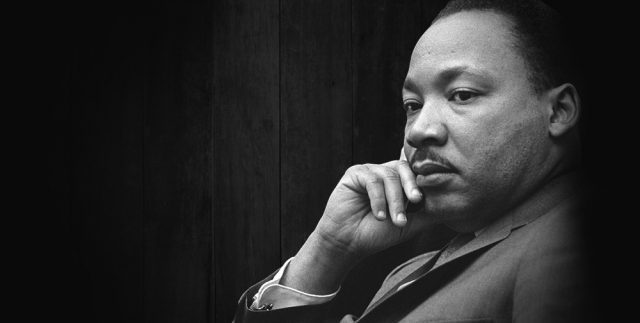
Why: “In my ninety-plus years I’ve lived a multitude of lives,” Norman Lear writes in his new memoir, Even This I Get to Experience. “I had a front-row seat at the birth of television; wrote, produced, created, or developed more than a hundred shows; had nine on the air at the same time; finished one season with three of the top four and another with five of the top nine; hosted Saturday Night Live; wrote, directed, produced, executive-produced, or financed more than a dozen major films; before normalization, led an entourage of Hollywood writers and producers on a three-week tour of China; founded several cause-oriented national organizations, including the 300,000-member liberal advocacy group People for the American Way; was told by the New York Times that I changed the face of television; was labeled the ‘No. 1 enemy of the American family’ by Jerry Falwell; was warned by Pat Robertson that my arms were ‘too short to box with God’; made it onto Richard Nixon’s ‘Enemies List’; was presented with the National Medal of the Arts by President Clinton; purchased an original copy of the Declaration of Independence and toured it for ten years in all fifty states; was ranked by Entertainment Weekly fortieth among the ‘100 Greatest Entertainers of the Century’ (twenty-nine places ahead of the Sex Pistols); ran the Olympic torch in the 2002 Winter Olympics; blew a fortune in a series of bad investments in failing businesses; and reached a point where I was informed we might even have to sell our home.” That’s quite a legacy for the ninety-four-year-old New Haven native, built around such innovative television programs as All in the Family, Good Times, The Jeffersons, Sanford and Son, Maude, Fernwood 2Night, One Day at a Time, and Marry Hartman, Mary Hartman but one that goes much further than that. On December 17, Lear will sit down with author and television writer Susan Fales-Hill (Always Wear Joy, A Different World) for the next installment of her “Icons & Innovators” series at the Greene Space for a conversation exploring Lear’s extensive life and career. They will be joined by filmmakers Heidi Ewing and Rachel Grady (Jesus Camp, 12th & Delaware), directors of the recently released documentary Norman Lear: Another Version of You, which opened the 2016 Sundance Film Festival. It should be a fascinating, wide-ranging talk, especially given the political situation in the country today.

ON THE MAP

Jersey’s Tal Brody gave up potential NBA career to help lift Israeli team to glory in 1977

Jersey’s Tal Brody gave up potential NBA career to help lift Israeli team to glory in 1977

ON THE MAP (Dani Menkin, 2016)
Cinema Village
22 East 12th St. between University Pl. & Fifth Ave.
Opens Friday, December 9
212-529-6799
www.cinemavillage.com
www.onthemapfilm.com

In the 1970s and 1980s, sports and politics began to mix in unsavory ways, from the horrific massacre of the Israeli Olympic team in Munich in 1972 to boycotts of the 1980 and 1984 Summer Games. But sports can also lift nations and their place in the world in remarkable ways. Three years before the “Miracle on Ice,” when the U.S. Olympic hockey team won the Gold Medal in Lake Placid, a previously unsuccessful Israeli basketball team was attempting to pull off a miracle of its own at the 1976-77 European Cup Championship. Writer-director Dani Menkin tells the improbable story of Maccabi Tel Aviv in On the Map, an exciting, superbly made documentary about a group of dedicated men whose on-court efforts were about more than going after the cup. “It’s not just basketball,” point guard Bob Griffin explains. Menkin mixes contemporary and archival footage for maximum impact; seeing the surviving members of the team donning their jerseys again and watching themselves in the biggest international game an Israeli team has ever participated in is tremendously moving. “It was something so unbelievable, so wishful, a great, golden place in sports history,” says sportscaster Alex Giladi, who took much of the amazing footage shown in the film. Fascinating insights emerge as Menkin speaks with Griffin, power forward Eric Minkin, forward Lou Silver, guard Miki Berkovich, center Aulcie Perry, superstar point guard and captain Tal Brody, and Jennifer Boatwright, the widow of small forward Jim Boatwright, in addition to former Notre Dame coach Digger Phelps, Hall of Famer Bill Walton, who played with Brody on the U.S. National Team, former NBA commissioner David Stern, NBA commentator Simmy Reguer, and broadcaster Gideon Hod. Among those putting Maccabi’s battles against Italy’s Mobilgirgi Varèse, Spain’s Real Madrid, and Russia’s CSKA Moscow Red Army into political perspective are former finance minister Yair Lapid, former Israeli ambassador to the U.S. Michael Oren, Maccabi president Shimon Mizrahi, and longtime Soviet prisoner and activist Natan Sharansky.

On the Map is a terrific documentary, particularly because Menkin (39 Pounds of Love, Dolphin Boy) was able to acquire so much outstanding black-and-white and color footage of the events discussed in the film, from Israeli defense minister Moshe Dayan greeting the team on court before games to Brody practicing by himself, from players sharing a prophetic cake to head coach Ralph Klein giving inspirational locker-room speeches. There is also archival footage of the 1972 Olympic massacre, the 1973 Yom Kippur War, Prime Minister Yitzhak Rabin preparing to resign, Egyptian president Anwar Sadat meeting with U.S. president Jimmy Carter, and the 1976 Air France hijacking that led to Operation Entebbe. In the middle of it all is Brody, a kid from Jersey who helped change Israel and its position on the world stage. “There are some things that are more important than sport,” Stern says. “The excitement was just too much. I wanted more,” Perry asserts with a big smile. On the Map expertly delivers big-time on both accounts. The film opens December 9 at Cinema Village, with Menkin participating in Q&As following the 3:00, 5:00, and 7:00 screenings December 9-11.

PUSHING THE ENVELOPE — A DECADE OF DOCUMENTARY AT THE CINEMA EYE HONORS: THE ACT OF KILLING / THE LOOK OF SILENCE

THE ACT OF KILLING

Proud mass murderers envision themselves as movie stars in Joshua Oppenheimer’s THE ACT OF KILLING

THE ACT OF KILLING (Joshua Oppenheimer, 2012)
Museum of the Moving Image
35th Ave. at 36th St., Astoria
Sunday, December 11, $12 (can be applied to museum admission), 3:00
Series runs through December 23
718-777-6800
www.movingimage.us
www.theactofkilling.com

Joshua Oppenheimer’s Oscar-nominated The Act of Killing is one of the most disturbing, and unusual, films ever made about genocide, and you can see even more of it on December 11 when the Museum of the Moving Image screens the director’s cut, containing thirty-seven minutes of additional material, as part of the nonfiction series “Pushing the Envelope: A Decade of Documentary at the Cinema Eye Honors.” In 1965–66, as many as a million supposed communists and enemies of the state were killed in the aftermath of a military coup in Indonesia. Nearly fifty years later, many of the murderers are still living in the very neighborhoods where they committed the atrocities, openly boasting about what they did, being celebrated on television talk shows, and even being asked to run for public office. While making The Globalization Tapes in Indonesia in 2004, the Texas-born Oppenheimer met some of these self-described gangsters and, struck by their brash, bold attitudes, decided to create a different kind of documentary. In addition to following them around as they go bowling, play golf, sing, and dance, proudly showing off how happy their lives are, Oppenheimer offered them the opportunity to tell their story as if it were a Hollywood movie. The men, whose love of American noir and Westerns heavily influenced the stylized killings they perpetrated, loved the idea and began to restage torture and murder scenes in great detail for the camera, getting in period costumes, putting on makeup, going over script details, reviewing the dailies, and playing both the violent criminals and their victims.

The leader is master executioner Anwar Congo, who is perhaps the only one haunted by his deeds; although on the surface he is proud of what he did, he is tormented by constant nightmares. Such is not the case for the others, who laugh as they go over the gory details, especially paramilitary leader Herman Koto, Congo’s protégé and a man seemingly without a conscience. Meanwhile, fellow executioner Adi Zulkadry wonders whether telling the truth will actually negatively impact their legendary status. “Human rights! All this talk about ‘human rights’ pisses me off,” Congo says in one scene. “Back then there was no human rights.” Oppenheimer also depicts how frighteningly powerful the three-million-strong, government-connected Pancasila Youth is, ready to fight for the very same things that led to the genocide in the first place. It’s hard to comprehend how these men continue to walk free, and one can argue whether Oppenheimer should indeed be giving them the platform that he does. Watching these gangsters — or “free men,” as they like to call themselves, since the Indonesian word for gangster is “preman,” derived from the Dutch “vrijman” — artistically re-create scenes of horrific violence is both illuminating and infuriating on multiple levels that will leave viewers angry and incredulous.

A family searches for answers in THE LOOK OF SILENCE

A family searches for answers in THE LOOK OF SILENCE

THE LOOK OF SILENCE (Joshua Oppenheimer, 2014)
Museum of the Moving Image
35th Ave. at 36th St., Astoria
Sunday, December 11, $12, 6:30
Series runs through December 23
718-777-6800
www.movingimage.us
thelookofsilence.com

Oppenheimer’s Oscar-nominated The Look of Silence opens with an old man, wearing a pair man, wearing a pair of red optic trial lens frames, gazing into and around the camera for twelve uncomfortable seconds, in complete silence, showing no emotion. It is a striking metaphor for the rest of the film, a shocking documentary about the 1965–66 Indonesian genocide and a bold man determined to confront the men who brutally murdered his brother then, along with a million other supposed communists. In 2012, Oppenheimer made the Oscar-nominated The Act of Killing, in which the leaders of the genocide, who are still in power today, restaged their killings as if they were Hollywood movie scenes. Created as a companion piece to that documentary, The Look of Silence follows forty-four-year-old optometrist Adi as he learns the details of what happened to his brother, Ramli, who was butchered two years before Adi was born. Adi has decided to do what no one else in his country will: break his culture’s silence and denial and face the perpetrators to make them take responsibility for what they did. If they are willing to show remorse, he is willing to forgive. But he has set out on what appears to be an impossible mission; the men he meets with still run Indonesia, and they are more than comfortable threatening the well-being of Adi and his family. Meanwhile, Adi’s parents and patients don’t want to talk about what occurred back in 1965–66, or what is still going on today, as they live in fear of these same men. “No, nothing happened,” one woman says when asked about the killings in her town of Aceh. “You ask too many questions,” she adds. Kemat, a survivor of the Snake River massacres, says, “The past is the past. I’ve accepted it. I don’t want to remember. It’s just asking for trouble.” Adi learns horrifying details as he meets with village death squad leader Inong (the old man shown at the beginning of the film), Snake River death squad commander Amir Siahaan, and regional legislature speaker M. Y. Basrun, all of whom defend their actions, and their power and wealth, while more than hinting that Adi should end his quest. But Adi isn’t about to back down.

THE LOOK OF SILENCE

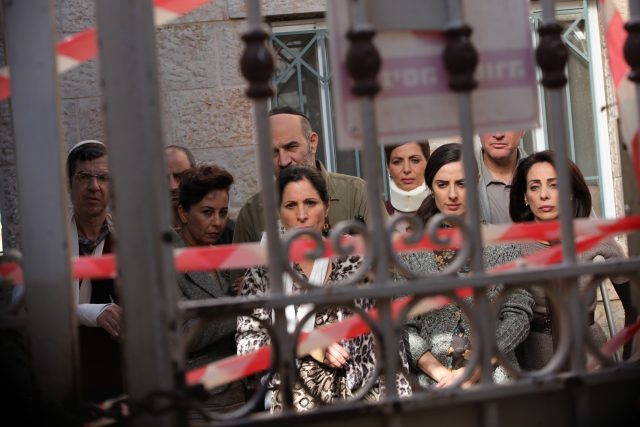
Adi faces a group of mass murders, including his brother’s killers, in powerful documentary

Adi is often shown in front of a television, mystified as Oppenheimer shows him footage taken for The Act of Killing; Adi stares ahead in disbelief and silence, much like we did when watching the final film, amazed at what we were seeing. It is a fascinating coincidence that Adi is an optometrist, going around his community fitting people for glasses, helping them see better, even if they don’t always want to look at certain things. He is appalled that his children’s school still teaches that the evil communists deserved to die; it’s particularly telling when his young daughter playfully puts on two pairs of glasses, as if perhaps the next generation will not look away — and to emphasize that, Oppenheimer cuts directly to Adi’s aging, decrepit father, Rukun (whom his wife, Adi’s mother, Rohani, claims is 140), his eyes closed, as he can barely see or hear anymore and needs to be taken care of like a baby. Adi has become a folk hero in Indonesia, where some regions have banned the film and screenings had to be canceled because of threats of violence from the police and military. But the film itself depicts Adi as an everyman; he could be any one of us, saying the things that need to be said. “Making any film about survivors of genocide is to walk into a minefield of clichés, most of which serve to create a heroic (if saintly) protagonist with whom we can identify, thereby offering the false reassurance that, in the moral catastrophe of atrocity, we are nothing like the perpetrators,” Oppenheimer (The Globalisation Tapes) writes in his extensive, must-read notes on the film’s official website. “But presenting survivors as saintly in order to reassure ourselves that we are good is to use survivors to deceive ourselves. It is an insult to survivors’ experience, and does nothing to help us understand what it means to survive atrocity, what it means to live a life shattered by mass violence, and to be silenced by terror. To navigate this minefield of clichés, we have had to explore silence itself.” In that way, to use a cliché, The Look of Silence speaks volumes. And although it’s specifically about the Indonesian genocide, it could just as easily be made about many other mass murders that have occurred, and are still going on, around the world. Adi might be receiving long standing ovations at screenings where he appears, but it’s telling that the film’s closing credits include more than two dozen people listed as “Anonymous,” from the codirector and a coproducer to a camera operator and production managers. Clearly, fear still rules in Indonesia.

An unforgettable film that needs to be widely seen, The Look of Silence, which was executive produced by Werner Herzog, Errol Morris, and André Singer, is being shown at 6:30 on December 11 at the Museum of the Moving Image, shortly after the director’s cut of The Act of Killing. “Pushing the Envelope: A Decade of Documentary at the Cinema Eye Honors,” which celebrates the upcoming tenth annual Cinema Eye Honors awards, continues through December 23 with such other past Cinema Eye nominees and winners as Michael Palmieri and Donal Mosher’s October Country, Bill Ross IV and Turner Ross’s 45365, and Jennifer Venditti’s Billy the Kid, with the directors on hand for Q&As. Both The Act of Killing and The Look of Silence won Cinema Eye Honors for Outstanding Achievement in Nonfiction Feature Filmmaking and Outstanding Achievement in Production; Oppenheimer also won for Outstanding Achievement in Direction. The nominees for Outstanding Achievement in Nonfiction Feature Filmmaking for the 2017 Cinema Eye Honors are Cameraperson, Fire at Sea, I Am Not Your Negro, OJ: Made in America, and Weiner; the winners will be announced at the Museum of the Moving Image on January 11.