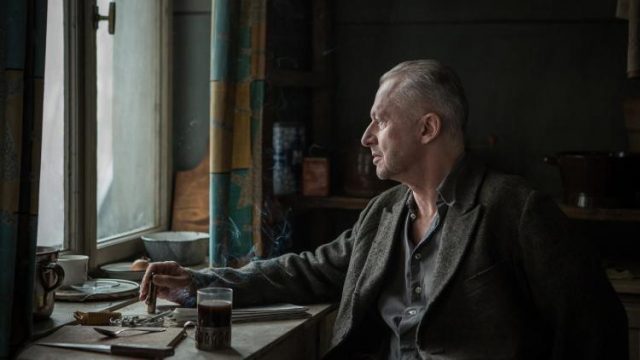
Władysław Strzemiński (Bogusław Linda) looks out on a changing Poland in Andrzej Wajda’s film film, Afterimage
AFTERIMAGE (POWIDOKI) (Andrzej Wajda, 2016)
Lincoln Plaza Cinema
1886 Broadway at 63rd St.
Opens Friday, May 19
212-757-2280
www.lincolnplazacinema.com
www.filmmovement.com
 In his final film, Polish master Andrzej Wajda makes a grand statement about the importance of art and its place in society. Afterimage, which was the opening-night selection of the thirteenth New York Polish Film Festival earlier this month, is based on a true story while also serving as a stern warning. Bogusław Linda, who has previously appeared in Wajda’s Man of Iron and Danton, gives a towering performance as real-life Polish avant-garde artist Władysław Strzemiński, a one-armed, one-legged painter considered one of the greatest Polish artists and theoreticians of the twentieth century but whose legacy was destroyed during the rise of Stalinism and social realism. The film begins with a bright, gleeful scene in which Professor Strzemiński and his students roll around a lush green field, smiling and laughing and loving life. Hanna (Zofia Wichłacz) arrives, wanting to study with the professor as well. “The image has to be what you absorb from this,” he tells her, pointing at the beautiful landscape while his students listen with rapt attention. “When we gaze at an object, we get its reflection in our eye. When we stop looking at it and move our gaze elsewhere, an afterimage of the object remains in the eye — a trace of the object with the same shape but the opposite color. An afterimage. Afterimages are the colors, the inside of the eye which looks at an object. Because a person really only sees what he is aware of.” He then gazes out with a big grin and closes his eyes — and Wajda cuts to him in his apartment in 1948, with the Polish United Workers’ Party now in charge; cinematographer Paweł Edelman switches to a very different color scheme, primarily dank grays save for the pervasive red of the Communist party. Virtually day by day, Strzemiński has his ability to make art and to teach stripped away a little at a time as the party enforces a strict code of what is permitted and what is not under its regime. “The purpose of art is to improve its truth on reality,” Strzemiński explains, and he has to face a series of disturbing new truths himself, especially when his young daughter, Nika (Bronislawa Zamachowska), whose mother is famous sculptor Katarzyna Kobro (Aleksandra Justa), starts falling in line with Communist ideals.
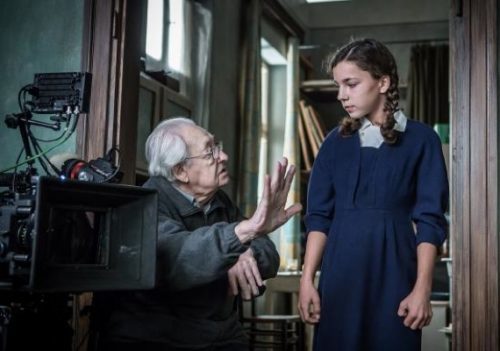
Andrzej Wajda directs Bronislawa Zamachowska on the set of Afterimage (photo © Akson Studio/Anna Włoch)
The film, written by Andrzej Mularczyk based on an idea by Wajda (The Maids of Wilko, The Promised Land), is a fitting finale for the Polish auteur, who won such prestigious prizes as the Palme d’Or, an honorary Golden Bear, and an honorary Academy Award before passing away in October at the age of ninety, following a sixty-five-year career. (In addition, four of his works were nominated for Best Foreign Language Film Oscars.) Afterimage might take place between 1948 and 1952, but it is frighteningly relevant today with so many countries around the world under dictatorships and the value of art and arts education in schools facing scrutiny even here in the United States. Much of the film has an elegiac tone, including the score, which features the music of the late Polish composer Andrzej Panufnik. Linda is brilliant as Strzemiński, who is almost always deep in thought, finding it hard to believe the lengths the party will go to in order to silence artists, including his eager students and his good friend, poet Julian Przyboś. The disheartened stares he makes while watching Nika become part of the problem instead of the solution are intensely moving. Rising Polish star Wichłacz (Warsaw 44) gives a touching performance as Hania, the new student who wants to fight the authorities and is determined to help Professor Strzemiński finish his master opus, The Theory of Vision, before everything is taken away from him. Even though the film shows Wajda at the top of his game, it might not be a stretch to suggest that the aging director identified with Strzemiński, a man who didn’t let the loss of two limbs prevent him from creating art, just as Wajda, approaching ninety at the time, didn’t let anything stop him as well; he joined up with the Polish resistance in 1942, trained to be a painter and then a filmmaker after the war, and was a major supporter of Lech Wałęsa’s Solidarity movement in the 1980s, ultimately making the film Wałęsa: Man of Hope. In the end, both Wajda and Strzemiński are inspiring figures whose works seal their legacies, from the former’s many films to the latter’s paintings and theories as well as his revolutionary Neoplastic Room, which was reconstructed in 1960 at the Muzeum Sztuki w Łodzi. “Everyone sees differently,” Professor Strzemiński says in the film, which is likely to leave a long-lasting afterimage on those who watch it.
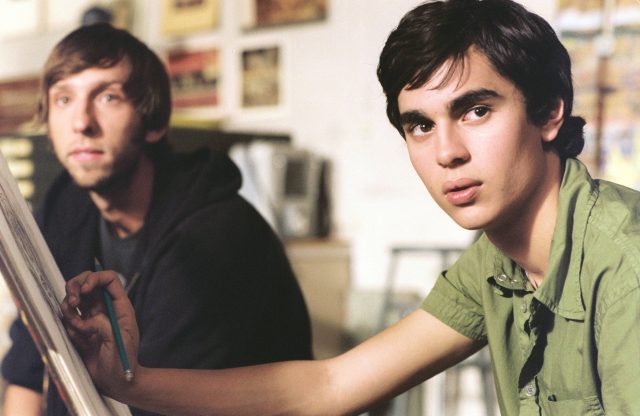
 Director Terry Zwigoff, who has claimed to “not be interested in comics too much” and who made the fab 1995 documentary Crumb, about comic book artist R. Crumb, reteamed with comics legend Daniel Clowes for the outrageously entertaining Art School Confidential, inspired by a four-page black-and-white strip Clowes wrote in a 1991 edition of his comic book Eightball. (The two previously worked together in 2001 on the outstanding Ghost World, earning them an Oscar nomination for Best Adapted Screenplay.) Clowes has expanded Art School Confidential into a very funny satire/murder mystery set in a New York City art school based somewhat on Pratt in Brooklyn (though the film was shot in Southern California). Max Minghella (The Social Network, The Handmaid’s Tale) stars as Jerome Platz, an art student from the suburbs who dreams of becoming the next Picasso. Used to being beat up by bullies, he is desperately looking to fit in somewhere, and he might just find his place in Strathmore art school, along with Beat Girl, Kiss-Ass, Army Jacket, Vegan, Filthy-Haired Girl, Preppy Girl, Nympho, and other stereotypes, as well as the art teacher claiming to be preparing for his own exhibition (John Malkovich, also one of the film’s producers). Jerome is befriended by Bardo (Joel David Moore), a disillusioned student who can’t figure out yet which stereotype Jerome is. Bardo introduces Jerome to Jimmy (Jim Broadbent), a drunken, failed artist who represents many a Strathmore student’s future. Jerome falls hard for Audrey (Sophia Myles), a part-time model who is also being courted by the ridiculously straitlaced and seemingly talentless, though celebrated, Jonah (Matt Keeslar). And one of Jerome’s roommates, the hyperactive Vince (Ethan Suplee), is making a movie about the Strathmore Strangler, who has claimed several victims and is still on the loose. Art School Confidential gets just about everything right (save for two brief appearances of the boom mic), turning clichés inside out in hysterical ways. You don’t have to be a comic-book fan geek to love this film, which is screening May 20 at 4:00 as part of Metrograph’s weekend tribute to Zwigoff, who will be on hand to discuss the work. The series also includes Ghost World, Louie Bluie, Crumb, and the New York premiere of the director’s cut of Bad Santa, with Zwigoff at Metrograph for all screenings.

 A month before her wedding, Michal (Noa Koler) finds out that her fiance, Gidi (Erez Drigues), doesn’t actually love her. Determined to not become an old maid, the thirty-two-year-old animal handler decides that she is going to go through with the ceremony anyway, that love — and the right man — are still out there waiting for her. “I believe God will help me find a groom by the end of Hanukkah,” she tells wedding planner Shimi (Amos Tamam), who is not so sure she is making the right decision. She then goes on a series of ever-more-silly dates with Orthodox men as her wedding day approaches, with no legitimate suitor in sight as her friends and family wonder about her sanity. And then she meets singer Yoss (Oz Zehavi), but is he Mr. Right? By then, you might not care. Written and directed by New York City native Rama Burshtein (Fill the Void, Venice 70: Future Reloaded), The Wedding Plan, which is called Through the Wall in Hebrew, is a Lifetime-like romantic comedy, trying too hard to be charming and funny, resulting in flat scenes that are predictable and trite. Michal’s wedding day is scheduled for the eighth day of Hanukkah, which holds special meaning at the end of the Festival of Lights, a time for rejuvenation; The Wedding Plan could use some rejuvenating of its own.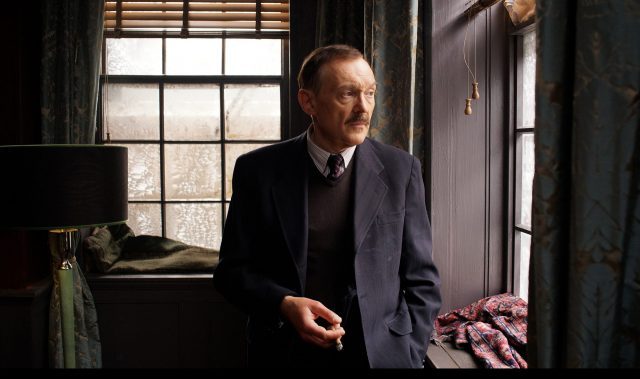
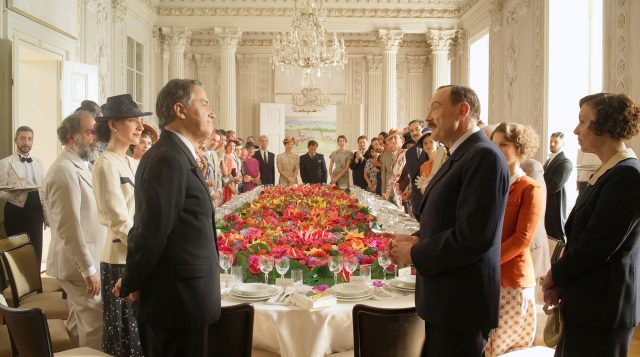
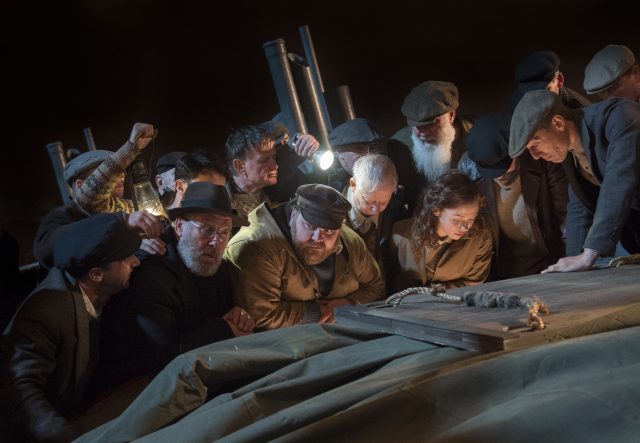
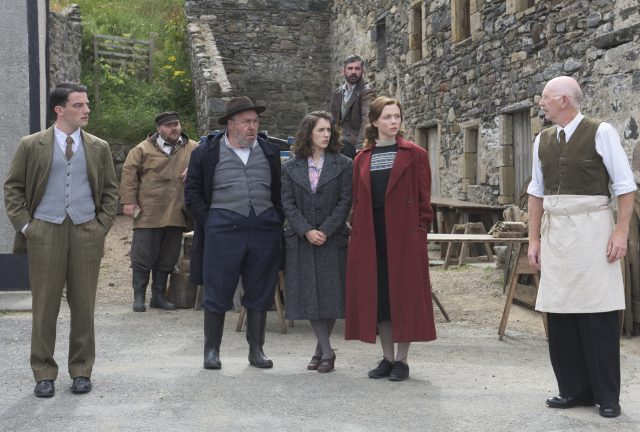
 Gillies Mackinnon’s Whisky Galore! follows in the tradition of such British charmers as Local Hero, Waking Ned Devine, and The Full Monty, another quirky tale of a small community coming together when facing unexpected challenges. It’s 1943, and WWII has not quite made it to the remote (and fictional) Scottish island of Todday, but you wouldn’t know it from the actions of Captain Wagget (Eddie Izzard), an English commander rigidly leading a ragtag unit of islanders just in case Hitler should attack. The town has gone dry, with no alcohol deliveries expected because of the war, putting a damper on everything, including celebrations; most importantly, postmaster Joseph Macroon (Gregor Fisher), a leader on the island, won’t allow his daughters, Catriona (Ellie Kendrick) and Peggy (Naomi Battrick), to marry their intendeds, schoolteacher George Campbell (Kevin Guthrie) and Sergeant Odd (Sean Biggerstaff), respectively, until they can have the proper party, with plenty of booze. George also faces the wrath of his Bible-thumping mother (Ann Louise Ross), who forbids him from marrying Peggy. In desperate need of drink, the town gets excited when a cargo ship runs aground just off the island, transporting tens of thousands of export-only alcohol for a cabinet minister. While Captain Waggett seeks to protect the bounty from thieves — his colleagues and neighbors — a group of thirsty islanders, including Joseph, George, Odd, Sammy (Iain Robertson), the Biffer (Antony Strachan), Old Roddy (Sean Scanlan), and Angus (Brian Pettifer), devise a plan to obtain the contraband whisky, right under Waggett’s nose.