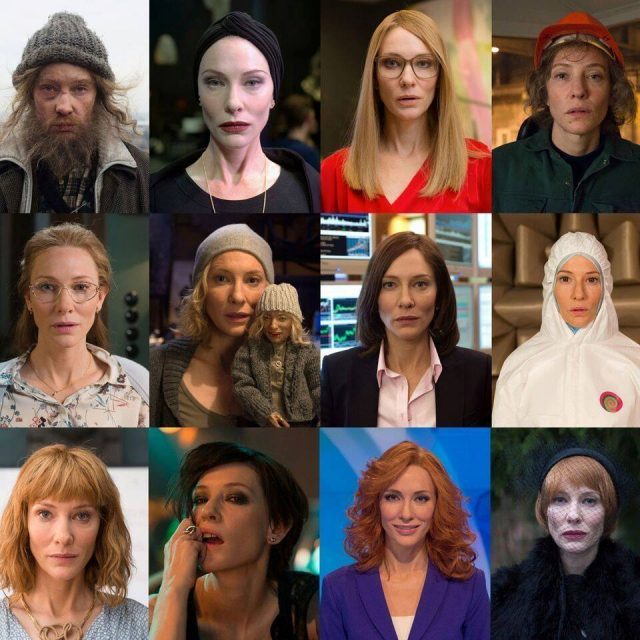
Cate Blanchett plays thirteen roles in twelve scenarios in Julian Rosefeldt’s Manifesto
MANIFESTO (Julian Rosefeldt, 2017)
Film Forum
209 West Houston St. between Sixth Ave. & Varick St.
Opens Wednesday, May 10
212-727-8110
filmforum.org
www.facebook.com
 Julian Rosefeldt’s Manifesto previously manifested as a captivating thirteen-channel installation in the Park Avenue Armory’s massive Wade Thompson Drill Hall, where visitors could walk among thirteen enormous screens, experiencing the work in whatever order they preferred, watching all 130 minutes or cherry picking individual scenes. Each screen (except for the prologue) showed a specific ten-and-a-half-minute scenario, running concurrently, in which Oscar-winning actress Cate Blanchett played a different character (in one she played two), her dialogue consisting almost exclusively of quotes from more than fifty manifestos by such artists and thinkers as Dziga Vertov, Claes Oldenburg, André Breton, Yvonne Rainer, Lars von Trier, Adrian Piper, Wassily Kandinsky, Guillaume Apollinaire, Lucio Fontana, Werner Herzog, and Marx and Engels. The stunning visuals, featuring spectacular indoor and outdoor architecture gorgeously photographed by Christoph Krauss, distracted positively from much of the theoretical mush, formal language that is not easy to turn into a film. Now writer-director Rosefeldt and editor Bobby Good have chopped Manifesto into a disappointing ninety-four-minute movie shown on a single screen, cutting back and forth among the scenarios, sacrificing the meditative rhythm of the long, individual scenes, each of which began with a lovely, peaceful establishing shot, and unfortunately highlighting snippets of pompous intellectual meanderings, eliminating the undercurrent of humor that made the installation worth watching in full.
Even Blanchett’s tour-de-force performance, playing such characters as a homeless man (Situationism), a funeral speaker (Dadaism), a financial broker (Futurism), a choreographer (Fluxus / Merz / Performance), a news reader and a reporter (Conceptual Art / Minimalism), and a teacher (Film), gets lost in the transition and now feels like more of a gimmick. In addition, in the installation, about two-thirds of the way through each scene all the characters face the camera in unison and spout different philosophical musings in a robotic monotone, creating a choral cacophony that resounded through the cavernous space, dominated by giant close-ups of Blanchett everywhere; nothing like that happens in the shortened film. Kudos still go out to costume designer Bina Daigeler, makeup magician Morag Ross, hair stylist Massimo Gattabrusi, and production designer Erwin Prib, but Rosefeldt (Trilogy of Failure, Deep Gold, The Ship of Fools) and Good have done a disservice to what was a grand work of art that itself was a grand statement about the critical importance of art. “Originality is nonexistent,” Blanchett says as a teacher, quoting Jim Jarmusch. “I am writing a manifesto because I have nothing to say,” she narrates in the prologue, quoting Philippe Soupault. The original Manifesto installation had plenty to say; the single-screen theatrical version, however, does not.
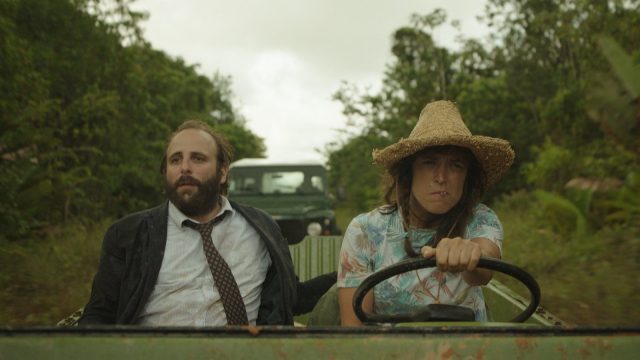
 “Vines . . . are like internships,” Ulrich (Pascal Tagnati) tells Marc Châtaigne (Vincent Macaigne) in Antonin Peretjatko’s madcap colonialist farce, Struggle for Life. “Don’t drop one till you got another.” Nothing ever goes right for middle-aged schlemiel Châtaigne, who has been assigned by Rosio (Jean-Luc Bideau) of the Ministry of Standards to oversee the construction of an indoor ski resort in the jungles of Guiana; Guia-Snow, Rosio explains, will show South America that France can export a coveted resource, cold weather. Châtaigne’s contact in Guiana is lunatic bureaucrat Galgaric (Mathieu Amalric), who assigns him a driver named Tarzan (Vimala Pons), a grown woman who is interning with the Department of Forestry and Water and is in charge of renovating gardens. Soon Châtaigne and Tarzan are lost in the jungle, encountering a variety of oddballs, including Christian Duplex (Pascal Légitimus), Georges (Thomas De Pourquery), and Damien (Rodolphe Pauly), each of whom is somehow involved in either tearing down or saving the Amazon. Meanwhile, Châtaigne is being hunted by strange and skillful tax minister Maître Friquelin (Fred Tousch). They also meet up with dangerous insects and animals, cannibals, and parking meters. Jerry Lewis’s The Patsy meets Woody Allen’s Bananas in this hit-or-miss satire of French colonialism and government programs, in which interns are given a tremendous amount of power and responsibility, with director-cowriter Peretjatko (La Fille du 14 juillet) leaving no sight gag unturned. Yes, a lot of them are just plain stupid, but a whole bunch are just plain funny as well.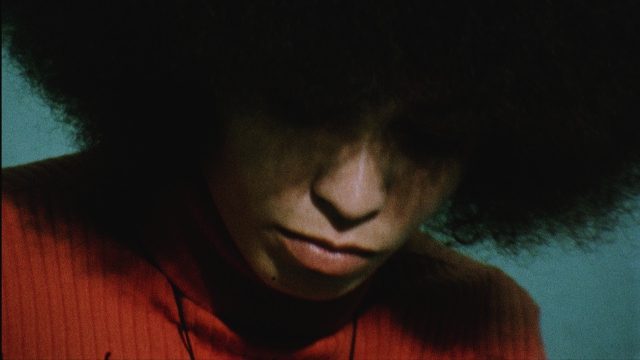
 From 1967 to 1975, a group of more than two dozen Swedish journalists came to America to document the civil rights movement. More than thirty years later, director and cinematographer Göran Hugo Olsson discovered hours and hours of unused 16mm footage — the material was turned into a program shown only once in Sweden and seen nowhere else — and developed it into The Black Power Mixtape 1967-1975, a remarkable visual and aural collage that focuses on the Black Panthers and the Black Power movement, a critical part of American history that has been swept under the rug. Olsson and Hanna Lejonqvist have seamlessly edited together startlingly intimate footage of such seminal figures as Eldridge Cleaver, Bobby Seale, Huey P. Newton, Dr. Martin Luther King, Jr., and Stokely Carmichael, including a wonderfully personal scene in which Carmichael interviews his mother on her couch. But the star of the film is the controversial political activist Angela Davis, who allowed the journalists remarkable access, particularly in a jailhouse interview shot in color. (Most of the footage is in black-and-white.) Davis also adds contemporary audio commentary, sharing poignant insight about that tumultuous period, along with Abiodun Oyewole of the Last Poets, singer Erykah Badu, professor, poet, and playwright Sonia Sanchez, Roots drummer Ahmir Questlove Thompson (who also composed the film’s score with Om’Mas Keith), and rapper Talib Kweli, who discusses specific scenes in the film with a thoughtful grace and intelligence. The Black Power Mixtape 1967-1975 is an extraordinary look back at a crucial moment in time that has long been misunderstood, if not completely forgotten, and has taken on new relevance with the rise of the Black Lives Matter movement. The film kicks off the IFC Center series “Queer/Art/Film: Summer of Resistance” on May 8 at 8:00 and will be followed by a discussion with