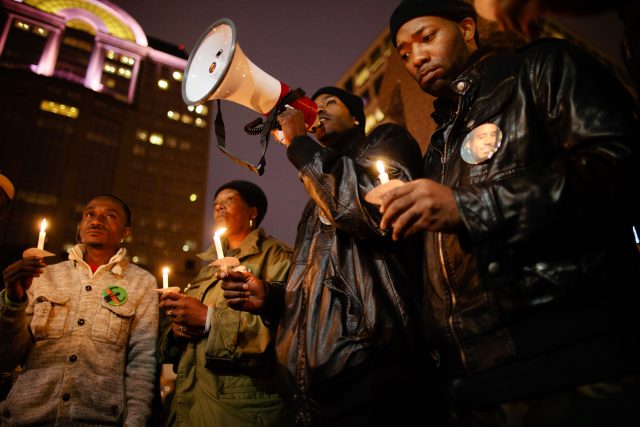
The family of Dontre Hamilton fights for justice in The Blood Is at the Doorstep (photo by Jennifer Johnson)
THE BLOOD IS AT THE DOORSTEP (Erik Ljung, 2017)
Friday, June 9, 7:00, IFC Center, 323 Sixth Ave. at West Third St.
Saturday, June 10, 8:45, Film Society of Lincoln Center, Walter Reade Theater, 165 West 65th St. between Eighth Ave. & Broadway
Festival runs June 9-18
ff.hrw.org/film
www.thebloodisatthedoorstep.tv
 Eric Garner, Michael Brown, Tamir Rice, Sandra Bland, Philando Castile, Alton Sterling, Freddie Gray — the list of unarmed black men, women, and children who died during or shortly after altercations with mostly white police officers keeps growing. Erik Ljung tells the story of a lesser-known victim, Dontre Hamilton, in The Blood Is at the Doorstep, making its New York premiere this weekend at the Human Rights Watch Film Festival. On the afternoon of April 30, 2014, the thirty-one-year-old Hamilton, who suffered from schizophrenia, was resting in a public park when he was roused by police officer Christopher Manney, who, after a confrontation, shot Hamilton fourteen times, killing him. The Hamilton family wasn’t notified until after midnight, more than eight hours later, then spent more than a year seeking information, and justice, trying to find out why Dontre had been killed and what was going to happen to the officer responsible. Ljung, who serves as director of photography as well, follows Dontre’s mother, Maria, and his brothers, Nate Hamilton and Dameion Perkins, as they demand answers, remaining peaceful yet strong. Ljung meets with Dontre’s father, Nathaniel Hamilton Sr., who is divorced from Maria but is still in his children’s lives, and Michael Bell, a white man who talks in detail about the murder of his son at the hands of Kenosha, Wisconsin, police officer Alberto Gonzales. Also sharing their views are Hamilton family attorney Jonathan S. Safran, District Attorney John T. Chisholm, and Milwaukee police chief Ed Flynn, who is quick to defend Manney’s actions while painting a false picture of Dontre as a repeat violent offender with a dangerous mental illness. Ljung, who has done work for VICE News, Al Jazeera, PBS, and other outlets, and editor Michael T. Vollman add footage from news reports, showing how the story played out in the media as public information trickled in over months and months.
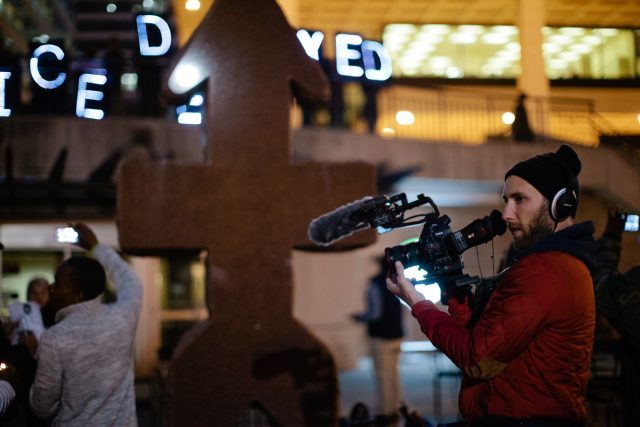
Director and photographer Erik Ljung examines the death of Dontre Hamilton in Human Rights Watch film (photo by Jennifer Johnson)
The Blood Is at the Doorstep reveals that not much is changing with regard to the epidemic that has led to the formation of such movements as Black Lives Matter, countered by Blue Lives Matter. At one point, a small group of peaceful protesters gather in front of Chisholm’s house, a wall of police there, just waiting for trouble. At another protest, outside agitators such as Khalil Coleman and Curtis Sails take things in a direction that Nate Hamilton is not happy about, while Milwaukee Police Association president Mike Crivello defends Manney to the fullest. Meanwhile, Maria Hamilton hosts a Mothers for Justice tea party, where black women talk about their sons who have been killed by police officers, comparing how many bullets were fired into their sons’ bodies. The only public official who seems to be listening to the Hamiltons at all is Mayor Tom Barrett, who at least takes some action. It’s one of the most divisive issues of the twenty-first century; millions of Americans can watch the exact same video of a shooting and reach completely different conclusions about what actually happened. There is no footage of the death of Dontre Hamilton, but there is plenty of evidence, more than enough to have viewers make up their own mind — and wonder whether this national crisis will ever end. The Blood Is at the Doorstep is screening June 9 at 7:00 at IFC Center and June 10 at 8:45 at the Walter Reade Theater; both shows will be followed by a Q&A with Ljung, Maria Hamilton, and her sons, Nate Hamilton and Dameion Perkins.
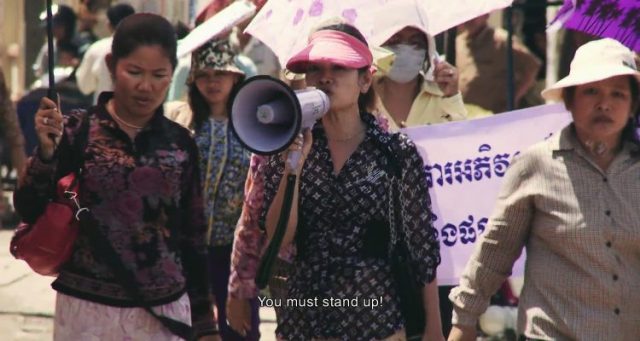
 It would be easy to assume that Chris Kelly’s documentary A Cambodian Spring, about a Phnom Penh community’s battle to save its village when developers move in, was part of the Human Rights Watch International Film Festival, which begins June 9 at Lincoln Center and IFC Center. However, it is actually being shown June 7 and 11 at the Wythe Hotel in the twentieth annual Brooklyn Film Festival, which began June 2 and continues through June 11. Winner of the Special Jury Prize for International Feature Documentary at the Hot Docs International Documentary Festival, A Cambodian Spring follows two women and one man as they lead the fight to protect their homes in Boeung Kak after Prime Minister Hun Sen cancels the World Bank’s Land Management program and makes a deal with Shukaku Inc. to develop the area. The new plan is based on eliminating the large lake around which many people live, struggling to survive day to day. Leading the charge against the land grab are Tep Vanny, a born activist; Toul Srey Pov, a quiet mother who suddenly finds herself thrust into the spotlight, rallying supporters using a megaphone; and the venerable Luon Sovath, a Buddhist monk and video activist whose pagoda threatens to defrock him if he doesn’t back off challenging the government. “They said that a monk shouldn’t care about the problems of the people,” he says, referring to the other members of his pagoda, “but I disagree.” The people of Boeung Kak are mired in abject poverty; their livelihood, fishing, has been taken away from them, and now Shukaku workers have shown up with equipment ready to tear down the decrepit shacks the villagers call home. “Soon, all the poor people will be gone. Only the rich will be left,” Pov says. When self-exiled opposition party leader Sam Rainsy returns to Cambodia to run against Hun Sen, the citizenry finds new hope, but then infighting threatens their cause. “If we have unity, compassion, and trust, then we will be strong and no one will break us,” Pov explains. “But if we don’t trust each other, then how can we work together? It will all come to an end. We won’t succeed.”