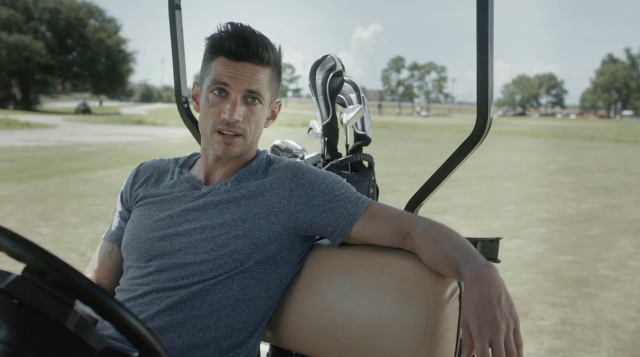
James Carpinello stars as luckless loser Connor Ryan in Michael Clayton’s The Dunning Man
THE DUNNING MAN (Michael Clayton, 2016)
Village East Cinema
181-189 Second Ave. at 12th St.
Friday, June 16, 7:45
Festival runs June 15-22
212-529-6799
www.sohofilmfest.com
www.villageeastcinema.com
 Named the Outstanding Narrative Feature at the 2017 Sacramento Film Festival, Michael Clayton’s debut, The Dunning Man, begins with a rather strange shot of an American flag flying in the foreground as a plane heads toward the Chrysler Building, disappears behind it, then emerges on the other side. It’s impossible not to think about 9/11, but fortunately the rest of the film is a quirky little black comedy about the travails of poor Connor Ryan (James Carpinello), a man who hightails it out of New York, leaving his job and his rich girlfriend, and heads to Atlantic City, where he owns several apartments he’s leasing to tenants who don’t exactly pay him on time, if at all. “I hate thinking that the best I got coming for me is being Mr. Roper,” he tells his well-connected Uncle Bishop (Tom Kemp). But Connor doesn’t like accepting help from anyone, even when he’s trapped in some questionable situations. He’s kind of a schmegegge, a luckless loser who can’t catch a break. He’s rented one of his lo-rise condos to Gillian (Karen Howell), who lives with a pair of killer Chechen “warriors in the spirit of the wolf,” Ferdinand (Scott Oakley) and Ramos (Matthew Rimmer), who are members of a group that likes to have sex as furries. Meanwhile, he develops a friendship with his other tenant, Alice (Dawn-Lyen Gardner), a single mother with a violent boyfriend. Living above Alice is party animal Stryker Jones (Nicoye Banks), a rapper with a hit album who is lying relatively low as he struggles to make his follow-up record. Connor just wants a normal life, but he can’t stay out of trouble, refusing to sacrifice his principles even when his very existence is at stake.
The Dunning Man is based on the title short story in a highly acclaimed 2014 collection by Kevin Fortuna, who cowrote the screenplay with Clayton and serves as producer. (“Dunning” refers to the payment of a debt as well as a dull, gray-brown color and a son.) The film, which occasionally goes too far over the top, challenging credulity, belongs to Carpinello, who has starred in such Broadway musicals as Saturday Night Fever, Xanadu, and Rock of Ages, such off-Broadway shows as Incident at Vichy, and such television series as The Good Wife and The Mob Doctor. He has an innate charm as Connor, goofy and likable even when he does really stupid things. Cinematographer Petr Cikhart, who shoots The Amazing Race, keeps his camera moving as Connor faces disaster after disaster. Throughout the film, Clayton includes archival footage of Atlantic City’s illustrious, and not so illustrious, past, evoking Connor’s dreams and failures. “I do enjoy my life,” he declares at one point, but it sure doesn’t look like it. The heavily Irish soundtrack is outstanding, featuring music by Spider Stacy and the Pogues, the Ryan Brothers, and Brent Butler. And where else can you hear discussion of Maslow’s Hierarchy of Need? The Dunning Man is screening June 16 at 7:45 at Village East as part of the Soho International Film Festival and will be followed by a Q&A with the filmmakers and members of the cast. The eighth annual festival continues through June 22 with such other films as Sloan Copeland’s Life Hack, Paul Jarrett’s Crazy Famous, Jill Salvino’s Between the Shades, and Marcia Kimton’s Bardo Blues.
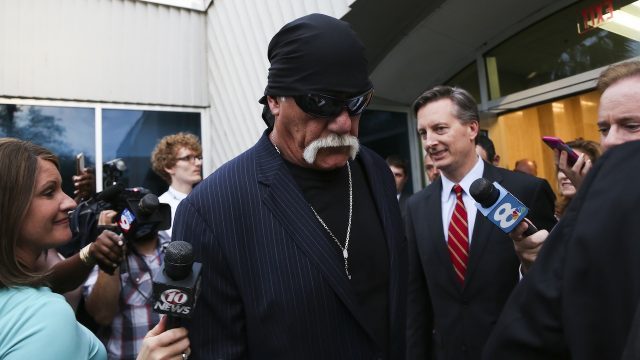
 The 2017 Human Rights Watch Film Festival comes to a close June 18 with the New York premiere of Brian Knappenberger’s Nobody Speak: Trials of the Free Press, a deeply troubling Netflix original that looks into the growing battle between billionaires and the fourth estate, between a person’s right to privacy and freedom of the press. Knappenberger begins by exploring the landmark Bollea v. Gawker case, in which Hulk Hogan, whose real name is Terry Gene Bollea, sued online media outlet Gawker for posting nine seconds of a tape depicting Bollea having sex with Heather Clem, the wife of his then-best friend, Todd Alan Clem, better known as radio personality Bubba the Love Sponge. The jury awarded Bollea $140 million, bankrupting Gawker, but Knappenberger reveals that the case was about a lot more than invasion of privacy — it was really about control of the media by the extremely wealthy. And Hogan/Bollea is not that wealthy. “Don’t be fooled into thinking that just because this case is so sleazy and rests on sex that it’s not important; this is one of the most important First Amendment cases in American history,” says Leslie Savan, who blogs on politics and the media for The Nation. “We’re talking about the very notion of truth,” she later adds. Knappenberger speaks extensively with Gawker cofounder Nick Denton, who defends what the company did as well as its overall journalistic ethics, covering stories that others wouldn’t; Knappenberger also meets with Gawker cofounder Elizabeth Spiers; former editor in chief A. J. Daulerio, who posted the Hogan story and sees himself as a patsy; former deputy editor James Wright; Hogan lawyers David Houston and Charles Harder; and former Gawker executive editor John Cook, who is boldly outspoken about Gawker’s purpose. “I wanted to write true things about bad people, and that’s what Gawker gave us all the freedom to do,” he says. First Amendment lawyer Floyd Abrams notes, “The reason to save Gawker was not because Gawker is worth saving. The reason to save it is that we don’t pick and choose what sort of publications are permissible, because once we do, it empowers the government to limit speech in a way that ought to be impermissible.” Among the other talking heads offering compelling insight are Politico media writer Peter Sterne, associate professor of journalism Jay Rosen, Buzzfeed business reporter Will Alden, NPR media correspondent David Folkenflik, and former New York Times columnist David Carr. The story takes a strange turn when it is discovered that there were potential improprieties involving Judge Pamela Campbell and that the lawsuit is being funded by billionaire venture capitalist Peter Thiel, who was outed by Gawker in 2007 and is now exacting a dangerous kind of revenge.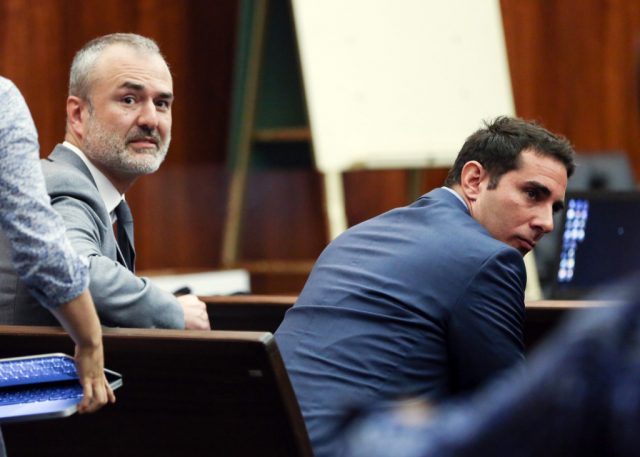

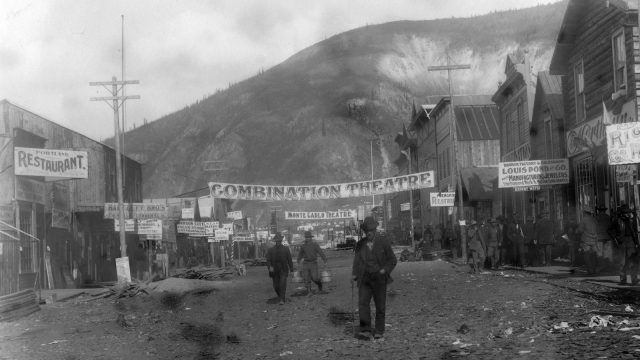
 “What power has gold to make men endure it all?” a title card asks in William Desmond Taylor’s 1928 silent film, The Trail of ’98, based on a novel by Robert Service. Both Taylor and Service were at one time residents of Dawson City, the town in the Yukon in Canada that was at the center of the Klondike Gold Rush in the late 1890s. In June 1978, while construction was just under way to build a new recreation center behind Diamond Tooth Gertie’s Gambling Hall in Dawson, Pentecostal minister and city alderman Frank Barrett uncovered a treasure trove of motion picture stock, hundreds of silent films that had been believed to have been lost forever. Writer, director, and editor Bill Morrison uses stunning archival footage from those films in his elegiac, beautiful documentary, Dawson City: Frozen Time, which brilliantly tells the story of greed, perseverance, and the growth of the entertainment industry in the late nineteenth and early twentieth centuries. After gold was discovered in Dawson, the indigenous Hän people were relocated to Tr’ochëk and some hundred thousand prospectors stampeded in, the gold mining destroying the Hän’s fishing and hunting grounds. Morrison also follows the invention of film itself, celluloid stock that would end up causing many fires, including one every year in Dawson for nine years. Bookended by an original interview with Michael Gates, Parks Canada curator of collections, and his wife, Kathy Jones-Gates, director of the Dawson Museum, the film traces the boom-and-bust fortunes and misfortunes of Dawson, as gambling casinos, movie theaters, hotels, and restaurants are built, including the Arctic, a hotel and restaurant owned by Ernest Levin and Fred Trump, the president’s grandfather, that might have served as a brothel as well. The film is supplemented with photographs by Eric A. Hegg, a giant in the field who left behind glass plates when he ultimately departed Dawson. Among others making their way through Dawson at one time or another are newsboy Sid Grauman, who went on to build Grauman’s Chinese Theatre; New York Rangers founder Tex Rickard; comic superstar Fatty Arbuckle; and Daniel and Solomon Guggenheim, who dominated the mining there.