this week in film and television

BRONX GOTHIC

(photo courtesy of Grasshopper Film)

Okwui Okpokwasili takes viewers behind the scenes of her one-woman show in Bronx Gothic (photo courtesy of Grasshopper Film)

BRONX GOTHIC (Andrew Rossi, 2017)
Film Forum
209 West Houston St.
July 12-25
212-727-8110
www.filmforum.org
grasshopperfilm.com

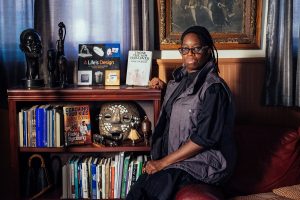
“Okwui’s job is to scare people, just to scare them to get them to kind of wake up,” dancer, choreographer, and conceptualist Ralph Lemon says of his frequent collaborator and protégée Okwui Okpokwasili in the powerful new documentary Bronx Gothic. Directed by Okpokwasili’s longtime friend Andrew Rossi, the film follows Okpokwasili during the last three months of her tour for her semiautobiographical one-woman show, Bronx Gothic, a fierce, confrontational, yet heart-wrenching production that hits audiences right in the gut. Rossi cuts between scenes from the show — he attached an extra microphone to Okpokwasili’s body to create a stronger, more immediate effect on film — to Parkchester native Okpokwasili giving backstage insight, visiting her Nigerian-born, Bronx-based parents, and spending time with her husband, Peter Born, who directed and designed the show, and their young daughter, Umechi. The performance itself begins with Okpokwasili already moving at the rear of the stage, shaking and vibrating relentlessly, facing away from people as they filter in and take their seats. She continues those unnerving movements for nearly a half hour (onstage but not in the film) before finally turning around and approaching a mic stand, where she portrays a pair of eleven-year-old girls exchanging deeply personal notes, talking about dreams, sexuality, violence, and abuse as they seek their own identity. “Bronx Gothic is about two girls sharing secrets. . . . It is about the adolescent body going into a new body, inhabiting the body of a brown girl in a world that privileges whiteness,” Okpokwasili, whose other works include Poor People’s TV Room and the Bessie-winning Pent-Up: A Revenge Dance, explains in the film. National Medal of Arts recipient Lemon adds, “It’s about racism, gender politics — it’s not just about these two little black girls in the Bronx.” Rossi includes clips of Okpokwasili performing at MoMA in Lemon’s “On Line” in 2011, developing Bronx Gothic at residencies at Baryshnikov Arts Center and New York Live Arts, and participating in talkbacks at Alverno College in Milwaukee and the Bronx Academy of Arts and Dance, where the tour concluded, right next to her childhood church, which brings memories surging back to her.

(photo courtesy of Grasshopper Film)

Okwui Okpokwasili nuzzles her daughter, Umechi, in poignant and timely documentary (photo courtesy of Grasshopper Film)

Rossi is keenly aware of the potentially controversial territory he has entered. “As a white man, I was conscious of the complexity and implications of embarking on a project that revolves around the experience of African American females,” he points out in his director’s statement. “But fundamentally, I believe in an artist’s creative ability to explore topics that are foreign to the artist’s own background. I think this takes on even more resonance when the work itself has an explicit objective to ‘grow our empathic capacity,’ as Okwui says of Bronx Gothic, [seeking] an audience that is composed of ‘black women, black men, Asian women, Asian men, white women, white men, Latina women, Latina men….’” Cinematographers Bryan Sarkinen and Rossi (Page One: Inside the New York Times, The First Monday in May) can’t get enough of Okpokwasili’s mesmerizing face, which commands attention, whether she’s smiling, singing, or crying, as well as her body, which is drenched with sweat in the show. “We have been acculturated to watching brown bodies in pain. I’m asking you to see the brown body. I’m going to be falling, hitting a hardwood floor, and hopefully there is a flood of feeling for a brown body in pain,” Okpokwasili says. Meanwhile, shots of the audience reveal some individuals aghast, some hypnotized, and others looking away. Editor Andrew Coffman and coeditors Thomas Rivera Montes and Rossi shift from Okpokwasili performing to just being herself, but the film has occasional bumpy transitions; also, Okpokwasili, who wrote the show when she was pregnant, does the vast majority of the talking, echoing her one-woman show but also at times bordering on becoming self-indulgent. (Okpokwasili produced the film with Rossi, while Born serves as one of the executive producers.) But the documentary is a fine introduction to this unique and fearless creative force and a fascinating examination of the development of a timely, brave work. Bronx Gothic opens July 12 at Film Forum, with Okpokwasili and Rossi taking part in Q&As at the 7:00 screenings on July 12, 14, and 15.

FILMS ON THE GREEN: THE SCIENCE OF SLEEP

Gael García Bernal and Charlotte Gainsbourg star in Michel Gondrys delightfully silly The Science of Sleep

Gael García Bernal and Charlotte Gainsbourg star in Michel Gondry’s delightfully silly The Science of Sleep

THE SCIENCE OF SLEEP (LA CIENCIA DEL SUEÑO) (Michel Gondry, 2006)
J. Hood Wright Park
351 Fort Washington Ave.
Wednesday, July 12, free, 8:30
Series continues Friday nights through July 28 (and September 7)
frenchculture.org
www.nycgovparks.org

The tenth anniversary of Films on the Green continues with a bonus Wednesday screening July 12 in J. Hood Wright Park of eclectic auteur Michel Gondry’s feature-length debut as both writer and director. The Science of Sleep is a complex, confusing, kaleidoscopic stew that is as charming as it is frustrating. Gael García Bernal (The Motorcycle Diaries, Mozart in the Jungle) stars as the juvenile but endearing Stéphane, a young man in a silly hat who has trouble differentiating dreams from reality. The childlike Stéphane becomes friends with his new neighbor, Stephanie (Charlotte Gainsbourg, daughter of Serge Gainsbourg and Jane Birkin), who still has plenty of the child left inside her as well. Stéphane has a job his mother (Miou-Miou) got him, toiling for a small company that makes calendars, alongside the hysterical Guy (Alain Chabat), who can’t help constantly poking fun at coworkers Serge (Sacha Bourdo) and Martine (Aurélia Petit).

Gondry, who is also responsible for the brilliant Eternal Sunshine of the Spotless Mind as well as the highly entertaining Dave Chappelle’s Block Party and the bizarre Human Nature, uses low-tech green-screening and stop-motion animation to reveal Stéphane’s fantasy world, bringing to mind such masters as Jan Svankmajer and the Brothers Quay. Unfortunately, just as Stéphane can’t tell what’s real from what he’s dreaming, viewers will often have difficulty as well; some of the plot turns are downright infuriating, and Stéphane’s TV show teeters on the edge of embarrassing. But you’ll also be hard-pressed not to leave the park feeling like a kid in a candy store. Presented in partnership with the Mexican Cultural Institute of New York, the screening, which is in French and English, will be shown with Spanish subtitles. Produced by the French Embassy, FACE Foundation, and NYC Parks, Films on the Green continues Friday nights through July 28 (before a September 7 finale) with such other French works as Marcel Carné’s Port of Shadows selected by Laurie Anderson, Jean Grémillon’s Lumière d’été picked and introduced by Matías Piñeiro, Jean Renoir’s Elena and Her Men chosen by Isabella Rossellini, and François Truffaut’s The Wild Child selected by James Ivory.

FORD TO CITY: DROP DEAD — NEW YORK IN THE 70s: THE TAKING OF PELHAM ONE TWO THREE

Walter Matthau tries to get to the bottom of a bizarre subway heist in The Taking of Pelham One Two Three

THE TAKING OF PELHAM ONE TWO THREE (Joseph Sargent, 1974)
Film Forum
209 West Houston St.
Saturday, July 8, 4:45, Sunday, July 16, 6:20, Friday, July 21, 5:00 & 10:00
Series runs through July 27
212-727-8110
filmforum.orgg

On October 29, 1975, President Gerald R. Ford refused to grant a federal bailout of New York, resulting in one of the all-time-great headlines in the Daily News: “Ford to City: Drop Dead.” Film Forum is looking back at that rather unique decade in Big Apple history in the fab series “Ford to City: Drop Dead — New York in the 70s.” Running through July 27, the festival features more than three dozen Gotham classics, beginning with Midnight Cowboy and Taking Off and continuing with such favorites as Mean Streets (shown with Film Forum master programmer Bruce Goldstein’s Les Rues de Mean Streets), Serpico, Saturday Night Fever, Network, Klute, and Marathon Man. With all the recent problems with the subway system, it’s definitely time to revisit Joseph Sargent’s underground thriller, The Taking of Pelham One Two Three. Loosely adapted from the book by John Godey, the film wonderfully captures the cynicism of New York City in the 1970s. Four heavily armed and mustached men — Mr. Blue (Robert Shaw), Mr. Green (Martin Balsam), Mr. Gray (Hector Elizondo), and Mr. Brown (Earl Hindman), colorful pseudonyms that influenced Quentin Tarantino’s Reservoir Dogs — hijack an uptown 4 train, demanding one million dollars in one hour from a nearly bankrupt city or else they will kill all eighteen passengers, one at a time, minute by minute. The hapless mayor (Lee Wallace) is in bed with the flu, so Deputy Mayor Warren LaSalle (Tony Roberts) takes charge on the political end while transit detective Lt. Zachary Garber (a great Walter Matthau) and Inspector Daniels (Julius Harris) of the NYPD team up to try to figure out just how in the world the criminals expect to get away with the seemingly impossible heist. Sargent (Sybil) offers a nostalgic look back at a bygone era, before technology radically changed the way trains are run and police work is handled.

The film also features a very funny, laconic Jerry Stiller as Lt. Rico Patrone and the beloved Kenneth McMillan as the borough commander. It was remade as a television movie in 1998, starring Edward James Olmos, Vincent D’Onofrio, and Lorraine Bracco, and as an embarrassingly bad big-budget bomb in 2009 by Tony Scott. The Taking of Pelham One Two Three is screening on July 8 (introduced by Goldstein), 16, and 21; the Film Forum series also includes such inspired double features as Shaft and Super Fly, Across 110th Street and Cops and Robbers, Dressed to Kill and Death Wish, Three Days of the Condor and The Eyes of Laura Mars, and The Warriors and Escape from New York. In addition, director Jerry Schatzberg will introduce The Panic in Needle Park on July 7, William Friedkin will introduce The French Connection via Skype on July 8, and New York Times media editor Bill Brink — whose father, William, wrote the infamous Daily News headline — will introduce Dog Day Afternoon on July 9.

BASTILLE DAY ON 60th STREET

Bastille Day

FIAF will celebrate Bastille Day with annual street fair on July 9

60th St. between Fifth & Lexington Aves.
Sunday, July 9, free, 12 noon – 7:00 pm
www.bastilledaynyc.com
fiaf.org

On July 14, 1789, a Parisian mob stormed the Bastille prison, a symbolic victory that kicked off the French Revolution and the establishment of the Declaration of the Rights of Man and of the Citizen. Ever since, July 14 has been a national holiday celebrating liberté, égalité, and fraternité. In New York City, the Bastille Day festivities are set for Sunday, July 9, along Sixtieth St., where the French Institute Alliance Française hosts its annual daylong party of food, music, dance, and other special activities. There will be a Summer in the South of France Wine, Beer, Cocktail, and Cheese Tasting in FIAF’s Tinker Auditorium from 12 noon to 4:30 ($25) as well as the elegant ninety-minute Champagne & Chocolate Tastings in Le Skyroom at 12:30 and 3:00 ($65-$75) featuring delights from Drappier, Pol Roger, Bollinger, Ayala, Brimoncourt, La Caravelle, Chocolat Moderne, La Maison du Chocolat, MarieBelle, Voilà Chocolat, and Maman Bakery, with live music from the Avalon Jazz Band. The annual raffle ($5) can win you such prizes as a trip to Paris and Le Martinique or dinners at French restaurants. Food and drink will be available from Bien Cuit, Brasserie Cognac, Dana Confection, DBGB Kitchen and Bar, Dominique Ansel Kitchen, Financier, Le Souk, Miss Madeleine, Oliviers & Co., Pain D’Avignon, Sel Magique, Simply Gourmand, St. Michel, Sud de France, François Payard Bakery, Pistache, the Crepe Escape, and others. The fête also includes roaming French mime Catherina Gasta, a photobooth, the pop-up Marché Français boutique, a kids corner, a pop-up library, a Caribbean Zouk dance lesson with Franck Muhel (12:15), the Citroën Car Show, a “Libres Ensemble” Slam Performance with Brooklyn rapper Napoleon Da Legend and Québecois slammer Webster (1:00), It’s Showtime NYC! (1:45), Can-Can Dancing with Karen Peled (2:30 & 3:45), DJ Ol’ Stark (2:45), the Hungry March Band (3:00), a concert with French baritone David Serero (3:45), and the New York premiere of Lisa Azuelos’s Dalida ($8-$14, 5:30).

NEW YORK ASIAN FILM FESTIVAL — HONG KONG PANORAMA: ELECTION

Simon Lam is caught in the middle of an epic battle for leadership in Johnnie Tos Election

Lok (Simon Yam) is caught in the middle of an epic battle for leadership in Johnnie To’s Election

ELECTION (HAK SE WUI) (Johnnie To, 2005)
Film Society of Lincoln Center, Walter Reade Theater
165 West 65th St. at Amsterdam Ave.
Friday, July 7, 8:30
Festival runs June 30 – July 15
212-875-5601
www.filmlinc.org
www.subwaycinema.com

Johnnie To’s Election is the thinking man’s gangster picture, a psychological thriller that does not depend on blood and violence to get its message across. Cool-headed Lok (Simon Yam) and wild-eyed Big D (Tony Leung Ka-fai) both want to be elected the next chairman of the Wo Sing Society, but when the uncles choose Lok, Big D refuses to accept their decision. Instead, he goes after the Dragon’s Head Baton, the antique symbol of leadership that would transfer power to him. As members of the society (including Lam Suet as the endearing Big Head, Louis Koo as the slick Jimmy, and Nick Cheung as tough-guy Jet) choose which side they want to be on, resulting in chaos, treachery, and betrayal, the cops are hovering around, seeking to put an end to all triad activities. Election features more dialogue and less violence than most films of its kind, but that doesn’t make it any less effective. The next year To made the sequel, the even better Triad Election; Election 3 is set for 2018. A big winner at the twenty-fifth Hong Kong Film Awards, Election is screening July 7 at 8:30 in the Hong Kong Parnorama section of the sixteenth annual New York Asian Film Festival, which runs through July at Lincoln Center and the SVA Theatre. Among the other films in the sidebar are Lawrence Lau’s Dealer/Healer, Tsui Hark’s The Taking of Tiger Mountain in 3-D, and Alan Lo’s Zombiology: Enjoy Yourself Tonight. (Note: Tony Leung Ka-fai was initially scheduled to appear at the screening of Election but had to cancel due to unforeseen circumstances.)

NEW YORK ASIAN FILM FESTIVAL: KFC

Youre gonna wanna keep the kiddies far away from Kfc

You’re gonna wanna keep the kiddies far away from Lê Bình Giang’s Kfc

Kfc (Lê Bình Giang, 2017)
Film Society of Lincoln Center, Walter Reade Theater
165 West 65th St. at Amsterdam Ave.
Thursday, July 6, 10:45
Festival runs June 30 – July 16
212-875-5601
www.filmlinc.org/films/kfc
www.subwaycinema.com

kfc 2Every year the New York Asian Film Festival tends to have one absolutely crazy, out-there movie that challenges the boundaries of good taste. This year’s entry is Vietnamese writer-director Lê Bình Giang’s utterly bizarre debut, Kfc, a sixty-eight-minute journey into a dark world that makes some of Charles Bukowski’s most cutting-edge tales seem like Disney stories. Expanded from a 2012 short, the film is as vile and disgusting as it is well made and fascinating, consisting of a series of interrelated vignettes depicting extreme violence, rape, torture, murder, arson, cannibalism, necrophilia, and plenty of fried chicken and French fries. (I can’t imagine that Colonel Sanders would approve of the film, which includes several scenes set in what appears to be a real Kentucky Fried Chicken restaurant in Hanoi.) The gruesome special effects (except for the worms, which are real) are by Tony Nguyễn, who plays the dude in the headphones, and they are balanced by the musical theme, Khanh Ly’s version of Trinh Cong Son’s romantic ballad “Quỳnh Hương.” Although there is not a ton of dialogue, what talking there is just happens to be very poorly translated in the subtitles, upping the overall psychotic quotient. And I have to admit that I’m downright worried about the future sanity of a few of the children who have major roles in the film, the original script of which got Lê kicked out of the University of Ho Chi Minh. There’s a reason that the NYAFF page on the movie begins by declaring, “WATCH AT YOUR OWN RISK!” Kfc is screening July 6 at 10:45 (what, they couldn’t wait until midnight?) at the Walter Reade Theater. The festival, which runs through July 16 at Lincoln Center and the SVA Theatre, consists of more than fifty films from China, Japan, Taiwan, South Korea, Hong Kong, and Southeast Asia, including a surprise twenty-fifth anniversary screening of a 1992 classic.

THE REAGAN SHOW

THE REAGAN SHOW

Nancy Reagan prepares to surprise her husband with a birthday cake to deflect attention from a potential media crisis in THE REAGAN SHOW

THE REAGAN SHOW: OUR COUNTRY WAS HIS STAGE (Sierra Pettengill & Pacho Velez, 2017)
Metrograph
7 Ludlow St. between Canal & Hester Sts.
Opens Friday, June 30
212-660-0312
metrograph.com

Taking its name from The Truman Show, Peter Weir’s 1998 satire in which Jim Carrey plays a character whose entire life is a reality television program, The Reagan Show posits the fortieth president of the United States as the first full-time made-for-TV leader and his two terms as the height of performance art. The film opens with a December 1988 ABC News interview in which David Brinkley asks outgoing president Ronald Reagan, “Did you learn anything as an actor that has been useful to you as president?” Reagan responds, “There have been times in this office when I wondered how you can do the job if you hadn’t been an actor.” Writer-director Pacho Velez (Manakamana) and producer-director Sierra Pettengill (Town Hall, Cutie and the Boxer) gained access to archives that included what was known as White House Television (WHTV), raw footage shot by White House cameras that obsessively followed Reagan, reminiscent of how Richard Nixon audiotaped everything in the Oval Office. The WHTV clips go behind-the-scenes of the before, during, and after of major and minor events, depicting the cultivation of Reagan’s public image, molding him to look like a leader while choosing style over substance. “The White House has become more and more the stage, a theater, and the question has become, Are the television networks gonna manage that theater, are they gonna manage that stage, or is the White House gonna do that?” communications director David Gergen asks. The all-archival chronological film includes news reports and commentary by such journalists and political insiders as William F. Buckley, Andrew Young, Ted Koppel, Lyn Nofziger, Sam Donaldson, Chris Wallace, Walter Cronkite, Dan Rather, George Will, Tom Brokaw, George Shultz, Peter Jennings, Bill Plante, David Frost, Charles Kuralt, Joe Biden, and Howard Baker as they share their thoughts on Reagan the president and Reagan the media star.

All-archival documentary explores the creation of a public image for the fortieth president of the United States

All-archival documentary explores the creation of a public image for the fortieth president of the United States

The film, edited with a sense of humor by cowriter Francisco Bello, Daniel Garber, and David Barker, focuses on key aspects of Reagan’s two terms: his summits with new Soviet premier Mikhail Gorbachev to end the Cold War, his development of the Star Wars SDI initiative, the arms-for-hostages crisis, and his relationship with the press and his wife, Nancy. The Great Communicator is seen rehearsing an endorsement for John Sununu in which he cannot pronounce Sununu’s name correctly, acting like a macho man on his ranch, meeting Michael Jackson and Mr. T, and pardoning turkeys for Thanksgiving. Pettengill and Velez also highlight telling scenes from some of Reagan’s films, explaining in a caption that he “was almost always typecast as the good-natured, all-American hero,” essentially preparing him for politics. In addition, there are numerous parallels to what is happening today, with a reality television star in the White House who plays hard and fast with the truth while the public grows concerned about nuclear war. “Together, we’ll make America great again,” Reagan declares at a rally. As White House deputy chief of staff Michael Deaver tells Barbara Walters, “It’s the staging, how you stage the message. It’s a game.” Five presidents later, it’s still a game we’re all playing, but who is winning and who is losing is up for debate. The Reagan Show opens June 30 at Metrograph, with Velez, Pettengill, and documentarian Matt Wolf participating in a Q&A following the 7:00 screening on June 30, Pettengill and director and producer Maxim Pozdorovkin after the 5:00 show on July 1, and Pettengill and cultural critic and Museum of the Moving Image associate film curator Eric Hynes following the 7:00 screening on July 2.