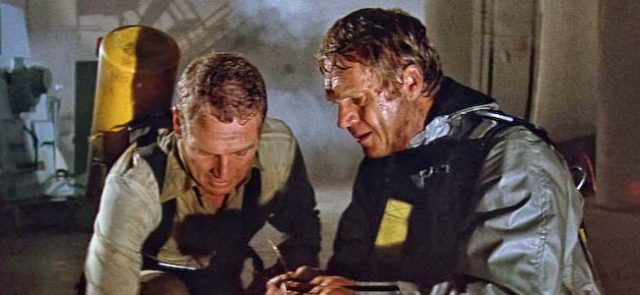
Paul Newman and Steve McQueen fight a fierce fire and corporate greed in The Towering Inferno
THE TOWERING INFERNO (John Guillermin, 1974)
Quad Cinema
34 West 13th St. between Fifth & Sixth Aves.
Saturday, August 19, 8:15, and Wednesday, August 23, 3.30
Series runs August 18-24
quadcinema.com
www.ifcfilms.com
 Disaster flicks were a big thing in the 1970s, and none was bigger than The Towering Inferno. The $14.3 million epic, the first coproduction between two major studios, Warner Bros. and 20th Century-Fox, was based on two novels, Richard Martin Stern’s The Tower and Thomas N. Scortia and Frank M. Robinson’s The Glass Inferno and stars a host of Hollywood greats, led by the dynamic duo of Paul Newman and Steve McQueen. Newman is recently retired architect Doug Roberts, who has come back to San Francisco for the opening-night party celebrating the final building he designed, the 138-story Glass Tower, owned by wealthy businessman James Duncan (William Holden). When a small electrical fire starts in a storage room on the eighty-first floor, Roberts becomes suspicious that Duncan’s son-in-law, smarmy electrical engineer Roger Simmons (Richard Chamberlain), did not follow the specs exactly and cut critical corners. As the fire grows, security chief Harry Jernigan (O. J. Simpson) calls in the fire department, anchored by battalion chief Mike O’Hallorhan (McQueen) and his right-hand man, Kappy (Don Gordon). O’Hallorhan insists that Duncan move the elegant party in the Promenade Room on the 135th floor to the lobby, but by the time Duncan agrees, the flames have spread and escape options become more and more limited — and dangerous. Among the others struggling to survive are con man Harlee Claiborne (Fred Astaire, earning his sole Oscar nomination), his potential target, Lisolette Mueller (Jennifer Jones, in her last performance), U.S. senator Gary Parker (Robert Vaughn), slick public relations man Dan Bigelow (Robert Wagner), his secretary and mistress, Lorrie (Susan Flannery), Duncan’s daughter, Patty Duncan Simmons (Susan Blakely), the deaf Mrs. Allbright (Carol McEvoy) and her two children, Angela (Carlena Gower) and Phillip (The Brady Bunch’s Mike Lookinland), and Roberts’s fiancée, Susan Franklin (Faye Dunaway). Meanwhile, throughout it all, bartender Carlos (Gregory Sierra) remains cool and calm.
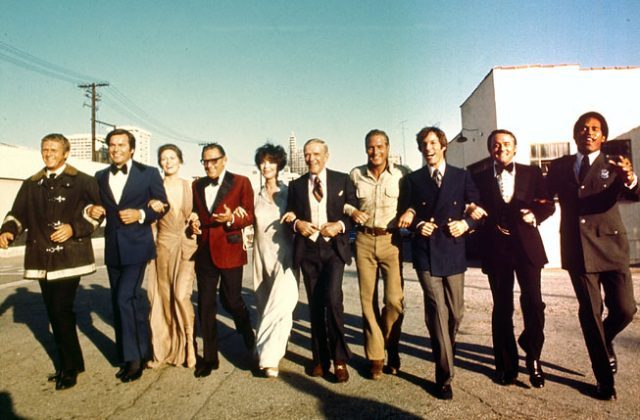
The all-star cast of The Towering Inferno in happier times
In spectacular scene after spectacular scene, director John Guillermin (Waltz of the Toreadors, King Kong), screenwriter Stirling Silliphant (In the Heat of the Night, Village of the Damned), and action director, producer, and disaster-movie king Irwin Allen (The Lost World, Voyage to the Bottom of the Sea) ups the ante as Roberts and O’Hallorhan play the heroes against corporate greed. “Jim, I think you suffer from an edifice complex,” Roberts tells Duncan. A huge hit when it was released in 1974, The Towering Inferno received eight Oscar nominations, winning for best song (“We May Never Love Like This Again,” sung by Maureen McGovern), Best Production Design, and Best Cinematography, by Fred J. Koenekamp and Joseph Biroc, who capture daring aerial shots and dazzling stunts. If the film resembles The Poseidon Adventure, that’s no, er, accident; the 1972 disaster film was also produced by Allen, with a score by John Williams and an Oscar-nominated theme song sung by McGovern (“The Morning After”). The Towering Inferno has taken on new meaning since 9/11, but it’s not as upsetting as you might think, although it is particularly difficult watching a few people jump or fall out of the building. It’s also impossible not to smirk when you see O.J. in a uniform, playing a heroic character. Newman and McQueen — the latter, as was his wont, insisted on equal billing and the same number of lines of dialogue as Newman — make a terrific duo, their stunning blue eyes fighting for equal screen time as well. And somehow the film avoids getting overly soapy and maudlin like so many of its brethren were. A true disasterpiece, The Towering Inferno is screening August 19 and 23 in the fab Quad series “Disasterpieces,” which runs August 18-24 and includes such other genre hits and duds as Airport and Airport ’75, Earthquake (but not in Sensurround), Black Sunday, The Poseidon Adventure, A Night to Remember, Two-Minute Warning, Airplane!, and the flop that ended the glut, 1980’s When Time Ran Out.
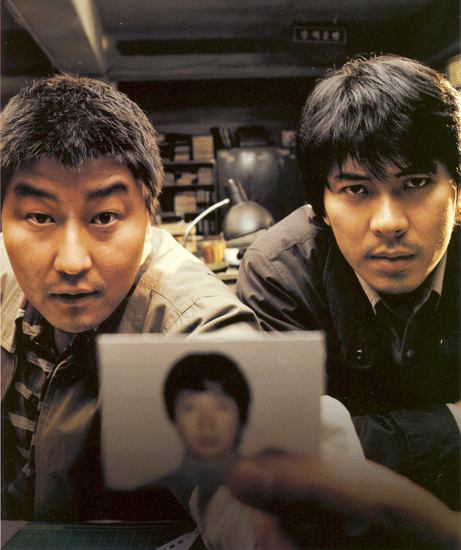
 In 2006, South Korean writer-director Bong Joon-ho burst onto the international cinematic landscape with the sleeper hit The Host, a modern-day monster movie with a lot of heart. He followed that up with the touching segment “Shaking Tokyo” in the compilation film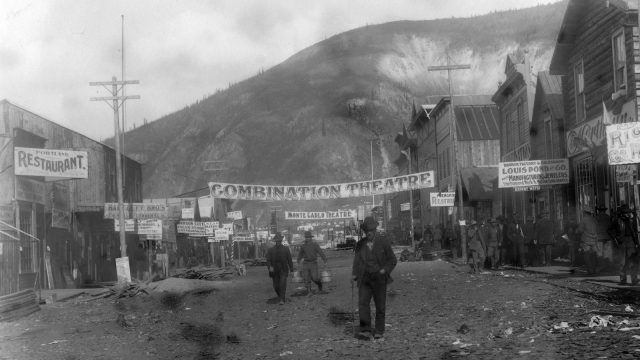
 “What power has gold to make men endure it all?” a title card asks in William Desmond Taylor’s 1928 silent film, The Trail of ’98, based on a novel by Robert Service. Both Taylor and Service were at one time residents of Dawson City, the town in the Yukon in Canada that was at the center of the Klondike Gold Rush in the late 1890s. In June 1978, while construction was just under way to build a new recreation center behind Diamond Tooth Gertie’s Gambling Hall in Dawson, Pentecostal minister and city alderman Frank Barrett uncovered a treasure trove of motion picture stock, hundreds of silent films that had been believed to have been lost forever. Writer, director, and editor Bill Morrison uses stunning archival footage from those films in his elegiac, beautiful documentary, Dawson City: Frozen Time, which brilliantly tells the story of greed, perseverance, and the growth of the entertainment industry in the late nineteenth and early twentieth centuries. After gold was discovered in Dawson, the indigenous Hän people were relocated to Tr’ochëk and some hundred thousand prospectors stampeded in, the gold mining destroying the Hän’s fishing and hunting grounds. Morrison also follows the invention of film itself, celluloid stock that would end up causing many fires, including one every year in Dawson for nine years. Bookended by an original interview with Michael Gates, Parks Canada curator of collections, and his wife, Kathy Jones-Gates, director of the Dawson Museum, the film traces the boom-and-bust fortunes and misfortunes of Dawson, as gambling casinos, movie theaters, hotels, and restaurants are built, including the Arctic, a hotel and restaurant owned by Ernest Levin and Fred Trump, the president’s grandfather, that might have served as a brothel as well. The film is supplemented with photographs by Eric A. Hegg, a giant in the field who left behind glass plates when he ultimately departed Dawson. Among others making their way through Dawson at one time or another are newsboy Sid Grauman, who went on to build Grauman’s Chinese Theatre; New York Rangers founder Tex Rickard; comic superstar Fatty Arbuckle; and Daniel and Solomon Guggenheim, who dominated the mining there.

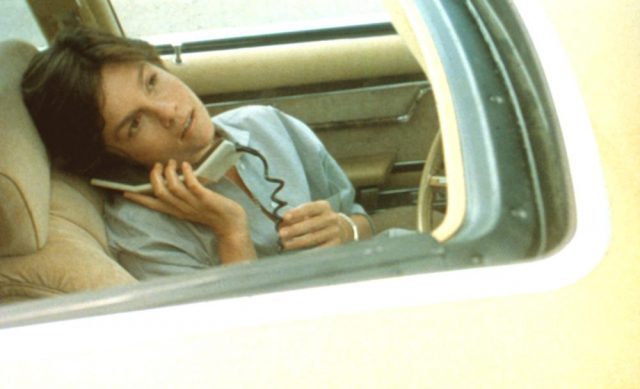
 French director Rebecca Zlotowski throws just about everything she can think of into her would-be historical epic, Planetarium, a disappointing, confusing movie about making movies (and lots of other stuff). In the 1930s, two sisters are carving out a little niche for themselves, holding séances and making public appearances displaying their remarkable abilities. The younger Kate Barlow (Lily-Rose Depp) is the medium, claiming to be able to contact the dead, while the older Laura (Natalie Portman) manages the séances and the business end. After seeing one of their performances, wealthy movie producer Andre Korben (Emmanuel Salinger) becomes enamored of the girls and takes them in, determined to make a film that, for the first time ever, captures actual spirits or ghosts onscreen, providing incontrovertible proof of the afterlife. Korben hires Andre Servier (Pierre Salvadori) to direct and Fernand Prouve (Louis Garrel) to serve as Laura’s love interest in the film. Kate and Laura have lived a relatively sheltered life when it comes to the real world, so this is all new to them; while Kate seems more interested in all the hoopla surrounding them, Laura is concerned that she is losing control over Kate. She is also worried that Korben might have more than just business in mind with them.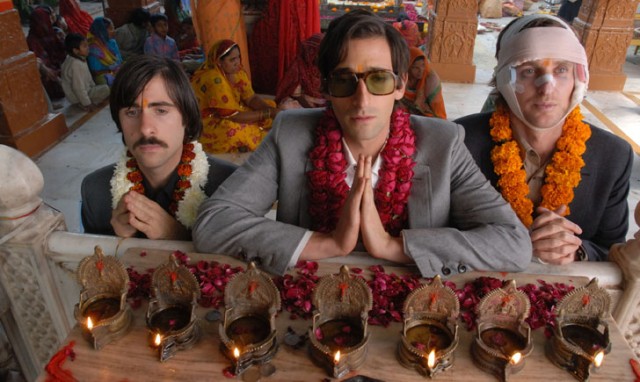
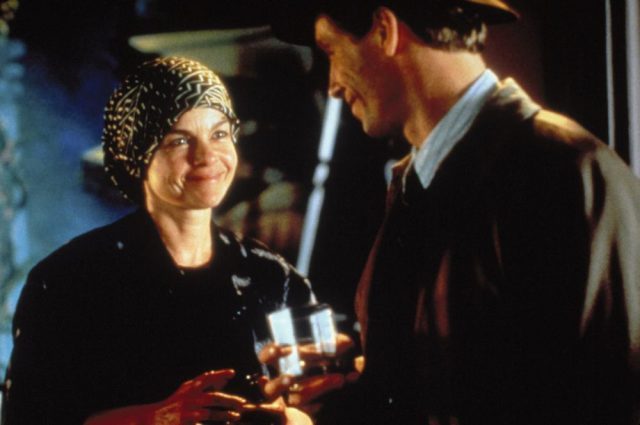
 Bujold comfortably settles into the background in her second film with Rudolph, 1988’s The Moderns, a wickedly sly riff on the Lost Generation in post-WWI Paris. Bujold is gallery owner Libby Valentin, the guiding conscience among the self-important literati, including Ernest Hemingway (Kevin J. O’Connor), who speaks in hysterical quotations that would wind up in The Sun Also Rises and other books; Gertrude Stein (Elsa Raven), and Alice B. Toklas (Ali Giron), who host high-falutin’ salon gatherings; gossip columnist Oiseau (Wallace Shawn), who never a met a story he couldn’t make up; wealthy art collector Nathalie de Ville (Geraldine Chaplin), who has more up her sleeves than she initially lets on; powerful, jealous businessman Bertram Stone (John Lone) and his wife, the sexy, troublesome Rachel (Linda Fiorentino); and expatriate painter Nick Hart (Keith Carradine), who has little time for nonsense as he homes in on Rachel. The beginning of the film is annoying, pretentious, and self-indulgent, but once it kicks into high gear, it wonderfully pokes fun at itself, especially via Oiseau, played to a comic T by Shawn — who likes to hang out at Bar Sélavy, owned by Rose (Marthe Turgeon), in a sweet homage to Marcel Duchamp. Cinematographer Toyomichi Kurita slowly switches from black-and-white to color as scenes change and the backstabbing heats up. The plot centers around forgeries, referencing the phoniness that resides within every character. The only one who remains steady throughout is Libby, who is played with just the right touch of mystery by Bujold. The Moderns is screening at the Quad on August 10 at 6:45.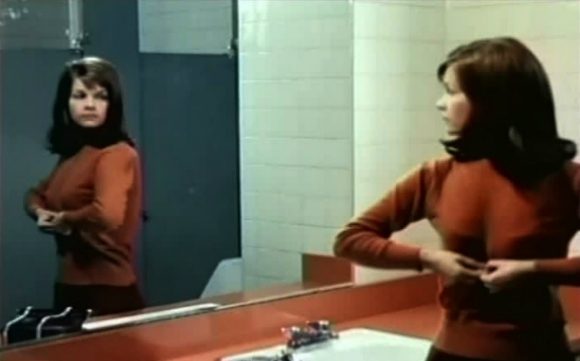
 Bujold made three films with her husband, Paul Almond, during their six-year marriage. In between 1968’s Isabel and 1972’s Journey is the very strange, ultimately unsatisfying The Act of the Heart, which earned Bujold a Canadian Film Award for Best Actress. The low-budget 1970 film hints at being a horror movie, which would have been much better than the rather drab drama it turns out to be, save for a bizarre finale. Bujold is Martha, a shy, devout young woman who has arrived in a small town on the North Shore of Quebec to be a nanny to Russell (Bill Mitchell), a boy being raised by his widowed mother, Johane (Monique Leyrac). Martha auditions for the church choir, which is conducted by Augustinian monk Father Ferrier (Donald Sutherland). As she becomes deeply involved in Billy’s life, which includes his getting seriously injured in a hockey game, she and Father Ferrier take a liking to each other, severely testing their faith. Bujold excels as Martha, as she grows from a church mouse to a woman filled with desire, but Sutherland sleepwalks through the first half of the film, and the subplot with Russell and Johane turns soapy. Still, watching Bujold work her magic is always worth it. Winner of six Canadian Film Awards (Best Director, Best Actress, Best Art Direction, Best Sound Editing, Best Sound, and Best Musical Score), The Act of the Heart is screening August 12 at 5:45 at the Quad. “The Beguiling Bujold” also boasts such other diverse Bujold films as the Michael Crichton medical thriller Coma with Michael Douglas, the Brian De Palma Hitchcock homage Obsession with Cliff Robertson, David Cronenberg’s creepy Dead Ringers with Jeremy Irons, Michael Cacoyannis’s Euripides adaptation The Trojan Women with Katharine Hepburn and Vanessa Redgrave, and Alain Resnais’s The War Is Over with Yves Montand. And as a bonus, the Quad is showing Mark Robson’s Earthquake, starring Bujold with Charlton Heston, Ava Gardner, George Kennedy, Lorne Greene, Richard Roundtree, Walter Matthau, Victoria Principal, et al., on August 20 and 21 in the upcoming