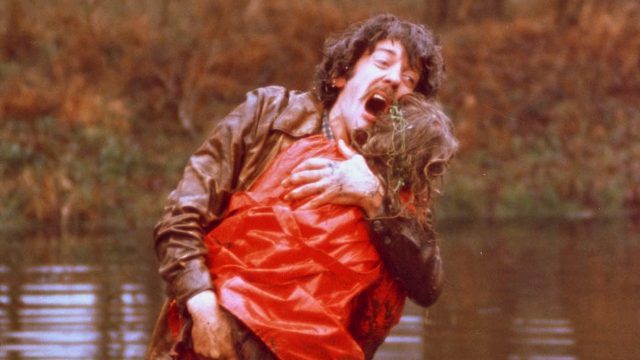
John Baxter (Donald Sutherland) cradles his dead daughter (Sharon Williams) in Nicolas Roeg’s psychological horror masterpiece, Don’t Look Now
DON’T LOOK NOW (Nicolas Roeg, 1973)
Quad Cinema
34 West 13th St. between Fifth & Sixth Aves.
September 1, 9:00, September 3, 5:45, September 5, 6:55, September 7, 9:10
Series runs September 1-7
quadcinema.com
 The Quad invites film lovers into the very strange cinematic world of eighty-nine-year-old British writer, director, and cinematographer Nicolas Roeg in the one-week series “Look Now: The Universe According to Nicolas Roeg,” beginning September 1. The eleven works in the series celebrate Roeg’s spectacular visual sense as well as his love of celebrity, the supernatural, and pop culture. The centerpiece of the Quad presentation is Roeg’s 1973 masterpiece, the haunting and harrowing psychological horror tale Don’t Look Now. Written by Allan Scott and Chris Bryant and based on a short story by Daphne du Maurier, the film is an extraordinarily rich and detailed study of a family trying to regain itself following the tragic loss of a young daughter. “Nothing is what it seems,” John Baxter (Donald Sutherland) says, alerting the viewer early on. In the opening, scene, Christine (Sharon Williams) and her brother, Johnny (Nicholas Salter), are playing outside, he in a blue jacket, riding his red bike over the green grass and through trees, she playing with a talking doll and red-striped white ball while wearing a red raincoat even though the sun is shining bright on a nearly cloudless day. Over Pino Donaggio’s gentle piano score, Anthony B. Richmond’s camera zeroes in on a puddle next to a pond, then editor Graeme Clifford cuts to a fire raging in a fireplace in front of which the children’s mother, Laura (Julie Christie), is reading about Lake Ontario and their father, John (Donald Sutherland), is looking at glass slides of a church in Venice he has been asked to restore. In one image of a stained-glass window, Christ, in a red robe, is cradling the lamb symbolizing sinners, while a figure in a red hood sits in a front pew, gazing up at it. The scene then shifts back to Christine in her red mac, seen reflected upside down in the pond. Johnny rides over a pane of glass, breaking it and falling to the ground. John looks up, sensing something. Laura reads aloud from her book. She innocently puts her hand to her mouth. Christine puts her hand to her mouth. John smiles at Laura. Johnny tries to fix one of the wheels on his bicycle. Christine throws the ball in the air. John tosses a pack of cigarettes to Laura. The ball splashes in the pond. John knocks over a glass. The ball swirls in the water. Red liquid oozes from the figure in the church slide. John feels something is wrong and heads outside. Johnny runs toward him. Christine, lying on her back, slowly submerges under the water. John rushes into the pond. Laura looks at the bloody slide. With a gasp, John dives under the water. Laura tosses the slide onto her book, Beyond the Fragile Geometry of Space. The blood spreads further across the slide as Donaggio’s music turns ominous. John lifts the lifeless body of his daughter out of the pond, letting out a heartbreaking howl. John is too late to save Christine. Laura sees what is happening and screams. Roeg cuts to a power drill marked with a red panel drilling into the wall of the church in Venice that John is renovating. It’s a spectacular scene, every second critical to the rest of the film and how it’s photographed and edited, dominated by the color red (along with sharp blues and greens), shattering glass, people falling, and water representing death as John and Laura try to put together the pieces of their devastatingly fractured life.
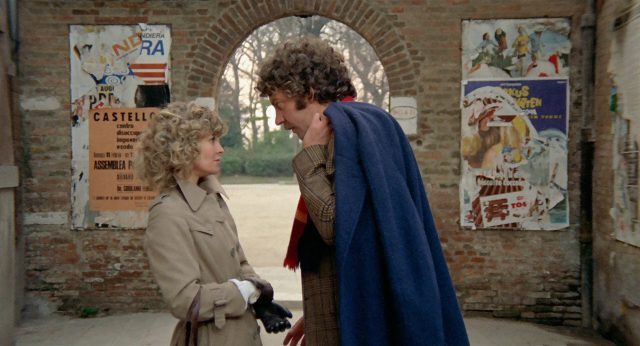
Laura (Julie Christie) and John Baxter (Donald Sutherland) try to get their fractured life back on track in Venice in Don’t Look Now
In a restaurant in Venice, the City of Canals, a pair of elderly sisters, Heather (Hilary Mason) and Wendy (Clelia Matania), stare at Laura and John. Heather, a blind woman with second sight, tells Laura that she can see Christine and that she is happy. Laura wants to believe her, but John is skeptical. The couple soon return to their hotel, where they engage in one of the most graphic sex scenes of its time, as Roeg cuts between their lovemaking and John and Laura getting dressed matter-of-factly afterward, the fiery emotion of their passion underscored by their practical desire to create another child. Meanwhile, a serial killer is on the loose in Venice, the victims being pulled from the canals. And John becomes obsessed with a figure in red he spots in the corners of the narrow streets and bridges of the city, wondering whether his dead daughter is trying to contact him. It all leads to an unforgettable finale of sheer genius. Viewers mustn’t look away from the screen for even a split second, as Roeg imbues each shot with power and meaning, from music and color to dialogue and cross-cutting, metaphorical clues and red herrings melding together, leaving nothing to chance.
Even the making of the film is filled with fascinating intrigue and classic stories. Wandering through Venice, Roeg came upon a church that was actually being renovated; coincidentally, it was named St. Nicolo dei Mendicoli, and there was already a sign on it that read “Venice in Peril.” When a stuntman refused to do a dangerous scene inside the church, Sutherland hesitantly did it himself, not knowing that the wire he was told would protect him was liable to break at any moment. For a long time it was rumored that the sex scene between Christie and Sutherland, which was added at the last moment, was not simulated but real, a claim vehemently denied by the participants (and one that did not make Warren Beatty too happy). Renato Scarpa, who plays the police inspector, could not speak English, so he performed his lines phonetically, not knowing what he was saying. And Roeg discovered Donaggio, a singer who had never composed a film score before, working on a gondola; Donaggio went on to compose the soundtrack for dozens and dozens of movies, including several for Brian De Palma. (Donaggio had already had a big hit with “Lo Che Non Vivo [Senza Te],” which Dusty Springfield turned into “You Don’t Have to Say You Love Me.”) But all of that merely enhances what is already a remarkable film, one of the greatest psychological horror movies of all time, and one that begs to be watched over and over again because of its many intricacies and nuances. Roeg might be telling us not to look, but we can’t help ourselves. You’ll also never think of the color red again in quite the same way. In addition to Don’t Look Now and the below films, the Quad is also screening Bad Timing: A Sensual Obsession, Castaway, Far from the Madding Crowd, Insignificance, Eureka, and Petulia, with such stars as George C. Scott, Theresa Russell, Tony Curtis, Gene Hackman, Oliver Reed, Richard Chamberlain, Harvey Keitel, and Art Garfunkel, all either directed and/or photographed by Roeg.
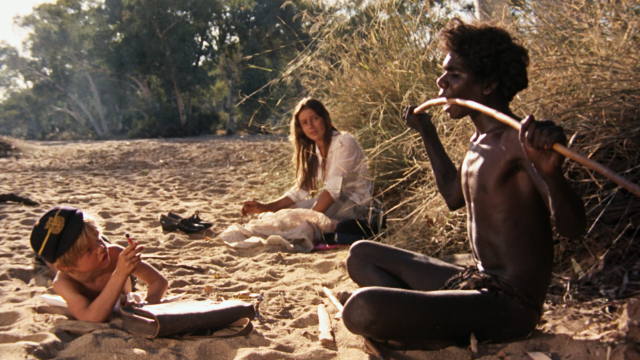
Runaway siblings (Jenny Agutter and Luc Roeg) learn about life from an Aborigine (David Gulpilil, later to be seen in Peter Weir’s The Last Wave) in Nicolas Roeg’s Walkabout
WALKABOUT (Nicolas Roeg, 1971)
Quad Cinema
September 1, 4:50, and September 2, 3:10
quadcinema.com
 Nicolas Roeg’s first solo project, as director and cinematographer, is a beautiful film about a teenage girl (Jenny Agutter) and her young brother (Roeg’s real-life son, Luc Roeg) lost in the Australian outback after their father (John Meillon) tries to kill them. The full ninety-six-minute version soars when the siblings encounter an Aborigine (David Gulpilil, later to be seen in Peter Weir’s The Last Wave) on a walkabout, living off the barren land to prove his manhood. The film was written by Edward Bond, based on James Vance Marshall’s novel. Agutter went on to star in such films as Logan’s Run, Equus, and An American Werewolf in London.
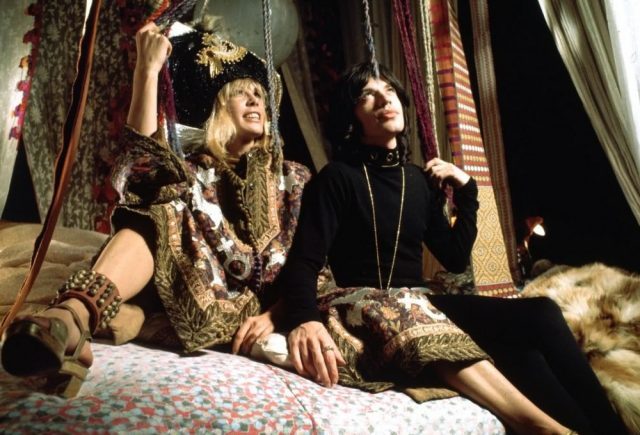
Mick Jagger and Anita Pallenberg show off their acting chops in Donald Cammell and Nicolas Roeg’s very strange Performance
PERFORMANCE (Donald Cammell and Nicolas Roeg, 1970)
Quad Cinema
Friday, September 1, 6:50, Sunday, September 3, 1:00, and Wednesday, September 6, 9:10
quadcinema.com
 A British gangster on the run hides out with a psychedelic rock star in this strangely enticing film from writer-director Donald Cammell (The Demon Seed) and Nicolas Roeg (making his big-screen directorial debut as well as serving as cinematographer). James Fox didn’t know what he was getting into when he signed on to play Chas, a mobster who finds sanctuary with mushroom-popping rock-diva has-been Turner, played with panache by Mick Jagger. Throw in Anita Pallenberg, a fab drug trip, and the great “Memo to Turner” scene and you have a film that some consider the real precursor to MTV, some think a work of pure demented genius, and others find to be one of the most pretentious and awful pieces of claptrap ever committed to celluloid.
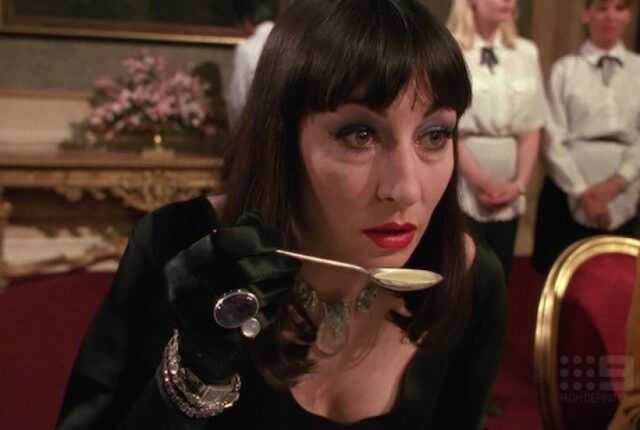
Anjelica Huston has a wicked blast in Nicolas Roeg’s Roald Dahl adaptation, The Witches
THE WITCHES (Nicolas Roeg, 1990)
Quad Cinema
Saturday, September 2, 1:15, and Tuesday, September 5, 5:00
quadcinema.com
Executive producer Jim Henson’s feature-film swan song is an enchanting tale of a young boy who, upon encountering a witches convention led by the evil Grand High Witch (Anjelica Huston), is given a tail — well, actually, he’s turned into a cute little mouse. The witches have come up with a plan to rid the world of children by turning them all into rodents, and little Luke (Jasen Fisher) and old Helga (Mai Zetterling) are the only ones who can stop them. However, this is no Stuart Little (Rob Minkoff, 1999); based on a wicked story by Roald Dahl and directed by Nicolas Roeg (whose 1973 stunner, Don’t Look Now, dealt with a couple’s agony over their dead child), The Witches is definitely not for little kids. The cast also includes turns by such British faves as Rowan Atkinson, Jane Horrocks, and Brenda Blethyn.
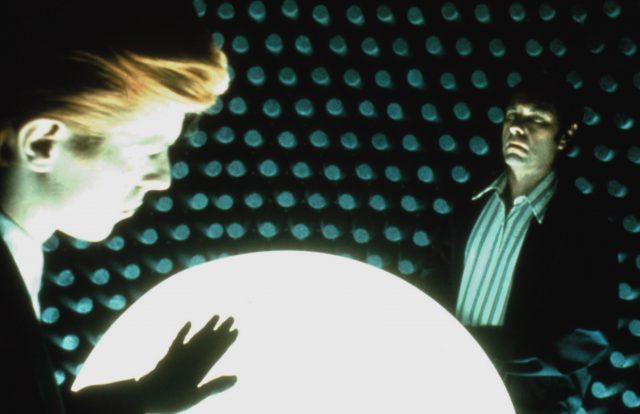
David Bowie made his feature-film debut in Nicolas Roeg’s The Man Who Fell to Earth
THE MAN WHO FELL TO EARTH (Nicolas Roeg, 1976)
Quad Cinema
Saturday, September 2, 5:15, and Sunday, September 3, 8:00
quadcinema.com
 Nicolas Roeg’s adaptation of Walter Nevis’s 1963 science-fiction novel, The Man Who Fell to Earth, is a nearly unwatchable unmitigated mess, with gorgeous visuals and beautiful individual scenes getting lost in a narrative nightmare. Written by Paul Mayersberg, the 1976 film served as a vehicle for androgynous pop star David Bowie, in his movie debut, playing television-addicted Thomas Jerome Newton, a soft-spoken alien who has come to Earth to figure out a way to save his water-starved planet. He enlists the aid of attorney Oliver V. Farnsworth (Buck Henry, in hysterically thick bottle glasses) and college professor and scientist Dr. Nathan Bryce (Rip Torn) as he builds up his World Enterprises Corporation and develops an awkward, volatile relationship with hotel employee Mary-Lou (Candy Clark). Editor Graeme Clifford can’t assemble the many hackneyed scenes into any kind of intelligible narrative; even the numerous sex scenes, in which we get to see various naked women as well as Torn’s schvantz and Bowie’s thin white duke, get confusing fast. Shortly before his death in January 2016 at the age of sixty-nine, Bowie participated in a musical adaptation of the film and novel, Lazarus, that was equally strange if somewhat more successful.
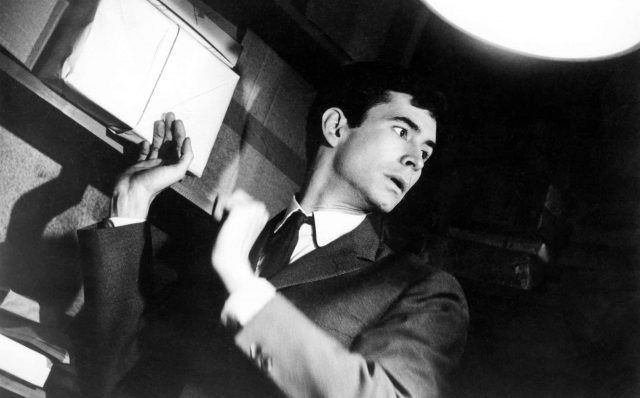

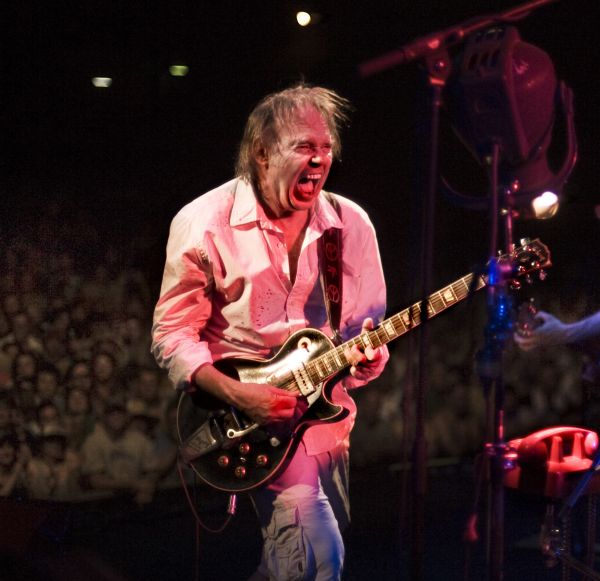
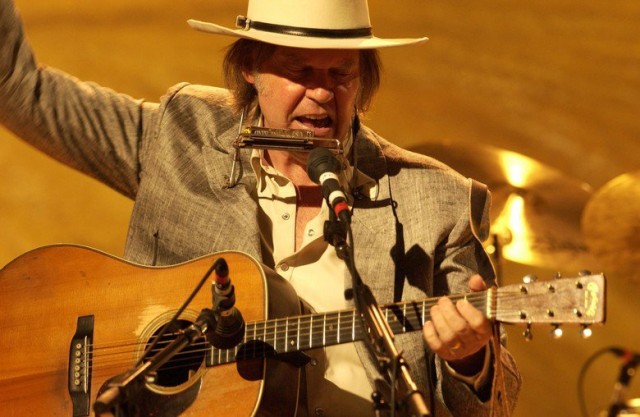
 The BAMcinématek screening of Neil Young Trunk Show will be preceded by another stellar collaboration between Jonathan Demme and Neil Young, Neil Young: Heart of Gold. In March 2005, less than a week before a scheduled operation for a brain aneurysm, Canadian country-folk-rock legend Neil Young headed to Nashville, assembled friends and family, and in four days recorded one of the best — and most personal — albums of his storied four-decade career, Prairie Wind. On August 18, he had recovered enough to put on a poignant show at the Ryman Auditorium in Nashville, captured on film by Demme, whose previous music-related works included Talking Heads in Stop Making Sense, Robyn Hitchcock in Storefront Hitchcock, and videos by the Pretenders and Bruce Springsteen. The concert film begins with brief interviews with band members as they prepare for the show; Demme does not harp on Young’s health but instead focuses on the music itself and the warming sense of a family coming together. And what music it is.