this week in film and television

HUMAN FLOW

Human Flow

Ai Weiwei takes a close look at the international refugee crisis in Human Flow

HUMAN FLOW (Ai Weiwei, 2017)
Angelika Film Center, 18 West Houston St. at Mercer St., 212-995-2570
Landmark at 57 West, 657 West 57th St. at 12th Ave.
Opens Friday, October 13
www.humanflow.com

This past fall, Chinese dissident artist Ai Weiwei had several concurrent exhibitions in New York City that dealt with the international refugee crisis. At Deitch Projects in SoHo, “Laundromat” included racks of clothing that had been worn by Syrian refugees at the Idomeni refugee camp in Iraq, all freshly cleaned and pressed, as if ready to give the migrant men, women, and children a new lease on life. Among other items, the gallery show also featured several monitors playing footage that Ai had shot in various refugee camps, film that has now been turned into the stunning documentary Human Flow. In 2016, Ai and his crew traveled to twenty-three countries, visiting dozens of camps in a year in which it was estimated that there were as many as 65 million displaced people around the world, fleeing war, poverty, famine, and persecution. In his first full-length documentary, Ai moves from macro to micro, shooting at a variety of scales. He uses drones to photograph tent cities in the desert from high above — reminiscent of the photography of Edward Burtynsky, turning individual items into parts of a vast pattern — along with gorgeous scenes of deserts and seascapes and intimate cell-phone footage and handheld camera shots that put viewers right in the middle of these makeshift villages, where some families live for decades. Ai, with his scruffy gray beard and in a hoodie, is often shown not only taking cell-phone videos but helping out and mingling with the refugees as dinghies arrive on the shores of Lesbos, Greece, or playfully trading passports with a refugee. Throughout the film, men and women stand proudly, often in traditional dress, looking directly at the camera for extended lengths of time, establishing their unique individuality, putting faces to what is most often seen in news clips as swaths of people struggling to survive. As Ai travels to each successive camp, he posts relevant quotes from writers and philosophers from that nation, from Turkish poet Nazim Hikmet, the Dhammapada Buddhist scripture, and Persian poet Baba Tahir to Kurdish poet Sherko Bekas, Syrian poet Adonis, and U.S. president John F. Kennedy. Details about the situations are sometimes delivered news-crawl-style, along the bottom of the screen.

Human Flow

Ai Weiwei gets deeply involved in situation in Human Flow

In addition to giving voice to the refugees themselves — “Where am I supposed to start my new life?” one woman asks — Ai speaks with crisis workers on the ground and United Nations officials and other experts, such as UNHCR Communications Officer Boris Cheshirkov, Princess Dana Firas of Jordan, Human Rights Watch Emergencies Director Peter Bouckaert, UN High Commissioner for Refugees Filippo Grandi, UNHCR Pakistan Senior Operation Coordinator Marin Din Kajdomcaj, UNICEF Lebanon representative Tanya Chapuisat, former Syrian astronaut Mohammad Fares, Dr. Cem Terzi of the Association of Bridging Peoples, and Dr. Kemal Kirişci, a senior fellow at the Brookings Institution who gets right to the point, explaining, “It’s going to be a big challenge to recognize that the world is shrinking, and people from different religions, different cultures, are going to have to learn to live with each other.” The powerful, immersive film was edited by Niels Pagh Andersen, who worked on Joshua Oppenheimer’s searing The Act of Killing and The Look of Silence, from nine hundred hours of footage, with a score by Karsten Fundal and a dozen cinematographers, among them Ai, Christopher Doyle, Zhang Zanbo, Konstantinos Koukoulis, and Johannes Waltermann. “The more immune you are to people suffering, that’s very, very dangerous. It’s critical for us to maintain this humanity,” one woman says, and that gets right to the heart of the film. Human Flow is very personal to Ai, whose own battles with Chinese authorities and exile — he spent much of his childhood in a hard labor camp in the Gobi Desert because his father, a poet and intellectual, was part of a revolutionary group, and as an adult Ai has been imprisoned, placed under house arrest, and beaten for his activism — were detailed in the Ai Weiwei: Never Sorry. A masterful Conceptualist whose work explores sociocultural elements through a historical lens, Ai has always believed that artists have a responsibility to reveal the truth, and that’s precisely what he does in Human Flow, with a determined fearlessness to do what’s right.

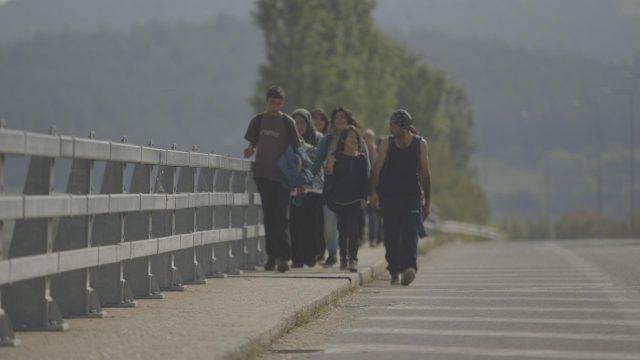
In one of the film’s most heart-wrenching moments, thirteen thousand refugees, mostly from Syria, Iraq, and Afghanistan, walk through the Greek countryside toward the Macedonian border, only to find that a fence has been erected and the entrance is now closed, leaving them with nowhere to go. It’s a harrowing scene, but Ai is no mere doomsayer. There are many shots in the film that show children running about and playing, laughing and smiling for the camera, still filled with hope for a better life. It’s the rest of the world’s job to make that happen, and as Ai exemplifies, every one of us can make a difference. Human Flow opens at the Angelika and the Landmark at 57 West on October 13; Ai will participate in Q&As following the 7:00 screening at the Landmark on October 13 and after the 1:50 show on October 14 at the Angelika. The film is being released in conjunction with the Public Art Fund project “Ai Weiwei: Good Fences Make Good Neighbors,” consisting of dozens of installations and interventions in all five boroughs: at Doris C. Freedman Plaza, the Washington Square Arch, the Unisphere, Essex Street Market, the Cooper Union, bus shelters, lampposts, newsstand kiosks, and other locations, furthering Ai’s artistic ideas about immigrant bans and the treatment of refugees, spread across a city he called home in the 1980s.

THY FATHER’S CHAIR

THY FATHER’S CHAIR

A cleaning crew has its work cut out for it in Alex Lora and Antonio Tibaldi’s Thy Father’s Chair

THY FATHER’S CHAIR (Alex Lora & Antonio Tibaldi, 2015)
Village East Cinema
181-189 Second Ave. at 12th St.
Opens Friday, October 13
212-529-6998
www.citycinemas.com

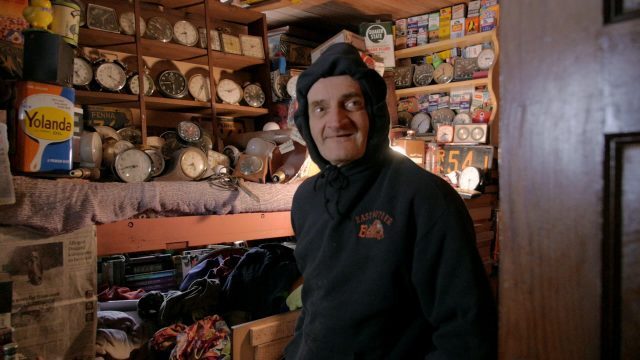
Directors Antonio Tibaldi and Alex Lora put the viewer right in the middle of twin brothers Abraham and Shraga’s desperately crowded and traumatic situation in the compulsively watchable observational documentary Thy Father’s Chair. After their parents died, the slovenly, unmarried Jewish scholars just plain stopped cleaning up after themselves, allowing newspapers, magazines, food, garbage, kitty litter, and myriad other items to pile up around them. They were not collectors hoarding valuable possessions or personal mementos; they were simply unable to organize anything or throw stuff away in their Brooklyn apartment. Only when their upstairs tenant stopped paying rent in protest, demanding they clean their place — the tenants had to deal not only with bad odors from the brothers’ apartment but with vermin as well — do they seek out assistance, hiring an Israeli man named Hanan of Home Clean Home to come and make their apartment safe and livable again. But it’s no easy task, as Abraham watches Hanan and his hazmat-suited team very carefully, continually trying to talk them out of tossing away certain items HCH insists must go; meanwhile, Shraga just moans on and on as he downs bottles of wine. (One of the only ways to tell the identical twins apart is by the wine stains on Shraga’s white shirt.)

“What the hell! Nobody’s helping me,” Abraham cries out. “We are here to help you!” Hanan says. “You’re not going to help me. You’re going to tell me what to do,” Abraham replies. Later, Abraham tells Hanan, “What is it, a punishment?” Hanan responds, “It’s not punishment. I’m trying to help you; you’re not working with me.” Abraham just can’t bear to get rid of what is clearly mostly junk and garbage, including vastly outdated electronic equipment and canned food. The only item that the brothers search for that is indeed worth keeping is their megillah scroll, but that is the exception. Abraham also agonizes over his father’s favorite chair, not wanting Hanan to take it yet debating whether he is even worthy enough to sit in it. “The Torah wants everything to be clean, but unfortunately we veered from it,” he concedes. The brothers actually do understand what is going on, that their hoarding is patently absurd and dangerous, but they are powerless to stop it.

THY FATHER’S CHAIR

Documentary focuses on Brooklyn twin brothers who have serious hoarding problem

Director and cinematographer Tibaldi and director and editor Lora cast no judgment on the two men; the filmmakers work, much like the Maysles brothers did, like flies on the wall, recording the crazy things going on in this railroad apartment in Midwood for eight days. Complicating matters, Tibaldi couldn’t always get the kinds of shots he wanted, as he was physically limited as to where he could stand because of the mounds of filth. There’s no back story; we find out almost nothing about who Abraham and Shraga are and what they have done with their lives, what their hopes and dreams might have been, other than what little they reveal of themselves onscreen, which is dominated by an overwhelming fear of things being taken away from them. There are also no talking heads offering expert opinions or psychological evaluations about the brothers and their situation.

Both melancholic and absurdly funny, the twins’ predicament is sort of what would happen if the Beale women of Grey Gardens had mated with Homer Lusk Collyer and Langley Wakeman Collyer, the famous hoarding brothers who died less than two weeks apart in their Harlem brownstone, no longer able to survive their suffocating surroundings. Bjarke Kolerus and Simon Don Eriksen’s gentle music also doesn’t comment on the ridiculousness of it all, instead treating it with understanding. “I feel sorry and sad to see you sad,” Hannan tells Abraham, who replies, “I feel bad about the stuff that’s being thrown out, but it has to be done,” trying to convince himself that it’s all going to be okay. The Father’s Chair, which is dedicated to Chantal Akerman, opens Friday, October 13, at the Village East and will be preceded by Artemis Shaw and Alexander Lewis’s 2016 short Single Room Occupancy.

NYFF55 SPOTLIGHT ON DOCUMENTARY: THE VENERABLE W.

The Venerable W.

Megalomaniacal monk spouts his extremist views in Barbet Schroeder’s The Venerable W.

THE VENERABLE W. (Barbet Schroeder, 2017)
New York Film Festival, Film Society of Lincoln Center
Friday, October 13, Walter Reade Theater, $25, 6:00
Saturday, October 14, Francesca Beale Theater, $25, 1:00
Festival runs September 28 – October 15
212-875-5601
www.filmlinc.org
www.filmsdulosange.fr/en

According to long-standing traditions and beliefs, Buddhists have empathy and compassion for all sentient beings. For example, in the recently released documentary The Last Dalai Lama?, His Holiness expressed such feelings even for the Chinese military and government that have waged war on the Tibetan people for more than fifty years and have decided that they will select the next Dalai Lama. So when Iranian-born Swiss-French director Barbet Schroeder heard about Ashin Wirathu, a Buddhist monk in Myanmar advocating violence against a Muslim minority known as the Rohingyas, he headed to the country, formerly known as Burma, where he was so shocked and disturbed by what he saw that he can still barely say the monk’s name in interviews. Nor could he bring himself to use it in the title of his film about the controversial figure, The Venerable W., which is screening at the New York Film Festival on October 13 and 14, followed by Q&As with the director. With the documentary, Schroeder, who is best known for such works as Barfly, Reversal of Fortune, and Single White Female, concludes his Trilogy of Evil, which began with General Idi Amin Dada: A Self Portrait in 1974, about the Ugandan dictator, and continued in 2007 with Terror’s Advocate, about lawyer Jacques Vergès, who has defended such clients as a former Nazi, a Khmer Rouge leader, and a Holocaust denier. The Venerable W. consists of archival footage and new interviews with Wirathu, as Schroeder essentially lets the leader speak his mind, in sermons to his rabid followers, at public events, and in his monastery, where he espouses his beliefs to the filmmaker. “The main features of the African catfish are that: They grow very fast. They breed very fast too. And they’re violent. They eat their own species and destroy their natural resources. The Muslims are exactly like these fish,” Wirathu, who was born in Kyaukse near Mandalay in 1968, says with a sly smile. He regularly boasts of his accomplishments in subduing the Rohingyas, whom he often refers to using a slur that is the equivalent of the N-word in America.

The Venerable W.

The Venerable Wirathu walks among his faithful minions in shocking documentary

A megalomaniacal nationalist with extremist positions on patriotism, protectionism, and border crossings and a clever manipulator of social media, Wirathu, inspired by the 1997 book In Fear of Our Race Disappearing, also makes extravagant, debunked claims using false statistics, from declaring that he started the 2007 Saffron Revolution to arguing that the Rohingyas are burning down their own villages so they can blame the Buddhists. Much of what he is saying sounds eerily familiar, evoking racist, nationalist sentiments that are gaining ground around the world, particularly in France, England, and America. “In the USA, if the people want to maintain peace and security, they have to choose Donald Trump,” Wirathu says. Schroeder also speaks with seven men who share their views about Wirathu: W.’s master, U. Zanitar; investigative magazine editor Kyaw Zayar Htun; Saffron Revolution monk U. Kaylar Sa; Fortify Rights creator Matthew Smith; Muslim political candidate Abdul Rasheed; Spanish journalist Carlos Sardiña Galache; and highly revered monk U. Galonni. Together they paint a portrait of a dangerous fanatic who is fomenting bitter hatred that has led to extensive episodes of rape, violence, and murder while the military and the government, headed by Aung San Suu Kyi, either support what Wirathu’s doing or merely look the other way. In numerous voiceovers, Portuguese actress Maria de Medeiros recites quotations from Buddhist texts, including the Metta Sutta, and states various sociopolitical facts. “The Buddha is often above good and evil, but his words should help us limit the mechanics of evil,” she narrates. Meanwhile, Wirathu, who was declared “the Face of Buddhist Terror” in a June 2013 Time magazine cover story, insists he is doing the right thing for his country. “I help people who have been persecuted by Muslims,” he says. “The threat against Buddhism has reached alert level.” It’s a brutal film to watch, infuriating and frightening, as Schroeder and editor Nelly Quettier clearly and concisely present the facts, without judgment, including scenes of people on fire and being viciously beaten; the director might not make any grand statements against what Wirathu and his flock are doing — he lets the monk take care of that by himself — but the film is a clarion call for us all to be aware of what is happening around the world, as well as in our own backyard. Both screenings of The Venerable W. will be preceded by the short film What Are You Up to, Barbet Schroeder?, which goes behind the scenes of his decision to tell Wirathu’s story.

INSPIRING WONDERSTRUCK: THE WIND

Lillian Gish in The Wind

Letty Mason (Lillian Gish) is being driven crazy by internal and external sources in The Wind

THE WIND (Victor Sjöström, 1928)
Museum of the Moving Image, Redstone Theater
35th Ave. at 36th St., Astoria
Sunday, October 15, $15, 2:00
Series runs October 13-22
718-777-6888
www.movingimage.us

Author Brian Selznick’s 2007 book The Invention of Hugo Cabret proved to be movie magic; it was turned into the film Hugo by Martin Scorsese, which garnered eleven Oscar nominations and won four. In conjunction with the theatrical release of the latest movie based on a Selznick book, Todd Haynes’s adaptation of Selznick’s 2011Wonderstruck, the Museum of the Moving Image is hosting the series “Inspiring Wonderstruck,” consisting of nine films that influenced and inspired the author. One of the most direct influences was Victor Sjöström’s 1928 now-classic silent film The Wind, starring Lillian Gish as Letty Mason, a young woman traveling from Virginia to Texas to live with her cousin Beverly (Edward Earle). Traveling from the cultured, civilized East to what was still the wild West, the uncertain Letty must confront the fierceness of nature head-on — both human nature and the harsh natural environment. On the train, she is wooed by cattleman Wirt Roddy (Montagu Love), but her fears grow as she first sees the vicious wind howling outside the train window the closer she gets to her destination. Once in Sweetwater, she is picked up by her cousin’s neighbors, the handsome Lige Hightower (Lars Hanson) and his goofy sidekick, Sourdough (William Orlamond). Both men take a quick liking to Letty, who seems most attracted to Wirt. Soon Beverly’s wife, Cora (Dorothy Cumming, in her next-to-last film before retiring), becomes jealous of Letty’s closeness with her husband and kids and kicks her out, leaving a desperate Letty to make choices she might not be ready for as the wind outside becomes fiercer and ever-more dangerous. The Wind is a tour de force for Gish in her last silent movie, not only because of her emotionally gripping portrayal of Letty but because she put the entire production together, obtaining the rights to the novel by Dorothy Scarborough, hiring the Swedish director and star Hanson, and arguing over the ending with the producers and Irving Thalberg. (Unfortunately, she lost on that account, just about the only thing that did not go the way she wanted.)

The Wind

Letty Mason (Lillian Gish) and Lige Hightower (Lars Hanson) have some tough decisions to make in Victor Sjöström’s silent classic

Sjöström (The Phantom Carriage, The Divine Woman), who played Professor Isak Borg in Ingmar Bergman’s Wild Strawberries, and cinematographer John Arnold create some dazzling effects as a twister threatens and Letty battles both inside and outside; she is regularly shot from the side, at the door of the shack where she lives, not knowing if she’d be safer inside or outside as the wind and sand blast over her. The film, an early look at climate change, was shot in the Mojave Desert in difficult circumstances; to get the wind to swirl, the crew used propellers from eight airplanes. Dialogue is sparse, and the story is told primarily in taut visuals. “Lillian Gish [is] at the height of her powers, fighting the wind and insanity nonstop for the entire movie,” Selznick says of The Wind. “A silent film made just after the silent era ended, the film is now recognized as one of Gish’s greats. The character of Lillian Mayhew, played by Julianne Moore in Wonderstruck, is directly inspired by Gish, and the fictional movie within a movie, Daughter of the Wind, is exactly that, an offspring of this very movie.” A restored 35mm print of The Wind with the original music and effects soundtrack is screening October 15 at 2:00 at the Museum of the Moving Image. “Inspiring Wonderstruck” runs October 13-22 and also includes, among others, Francis Ford Coppola’s The Conversation, Haynes’s I’m Not There and Poison, Diane Garey and Lawrence Hott’s Through Deaf Eyes, Robert Mulligan’s To Kill a Mockingbird, and Hal Ashby’s Being There as well as a preview screening of Wonderstruck, followed by a Q&A with Selznick, production designer Mark Friedberg, and costume designer Sandy Powell and a book signing with Selznick.

PERFORMA 17 BIENNIAL

performa 17

Multiple venues
November 1-19, free – $40
17.performa-arts.org

The seventh Performa biennial takes place November 1-19 in multiple venues around the city, featuring an impressive roster of international artists pushing the limits of what live performance can be. This year’s lineup includes ten Performa commissions and dozens of events, from film, poetry, and dance to architecture, music, and comedy, arranged in such categories as Performa Projects, Performa Premieres, and Pavilion without Walls. In addition to the below recommendations for this always exciting festival, there will be presentations by Kendell Geers, Xavier Cha, Yto Barrada, Brian Belott, Flo Kasearu, Jimmy Robert, Mohau Modisakeng, Kelly Nipper, Kemang Wa Lehulere, Nicolas Hlobo, Kris Lemsalu with Kyp Malone, the Marching Cobras of New York, and others at such venues as Abrons Arts Center, BAM, the Met, White Box Arts Center, Marcus Garvey Park, the Connelly Theater, St. Mark’s Church in-the-Bowery, Harlem Parish, and the Glass House in New Canaan.

Thursday, November 2, 7:00
Friday, November 3, 7:00 & 9:00
Saturday, November 4, 7:00

Teju Cole: Black Paper, BKLYN Studio at City Point, 445 Albee Square West, $15-$25

Thursday, November 2, 9, 16
Barbara Kruger: The Drop, Performa 17 Hub, 47 Walker St., $5, 4:00 – 8:00

Sunday, November 5
Monday, November 6

William Kentridge: Ursonate, Harlem Parish, 258 West 118th St., $25-$40, 7:00

Sunday, November 5, 12, 19
Eiko Otake: A Body in Places, Metropolitan Museum of Art, free with museum admission, 10:30 am

Wednesday, November 8
Estonian Pavilion Symposium: Call for Action — Key Moments of Estonian Performance Art, lecture and screening with curators Anu Allas and Maria Arusoo, free, Performa 17 Hub, 47 Walker St., 5:00

Thursday, November 9
Friday, November 10
Saturday, November 11

The Tracey Rose Show in Collaboration with Performa 17 and Afroglossia Presents: The Good Ship Jesus vs The Black Star Line Hitching a Ride with Die Alibama [Working Title], the Black Lady Theatre, 750 Nostrand Ave., $15-$25, 7:30

Friday, November 10
Zanele Muholi on Visual Activism, grand finale of two weeks of meetings, performances, discussions, and art-making, the Bronx Museum, 1040 Grand Concourse, free, 7:00

Friday, November 10
through
Sunday, November 19

Alex Schweder and Ward Shelley: The Newcomers, with Lena Kouvela and Sarah Burns, 28 Liberty Plaza, free, all day

be here now

Saturday, November 11
Architecture Conference, with Giovana Borasi, Lluís Alexandre Casanovas Blanco, Yve Laris Cohen, Cooking Sections (Daniel Fernández Pascual & Alon Schwabe), and Elizabeth Diller, Performa 17 Hub, 47 Walker St., free, 2:00 – 6:00

Monday, November 13
Tuesday, November 14

Wangechi Mutu: Banana Stroke, Metropolitan Museum of Art, Grace Rainey Rogers Auditorium, free with museum admission, 7:00

Monday, November 13
through
Friday, November 17

Kwani Trust: Everyone Is Radicalizing, multimedia installation and public programs, Performa 17 Hub, 47 Walker St., free, 12 noon – 6:00 pm

Wednesday, November 15
Thursday, November 16
Friday, November 17

Anu Vahtra: Open House Closing. A Walk, Performa 17 Hub, 47 Walker St., free, 5:00

Thursday, November 16
Julie Mehretu and Jason Moran: MASS (HOWL, eon), Harlem Parish, 258 West 118th St,, $25-$40, 7:00 & 9:00

Thursday, November 16
Friday, November 17
Saturday, November 18

Gillian Walsh: Moon Fate Sin, Danspace Project, St. Mark’s Church in-the-Bowery, 131 East Tenth St., $22-$25, 8:00

NYFF55: CLAUDE LANZMANN’S FOUR SISTERS

Holocaust survivor Ruth Elias tells her amazing story to Claude Lanzmann — and sings — in The Hippocratic Oath

Holocaust survivor Ruth Elias tells her amazing story to Claude Lanzmann — and sings — in The Hippocratic Oath

CLAUDE LANZMANN’S FOUR SISTERS (Claude Lanzmann, 2017)
New York Film Festival, Film Society of Lincoln Center
Sunday, October 8, The Hippocratic Oath, Walter Reade Theater, $25, 11:30 am, introduced by Claude Lanzmann
Sunday, October 8, Baluty, Walter Reade Theater, $25, 2:00
Tuesday, October 10, The Merry Flea and Noah’s Ark, Francesca Beale Theater, $25, 6:00
Festival runs September 28 – October 14
212-875-5601
www.filmlinc.org

“You are very well informed,” Holocaust survivor Ruth Elias tells filmmaker Claude Lanzmann in The Four Sisters: The Hippocratic Oath. Thanks to the Paris-born Lanzmann, a French resistance fighter during WWII, we are all very well informed about so many of the atrocities perpetrated by the Nazis, told to him in moving, powerful stories by “living witnesses” for decades. In The Four Sisters, making its world premiere at the New York Film Festival on October 8 and 10, the Shoah director focuses on the extraordinary experiences of four strong women who survived concentration camps, each one originally interviewed for Shoah. “The more I thought about these four women, the more the necessity to bring the spotlight on these female faces of the Shoah seemed important,” Lanzmann explains in his director’s note about deciding to turn them into four separate portraits. “Each of them deals with a little-known chapter of the Holocaust, each from a unique point of view. . . . The incredible strength in each of them has to exist in its own right, and yet the exceptional quality they all share also had to come through — that searingly sharp, almost physical intelligence, and an irrepressible survival instinct which could not be extinguished, despite an apparently certain death awaiting them.”

Ada Lichtman details her time in Sobibór in The Merry Flea

Ada Lichtman details her time in Sobibór in The Merry Flea

In The Hippocratic Oath, which the ninety-one-year-old Lanzmann (The Last of the Unjust) will introduce at the Walter Reade Theater on October 8 at 11:30 am, Elias tells her remarkable story from the Nazi occupation of Czechoslovakia in March 1939 to her deportation in April 1942 to Theresienstadt, where she was reunited with and married her boyfriend, to her pregnancy in the winter of 1943, which led to her being sent to Ravensbrück and Auschwitz, where she met Dr. Josef Mengele, who chose to use her baby in an inhuman experiment. Filmed in a little garden, Elias, an accordion player, is firm and direct as she shares the details of precisely what happened, her dark eyes seemingly sent back to Eastern Europe as her words bring it all to vivid life; one can visualize each location, each movement, each glance. The camera occasionally turns to Lanzmann, smoking a cigarette as he listens to her, mesmerized, just as the audience is. Lanzmann is more active in Baluty, walking along the shore in Panama City, Florida, with Paula Biren, whose story begins in Lodz, Poland. An elegant woman, Biren needs a little more prodding to speak, which she does very carefully, with a brutally cold honesty. She describes how Lodz was turned into a ghetto, how she became a police officer there, and then was sent to Auschwitz, where her younger sister and mother were killed, followed by her father’s death shortly thereafter. Lanzmann supplements the film with archival photographs of Lodz. Throughout The Merry Flea, Ada Lichtman is cleaning and mending dolls; it is eerie as viewers eventually find out why. Lichtman, from the Polish town of Wieliczka, relates her story of being captured by the Germans and sent to Sobibór, speaking at a determined, almost eager pace, sometimes skipping around so that Lanzmann has to interject to get her back on track or to go into more specifics, particularly regarding her treatment at the hands of a Nazi officer named Wagner and her description of cattle cars where naked men, women, and children were forced to dance with one another. The camera occasionally shifts to her husband, who she met in the camps; he stares ahead almost blankly, with hollow, haunted eyes, then hides his head in his hands. The sound of traffic outside can be heard, as if coming from another time and place.

Hanna Marton has a frightening tale to tell Claude Lanzmann in Noah’s Ark

Hanna Marton has a frightening tale to tell Claude Lanzmann in Noah’s Ark

Finally, in Noah’s Ark, Lanzmann introduces Hungarian native Hanna Marton, who sits calmly in a chair, holding a small notebook as she speaks in Hebrew, the director sitting right in front of her, nearly knocking knees; in the film’s production notes, Lanzmann explains, “I’ve never heard an account that is as constantly, relentlessly painful as the one that Hanna Marton gave me when I filmed her during the shoot for Shoah in her Jerusalem apartment.” Her eyes sometimes tearing up, Marton, continually on edge and at times defensive, talks about the early Zionist movement in her hometown of Cluj, the capital of Transylvania; discusses how Jews were used by the Hungarian army, which supported Germany and Italy, as living mine detectors; details the creation of the Kolozsvár ghetto in May 1944 as a way to quickly exterminate Jews; and delves into her involvement with the Kastner train, a deal made between Jewish-Hungarian lawyer Rudolf Kastner and Nazi Obersturmbannführer Adolph Eichmann. The Four Sisters is no mere addendum to Shoah, nor is it a footnote to Lanzmann’s long, important career; together, the four films make a powerful statement about hatred and bigotry, about violence and war, and about the indomitable strength and spirit of women, especially during the war and its aftermath. They are also a terrifying reminder that given the state of the world today, it’s not impossible that something like this could happen again, even right here in America, as there are fewer and fewer concentration-camp eyewitnesses, Holocaust deniers litter the internet, nations build walls and fences to keep out refugees, and a sitting president insists that some white supremacists are “very fine people.”

CHAVELA

The extraordinary life and career of Chavela Vargas is documented in revelatory documentary

The extraordinary life and career of Chavela Vargas is documented in revelatory documentary

CHAVELA (Catherine Gund & Daresha Kyi, 2017)
Film Forum
209 West Houston St.
October 4-17
212-727-8110
filmforum.org
www.musicboxfilms.com

The extraordinary story of beloved Mexican ranchera singer Chavela Vargas is intricately documented in Catherine Gund and Daresha Kyi’s warm and intimate Chavela, opening at Film Forum today. Chavela’s life might seem an all-too-familiar archetype, the tale of a powerful female vocalist, a lesbian performer whose career was wrecked by the lethal combination of a heterosexual macho society, personal demons, and addiction, but Chavela avoids stereotypes and instead delivers a very human portrait. Born in Costa Rica in 1919, Chavela had an unhappy childhood and ran away to Mexico when she was fourteen to pursue a singing career and live a freer life, able to explore her sexual orientation as she grew older. “Her own parents saw her as a strange girl. They realized she was a boyish girl,” composer Marcela Rodríguez says. “Her movement, her hands, and her body language were manly.” Her longtime partner, human rights lawyer Alicia Pérez Duarte, adds, “Chavela created her persona in a very macho world.” Chavela dedicated her life to her music while keeping much of her personal life private — the film drops little more than tantalizing hints about her relationship with artist Frida Kahlo and an evening with Ava Gardner — and her commanding presence and powerful vocal style quickly made her a star in the 1940s and ’50s. “Hers wasn’t a sweet, crystal clear voice,” says cabaret owner Jesusa Rodríguez. “And she always sounded like she’d been torn apart, as if she’d been born with the wounds of life and death.” But at the height of her fame, those wounds started catching up to her as she began drinking heavily, resulting in a fifteen-year hiatus during which many people thought she was dead. The film centers around a never-before-seen 1991 interview Gund conducted with Chavela upon her return to singing, as she speaks more openly and honestly about her sexuality, her family, and her career. She’s a riveting figure, confident and determined, ready to face the world again. “We all have to live in the present. Don’t think about yesterday or tomorrow. Today,” she says.

Editor Carla Gutiérrez seamlessly weaves between archival film and photographs of Chavela performing onstage and in movies, complete with English translations of the heartfelt lyrics; interviews from 1991 and later, as she revels in being a star again; and new interviews with cabaret owners Jesusa Rodríguez and Liliana Felipe, singers Tania Libertad and Miguel Bosé, Federico García Lorca Foundation president Laura García Lorca, artist Martirio, composer and singer José Alfredo Jiménez Jr., whose father wrote many of the songs that made Chavela famous, and Spanish director Pedro Almodóvar, who used her music in his movies and played a major role in her comeback, which took Chavela around the globe, including to her beloved Madrid and to Carnegie Hall. “In her voice, I’ve found one of my best collaborators. And a faithful reflection of myself,” he says in an old clip, a feeling that is shared by many who knew her. Producer-directors Gund (Born to Fly, A Touch of Greatness) and Kyi (Land Where My Fathers Died; Thugs, the Musical) clearly love their subject, and their love is contagious, welcoming viewers into the pure majesty that is Chavela Vargas. (The 6:15 show on October 7 will be followed by a Q&A with Gund and Kyi, moderated by LGBT activist Eliel Cruz; the 2:20 show on October 8 will be followed by a Q&A with Gund and Kyi; the 8:10 show on October 10 will be followed by a Q&A with Gund, moderated by NewFest’s Nick McCarthy; and the 8:10 show on October 17 will be followed by a Q&A with Carnegie Hall show producer Claudia Norman, moderated by Cinema Tropical executive director Carlos Gutiérrez. In addition, Stephanie Trudeau is bringing her one-woman docu-cabaret show Chavela: Think of Me back to the Pangea Restaurant & Supper Club on November 2, 19, and 16.)