this week in film and television

COMPLETE CUARÓN: GRAVITY

Space debris from a Russian satellite threatens an American shuttle crew in GRAVITY

Space debris from a Russian satellite threatens an American shuttle crew in Gravity

GRAVITY (Alfonso Cuarón, 2013)
Film Society of Lincoln Center, Walter Reade Theater
165 West 65th St. at Amsterdam Ave.
Saturday, January 5, 9:00, and Monday, January 7, 7:00
Series runs January 4-8
212-875-5601
www.gravitymovie.warnerbros.com
www.filmlinc.org

Alfonso Cuarón’s Gravity is a breathtaking thriller that instantly enters the pantheon of such classic space fare as 2001: A Space Odyssey, Alien, and The Right Stuff. While medical engineer Dr. Ryan Stone (Sandra Bullock) is fixing a computer glitch outside the shuttle Explorer, veteran astronaut and wisecracker Matt Kowalski (George Clooney), on his final mission before retirement, is playing around with a new jetpack and Shariff (voiced by Paul Sharma) is having fun going on a brief spacewalk. But disaster strikes when debris from a destroyed Russian satellite suddenly comes their way, killing Shariff and the rest of the crew and crippling the shuttle, leaving Stone and Kowalski on their own in deep space, their communication with Mission Control in Houston (voiced by Ed Harris, in a nod to his participation in Apollo 13 and The Right Stuff) gone as well. Kowalski is cool and calm, listening to country music as he tries to come up with a plan that will get them to the International Space Station, but the inexperienced Stone is running out of oxygen fast as she tumbles through the emptiness, Earth in the background, so close yet so far. Written by Cuarón (Y Tu Mamá También, Children of Men) with his son Jonás, Gravity is spectacularly photographed by Emmanuel Lubezki, the master behind numerous works by Cuarón and Terrence Malick (The New World, The Tree of Life), among others. Lubezki and his team even created a new LED light box to increase the film’s realism, which is nothing less than awe-inspiring and mind-bending as it takes place in real time. Despite the vastness of space, Gravity often feels claustrophobic, particularly as Stone struggles to get a breath or attempts to operate a foreign module.

GRAVITY

Matt Kowalski (George Clooney) and Dr. Ryan Stone (Sandra Bullock) try to remain together in Alfonso Cuarón’s masterful space epic

Close-ups of Stone and Kowalski reveal reflections of the shuttle and Earth, emphasizing the astronauts’ dire situation as they engage in a very different kind of pas de deux. Gravity also succeeds where directors like James Cameron often fail, as a solid, relatively unsentimental and unpredictable script accompanies the remarkable visuals, which evoke both harrowing underwater adventures as well as dangerous mountain-climbing journeys. (Cuarón also manages to bring it all in in a terrifically paced ninety minutes.) Cuarón and Lubezki favor long takes, including an opening shot lasting more than thirteen minutes, immersing the viewer in the film, further enhanced by being projected in IMAX 3D, which is not used as merely a gimmick here. Stephen Price’s score increases the tension as well until getting melodramatic near the end. Clooney is ever dapper and charming and Bullock is appropriately nervous and fearful in their first screen pairing, even though they only make contact with each other through bulky spacesuits, their connection primarily via speaking. Cuarón, who also edited Gravity with Mark Sanger, has made an endlessly exciting film for the ages, a technological marvel that should have a tremendous impact on the future of the industry. Winner of seven Oscars including Best Director, Best Cinematography, and Best Editing, Gravity is screening January 5 and 7 in the Film Society of Lincoln Center series “Complete Cuarón,” comprising all eight of his movies (Y tu mamá también, Children of Men, Sólo con tu pareja, Great Expectations, Harry Potter and the Prisoner of Azkaban) in conjunction with the success of his latest, Roma.

TO SAVE AND PROJECT: THE VENERABLE W.

The Venerable W.

Megalomaniacal monk spouts his extremist views in Barbet Schroeder’s The Venerable W.

THE 16th MoMA INTERNATIONAL FESTIVAL OF FILM PRESERVATION: THE VENERABLE W. (Barbet Schroeder, 2017)
MoMA Film, Museum of Modern Art
11 West 53rd St. between Fifth & Sixth Aves.
January 4-10
Festival runs January 4-31
212-708-9400
www.moma.org
www.filmsdulosange.fr/en

“To Save and Project: The 16th MoMA International Festival of Film Preservation,” comprising newly restored and preserved works from throughout the history of cinema, kicks off January 4 with a tribute to Iranian-born Swiss-French director Barbet Schroeder’s self-described “trilogy of evil”: 1974’s Général Idi Amin Dada: Autoportrait (General Idi Amin Dada: A Self Portrait), about the Ugandan dictator; 2007’s L’avocat de la terreur (Terror’s Advocate), a portrait of Siamese-born French lawyer Jacques Vergès, who has defended such clients as Klaus Barbie, French philosopher and Holocaust denier Roger Garaudy, and Carlos the Jackal; and last year’s Le vénérable W. (The Venerable W.), a look at controversial Buddhist monk Ashin Wirathu. According to long-standing traditions and beliefs, Buddhists have empathy and compassion for all sentient beings. For example, in the 2017 documentary The Last Dalai Lama?, His Holiness expressed such feelings even for the Chinese military and government that have waged war on the Tibetan people for more than fifty years and have decided that they will select the next Dalai Lama.

So when Schroeder, who is best known for such fiction films as Barfly, Reversal of Fortune, and Single White Female, first heard about Wirathu, a Buddhist monk in Myanmar advocating violence against a Muslim minority known as the Rohingyas, he headed to the country, formerly known as Burma, where he was so shocked and disturbed by what he saw that he can still barely say the monk’s name in interviews; nor could he bring himself to use it in the title of his film about Wirathu. The Venerable W. consists of archival footage and new interviews with Wirathu, as Schroeder essentially lets the leader speak his mind, in sermons to his rabid followers, at public events, and in his monastery, where he espouses his beliefs to the filmmaker. “The main features of the African catfish are that: They grow very fast. They breed very fast too. And they’re violent. They eat their own species and destroy their natural resources. The Muslims are exactly like these fish,” Wirathu, who was born in Kyaukse near Mandalay in 1968, says with a sly smile. He regularly boasts of his accomplishments in subduing the Rohingyas, whom he often refers to using a slur that is the equivalent of the N-word in America.

The Venerable W.

The Venerable Wirathu walks among his faithful minions in shocking documentary

A megalomaniacal nationalist with extremist positions on patriotism, protectionism, and border crossings and a clever manipulator of social media, Wirathu, inspired by the 1997 book In Fear of Our Race Disappearing, also makes extravagant, debunked claims using false statistics, from declaring that he started the 2007 Saffron Revolution to arguing that the Rohingyas are burning down their own villages so they can blame the Buddhists. Much of what he is saying sounds eerily familiar, evoking racist, nationalist sentiments that are gaining ground around the world, particularly in France, England, and America. “In the USA, if the people want to maintain peace and security, they have to choose Donald Trump,” Wirathu says. Schroeder also speaks with seven men who share their views about Wirathu: W.’s master, U. Zanitar; investigative magazine editor Kyaw Zayar Htun; Saffron Revolution monk U. Kaylar Sa; Fortify Rights creator Matthew Smith; Muslim political candidate Abdul Rasheed; Spanish journalist Carlos Sardiña Galache; and highly revered monk U. Galonni. Together they paint a portrait of a dangerous fanatic who is fomenting bitter hatred that has led to extensive episodes of rape, violence, and murder while the military and the government, headed by Aung San Suu Kyi, either support what Wirathu’s doing or merely look the other way. In numerous voiceovers, Portuguese actress Maria de Medeiros recites quotations from Buddhist texts, including the Metta Sutta, and states various sociopolitical facts. “The Buddha is often above good and evil, but his words should help us limit the mechanics of evil,” she narrates.

Barbet Schroeder’s General Idi Amin Dada: A Self Portrait is part of MoMA film-preservation festival

Barbet Schroeder’s General Idi Amin Dada: A Self Portrait is part of MoMA film-preservation festival

Meanwhile, Wirathu, who was declared “the Face of Buddhist Terror” in a June 2013 Time magazine cover story, insists he is doing the right thing for his country. “I help people who have been persecuted by Muslims,” he says. “The threat against Buddhism has reached alert level.” It’s a brutal film to watch, infuriating and frightening, as Schroeder and editor Nelly Quettier clearly and concisely present the facts, without judgment, including scenes of people on fire and being viciously beaten; the director might not make any grand statements against what Wirathu and his flock are doing — he lets the monk take care of that by himself — but the film is a clarion call for us all to be aware of what is happening around the world, as well as in our own backyard. The Venerable W. will be preceded by the short film Où en êtes-vous Barbet Schroeder? (What Are You Up to, Barbet Schroeder?), which goes behind the scenes of his decision to tell Wirathu’s story. Schroeder will be at MoMA to introduce multiple screenings of The Venerable W., Terror’s Advocate, and General Idi Amin Dada: A Self Portrait as well as Charles Bukowski par Barbet Schroeder (The Charles Bukowski Tapes) and “Four by Barbet Schroeder,” a compilation of Koko, le gorille qui parle (Koko: A Talking Gorilla), Le cochon aux patates douces, Maquillages, and Sing Sing. “To Save and Project” continues through January 31 with such other international films as Yvonne Rainer’s Journeys from Berlin, Alexander Korda’s The Private Life of Henry VIII, F. W. Murnau’s Faust, and Chantal Akerman’s Histoires d’Amérique: Food, Family and Philosophy.

HOLIDAY SPECTACULAR: BLACK CHRISTMAS

BLACK CHRISTMAS

Creepy phone calls lead to gory violence in Bob Clark’s holiday favorite, Black Christmas

MIDNITE MOVIE: BLACK CHRISTMAS (Bob Clark, 1974)
Nitehawk Cinema
136 Metropolitan Ave. between Berry St. & Wythe Ave.
Friday, December 21, and Saturday, December 22, 12:10 am
718-384-3980
nitehawkcinema.com

American-Canadian filmmaker Bob Clark might be best known for the holiday favorite A Christmas Story, but he also directed another, very different yuletide cult classic, Black Christmas. Clark, who had previously made Children Shouldn’t Play with Dead Things and would go on to make such wide-ranging fare as Rhinestone, Turk 182!, Porky’s, and Baby Geniuses, assembled quite a cast for the 1974 horror flick, also known as Silent Night, Evil Night: Olivia Hussey (Romeo and Juliet), Keir Dullea (2001: A Space Odyssey, Bunny Lake Is Missing), Margot Kidder (Sisters, Superman), John Saxon (Enter the Dragon, A Nightmare on Elm Street), Art Hindle (The Brood, Invasion of the Body Snatchers), and Andrea Martin (SCTV, Pippin). The story is set in a sorority house run by Mrs. MacHenry (Marian Waldman), who lets the young women pretty much do whatever they want (while regularly sneaking drinks herself). A series of obscene phone calls has some of the sisters on edge while Barb (Kidder) is much more bold, challenging the twisted voice. After Clare (Lynne Griffin) disappears, the other women start growing more concerned, including Phyllis (Martin) and Jess (Hussey), as do Phyllis’s boyfriend, Patrick (Michael Rapport), Clare’s boyfriend, Chris (Hindle), and Olivia’s lover, Peter (Dullea), along with Clare’s prim and proper father (James Edmond) and local police lieutenant Kenneth Fuller (Saxon). With Christmas approaching, the body count starts piling up, as do the genre clichés, but it’s all in good fun.

Written by A. Roy Moore and shot in dark, eerie killer’s-point-of-view creepiness by former documentary cinematographer and longtime Clark collaborator Reg Morris (A Christmas Story, Empire of the Ants), Black Christmas is a choppy yet scary slasher flick, evoking the giallo tradition exemplified by Mario Bava and Dario Argento. Clark keeps things mysterious as the brutal murders unfold while also avoiding the key question: Why does no one ever check the freaking attic? Red herrings abound as Carl Zittrer’s sinister score ups the tension. Inspired by real murders as well as urban legends, Black Christmas, which was remade by Glen Morgan in 2006 (with Andrea Martin as Ms. MacHenry!), should be a seasonal tradition in every household, but for now you can check it out in its annual screenings at Nitehawk Cinema, December 21 and 22, as part of the Holiday Show Spectacular, which continues through the end of the year with such other Xmas classics as Scrooged, Fargo, Hook, Little Women, and It’s a Wonderful Life.

IN THE YEAR OF THE GRIFTER

Metrograph series about grifters includes The Grifters

Metrograph series about grifters includes The Grifters

Metrograph
7 Ludlow St. between Canal & Hester Sts.
December 14-22
212-660-0312
metrograph.com

Tales of hustlers, swindlers, con artists, scammers, flim-flammers, and the like have been part of cinema since the early days of the medium. We often find ourselves rooting for the snake-oil salesmen while believing that we would never fall for these elaborate, costly hoaxes. From December 14 to 22, Metrograph is presenting “In the Year of the Grifter,” consisting of sixteen flicks with complicated plots involving lots of fakery and fraud, dating from 1932 to 2013. The series begins with Orson Welles’s Citizen Kane reimagination, Mr. Arkadin, and continues with David Mamet’s House of Games and The Spanish Prisoner, Frank Borgaze’s Desire, Sofia Coppola’s The Bling Ring, and Stephen Frears’s The Grifters, among others. It’s not quite a primo collection, but it has some real doozies. Don’t forget to keep looking over your shoulder while watching these flicks.

F FOR FAKE

Orson Welles explores cinematic reality and artistic forgery in F for Fake

F FOR FAKE (Orson Welles, 1976)
Sunday, December 16, 6:00 & 10:15
metrograph.com

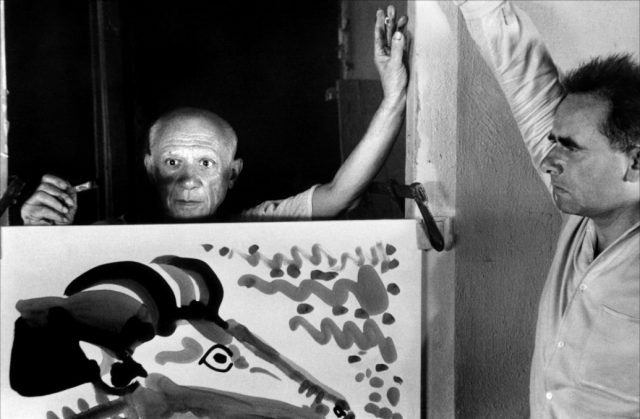
Orson Welles plays a masterful cinematic magician in the riotous F for Fake, a pseudo-documentary (or is it all true?) about art fakes and reality. Exploring slyly edited narratives involving art forger Elmyr de Hory, writer Clifford Irving, Spanish painter and sculptor Pablo Picasso, and reclusive billionaire Howard Hughes, the iconoclastic auteur is joined by longtime companion Oja Kodar and a cast of familiar faces in a fun ride that will leave viewers baffled — and thoroughly entertained. Welles manipulates the audience — and the process of filmmaking — with tongue firmly planted in cheek as he also references his own controversial legacy with nods to such classics as Citizen Kane and The Third Man. It’s both a love letter to the art of filmmaking as well as a warning to not always believe what you see, whether in books, on canvas, or, of course, at the movies.

Stockbroker Jordan Belfort (Leonardo DiCaprio) and his team thinks they’re invincible in THE WOLF OF WALL STREET

Stockbroker Jordan Belfort (Leonardo DiCaprio) and his team thinks they’re invincible in The Wolf of Wall Street

THE WOLF OF WALL STREET (Martin Scorsese, 2013)
Friday, December 21, 7:00
Saturday, December 22, 1:00
metrograph.com

Based on Jordan Belfort’s 2007 memoir, The Wolf of Wall Street relates the rise and fall of a fast-talking, high-living stockbroker, played to the hilt by an impressive Leonardo DiCaprio. But Martin Scorsese’s picture, his fifth starring DiCaprio, has trouble walking that fine line between glorifying Belfort’s money, drugs, and women lifestyle and portraying him as a greedy con man who ransacked innocent people’s savings and ruined their lives. In 1987, Belfort gets a job working for rather strange LF Rothschild trader Mark Hanna (Matthew McConnaughey) and immediately gets a taste for the business; however, Black Monday strikes, and he soon finds himself selling penny stocks with a rag-tag group of losers out of a Long Island storefront run by a man named Dwayne (Spike Jonze). But he’s able to excel at the job, taking home big bucks and eventually opening his own firm, Stratton Oakmont, with right-hand man Donnie Azoff (Jonah Hill). Nearly instant success leads to endless partying, strippers, prostitutes, dwarf tossing, cocaine, ludes, and absurdly lavish expenses that enrage Belfort’s father, Max (a hysterical Rob Reiner), when he goes over the books. But nothing can stop Jordan and Donnie as they rake in the dough and do whatever they want, seemingly without consequence, even when the Feds, led by FBI agent Patrick Denham (Kyle Chandler), start sniffing around. Even when it does come crashing down, it still doesn’t seem to have too much of an effect on Belfort and his buddies, who keep feeling invincible.

Things get a little out of hand at Stratton Oakmont in Scorsese financial epic

Things get a little out of hand at Stratton Oakmont in Scorsese financial epic

Written by Terence Winter, who previously celebrated criminals in The Sopranos and currently on Boardwalk Empire — two cable series that deal with the good/evil delineation much better — The Wolf of Wall Street is far too long at three hours, and it features a surprising number of bad continuity and synching edits by longtime Scorsese collaborator Thelma Schoonmaker. And the soundtrack lacks the usual Scorsese power, found in such films as Goodfellas, which bears a strong thematic resemblance to Wolf. The large cast also includes Jean Dujardin as Swiss banker Jean-Jacques Saurel, Cristin Milioti as Belfort’s first wife, Margot Robbie as Belfort’s second wife, Joanna Lumley as her aunt, Jon Favreau as his lawyer, Jake Hoffman as Steve Madden, Sharon Jones as a singer, Fran Lebowitz as a judge, and private investigator Bo Dietl as private investigator Bo Dietl. The real Belfort, who recently took to Facebook to explain that he is using one hundred percent of his profits from the book and film to pay back the victims of his shady dealings, makes a cameo appearance at the end of the film as an emcee. Despite its drawbacks — even PETA has attacked the film for its treatment of animals — The Wolf of Wall Street, which was nominated for five Oscars, nails the feeding frenzy that was the financial fury of the late 1980s, which set the table for future economic disasters.

THE LADY EVE

Barbara Stanwyck lures an unsuspecting Henry Fonda into her alluring trap in The Lady Eve

THE LADY EVE (Preston Sturges, 1941)
Tuesday, December 25, 6:15
Wednesday, December 26, 5:00 & 9:15
Monday, December 31, 6:00 & 10:00
metrograph.com

Barbara Stanwyck delivers one of her most nuanced and beguiling performances as the tough-talking title character in The Lady Eve. Usually lumped in with her classic screwball comedies, Preston Sturges’s black-and-white film, based on an original story by Irish playwright Monckton Hoffe (who was nominated for an Oscar), is much darker and slower than its supposed brethren. A brunette Stanwyck is first seen as Jean Harrington, a con artist looking to trick a wealthy man on a cruise ship. At her side is her father, “Colonel” Harrington (Charles Coburn), a gambler and a cheat. As soon as Jean sees rich ale scion Charles Pike (a wonderfully innocent Henry Fonda), she digs her claws into the shy, humble man, challenging the Hays Code as she shows off her gams and leans into him with a heart-pounding sexiness. Pike of course falls for, but when his right-hand man, Muggsy (William Demarest), discovers that she regularly preys on suckers, Charles is devastated. However, in this case, Jean’s feelings might actually be real, forcing her to go to extreme circumstances to try to get him back. Stanwyck is, well, a ball of fire as Jean/Eve, determined to win at all costs. Fonda, not usually known for his comedic abilities, is a riot as poor Hopsie, as Jean calls him; the looks on his face when she ratchets up the sex appeal are priceless, and a later scene when he keeps falling down at a party displays a surprising flair for physical comedy. The opening and closing credits feature a corny animated snake in the Garden of Eden; in The Lady Eve, Stanwyck offers the apple, and Fonda can’t wait to take a bite. And there’s nothing shameful about that.

Kay Francis, Miriam Hopkins, and Herbert Marshall are caught in quite a pickle in risqué Ernst Lubitsch classic

TROUBLE IN PARADISE (Ernst Lubitsch, 1932)
Saturday, December 29, 1:15
Sunday, December 30, 3:15
Monday, December 31, 4:00 & 8:00
metrograph.com

“Beginnings are always difficult,” suave thief Gaston Monescu (Herbert Marshall) says at the beginning of Trouble in Paradise, but it’s not difficult at all to fall in love with the beginning, middle, and end of Ernst Lubitsch’s wonderful pre-Code romantic comedy. It’s love at first heist for Gaston and Lily (Miriam Hopkins) as they try to outsteal each other on a moonlit night in Venice. Soon they are teaming up to fleece perfume heir Madame Mariette Colet (Kay Francis) of money and jewels as the wealthy socialite takes a liking to Gaston despite her being relentlessly pursued by the hapless François Filiba (Edward Everett Horton) and the stiff Major (Charles Ruggles). Displaying what became known as the Lubitsch Touch, the Berlin-born director has a field day with risqué sexual innuendo, particularly in the early scene when Gaston and Lily first meet (oh, that garter!) and later as Madame Colet’s affection for Gaston grows, along with Lily’s jealousy. Loosely based on the 1931 play The Honest Finder by Aladár László, which was inspired by the true story of Romanian con man George Manolescu, the 1932 film remained out of circulation for decades during the Hays Code, and it’s easy to see why.

RATED X

Ralph Bakshis animatedFritz the Cat is part of Quad tribute to X-rated cinema

Ralph Bakshi’s animated Fritz the Cat is part of Quad tribute to X-rated cinema

Quad Cinema
34 West 13th St. between Fifth & Sixth Aves.
Series runs December 14 – January 10
212-255-2243
quadcinema.com

In 1974, the promotional tag line for the porn sequel Emmanuelle II was “X was never like this.” While that film flaunted it, more mainstream movies treat the rating as a plague that could kill distribution and box office. The Quad is paying tribute to the controversial grade with “Rated X,” consisting of thirty-four films screening December 14 to January 10 that were either X-rated or had to make a few nips and tucks in order to avoid that tag. The films range from Stanley Kubrick’s A Clockwork Orange and John Schlesinger’s Midnight Cowboy to George A. Romero’s Dawn of the Dead and Tobe Hooper’s The Texas Chainsaw Massacre, from Marco Bellocchio’s Devil in the Flesh and Pedro Almodóvar’s Tie Me Up! Tie Me Down! to Vilgot Sjöman’s I Am Curious (Yellow) and Nagisa Oshima’s In the Realm of the Senses. Keep watching this space for additional reviews of this, um, titillating film fest.

LAST TANGO IN PARIS

Marlon Brando and Maria Schneider star in Bernardo Bertolucci’s controversial Last Tango in Paris

LAST TANGO IN PARIS (ULTIMO TANGO A PARIGI) (Bernardo Bertolucci, 1972)
Saturday, December 15, 7.40
Sunday, December 16, 7:20
Friday, December 28, 8:35
Saturday, January 5, 8:55
www.fiaf.org

One of the most artistic films ever made about seduction, Bernardo Bertolucci’s controversial X-rated Last Tango in Paris is part of the Quad’s “Paris Stripped Bare” and “Pictures from the Revolution: Bertolucci’s Italian Period” series in addition to “Rated X.” Written by Bertolucci (The Conformist, The Spider’s Stratagem), who passed away in Rome in November at the age of seventy-seven, with regular collaborator and editor Franco Arcalli and with French dialogue by Agnès Varda (Le Bonheur, Vagabond), the film opens with credits featuring jazzy romantic music by Argentine saxophonist Gato Barbieri and two colorful and dramatic paintings by Francis Bacon, “Double Portrait of Lucian Freud and Frank Auerbach” and “Study for a Portrait,” that set the stage for what is to follow. (Bacon was a major influence on the look and feel of the film, photographed by Vittorio Storaro.) Bertolucci then cuts to a haggard man (Marlon Brando) standing under the Pont de Bir-Hakeim in Paris, screaming out, “Fucking God!” His hair disheveled, he is wearing a long brown jacket and seems to be holding back tears. An adorable young woman (Maria Schneider) in a fashionable fluffy white coat and black hat with flowers passes by, stops and looks at him, then moves on. They meet again inside a large, sparsely furnished apartment at the end of Rue Jules Verne that they are each interested in renting. Both looking for something else in life, they quickly have sex and roll over on the floor, exhausted. For the next three days, they meet in the apartment for heated passion that the man, Paul, insists include nothing of the outside world — no references to names or places, no past, no present, no future; the young woman, Jeanne, agrees. Their sex goes from gentle and touching to brutal and animalistic; in fact, after one session, Bertolucci cuts to actual animals. The film is nothing if not subtle.

LAST TANGO IN PARIS

Jeanne (Maria Schneider) and Paul (Marlon Brando) share a private, sexual relationship in Last Tango in Paris

The lovers’ real lives are revealed in bits and pieces, as Paul tries to recover from his wife’s suicide and Jeanne deals with a fiancée, Thomas (Jean-Pierre Léaud), who has suddenly decided to make a film about them, without her permission, asking precisely the kind of questions that Paul never wants to talk about. When away from the apartment, Jeanne is shown primarily in the bright outdoors, flitting about fancifully and giving Thomas a hard time; in one of the only scenes in which she’s inside, Thomas makes a point of opening up several doors, preventing her from ever feeling trapped. Meanwhile, Paul is seen mostly in tight, dark spaces, especially right after having a fight with his dead wife’s mother. He walks into his hotel’s dark hallway, the only light coming from two of his neighbors as they open their doors just a bit to spy on him. Not saying anything, he pulls their doors shut as the screen goes from light to dark to light to dark again, and then Bertolucci cuts to Paul and Jeanne’s apartment door as she opens it, ushering in the brightness that always surrounds her. It’s a powerful moment that heightens the difference between the older, less hopeful man and the younger, eager woman. Inevitably, however, the safety of their private, primal relationship is threatened, and tragedy awaits.

Jeanne and Paul develop a complicated sexual relationship in LAST TANGO

Jeanne and Paul develop a complicated sexual relationship in Last Tango

“I’ve tried to describe the impact of a film that has made the strongest impression on me in almost twenty years of reviewing. This is a movie people will be arguing about, I think, for as long as there are movies,” Pauline Kael wrote in the New Yorker on October 28, 1972, shortly before Last Tango closed the tenth New York Film Festival. “It is a movie you can’t get out of your system, and I think it will make some people very angry and disgust others. I don’t believe that there’s anyone whose feelings can be totally resolved about the sex scenes and the social attitudes in this film.” More than forty years later, the fetishistic Last Tango in Paris still has the ability to evoke those strong emotions. The sex scenes range from tender, as when Jeanne tells Paul they should try to climax without touching, to when Paul uses butter in an attack that was not scripted and about which Schneider told the Daily Mail in 2007, “I felt humiliated and to be honest, I felt a little raped, both by Marlon and by Bertolucci. After the scene, Marlon didn’t console me or apologise. Thankfully, there was just one take.” At the time of the shooting, Brando was forty-eight and Schneider nineteen; Last Tango was released between The Godfather and Missouri Breaks, in which Brando starred with Jack Nicholson, while Schneider would go on to make Michelangelo Antonioni’s The Passenger with Nicholson in 1975. Brando died in 2004 at the age of eighty, leaving behind a legacy of more than forty films. Schneider died in 2011 at the age of fifty-eight; she also appeared in more than forty films, but she was never able to escape the associations that followed her after her breakthrough performance in Last Tango, which featured extensive nudity, something she refused to do ever again. Even in 2018, Last Tango in Paris is both sexy and shocking, passionate and provocative, alluring and disturbing, all at the same time, a movie that, as Kael said, viewers won’t easily be able to get out of their system.

DESPERATE LIVING

Peggy Gravel’s quaint suburban life is about to go to hell in John Waters’s Desperate Living

DESPERATE LIVING (John Waters, 1977)
Friday, December 21, 8:35
Wednesday, December 26, 8:35
Wednesday, January 2, 8:35
quadcinema.com

A turning point in his career, John Waters’s Desperate Living is an off-the-charts bizarre, fetishistic fairy tale, the ultimate suburban nightmare. Mink Stole stars as Peggy Gravel, a wealthy housewife suffering yet another of her mental breakdowns. In the heat of the moment, she and the family maid, four-hundred-pound Grizelda Brown (Jean Hill), kill Peggy’s mild-mannered husband, Bosley (George Stover), and the two women end up finding refuge in one of the weirdest towns ever put on celluloid, Mortville, where MGM’s The Wizard of Oz and Babes in Toyland meet Russ Meyer’s Faster, Pussycat! Kill! Kill! (with some Kenneth Anger, Jack Smith, and Douglas Sirk thrown into the mix as well). “I ain’t your maid anymore, bitch! I’m your sister in crime!” Grizelda declares. Peggy and Grizelda move into the “guest house” of manly Mole McHenry (Susan Lowe) and her blonde bombshell lover, Muffy St. Jacques (Liz Renay). Mortville is run as a kind of fascist state by the cruel and unusual despot Queen Carlotta (Edith Massey), an evil shrew who enjoys being serviced by her men-in-leather attendants, issues psychotic proclamations, and is determined that her daughter, Princess Coo-Coo (Mary Vivian Pearce), stop dating her garbage-man boyfriend, Herbert (George Figgs). (Wait, Mortville has a sanitation department?) Camp and trash combine like nuclear fission as things get only crazier from there, devolving into gorgeous low-budget madness and completely over-the-top ridiculousness, a mélange of sex, violence, and impossible-to-describe lunacy that Waters himself claimed was a movie “for fucked-up children.”

DESPERATE LIVING

John Waters’s Desperate Living is a celebration of camp and trash, an extremely adult and bizarre fairy tale

The opening scenes of Peggy’s meltdown are utterly hysterical. When a neighbor hits a baseball through her bedroom window and offers to pay for it with his allowance, she screams, “How about my life? Do you get enough allowance to pay for that? I know you were trying to kill me! What’s the matter with the courts? Do they allow this lawlessness and malicious destruction of property to run rampant? I hate the Supreme Court! Oh, God. God. God. Go home to your mother! Doesn’t she ever watch you? Tell her this isn’t some communist day-care center! Tell your mother I hate her! Tell your mother I hate you!” The sets and costumes are deranged — and perhaps influenced Pee-wee’s Playhouse — the relatively spare score is fun, and the acting is, well, appropriate. The first half of the film is better than the second half, but it’s still a delight to watch Waters, who wrote, directed, and produced the film, which was shot in a kind of lurid Technicolor by Charles Ruggero, take on authority figures (beware of Sheriff Shitface), gender identity, class structure, hero worship, beauty, race, crime, nudity, and, of course, at its very heart, love and romance.

MIchael Rooker stars as a troubled murderer in HENRY: PORTRAIT OF A SERIAL KILLER

Michael Rooker stars as a troubled murderer in Henry: Portrait of a Serial Killer

HENRY: PORTRAIT OF A SERIAL KILLER (John McNaughton, 1986)
Thursday, December 27, 6:45
Saturday, January 5, 1.00
quadcinema.com

More than thirty years ago, when director John McNaughton (Mad Dog and Glory, Wild Things) was asked by executive producers Malik B. and Waleed B. Ali to make a low-budget horror film, he and cowriter Richard Fire decided to base their tale on the exploits of serial killer Henry Lee Lucas, whose story McNaughton had just seen on 20/20. The result was this creepy, dark, well-paced effort starring Michael Rooker as Henry, a brooding, casual serial killer who can’t quite remember how he murdered his mother. Henry lives in suburban Chicago with ex-con Otis (Tom Towles), whose sexy young sister, Becky (Tracy Arnold), comes to stay with them to get away from her abusive husband. As the relationship among the three of them grows more and more complicated, Henry continues to kill people — and get away with it. The opening tableau of some of Henry’s murder victims — the actual killings aren’t shown in the beginning — is beautifully done, although it also fetishizes violence against women, which is extremely disturbing. (Several of the victims are played by the same woman, Mary Demas, in different wigs.) Henry: Portrait of a Serial Killer, which was not released until 1989 because of its graphic content, was nominated for six Independent Spirit Awards in 1990, and Rooker was named Best Actor at the Seattle International Film Festival.

Michel Piccoli prepares to make a pig of himself in La Grande Bouffe

Michel Piccoli prepares to make a pig of himself in La Grande Bouffe

LA GRANDE BOUFFE (THE BIG FEAST) (BLOW-OUT) (Marco Ferreri, 1973)
Tuesday, January 1, 5:30
Friday, January 4, 9:15
quadcinema.com

Fed up with their lives, four old friends decide to literally eat themselves to death in one last grand blow-out. Cowritten and directed by Marco Ferreri (Chiedo asilo, La casa del sorriso), La Grande Bouffe features a cast that is an assured recipe for success, bringing together a quartet of legendary actors, all playing characters with their real first names: Marcello Mastroianni as sex-crazed airplane pilot Marcello, Philippe Noiret as mama’s boy and judge Philippe, Michel Piccoli as effete television host Michel, and Ugo Tognazzi as master gourmet chef Ugo. They move into Philippe’s hidden-away family villa, where they plan to eat and screw themselves to death, with the help of a group of prostitutes led by Andréa (Andréa Ferréol). Gluttons for punishment, the four men start out having a gas, but as the feeding frenzy continues, so does the flatulence level, and the men start dropping one by one. While the film, which won the FIPRESCI Prize at the 1973 Cannes Film Festival, might not be quite the grand feast it sets out to be, it still is one very tasty meal. Just be thankful that it’s not shown in Odoroma. Bon appetit!

THAT WAY MADNESS LIES…

That Way Madness Lies...

A man’s descent into mental illness is documented by his sister in That Way Madness Lies…

THAT WAY MADNESS LIES… (Sandra Luckow, 2018)
Cinema Village
22 East 12th St. between University Pl. & Fifth Ave.
Opens Friday, December 14
212-529-6799
www.madnessthemovie.com
www.cinemavillage.com

Filmmaker Sandra Luckow documents her brother’s battle with mental illness in the very personal That Way Madness Lies… “What happened to Duanne? And why didn’t we see this coming?” she asks. Luckow, who for her Yale thesis in 1986 made Sharp Edges, about unknown fifteen-year-old figure skater Tonya Harding, follows the sad tale of her brother, Duanne, as he spirals out of control, trapped in a system that is not built to help him. “Our eccentricity defined who we were, but where was the line between creativity and crazy?” Sandra says about Duanne, who had his own very successful business as a car restorer — he was considered a magician at it — before his troubled mind destroys his ability to function. He experiences manic episodes, falls for conspiracy theories, and believes he is destined to marry an internet self-help guru. Duanne was also an amateur filmmaker himself, and Sandra includes footage from short movies Duanne made when he was a kid, as well as his recordings from his stays in Oregon State Hospital, where One Flew Over the Cuckoo’s Nest was filmed. Sandra and Duanne’s elderly parents, the mother a dollhouse builder, the father also an auto specialist, are at a loss as to what to do as Sandra shares information about Duanne’s exploits, which grow ever more confounding and threatening, particularly as he sides with scam artists instead of his family. “My big mistake has been trying to circumvent the suffering,” Sandra tells a lawyer of her attempts to help her brother.

Duanne and Sandra Luckow are seen in happier times in That Way Madness Lies...

Duanne and Sandra Luckow are seen in happier times in That Way Madness Lies…

Nominated for the Women Film Critics Circle’s Courage in Filmmaking award, That Way Madness Lies… is indeed a brave work by Luckow, who did not intend to spend so much time in front of the camera herself. She fights a broken system, thwarted again and again by government agencies and the courts. But she sees the film as a tool for change. “The last thing I ever wanted to do was to turn the camera on my own family and expose the vulnerability, suffering, and loss that took place,” she has said. “However, I believe lives depend on this film having been made and seen. People will be able to understand why it is almost impossible to help the most vulnerable in our society.” She was inspired to make the documentary after asking Duanne to record his experiences in Oregon State Hospital and seeing the footage, which devastated her personally but also made her realize that the story was bigger than just her family. It’s a heart-wrenching tale, one that exposes a deep crack in America’s treatment of the mentally ill.

BODYS ISEK KINGELEZ: CITY DREAMS

Bodys Isek Kingelez, Ville Fantôme, paper, paperboard, plastic, and other various materials, 1996 (CAAC - The Pigozzi Collection, Geneva / photo by twi-ny/mdr)

Bodys Isek Kingelez, “Ville Fantôme,” paper, paperboard, plastic, and other various materials, 1996 (CAAC — The Pigozzi Collection, Geneva / photo by twi-ny/mdr)

Museum of Modern Art
11 West 53rd St. between Fifth & Sixth Aves.
Through January 1, $25
212-708-9400
www.moma.org

“If you succeed in building a model, you visualize what is living inside you so that the outside world can adapt it, study it, discover it, see it,” Congolese artist Bodys Isek Kingelez says in a promotional video for the dazzling exhibition “Bodys Isek Kingelez: City Dreams,” continuing at MoMA through January 1. The deservedly popular show consists of buildings, plazas, and urban areas that sprung from Kingelez’s vast imagination, using paper, paperboard, plastic, and such found materials as soda cans and bottlecaps, that practically beg visitors to study them, discover them, see them. And as playful and colorful as they are, with an infectious, childlike quality, they also comment on economic inequality, the importance of community, and a government’s responsibility to its citizenry. Kingelez, who was born in Kinshasa in 1948 and passed away in 2015, built an urban utopia that included such fantastical architectural structures as “Kinshasa la Belle,” “U.N.” “Miss Hotel Brussels,” “The Scientific Center of Hospitalisation the SIDA,” and “Palais d’Hirochima,” reimagining urban renewal and the social contract while referencing the AIDS crisis, international diplomacy, tourism, and nuclear war. Most impressive are several large areas that resemble gigantic game boards, such as “Ville Fantôme,” “Ville de Sète 3009,” and “Kimbembele Ihunga,” but they are more than just massive toys or maquettes for the future. “Without a model, you are nowhere. A nation that can’t make models is a nation that doesn’t understand things, a nation that doesn’t live,” Kingelez said.

Bodys Isek Kingelez, Ville de Sète 3009, paper, paperboard, plastic, and other various materials, 2000 (Collection Musée International des Arts Modestes (MIAM), Sète,  France / photo by twi-ny/mdr)

Bodys Isek Kingelez, “Ville de Sète 3009,” paper, paperboard, plastic, and other various materials, 2000 (Collection Musée International des Arts Modestes (MIAM), Sète, France / photo by twi-ny/mdr)

Curators Sarah Suzuki and Hillary Reder organize the show with plenty of room to wander around the installations, as well as adding ceiling mirrors to better experience the remarkable details on several of the bigger works. In a back room, “Ville Fantôme” comes alive in a large-scale, sophisticated virtual reality experience that allows the viewer to navigate through one of Kingelez’s creations as if life-size. The exhibition, the first American retrospective of his work, also features a soundtrack selected by Carsten Höller and Kristian Sjöblom, with songs by Franco & Le T.P.O.K. Jazz, Docteur Nico & l’African Fiesta Sukisa, Pepe Ndombe & L’Orchestre Afrizam, M’Pongo Love, and Ndombe Opetum, Pepe Ndombe & Zing Zong Personnel, among others, bringing music into these inviting spaces. In search of a “better, more peaceful world,” Kingelez described himself as “a designer, an architect, a sculptor, engineer, artist.” He might have saved “artist” for last, but he is finally being recognized for his bold, imaginative artistic expression. On December 10, MoMA will host “An Evening with Bogosi Sekhukhuni,” with the South African artist presenting video works dealing with technology and the diaspora, followed by a conversation with Sekhukhuni, poet manuel arturo abreu and MoMA curatorial fellow Hanna Girma. On December 5 (11:30), 12 (1:30), and 19 (11:30), Angela Garcia will lead the Gallery Sessions tour “Bodys Isek Kingelez’s Extreme Maquettes”; on December 15 and 31 (1:30), Maya Jeffereis will lead “Drawing in Bodys Isek Kingelez”; and on December 22 (11:30) and 27 (1:30), Petra Pankow will lead “Bodys Isek Kingelez’s Urban Dreamscapes.”