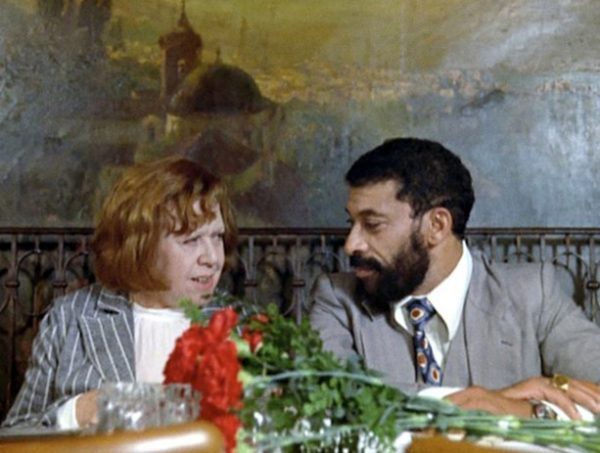
Emmi (Brigitte Mira) and Ali (El Hedi ben Salem) unexpectedly fall in love in Rainer Werner Fassbinder’s Ali: Fear Eats the Soul
ALI: FEAR EATS THE SOUL (ANGST ESSEN SEELE AUF) (Rainer Werner Fassbinder, 1974)
BAMcinématek, BAM Rose Cinemas
30 Lafayette Ave. between Ashland Pl. & St. Felix St.
Tuesday, February 19, 8:45
Series runs through February 21
718-636-4100
www.bam.org
 The BAM series “Programmers’ Notebook: On Love” is not your traditional look at romance, passion, and family bonds, with such films as A.I. Artificial Intelligence, about a mother and a robot; Senna, about a race-car driver and his sport; and My Neighbor Totoro, about a young girl and the cutest animated creature ever. It also includes one of the strangest love stories, and one that is surprisingly politically relevant after all these years, Rainer Werner Fassbinder’s masterful Ali: Fear Eats the Soul. On a rainy day, sixty-year-old West German cleaning woman Emmi (Brigitte Mira), a short, stout, quiet lady, enters a Munich bar to get out of the rain. There she encounters ruggedly handsome Moroccan guest worker Ali (El Hedi ben Salem), whose friends encourage him to dance with Emmi. What begins as a joke evolves into an unusual love affair that confuses just about everyone, from Ali’s and Emmi’s friends and coworkers to local shopkeepers and her family and landlord — and even to Ali and Emmi themselves. “It will never work out. It’s unnatural,” an Arab woman (Katharina Herberg) at the bar says. Emmi’s bitter son-in-law, Eugen, played by Fassbinder, refers to migrants as “swine.” Her daughter, Krista, played by Irm Hermann, one of Fassbinder’s former lovers, calls her an “old whore.” When their relationship takes a turn for the worse, Emmi solemnly tells Ali, “When we’re together, we must be nice to each other. Otherwise, life’s not worth living.”

Rainer Werner Fassbinder plays a lazy bigot in his masterful Douglas Sirk homage, Ali: Fear Eats the Soul
Forty-five years after its release, Ali: Fear Eats the Soul still packs a heavy punch. Partly an homage to German-born Douglas Sirk’s All That Heaven Allows taken to a Brechtian extreme (and expanded from a brief story told by a hotel chambermaid in Fassbinder’s The American Soldier), the film deals with racism, bigotry, xenophobia, exploitation, alienation, shame, fearmongering, and immigration in prescient ways, especially here in America under the current administration. Shot in just two weeks, the film is photographed in saturated blues, reds, greens, and yellows by cinematographer Jürgen Jürges, with limited camera movement. Fassbinder’s composition is extraordinary, with long shots that highlight the protagonists’ loneliness and exclusion. Early on, a woman in Emmi’s apartment building watches her go upstairs with Ali, the woman seen from behind, her out-of-focus hair dominating the right side of the frame, the eventual couple visible through a caged screen, as if prisoners. Later, in a restaurant, Emmi and Ali are seen through a doorway sitting in the far back of an otherwise empty restaurant, as if outcasts from society.
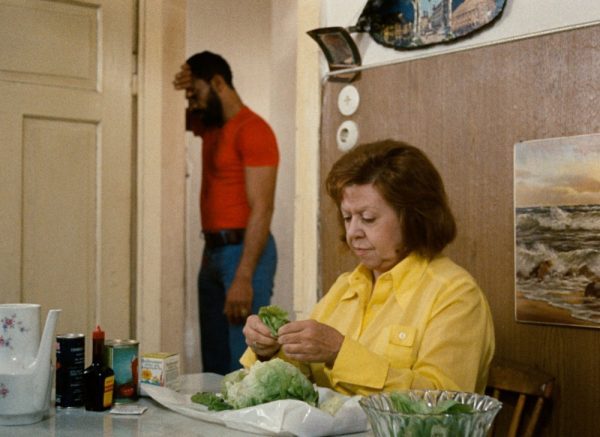
Life and love are not easy for Emmi (Brigitte Mira) and Ali (El Hedi ben Salem) in Fassbinder’s romantic melodrama Ali: Fear Eats the Soul
Mira and ben Salem, Fassbinder’s partner at the time, play the unexpected lovers with an intense level of uncomfortability that keeps the viewer on edge; Barbara Valentin is fabulously creepy as the bar owner and Ali’s former lover, the deep, dark circles around her eyes clashing with her long blonde hair, as if she’s a walking zombie. The film was deeply personal to Fassbinder (The Marriage of Maria Braun, The Bitter Tears of Petra von Kant), who encountered racism during his time with ben Salem, had many immigrant relatives, and had a complex relationship with his mother and business manager, Lisolette Eder (aka Lilo Pempeit), who appears as Mrs. Münchmeyer in Ali. At one point, Ali, who speaks in broken German, and Emmi are seen in a narrow space through the door to her kitchen. He reaches out and holds her as she sobs. “Why cry?” he asks. “Because I’m so happy and so full of fear, too,” she says. “Not fear. Fear not good. Fear eat soul,” he explains. “Fear eats the soul? That’s nice,” she responds with a big smile. If only love were always that simple.





 Last summer, MoMA presented “The Future Is Female,” a week of independent features and shorts written, directed, and starring women, dealing with important issues of inclusivity and gender. The series is back for its second iteration, running February 14-21 and beginning with a recent head spinner. Twenty-two-year-old