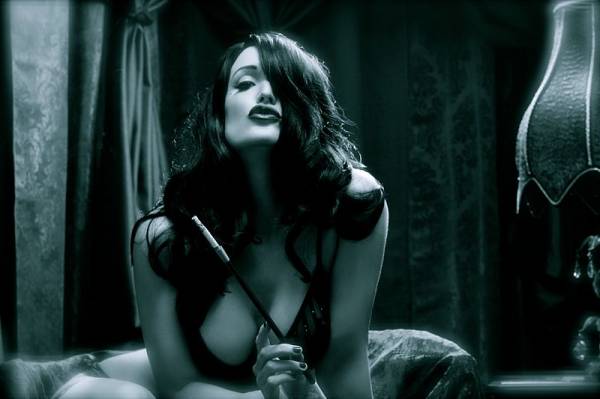
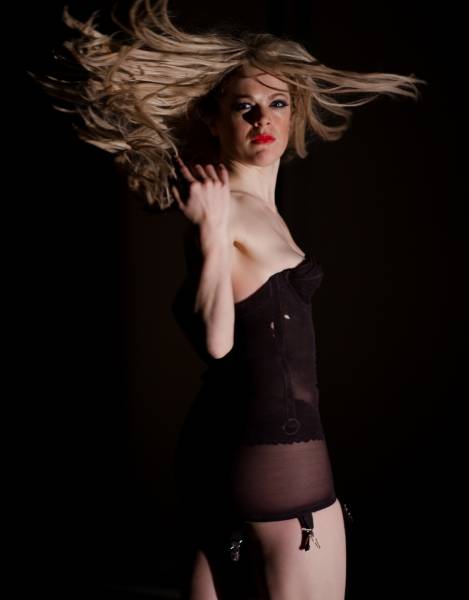
Veronica Varlow will channel Bettie Page at Swing House party
Shangri-La Loft
100 Sutton St.
Saturday, April 23, $15 with RSVP + themed dress, $20 at the door, $10 after midnight, $5 after 2:00 am www.geminiandscorpio.com
Self-described “online dating gurus and offline party mavens” Gemini & Scorpio recently celebrated the third anniversary of their popular speakeasy vintage/remix party series, and they’re ready for another all-nighter this Saturday with a wild and crazy affair at Shangri-La Loft in Greenpoint. Attendees are encouraged to wear vintage 1920s-1940s dress with a modern twist for the costumed dance ball, which features a gypsy swing dance class led by Angela Harriell of the Love Show at 8:30, followed by the party at 9:00. There will be live performances by LES Hot Club, Poum Tchak, and burlesque star Veronica Varlow, who will be paying tribute to Bettie Page, who would have turned eighty-eight on Friday. Marcy Currier will give tarot readings, the House of St. Eve will be mixing exotic cocktails, Bettie Page Reveals All documentary filmmaker Mark Mori will be giving away special Bettie Page-related prizes, and everyone is eligible to enter the Bettie Page costume contest. In addition, DJs Miss Bliss and Shakey will keep the jazzy joint jumping to all hours. So if you’re looking for something a little different to do this weekend, you’ll be hard-pressed to find anything quite as unusual as Gemini & Scorpio’s latest gathering.
Laura Careless is outstanding playing several of Charles Bukowski’s women in new play (photo by Corey Tatarczuk)
A DANCE/THEATRE MEDITATION ON BUKOWSKI’S WOMEN
303 Bond Street Theatre
303 Bond St. between Union & Sackett Sts.
Fridays – Sundays through May 8, $25-$30, 8:00
800-838-3006 www.companyxiv.com
“I need a good woman. I need a good woman more than I need my typewriter,” Charles Bukowski (Jeff Takacs) proclaims in Company XIV’s mesmerizing new production, Lover. Muse. Mockingbird. Whore. “I need a good woman so badly that I can taste her in the air.” As Takacs makes his way around Zane Pihlstrom’s clever, enigmatic set, speaking into a series of old-fashioned microphones, the delightful Laura Careless embodies two of Bukowski’s muses, Vivian and Scarlet, wearing a succession of sexy, exotic lingerie, wigs, and high heels, moving sharply and dramatically in a center rectangular space cordoned off by a border of white neon lighting on the floor. She glances knowingly at the audience on occasion, changing bras with her back to the crowd, stomping atop a rotted piano, rolling around in asphalt, and jumping onto a piece of narrow furniture to write on the wall in lipstick. Conceived, choreographed, and directed by Austin McCormick expanded from a senior project at Juilliard, Lover. Muse. Mockingbird. Whore is an enticing and intoxicating sixty-minute journey into the lurid mind of Bukowski, author of such novels as Factotum, Women, Barfly, and Pulp. The tale takes place in Company XIV’s fascinating space, a former tow-truck warehouse in Brooklyn, with large doors leaning in corners and chandeliers cluttering the floor. Some of the action occurs in a separate living area with a bed, a bathtub, a toilet, and a desk where Takacs continues reciting Bukowski’s text, his image projected onto doors and walls and large shadows hovering over the space. Takacs does an excellent job portraying the iconoclastic writer with a thing for women, drink, and the horses, but it’s Careless who demands the audience’s attention, engaging in brief solo dances, writhing around on the ground, and occasionally grabbing a mic and speaking. A graduate of Juilliard and London’s Royal Ballet School, Careless moves and dances with an arresting confidence that gives emotional depth to women who could have just as easily been portrayed as shallow, cheap whores. Lover. Muse. Mockingbird. Whore., which plays Fridays through Sundays through May 8, is a thrilling night of experimental dance theater.
For more than twenty-five years, Janis Brenner has been choreographing works that explore the mind-body connection, set to a wide range of music by such composers as Meredith Monk, Led Zeppelin, Bob Dylan, Simon & Garfunkel, Pat Benatar, Eddie Money, the Beatles, and Marianne Faithfull as well as Dvorak, Schubert, Bach, and Mozart. Last year the choreographer/dancer/artistic director, who established Janis Brenner & Dancers in 1989 after working with the likes of Michael Moschen, Annabelle Gamson, and Murray Louis, staged 5 Decades, featuring works from five different decades celebrating the history of dance. She is now back with the sequel, 5 Decades II, at Danspace Project April 7-9, consisting of the world premiere of the site-specific The Mind-Stuff Variations, with live music by Jerome Begin and his ensemble; duets from Louis’s 1976 ballet, Cleopatra, and Brenner’s Pieces of Trust (1987 & 1989); Brenner performing two 1929 pieces by Mary Wigman, Seraphic Song and Pastorale; and a revival of Brenner’s 1998 signature work, heartSTRINGS. The works will be performed by Brenner, Kyla Barkin, Esme Boyce, Sumaya Jackson, Luke Murphy, Christopher Ralph, Aaron Selissen, and Chen Zielinski, with lighting by Mitchell Bogard and costumes by Ramona Ponce, Susan Soetaert, and Frank Garcia.
In describing their sixty-minute piece I Like This, directors and choreographers Antony Hamilton and Byron Perry use such phrases as “dialogue firmly seated in the ridiculous,” “the challenge of extrapolating this unbridled creative fascination,” “fantastically muscular and rhythmic conversations,” “sheer delight and mutability of thought,” “creative cannibalism,” and “general silliness.” In many ways, those terms also relate to their company itself, the Australian-based Chunky Move, which has been presenting visual and physical wonders since its founding in 1995 by artistic director Gideon Obarzanek. In such works as Glow, which played the Kitchen in February 20008 and featured a solo dancer performing on a rectangular floor with motion detectors that integrated her movement with light projections, and Mortal Engine, a 2009 BAM Next Wave entry that took place on a tilted platform that incorporated light and sound into the troupe’s movement, Chunky Move uses cutting-edge technology to create intriguing works that range from being deeply intimate to being overly dependent on too many bells and whistles, although their work is always dazzling to watch. This week Chunky Move will present I Like This at the Joyce Soho, a multimedia piece that comments on itself as it develops in front of the audience, performed by a five-person team that includes Hamilton and Perry along with Stephanie Lake, Alisdair Macindoe, and Joseph Simons. I Like This debuted in November 2008 in Australia, part of the company’s Next Move series, which focuses on work by emerging talent. An After Hours @ Joyce SoHo event will take place following the April 7 performance, with a Q&A and refreshments.
Update: It’s easy to like I Like This. Chunky Move’s hour-long piece is an ingenious display of creation and experimentation as the co-director-choreographer team of Antony Hamilton and Byron Perry have a blast with performers Stephanie Lake, Alisdair Macindoe, and Joseph Simons. Hamilton and Perry spend most of the show on the floor amid exposed, snaking power cords and a boombox, flicking on and off handheld lights to perfectly synchronized electronic soundscapes and effects as the dancers go from seated positions to traversing the stage. Lake does most of the talking, getting into the process as the troupe hides behind chairs, enters a noir tale, finds itself at a campfire, and floats underwater, casting shadows on the surrounding black curtains and changing their positions in the dark as lights go on and off. But I Like This never feels gimmicky; instead, Chunky Move involves the audience by enjoying their own work just like the audience is doing, everyone in the theater getting a kick out of just how much fun all this process-based performance is. Hamilton and Perry also allow Lake, Macindoe, and Simons time to show off their mad dance skills in several vignettes. Following the high-tech grandeur of Mortal Engine, Chunky Move’s I Like This is an immensely likable low-tech wonder.
Originally commissioned for the Sydney Dance Company in 2003, Stephen Petronio’s Underland is at last making its New York premiere this week at the Joyce, running April 5-10. The hour-long piece is set to songs by Australian musician Nick Cave, who has been telling epic tales of exquisitely choreographed sex, violence, and madness since the 1970s, first with his band the Birthday Party, then with the Bad Seeds and its raucous spinoff, Grinderman. Among the songs Petronio chose for Underland are such Cave classics as “Stagger Lee,” “Wild World,” “The Mercy Seat,” “The Weeping Song,” and his cover of Bob Dylan’s “Death Is Not the End,” not your usual fare for contemporary dance with their graphic depictions of murder and execution. “He said, ‘Well, bartender, it’s plain to see / I’m that bad motherf$%ker called Stagger Lee’ / Mr. Stagger Lee / Barkeep said, ‘Yeah, I’ve heard your name down the way / And I kick motherf$%king asses like you every day’ / Mr. Stagger Lee / Well, those were the last words that the barkeep said / ’Cause Stag put four holes in his motherf%$king head,” Cave sings in his version of the old Stagger Lee tale, from his spectacular 1996 album, Murder Ballads. No, Petronio does not do a literal interpretation with props, instead letting his powerfully muscled company display his own unique visual language, melding with Cave’s rather colorful words and intense music. Underland features projected images by lighting designer Ken Tabachnick and video artist Mike Daly, costumes by Tara Subkoff/Imitation of Christ, and soundscape by Paul Healy and is performed by Julian De Leon, Gino Grenek, Barrington Hinds, Tara Lorenzen, Natalie Mackessy, Emily Stone, Shila Tirabassi, Joshua Tuason, and Amanda Wells, with guest dancers Davalois Fearon and Reed Luplau.
Update: “This is the way art can be made,” Stephen Petronio said in a Dance Chat following the April 6 performance of Underland at the Joyce. The New York City–based choreographer was explaining the freedom — both creative and financial — he was given by the Sydney Dance Company when they commissioned the piece back in 2003. As soon as Sydney’s exclusive option ran out, Petronio snapped it back up for his own company, who was itching to perform the evening-length work, and their enthusiasm is evident in their energetic performance. Underland begins with Reed Luplau, who was brought over from Sydney, climbing down a rope ladder, making his way into the dark, demonic world of Nick Cave, his movement doubled on a three-screen video projection. Petronio then introduces the audience to Cave’s morbid sense of humor and deep voice with Julian De Leon and Shila Tirahassi dancing to a recording of Cave reading the “Mah Sanctum” section from his 1989 novel, And the Ass Saw the Angel, followed by seven Cave songs linked together by his producer, Tony Cohen, using the music’s original source material. Petronio does not literally depict the scenes of sex and violence in Cave’s lyrics, instead concentrating on the overall feel, creating an evocative, powerful mood built around vertical movement. Tara Subkoff’s costumes go from torn black tops to bright-red tutus to military fatigues as the dancers journey through such Cave ditties as “Wild World,” “The Carny,” and “The Weeping Song,” including beautiful solos by Gino Grenek, Amanda Wells, and Tirahassi and a playfully erotic quartet (Grenek, Tirahassi, Joshua Tuason, and Wells) coming to the front of the stage for “The Ship Song.” Underland — which has been pared down from eighteen dancers in Sydney to eleven here in New York, resulting in a fabulous fury of comings and goings — ends appropriately with the full company performing to “The Mercy Seat,” about an execution, and Cave’s interpretation of Bob Dylan’s “Death Is Not the End,” but instead of getting lost in the darkness, Petronio celebrates the light as an enchanting whiteness takes over. Underland is a fast-paced, illuminating night of music and dance that takes audiences into places they might not usually venture but will be glad they did.
Eiko and Koma’s mesmerizing NAKED continues at the Baryshnikov Arts Center through April 9 (photo by Anna Lee Campbell)
Baryshnikov Arts Center
450 West 37th St.
April 5-8, 6:00-10:00 pm, April 9, 3:00 – 9:00 pm
Admission: free with advance RSVP www.eikoandkoma.org
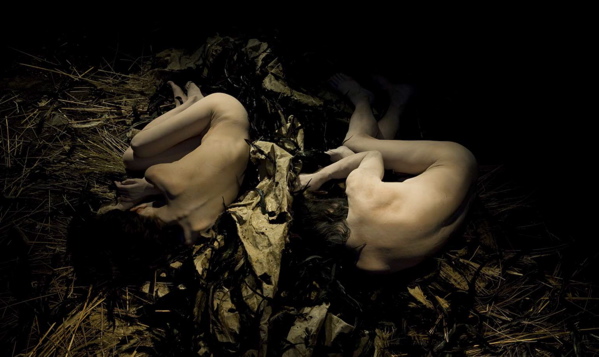
Created during a three-month residency at the Park Avenue Armory and first presented at the Walker Art Center last year, Eiko and Koma’s Naked is an intimate, deeply personal experience about love and loss, time and space, birth, death, and rebirth. Part of their Retrospective Project that examines their forty-year collaboration, Naked takes place in the Baryshnikov Arts Center’s Studio 6A, which has been transformed into an organic environment surrounded on three sides by scorched canvases with holes in them that people can peer through before entering the main area, where the two New York-based dancers are lying naked amid a nestlike mound of straw, feathers, and dirt, their bodies moving remarkably slowly. Small sculptures dangle from the ceiling lights, making rustling wind-chime noises and casting eerie shadows across the performers as water drips from above, each drop echoing through the room, along with sounds of what appear to be animal howls and a faraway foghorn. People can walk in and out during each performance, sitting on benches or sitting or standing on the scorched canvas on the floor, which makes slight noises as they shuffle their feet and move about. Even an accidentally slammed door doesn’t break Eiko and Koma’s concentration as they lift a finger, reach out for each other, interlock their legs, or turn away. Occasionally they open their eyes; whereas Koma’s are like a newborn bird’s looking out at the world for the first time, Eiko’s are filled with yearning, as if barely able to see what has become of the earth around her. That is part of what makes Naked so mesmerizing; it evokes birth and death at the same time, especially with the devastation going on in Japan, where both Eiko and Koma are from. The two can represent survivors and victims, lovers coming together or being torn apart, Adam and Eve starting life anew or a couple facing death. They are both prehuman and posthuman, living organisms emerging from the primordial ooze as well as postapocalyptic beings facing a dark future. Naked is a mesmerizing, beautiful work that is always evolving; if you let yourself get swept away in its gentle, tender movements, you’ll find your mind leading you through its own abstract narratives, making the experience different for each individual as time just slips away.
Naked is accompanied by a multimedia retrospective in the next-door Studio 6B that features eight videos of previous Eiko and Koma naked performances, including Night Tide, By the River, Tree, Rust, and Passage shown in video boxes you have to look down into, in addition to Lament and Undertow, which are projected onto the “White Cart” sculpture made of sea salt, sweet rice paste, postcards, water, wood, and other materials. Also, in the downstairs lobby “36 Works by Eiko & Koma” consists of thirty-six minutes of still photos and brief film clips from thirty-six of their earlier pieces. For more on Eiko and Koma and Naked, you can find our twi-ny talk with them here.
Since last fall, Brooklyn-based dancer and choreographer Wally Cardona has been staging “Interventions” in which he goes to various cities and is introduced to a local stranger who is an expert in a field other than dance, and the two collaborate for five days, then present their one-night-only work to the public. On March 26, Cardona will offer Intervention #6, the third of three Interventions at the Baryshnikov Arts Center. Following his fruitful collaboration with activist and sound artist Robert Sember in January — the two developed a complex piece involving verbal and nonverbal communication and movement over the course of a series of repeated scenes, each with unique and challenging variations — and his not-quite-as-successful pairing with performance-space architect Martin Kapell, which included literary quotations and lots of time and space to kill, Cardona (Really Real, A Light Conversation) has teamed with Raj Patel, Rachid Abu-Hassan, and Terence Caulkins of Arup Acoustics and Theatre Consulting, the company behind part of the refurbishment of the Jerome Robbins Theatre at BAC. “For me,” Cardona explained in our February twi-ny talk “a powerful thing in each Intervention is not just the fact that I’m meeting a person from a very different discipline or field of inquiry but that I’m meeting a complete stranger. And with the agreement that we’ll spend a week together. The first thing that happens is I perform my ‘empty solo’ for them, and I have to confess that with each Intervention, I begin the second day wondering if the person will show up again.” The Interventions are part of a collaboration with Paris-based choreographer Jennifer Lacey, whose My First Time with a Dramaturge series will come together with Cardona’s Interventions for the larger project Tool Is Loot, with music by Berlin-based composer Jonathan Bepler. The seventh and final Intervention takes place April 23 at Dance Place in Washington, DC, with public servant Silas Grant.