this week in dance

KDNY: GOING

KDNY will present three world premieres at annual New York City season this weekend

The Ailey Citigroup Theater
The Joan Weill Center for Dance
405 West 55th St. at Ninth Ave.
March 18-19 at 8:00, March 20 at 3:00, $20
866-811-4111
www.kdnydance.com

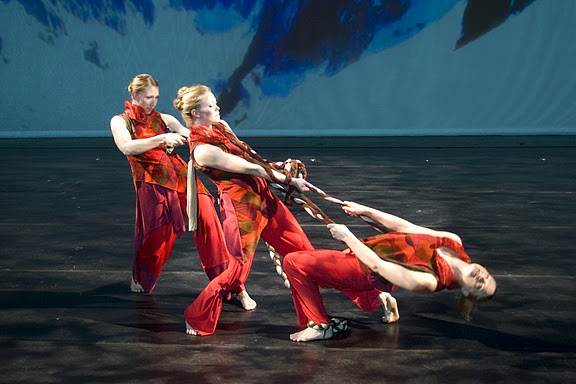
Since 1997, Kathleen Dyer and her KDNY Dancers have been staging productions “dedicated to the passions and intricacies of the female spirit” in such works as Sheridan in Limbo, Attending Kinneely, Moerae, and East Whistwaddle Ladies and as members of the Women in Motion (WIM) Project. For the company’s thirteenth annual New York City season, they’ll be at the Ailey Citigroup Theater March 18-20, presenting three premieres, Vinegar Hill, Going, and Formula, set to original music by composer Cristina Spinei and avant cellist Zoë Keating, along with 2009’s Evergreen. Together the works explore nature and the human condition, featuring dancers Carly Berrett, Heather Kemp, Lindsey McGill, Melissa Peraldo, Katlyn Baskin Waldo, and Leslie Ziff, with lighting by Dans Maree Sheehan and video projection by Kemp.

TRISHA BROWN DANCE COMPANY

The Trisha Brown Dance Company will be making their Dance Theater Workshop debut this month (photo by Mark Hanauer)

Dance Theater Workshop
219 West 19th St.
March 16-26, $25
212-924-0077
www.dtw.org
www.trishabrowncompany.org

Over the course of its more-than-forty-year history, the Trisha Brown Dance Company has performed in big and small houses all over the world, including last year in France, Tunisia, England, and Brazil in addition to the Guggenheim and already this year in Sweden, France, Spain, and MoMA. So it’s hard to believe that the New York-based troupe has never before appeared at Dance Theater Workshop, where they will at last be making their debut March 16-26. The program includes two works from Brown’s Back to Zero Cycle, the slow, subtle For MG: The Movie , with live music played by score composer Alvin Curran, and Foray Forêt, featuring visual design and costumes by Robert Rauschenberg and a live traditional marching band. “I make order out of chaos, Bob makes chaos out of order, and where we meet is chaos,” Brown has said of working with Rauschenberg. The evening will also premiere Neal Beasley dancing the 1978 solo piece Watermotor, which only Brown has previously performed. The opening-night performance will be preceded by a Coffee and Conversation gathering, and Brown will participate in a postshow talk on March 25.

DOUG VARONE AND DANCERS: CHAPTERS FROM A BROKEN NOVEL

Joyce Theater
175 Eighth Ave. at 19th St.
March 15-20, $10-$59
212-242-0800
www.joyce.org
www.dougvaroneanddancers.org

Long Island native Doug Varone is celebrating his company’s twenty-fifth anniversary with the New York premiere of Chapters from a Broken Novel, running at the Joyce March 15-20. The evening-length piece consists of twenty vignettes inspired by quotes from books, movies, and overheard conversations, resulting in dramatic portraits that delve into human nature, the body, and private and public intercommunication. Composer and percussionist David Van Tieghem will perform his original score live; the crew also includes lighting designer Jane Cox, scenic designer Andrew Lieberman, and costume designer Liz Prince. Doug Varone and Dancers, the resident company of the 92nd St. Y’s Harkness Dance Center, features Julia Burrer, Ryan Corriston, Natalie Desch, Erin Owen, Alex Springer, Eddite Taketa, and Netta Yerushalmy, who will be following up such relatively recent projects as Alchemy, Dense Terrain, Lux, and Orpheus and Euridice.

Update: Like a great book that you can’t put down, Doug Varone & Dancers’ Chapters from a Broken Novel — performed without intermission — contains compelling characters, unexpected plot twists, complex relationships, and emotional depth. Consisting of twenty vignettes ranging from barely sixty seconds to several minutes, the evening-length piece begins with “Spilling the Contents,” in which the full company presents a dazzling overview of what is to come, a sort-of précis filled with anticipation, followed by individual chapters whose titles are projected onto an arched white sheet hanging from the ceiling. With percussionist David Van Tieghem providing live accompaniment to his prerecorded score, the seven dancers flawlessly turn the pages of an abstract cinematic narrative that offers aggressive conflict, introspective moments of loneliness and desperation, scenes of chaos and confusion, depictions of love and desire, and forays into death and forgiveness. The outstanding company is highlighted by Eddie Taketa’s somber “Funeral,” Erin Owen’s playful “Tile Riot,” Netta Yerushalmy’s breathless “Twelve Dreams for Rent,” and Ryan Corriston and Yerushalmy’s poignant “Ruby Throated Sparrows,” with subtle but superb lighting by Jane Cox, often casting haunting, illuminating shadows against the backdrop. Chapters from a Broken Novel is a thrilling night of moving literature at its very best.

TWI-NY TALK: YVONNE RAINER

Yvonne Rainer’s ASSISTED LIVING will get its New York premiere March 16-19 at the Baryshnikov Arts Center

Baryshnikov Arts Center
450 West 37th St. between Ninth & Tenth Aves.
March 16-19, $25, 8:00
212-366-5700
www.performa-arts.org

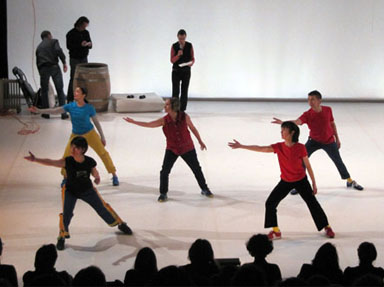
Legendary choreographer and experimental filmmaker Yvonne Rainer looks back while moving ahead at the Baryshnikov Arts Center next week, reprising 2009’s Spiraling Down and presenting the New York premiere of Assisted Living: Good Sports 2. Drawing on principles developed in her seminal work, Trio A, and other pieces from the 1960s, Rainer’s most recent dances incorporate sports, primarily soccer, as well as old and new pop-culture references. For Assisted Living, Pat Catterson, Emily Coates, Patricia Hoffbauer, Emmanuelle Phuon, Keith Sabado, and Sally Silvers were each given photos from the New York Times sports section to inspire their movement; lighting designer Les Dickert, set designer Joel Reynolds, and Rainer herself also appear onstage, involved in set changes and various cues. The work is sponsored by Performa; since 2007, Rainer has been working with the nonprofit arts organization, which “is dedicated to exploring the critical role of live performance in the history of twentieth century art and to encouraging new directions in performance for the twenty-first century.” Rainer, who will turn seventy-seven in November, has been choreographing dances for more than fifty years, having trained with such giants as Martha Graham, Merce Cunningham, and Anna Halprin, in addition to making such influential films as The Man Who Envied Women and Privilege, earning the right to choreograph the questions in our latest, albeit brief, twi-ny talk.

twi-ny: Both works you are presenting at BAC deal with sports and sports photography, among other things. Are you a big sports fan, and what was it from those images that inspired you?

Yvonne Rainer: I am a tennis fan, but do not play myself. As a kid I loved street games, and in high school played softball. But as a choreographer it is not competitive sports that interest me so much as all the incidental movements that do not contribute directly to the rules and organization of play. For example, the languid movements of soccer players when they are waiting to be engaged and the stillness of photos that record the interactions of individual bodies.

twi-ny: How is it different performing at Judson Church back in the 1960s versus performing today in New York City?

Yvonne Rainer: At Judson Church we were a community with shared interests and enthusiasms and objectives. Today in NYC the choreographer is on her own, an autonomous molecule struggling to find a place.

twi-ny: What has it been like collaborating with Performa over the years?

Yvonne Rainer: Performa has been my life saver, a buffer in the cultural maelstrom. Their support has been essential to the continuity of my work.
MARTHA GRAHAM DANCE COMPANY: 85th ANNIVERSARY SEASON

The Martha Graham / Isamu Noguchi collaboration EMBATTLED GARDEN is part of MGDC season at the Rose Theater (photo by Nan Melville)

Rose Theater
10 Columbus Circle, Broadway at West 60th St.
March 16-20, $48-$133
212-721-6500
www.marthagraham.org
www.jalc.org

Since 1926, the Martha Graham Dance Company has been one of the most famous and influential dance companies in the world, boasting some 181 works from such choreographers as Merce Cunningham, Paul Taylor, and Pascal Rioult performed by such superstars as Rudolf Nureyev, Mikhail Baryshnikov, and Margot Fonteyn. Under the current leadership of executive director LaRue Allen and artistic director Janet Eilber, MGDC, continuing the legacy of its legendary iconic founder, will be at Jazz at Lincoln Center’s Rose Theater March 15-20, celebrating its eighty-fifth anniversary season by presenting several of its most exciting pieces from throughout its storied history, many of which are either choreographed by Graham or reference her directly. The season begins Tuesday with a gala honoring Robert Wilson and a revival of his Snow on the Mesa, which has not been performed in fifteen years, along with Maple Leaf Rag, Graham’s final ballet. On March 16 & 19, “New Revival / New Work” features Graham’s 1943 Deaths and Entrances and the world premiere of a commissioned piece by Taiwanese choreographer Bulareyaung Pagarlava. On March 17, “The Noguchi / Graham Connection” is explored in three collaborations between Graham and Queens-based Japanese sculptor Isamu Noguchi, Appalachian Spring, Cave of the Heart, and Embattled Garden. On March 18, “Wilson / Graham” includes Snow on the Mesa and Maple Leaf Rag. The March 19 matinee, “Political Dance Project,” features Dance Is a Weapon, a montage by Graham, Isadora Duncan, Jane Dudley, and others, in addition to a performance of Graham’s 1935 Panorama by thirty New York City high school students. The season concludes with the Sunday matinee “Wilson / Graham / Noguchi,” a grand finale of Snow on the Mesa and Embattled Garden in conjunction with the JapanNYC festival.

PERFORATIONS FESTIVAL NEW YORK

Via Negativa’s INVALID is part of Perforations Festival at La MaMa (photo by Marcandrea)

Club La MaMa
74A East Fourth St. between Bowery & Second Ave.
March 11-20, $15
212-475-7710
www.perforationsny.com
www.lamama.org

Held in conjunction with the Perforacije Festival in Croatia, the first Perforations Festival New York will take place March 11-20 at Club La MaMa, consisting of twelve productions from the Eastern European nations of Bulgaria, Croatia, Serbia, Slovakia, and Macedonia. Curated by Zvonimir Dobrovic, who also organizes the Croatian festival, Perforations focuses on works by independent artists in such disciplines as performance art, theater, and dance. “State-subsidized venues receive the majority of available arts funding in the Balkans, but some of the most exciting and compelling work in the region is being developed by independent artists working outside of these institutions,” Dobrovic said in a statement. “It is this group of artists that Perforations supports and presents, in part, to counter established funding and cultural policy that has not created a sustainable working environment for these more progressive artists.” The festival begins March 11 with Ivo Dimchev’s Lili Handel: blood, poetry, and music from the white boudoir of a whore…, about the end of the line for a variety show diva. Other productions include BADco.’s Semi-interpretations or How to Explain Contemporary Dance to an Undead Hare, Sanja Mitrović’s Will You Ever Be Happy Again?, Mladinsko Theater’s Damned Be the Traitor of His Homeland, and Via Negativa’s Out. On March 14, Petra Kovačić and Željko Zorica will present the performance installations Act(ing) and Digitalization of Monumental Heritage and Its Commercial Exploitation, respectively, at La MaMa, free with advance RSVP, and on March 21 the New School for Social Research will host a wrap-up panel discussion, “Transgressing Borders in the Balkans: The State of Art,” with Dobrovic and Perforations participants Ivica Buljan, Igor Josifov, and Kovačić, moderated by Croatian journalist Vesna Kesic.

TWI-NY TALK: EIKO & KOMA

Eiko & Koma will be in New York City this month presenting three very different projects

Tuesday, March 8, Art Work: An Evening with Eiko Otake, the New School, Wollman Hall, 65 West 11th St., free, 6:00
Tuesday, March 15, and Wednesday, March 16, Delicious Movement Workshop, Baryshnikov Arts Center, 450 West 37th St., $65 with preregistration, 7:00
March 29 – April 9, Baryshnikov Arts Center, free with advance RSVP, Tuesday – Friday 6:00 – 10:00 pm, Saturday 3:00 – 9:00 pm
www.eikoandkoma.org

Shortly after meeting as students in Japan in 1971 at the Tatsumi Hijikata dance studio, Eiko Otake and Takashi Koma Otake formed a partnership that is now in its fifth decade. Based in New York City since 1976, Eiko & Koma have presented experimental modern dance and installation indoors and outdoors all over the world, including such highly praised works as White Dance (1976), Grain (1983), Memory (1989), River (1995), The Caravan Project (1999), and Hunger (2008). Having studied with such innovative choreographers as Kazuo Ohno, Lucas Hoving, and Anna Halprin, their own pieces, for which they generally design all elements, including sets, sound scores, and costumes, have earned them NEA, Guggenheim, and MacArthur Foundation Fellowships, two Bessies, and other prestigious awards.

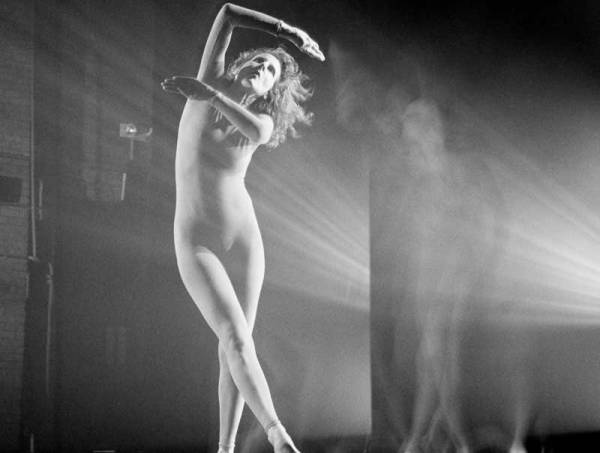
On March 8, Eiko & Koma will give a free illustrated lecture at the New School on their Retrospective Project (2009-12), in which they are looking back over the course of their storied career. On March 15-16, they’ll be holding two Delicious Movement Workshops at the Baryshnikov Arts Center, inviting participants to “move/dance to actively forget the clutter of our lives so to fully ‘taste’ body and mind.” And from March 29 through April 9 they will present the two-week performance piece Naked at BAC, a movement/visual art installation that explores time, desire, and nakedness that was created during a three-month residency at the Park Avenue Armory and first presented at the Walker Art Center last year. Part of Carnegie Hall’s JapanNYC Festival, Naked is free with advance tickets that allow the audience to come and go as they please during specific time periods, watching Eiko & Koma in an organic environment that will be accompanied by a video retrospective. As they prepare for their New York blitz, Eiko discussed the audience-performer dynamic, nakedness, and more in our latest twi-ny talk.

twi-ny: You will be giving an Art Work talk at the New School on March 8, focusing on the Retrospective Project. What has the experience been like looking back at your long career while you’re still creating fascinating works for the future?

Eiko: We can remember what we were thinking of, about and how. We are sometimes surprised to find so much of what we do now has started long ago. We did not become wiser or better with age. That is a sort of myth. Instead we see more continuity in what we have done and what we are doing now.

twi-ny: That will be followed March 15-16 with your Delicious Movement Workshop at BAC, targeted not at professional dancers but everyone and anyone. What would you tell someone who knows very little, if anything, about dance about the program? Essentially, why should a dance novice not be scared of taking part in the workshop?

Eiko: Of course they should not be scared, because we have developed a way to make the workshop very inclusive and tasty. It is not so much about dance. it is more about moving in a way that is not too difficult and find a pleasure in it.

Eiko & Koma will perform NAKED at the Baryshnikov Arts Center (photo by Anna Lee Campbell)

twi-ny: Your living installation, Naked, will be presented March 29 – April 9 at BAC, where audiences will come and go as they please. You previously performed the piece at the Walker Art Center. How did the unusual staging affect the performer-audience dynamic?

Eiko: We were very close to people, which created the sense of intimacy. There was no beginning or end but purely entries and exits of people, which audience decided themselves. So there was more of an individual act of seeing and feeling on their own accord.

twi-ny: How did the audience react to the piece, which was not staged like a regular dance performance?

Eiko: Unlike a theater event, people in the museum did not know who we are or what we do. So there was a lot of surprise in seeing human naked bodies moving in a gallery. Some people, of course, did not get into it but surprisingly many people stayed longer than we or they expected. Many people also came back to see it again or bring friends. Some people cried. Some people said it was hard for them to leave us since we did not end anything but we just went on.

twi-ny: What was it like performing to an ever-changing, moving audience, with you and Koma on view as maybe more of a spectacle?

Eiko: I did not feel it was a spectacle. We really enjoyed performing for just a few people since we feel their emotions. It was a special experience for both sides. But when there was no one in the room, it was hard to continue with the same intensity. At the same time we could not stop or rest since at any time people might come in.

twi-ny: You’ve appeared naked in previous productions, but this one you even title Naked. What is it that draws you to the nakedness you reveal in your work?

Eiko: Nakedness is a bottom line . . . nothing to lose, nothing to protect us, where we become both more human and more like any other creatures.